Working Dog Agility Training: 5 Pro Drills That Build Confidence
Introduction
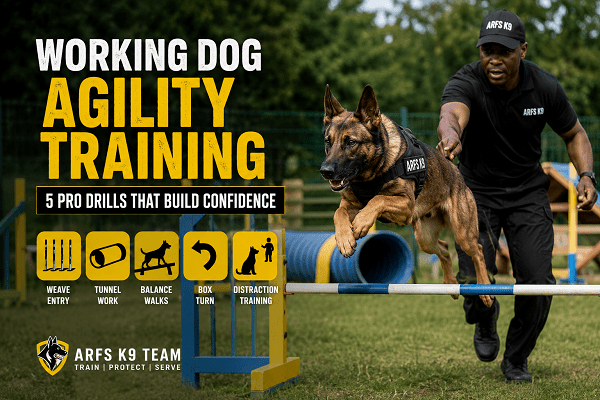
Working dog agility training is about far more than clearing obstacles. The right drills develop body awareness, handler focus, directional control, and the confidence dogs need to perform under pressure. Whether you’re training a police K9, protection dog, search and rescue dog, or a high-drive sporting breed, these five professional agility drills will help improve precision, coordination, and real-world performance while reducing injury risk and strengthening the handler-dog partnership.
Table of Contents
- Why Agility Matters for Working Dogs
- Before You Start: Setting Up for Success
- Drill 1 — The Weave Entry Reset
- Drill 2 — Send-Away Tunnel Work
- Drill 3 — Elevated Balance Walks
- Drill 4 — The Box Turn (Directional Control)
- Drill 5 — Full Sequence Under Distraction
- Common Mistakes That Slow Down Progress
- How Often Should You Train Agility?
- FAQ
- Final Takeaways
Why Agility Matters for Working Dogs
Agility isn’t just a sport you see at trial weekends with striped tunnels and colorful poles. For working dogs, agility training is functional conditioning. It sharpens the same skills a K9 needs on a real job: body awareness, directional response to a handler’s cue, and the ability to stay focused while moving fast.
A dog that can’t turn tightly around an obstacle at a run is going to struggle navigating rubble, furniture, or a crowded street during real work. That’s the part a lot of owners miss. Working dog agility training isn’t about ribbons. It’s about building a dog that trusts its body and trusts you, even when things get chaotic.
I’ve run agility sessions with everything from green Malinois pups to seasoned patrol dogs who needed a tune-up after an injury layoff. The five drills below are the ones I come back to again and again, because they build real skill instead of just burning energy.
| What Agility Builds | Why It Matters On the Job |
|---|---|
| Body awareness | Fewer injuries navigating obstacles, stairs, uneven ground |
| Handler focus at speed | Dog stays responsive even when excited or under pressure |
| Directional cueing | Faster response to hand signals and verbal redirects |
| Confidence on new surfaces | Less hesitation on ramps, ladders, unstable footing |
| Impulse control | Dog waits for the release instead of freelancing |
Before You Start: Setting Up for Success
You don’t need a full competition course to start. Most of what matters happens with three or four pieces of equipment and a handler who’s willing to be consistent.
Here’s a quick rundown of a starter setup that covers everything in this guide.
| Equipment | Purpose | Budget Option |
|---|---|---|
| 6-8 weave poles | Directional control, spine flexibility | PVC pipe and rebar stakes |
| Collapsible or open tunnel | Send-away confidence | Pop-up fabric tunnel |
| Low balance beam (4-6 inches off ground) | Proprioception, footing awareness | 2×6 board on cinder blocks |
| Jump bar or low hurdle | Timing and stride adjustment | Broomstick on two buckets |
Before jumping into drills, warm the dog up for five to seven minutes. A few loose leash laps, some light tugging, and a couple of sits and downs get the muscles ready and the brain switched on. Skipping the warm-up is one of the fastest ways to end up with a soft tissue strain, especially in dogs under two years old whose growth plates haven’t fully closed.
If your dog is still building foundational obedience, it’s worth circling back to structured basics first. There’s a good breakdown of how obedience and drive interact in Dog Obedience vs. Instinct: How to Balance Drive and Control, which pairs well with everything covered here.
Drill 1 — The Weave Entry Reset
Weave poles are where most agility programs stall out, and it’s almost always because handlers rush the entry.
Set up 6 poles in a straight line, spaced about 24 inches apart to start. Rather than sending the dog through the full set right away, work only the entry: the dog approaches on your left, you cue “weave,” and the dog takes the first two poles correctly before you reward and reset.
Step-by-step:
- Stand beside pole one with the dog on a loose leash.
- Cue “weave” as you step forward, guiding the entry with your body position, not the leash.
- Reward the second the dog clears pole two, even if the rest of the sequence would’ve been sloppy.
- Reset and repeat 5-6 times before adding a third pole to the sequence.
Once the entry is solid, add poles one at a time rather than throwing the dog into all six poles on day one. Rushing this step is the number one reason dogs develop a habit of popping out early, which is genuinely hard to retrain later.
Pro tip: Use channel weaves (poles set wide apart, gradually narrowed over sessions) if you’re working with a dog who’s naturally fast and prone to blowing past the entry point.
Drill 2 — Send-Away Tunnel Work
Sending a dog into an enclosed space away from you, without hesitation, is a skill with obvious real-world value beyond the sport. Detection dogs, search and rescue dogs, and patrol dogs all need to commit to spaces without the handler physically leading the way.
Start with the tunnel fully collapsed and shortened so the dog can see straight through. Stand at the entrance with your dog, toss a high-value reward through to the other end, and release with a clear cue like “tunnel” or “through.”
As confidence builds, extend the tunnel length and start standing farther back, sending the dog from three, then six, then ten feet away. This is where a lot of dogs show hesitation for the first time, and that’s normal. Don’t force it. Back up a step in distance and rebuild the pattern.
For dogs who show real reluctance or fear responses around enclosed spaces, it helps to slow the whole process down and lean on positive association work. The approach outlined in Best Training Methods for Fearful Dogs applies directly here, since tunnel work is fundamentally about building trust in an uncertain space.
Drill 3 — Elevated Balance Walks
This drill isn’t flashy, but it does more for proprioception (the dog’s sense of where its body is in space) than almost anything else on this list.
Using a low, wide beam or a series of stable platforms, walk the dog across at a controlled pace on leash. The goal is precision, not speed. Reward small, deliberate steps and correct footing rather than rushing across.
| Skill Level | Beam Height | Beam Width | Session Length |
|---|---|---|---|
| Beginner | 4-6 inches | 8-10 inches | 5 minutes |
| Intermediate | 8-12 inches | 6 inches | 8-10 minutes |
| Advanced | 12+ inches, uneven surfaces | 4-6 inches | 10-15 minutes |
Working dogs used for search and rescue or tactical entry benefit enormously from this drill because it directly translates to navigating debris, ladders, and unstable terrain. It’s also one of the best low-impact exercises for older dogs recovering from injury, since it builds strength without hard landings.
Drill 4 — The Box Turn (Directional Control)
The box turn teaches a dog to change direction sharply on a cue rather than running wide, which is exactly the skill that separates a controlled working dog from one that’s just running around burning energy.
Set up four cones in a small square, roughly 6 feet apart. Walk your dog around the outside of the box, then introduce direction cues (“left,” “right,” “here”) as you change your own direction at each corner. The dog should mirror your movement tightly, staying close rather than swinging wide.
Once the dog is reliably mirroring you on leash, drop the leash and run the same pattern off-lead in a fenced or controlled area. This is usually the point where handlers realize how much of their dog’s “agility” was actually just leash guidance the whole time. If the dog falls apart without the leash, that’s useful information. Go back on lead and rebuild.
Drill 5 — Full Sequence Under Distraction
This is the integration drill. Combine everything above into a short 20-30 second sequence: weave entry, tunnel send, balance walk, box turn.
Run it clean first, in a quiet space with no distractions, until the dog completes the full sequence smoothly at least three times. Then start adding real-world distraction, other dogs at a distance, unfamiliar people walking by, a ball rolling across the yard.
This is the step most hobbyist programs skip entirely, and it’s the one that actually matters for a working dog. A dog that’s brilliant on an empty course but falls apart the second a distraction shows up hasn’t actually learned the skill. It’s learned the environment.
If your dog struggles specifically with focus around new equipment or gear, it’s worth checking that the harness and collar setup isn’t part of the problem. An ill-fitting harness can throw off a dog’s stride and confidence on obstacles. There’s a solid rundown of what to look for in Best Tactical K9 Harness: What Military Handlers Look For.
Common Mistakes That Slow Down Progress
| Mistake | Why It Hurts Progress | Better Approach |
|---|---|---|
| Rushing full sequences too early | Builds sloppy habits that are hard to unlearn | Master single obstacles first |
| Training on a full stomach | Increases risk of bloat, especially in deep-chested breeds | Train 1-2 hours before or after meals |
| Skipping the warm-up | Raises injury risk, especially soft tissue strains | 5-7 minutes of light movement first |
| Over-repeating a drill in one session | Leads to frustration and physical fatigue | Keep reps short, end on success |
| Ignoring surface conditions | Wet grass, hot pavement, and hard concrete all affect performance | Match the surface to the dog’s experience level |
How Often Should You Train Agility?
Three sessions a week of 15-20 minutes each tends to outperform daily hour-long sessions, especially for dogs under two years old. Agility work is physically demanding, and joints, tendons, and growth plates need recovery time between sessions.
Agility should be one piece of a broader exercise and conditioning plan, not the whole plan. For a full picture of how much total activity a working dog needs across the week, the breakdown in How Often Should You Exercise a Working Dog is a useful companion piece to this guide.
FAQ
What age can a working dog start agility training?
Puppies can start basic foundation work, like walking over low, stable surfaces and simple recall games, as early as 8-10 weeks. True jumping and weave pole work should wait until growth plates close, usually between 12-18 months depending on breed size.
Do working dogs need agility training if they already do obedience work?
Obedience and agility build different things. Obedience teaches a dog to respond to commands; agility teaches the dog to execute those commands accurately while moving at speed and navigating obstacles. Both matter for a well-rounded working dog.
How long does it take to see results from agility drills?
Most handlers notice improved body awareness and confidence within 3-4 weeks of consistent training, three sessions a week. Full sequence fluency under distraction usually takes 8-12 weeks depending on the dog’s age and prior training foundation.
Can agility training help with a dog’s behavioral issues?
It can help with excess energy, poor impulse control, and some anxiety-related behaviors, since it channels drive into structured tasks. It’s not a substitute for addressing the root cause of aggression or fear-based reactivity, which needs dedicated behavioral work.
What breeds are best suited for working dog agility?
Belgian Malinois, German Shepherds, Border Collies, and Dutch Shepherds are common choices because of their drive and athleticism, but almost any healthy dog can benefit from structured agility work at a level appropriate to its build and fitness.
Is agility training safe for dogs with hip or joint concerns?
Low-impact elements like balance beam work can often continue with vet approval, but jumping and tight turns should be modified or avoided. Always get a vet’s clearance before starting agility work with a dog that has a known joint condition.
What’s the difference between competition agility and working dog agility?
Competition agility is scored on speed and precision against a standard course. Working dog agility borrows the same obstacles and skills but is applied toward functional goals, like navigating real terrain, staying focused near distractions, and responding to directional cues under pressure.
Do I need professional equipment to start?
No. Most of the drills above can be built with PVC pipe, cinder blocks, and a pop-up tunnel for well under $100. Professional-grade equipment matters more once a dog is training for competition or advanced tactical work.
Final Takeaways
Working dog agility training comes down to five things: tight weave entries, confident tunnel sends, controlled balance work, sharp directional turns, and the ability to hold all of it together under distraction. Build each piece slowly, keep sessions short, and resist the urge to chain the whole sequence together before the dog has mastered the individual pieces.
If you’re building out a full training toolkit for your working dog, our e-book covers agility progressions in more depth alongside obedience and drive-building exercises: Grab the ARFS K9 Team e-book here.
For more hands-on guides like this one, browse the full Training & Handling section on our blog, or reach out directly if you want a training plan built around your dog’s specific job and drive level.

Her work centres on obedience, detection, protection and operational readiness. She favours proven methods built on repetition, consistency and real-world conditioning, so that both dogs and handlers are prepared for high-pressure tasks.
Rofiat represented the Nigerian Army Dog Centre at the Nigerian Army Day Celebration (NADCEL) 2026, where she led demonstrations in obedience, explosive detection, agility and tactical movement. Through articles, training content and documentaries, she shares field-based insight into how structured training, clear communication and trust between handler and dog affect performance and reliability.
She is the author of Beyond the Bark: Inside a Pro Handler's Playbook for Raising the Ideal Dog, a practical guide that helps dog owners and handlers apply professional training principles in everyday situations.
- Local Dog Breeds: Temperament, Health & Training Guide - October 6, 2026
- How Long Do Military Working Dogs Serve? Full Guide - October 5, 2026
- National Puppy Day 2026: Date, Best Deals & Freebies - October 4, 2026