Roanoke Police Rescue Dog: How K9 Units Train Them
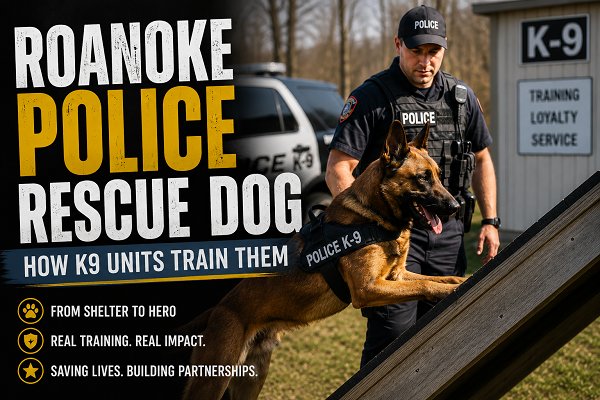
A Roanoke police rescue dog starts as a shelter or rescue dog with extreme play drive and steady nerves. It then goes through about 2 to 6 months of structured training: scent imprinting, obedience, and scenario work with its handler. It finishes with a certification test, such as those run by the Virginia Police Work Dog Association (VPWDA). Only a small share of shelter dogs make it. The ones that do can save a department thousands of dollars.
Table of Contents
- Introduction
- What the Roanoke Story Really Shows
- What “Rescue Dog” Means in K9 Work
- How Trainers Pick a Rescue Dog
- The Training Timeline, Phase by Phase
- The Methods That Make It Work
- Certification: The Test Every K9 Must Pass
- What It Costs
- Where Rescue K9 Programs Struggle
- What I Look for as a Handler
- Think Your Dog Has the Drive?
- FAQs
- Conclusion
Introduction
Search “Roanoke police rescue dog” and you’ll find heartwarming stories. A shelter dog gets a second chance. A department gets a partner. But most of those stories skip the part you actually want: how does a dog nobody wanted become a certified police K9?
I’ll walk you through the whole pipeline. You’ll see what Roanoke’s K9 teams are really doing, how rescue dogs get selected, what the training looks like week by week, and how certification works. I’ll also tell you where this model falls short, because it does.
Whether you’re a handler, a shelter volunteer, or just curious, you’ll leave knowing how it really works.
What the Roanoke Story Really Shows
First, a quick clarification that most articles miss. “Roanoke police” can mean two different agencies.
Roanoke City Police Department. In May 2023, the department added three dual-purpose K9s: Magnum, Knox and Vader. All three were under two years old. They spent about two months training with their handlers, which brought the unit to seven K9 officers, according to WDBJ and WSLS coverage. “Dual-purpose” means each dog does patrol work and detection work.
Roanoke County Police Department. This is where the rescue connection is clearest. Kayos, a 2-year-old Belgian Malinois, was donated to the department by the Throw Away Dogs Project. The Roanoke Times covered his K9 school graduation. A second Virginia dog, Rousey, a German Shepherd rescued in York County, Pennsylvania, was paired with an officer at the Rocky Mount Police Department.
The county also shows what the work looks like after graduation. According to The Roanoker, each county K9 must be recertified every year by the Virginia Police Work Dog Association. The teams also train 16 hours a month to stay sharp.
Community groups matter too. Spike’s K9 Fund, a Virginia Beach nonprofit, built a training obstacle course behind Roanoke County police headquarters in 2020 at no cost to taxpayers. It has also supplied bulletproof vests for the county’s dogs.
So here’s the honest picture. Roanoke’s K9 units are real, active, and well supported. Rescue dogs are part of the story, especially through Throw Away Dogs. But not every Roanoke K9 is a shelter dog, and anyone who tells you otherwise is guessing.
What “Rescue Dog” Means in K9 Work
People use “rescue” loosely, so let’s separate three paths:
- Shelter-sourced dogs. A department or trainer tests dogs in a local shelter and pulls the best prospect.
- Rescue-to-service nonprofits. Groups like the Throw Away Dogs Project rescue dogs, rehabilitate them, train them, then donate them. Founder Carol Skaziak says the group has placed 31 dogs with police and fire departments since 2014. It donates them for free.
- Bred or imported dogs. Many departments still buy trained dogs from specialist breeders. Virginia Beach Sheriff’s Office bought a 17-month-old German Shepherd named Pablo from a North Carolina kennel for $7,500, paid for by a Justice Department grant.
Also, “rescue K9” has a second meaning. Some dogs are trained for search and rescue, finding missing people. A shelter dog can end up doing both: rescued, then trained to rescue.
How Trainers Pick a Rescue Dog
Here’s the thing most people get wrong. It’s not about breed, and it’s not about looking tough.
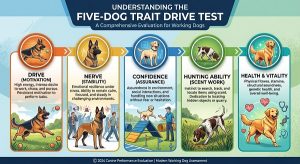
Throw Away Dogs handlers say they look for dogs with a strong “play drive.” That matches what I see in my own work. Play drive is the engine. Without it, a detection dog won’t work for hours just to earn a toy.
What trainers test for:
- Ball or toy obsession. Will the dog ignore food, noise and people to keep chasing a ball?
- Nerve strength. Does it stay steady after a dropped metal bowl or a slamming door? How fast does it recover?
- Confidence. Does it explore new rooms on its own, or cling to you?
- Hunt drive. Hide a toy. Does the dog keep searching when it gets hard, or quit?
- Health and age. Most programs prefer dogs around 1 to 3 years old. Hips, elbows and general fitness matter, because the career is physical.
A simple field test (done by pros, not by owners at home):
- Show the dog a ball, then hide it in tall grass or a box.
- Watch how long the dog keeps hunting.
- Repeat in a new location with a distraction.
- Add a sudden noise from a safe distance.
- Score drive, recovery and focus.
Red flags that end a candidate’s chances:
- Fear that doesn’t improve with exposure
- Aggression toward unfamiliar people that isn’t controllable
- Low interest in toys
- Painful joints or poor structure
Breeds like German Shepherds and Belgian Malinois fill many K9 rosters. Roanoke County’s Kayos is a Malinois. But breed is only a clue. A Lab mix with huge drive can beat a Shepherd with none.
If you want to understand the line between drive and control, I wrote about it in Dog Obedience vs. Instinct: How to Balance Drive and Control.
The Training Timeline, Phase by Phase
How long does it take? It depends on the dog, the job and the program. Here’s what real examples show:
- Roanoke City’s three new K9s spent about two months training with their handlers.
- Throw Away Dogs trains for roughly three months before testing, according to an NBC News report.
- Virginia Beach’s Pablo spent about three and a half months with his handler before certifying.
- Virginia Beach’s Apollo and his handler trained about six months.
- A specialty job takes longer. The Throw Away Dogs Project spent a year training an arson dog named Hansel, then he went through 16 weeks at a fire academy.
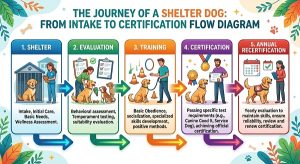
So a fair rule: 2 to 4 months for a prepared dog’s handler training, 3 to 6 months for a full shelter-to-certified path, and up to a year or more for specialty detection.
| Phase | What happens | Typical time |
|---|---|---|
| 1. Evaluation | Drive testing, vet check, basic obedience | 1–3 weeks |
| 2. Foundation | Obedience, socialization, nerve building | 3–6 weeks |
| 3. Imprinting | Target odor linked to the reward | 4–8 weeks |
| 4. Handler bonding | Dog and officer train together daily | Overlaps with phases 2–3 |
| 5. Scenarios | Vehicles, buildings, luggage, tracking, distractions | 4–8 weeks |
| 6. Certification | Formal test, then annual recertification | Test day, then yearly |
Note: these are ranges based on the programs above and general K9 practice, not a single official standard.
The Methods That Make It Work
Modern K9 units rely on reward-based, drive-based training. A dog that works because it wants the reward searches harder and longer than one working to avoid a correction.
Scent imprinting. Skaziak describes it simply: the dog is imprinted on a specific odor, such as narcotics, explosives or accelerants, and then learns “the game.” The odor predicts the toy. After hundreds of repetitions, finding the smell becomes the whole point.
Proofing. Once the dog knows the game, trainers make it harder. They add new locations, noise, crowds, other animals and time pressure. A dog isn’t “trained” until it works when everything around it says to quit.
Controlled apprehension work (patrol dogs only). Handlers use protective sleeves and trained decoys. The dog learns to bite on command and, just as important, to stop on command. Roanoke County Officer Kristina Wilhelm told The Roanoker how she called her dog off a suspect mid-run, and the dog held until backup arrived. That moment is the training working.
Handler bonding. In my experience, the handler is half the equation. A strong dog with a weak handler fails. A decent dog with a skilled, consistent handler often succeeds.
Handlers need the right gear for all of this. I cover it in Essential K9 Training Equipment Every Working Dog Handler Needs.
Certification: The Test Every K9 Must Pass
This is the part competitors skip, and it’s what separates a nice story from a working police K9.
In Virginia, the Virginia Police Work Dog Association (VPWDA) is a nonprofit that runs workshops and certifications for patrol/utility, narcotic detection, explosive detection and accelerant detection. A narcotics test, for example, evaluates the team across several environments. A Virginia Beach Sheriff’s Office report lists building interiors, vehicles, luggage and parcels, and couriers (people).
Other bodies, like the North American Police Work Dog Association (NAPWDA), certify in areas such as patrol, tracking, cadaver and explosives.
A few details show how serious this is:
- Fake alerts can fail you. A national sample standard published by the National Academies says two false indications fail the entire narcotics certification.
- Evaluators must be neutral. The same sample standard bars an evaluator from certifying a dog they originally trained.
- Certification doesn’t last forever. Roanoke County K9s recertify every year.
- Standards change. VPWDA only recently recognized fentanyl and Suboxone odors. Virginia Beach’s Apollo earned certification for both.
Certification also matters in court. The Supreme Court of Virginia held that a drug dog’s alert can establish probable cause when the dog’s training and track record show it’s reliable. That’s why records matter. Every training session, every certification, every alert gets documented.
Here’s the point for rescue dogs: the test doesn’t care where the dog came from. A rescue dog and an imported dog take the same certification. That’s the fair way to judge.
What It Costs
Costs vary widely, so I’ll stick to figures I can trace:
- Skaziak says training one K9 can cost more than $20,000. Her group donates its dogs free.
- Virginia Beach Sheriff’s Office paid $7,500 for Pablo, a young trained German Shepherd, using a federal grant.
- Roanoke County’s obstacle course and dog vests came from a nonprofit, not taxpayers.
So the real saving isn’t only the dog’s price. It’s the combination of a donated dog, nonprofit equipment, and smaller departments getting a K9 they could otherwise never afford.
One honest caution: rescue doesn’t make the program free. You still pay for handler training, vet care, vehicle equipment, certification, and the officer’s time. Evaluating many dogs to find one good one also takes staff hours.
Where Rescue K9 Programs Struggle
I won’t pretend this is a magic fix. Here are the real limits:
- Unknown history. Many rescues arrive with no hip or elbow records and no known parents. That’s a gamble for a dog expected to work 6 to 9 years.
- Behavior surprises. Some rescues carry fear or poor socialization that takes months to fix, if it can be fixed.
- Low selection rates. You may test a dozen dogs to find one real prospect. Throw Away Dogs reported that nine of its first twelve rescues went on to serve, but that’s one program with careful screening, not a national average.
- Liability worries. Some insurers and city lawyers want extra paperwork for shelter-sourced K9s.
None of these are deal-breakers. They just mean departments should budget time for testing, not only training.
And what about dogs that don’t make it? Most do well as pets, therapy dogs or scent-sport competitors. Roanoke County Sheriff’s Office even brought on Liberty, a rescue doodle, as a therapy dog for staff mental health and community outreach. Not every rescue needs to chase suspects to do meaningful work.
What I Look for as a Handler
I’ve spent years in dog selection and foundational training at the Nigerian Army Dog Centre. Different country, same dogs. A few lessons carry over everywhere:
- Drive without nerve is a trap. A wild, ball-crazy dog that panics at noise will wash out. I’ll take a slightly less intense dog with rock-solid nerve every time.
- Consistency beats intensity. Short daily sessions beat long weekend marathons.
- The reward timing matters more than the reward. Mark the right moment, within a second, and the dog learns fast. Mark it late and you teach the wrong thing.
- Retire the myth of the “natural.” Great K9s are built. Selection gives you raw material, training gives you the dog.
If you want to become the person on the other end of the leash, start with How to Become a K9 Dog Handler: Complete Guide.
Think Your Dog Has the Drive?
Be honest with yourself first. Most dogs, even great ones, aren’t police K9 material, and that’s fine.
If your dog never stops chasing a ball, stays calm around noise, and keeps hunting a hidden toy, here’s what to do:
- Don’t self-test aggression. Leave bite or protection work to professionals.
- Video the behavior. Show a ball session and a hide-and-find game.
- Contact a local K9 unit or working-dog rescue. Many will do a drive evaluation.
- Build the foundation. Reliable obedience helps in any working role.
- Consider other jobs. Search and rescue, scent work and therapy work all value the same traits.
If you want the same foundational thinking professional trainers use, explained in plain language, my e-book Beyond the Bark covers reward timing, drive-building and the shift from obedience to partnership.
FAQs
1. Does Roanoke police use rescue dogs as K9s?
Rescue dogs are part of the picture. Roanoke County Police received Kayos, a Malinois, from the Throw Away Dogs Project, a rescue-to-service nonprofit. Roanoke City Police added three young dual-purpose dogs in 2023, though public reports don’t say where they came from.
2. How long does it take to train a rescue dog to be a police K9?
Expect roughly 3 to 6 months from shelter to certification, based on examples like Throw Away Dogs (about three months before testing) and Virginia Beach’s Apollo (about six months of team training). Specialty jobs, such as arson detection, can take a year or more.
3. What certification do Virginia police dogs need?
Many Virginia teams certify through the Virginia Police Work Dog Association in patrol/utility, narcotics, explosives or accelerant detection. Roanoke County K9s recertify every year, according to The Roanoker.
4. What breeds become police rescue dogs?
German Shepherds and Belgian Malinois are common, but drive and nerve matter more than breed. Trainers look for strong play drive, steady temperament and good health.
5. What happens to rescue dogs that don’t pass K9 training?
Most go to loving homes or take on other work such as therapy, scent sports, or search and rescue. Failing police selection usually means the dog isn’t the right match for that job, not that something is wrong with the dog.
Conclusion
The Roanoke story shows what’s real and what’s hype. Roanoke’s K9 units are active and well supported, and rescue-trained dogs like Kayos have joined them through programs like the Throw Away Dogs Project. But the heart of the story isn’t where the dog came from. It’s the process: careful selection, reward-based training, handler bonding, and a certification test that every dog must pass.
Your next steps:
- Departments: test for drive and nerve before spending money, and budget extra time for evaluation.
- Handlers: invest in your timing and consistency. They matter as much as the dog.
- Dog owners: if your dog has serious drive, ask a professional to evaluate it, and keep other working roles in mind.
Want weekly K9 training tips and articles like this one? Subscribe to our weekly roundup newsletter.
Sources used (for your records)
- Roanoke Times / roanoke.com: Throw Away Dogs Project coverage (Kayos, Rousey)
- WDBJ7 and WSLS: Roanoke PD K9 announcement (May 2023); Roanoke County obstacle course (2020)
- The Roanoker, “Paw Patrol” (Roanoke County K9 recertification and 16 hours monthly training)
- NBC News and WKBW/Scripps: Throw Away Dogs Project (training length, free donation, 31 placements, $20,000+ cost)
- Virginia Beach city and Sheriff’s Office releases, WTKR, 13NewsNow (Apollo, Pablo, VPWDA)
- National Academies Press, sample certification standards
- Virginia Lawyers Weekly: Supreme Court of Virginia drug-dog ruling
- Virginia Sheriffs’ Institute (Liberty)

Her work centres on obedience, detection, protection and operational readiness. She favours proven methods built on repetition, consistency and real-world conditioning, so that both dogs and handlers are prepared for high-pressure tasks.
Rofiat represented the Nigerian Army Dog Centre at the Nigerian Army Day Celebration (NADCEL) 2026, where she led demonstrations in obedience, explosive detection, agility and tactical movement. Through articles, training content and documentaries, she shares field-based insight into how structured training, clear communication and trust between handler and dog affect performance and reliability.
She is the author of Beyond the Bark: Inside a Pro Handler's Playbook for Raising the Ideal Dog, a practical guide that helps dog owners and handlers apply professional training principles in everyday situations.
- 10 Red Flags to Avoid When Hiring Local Dog Groomers - October 24, 2026
- Can You Handle a Cane Corso Puppy? 7 Hard Truths - October 23, 2026
- How to Train a Stubborn Pug: A K9 Trainer’s Real Guide - October 22, 2026