Are Corgis Easy to Train? A K9 Trainer’s Honest Guide
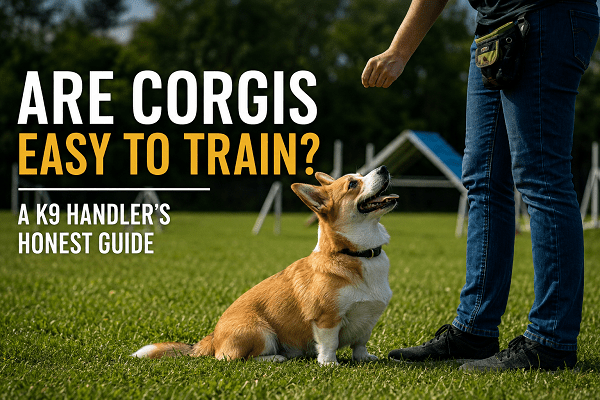
Yes, Corgis are easy to train in the sense that matters most to a trainer: they learn new commands fast, usually within 5 to 15 repetitions, and the Pembroke Welsh Corgi ranks 11th out of over 130 breeds for working obedience intelligence, according to canine psychologist Stanley Coren. But “smart” and “obedient” aren’t the same thing. Corgis are herding dogs with an independent streak, so they learn quickly whether or not you actually want them to learn it. Get consistency and early socialization right, and a Corgi is one of the most rewarding dogs you’ll ever train. Skip that step, and you’ll end up with a very clever dog running the household instead of you.
Table of Contents
- Introduction
- What “Easy to Train” Actually Means
- Are Corgis Easy to Train? The Straight Answer
- How Smart Are Corgis, Really?
- The Corgi Paradox: Brilliant But Bossy
- Pembroke vs. Cardigan: Any Training Differences?
- The Corgi Puppy Training Timeline (Week by Week)
- 7 Expert Tips for Training a Corgi
- Mistakes Most Corgi Owners Make (And Most Blogs Don’t Mention)
- Real-World Case: What a Working Corgi Can Do
- How Much Does Professional Corgi Training Cost?
- FAQs
- Conclusion
Introduction
Ever watched a Corgi stare you down like it’s negotiating a hostage situation over a piece of chicken? That’s not cuteness. That’s a herding dog’s brain running a cost-benefit analysis on whether listening to you is actually worth it right now.
If you’re considering a Corgi, or you already have one chewing your shoelaces off, you’ve probably typed “are Corgis easy to train” into Google more than once. Most of the answers you’ll find give you half the story: “Yes, they’re smart!” or “No, they’re stubborn!” Neither one tells you what actually happens when you try to teach a Corgi to walk politely on a leash or stop barking at the mail carrier.
I’ve worked with working and companion dogs long enough to know that breed intelligence rankings only tell you how fast a dog can learn, not how willing it is to listen. Corgis sit right at that fascinating intersection. By the end of this guide, you’ll know exactly what to expect, a real training timeline broken down by week, the specific mistakes that turn a smart Corgi into a defiant one, and what it actually costs to get professional help if you need it.
What “Easy to Train” Actually Means
Before we get to Corgis specifically, it helps to separate two things people lump together:
- Working and obedience intelligence — how fast a dog learns a new command and how reliably it obeys a known one.
- Trainability — whether the dog actually wants to cooperate with you once it understands what you’re asking.
A dog can ace the first and completely flunk the second. That’s the whole Corgi story in one sentence, and it’s the piece most “top 10 smartest dogs” listicles leave out entirely.
Are Corgis Easy to Train? The Straight Answer
Here’s the direct, no-fluff version: yes, with conditions.
Corgis are herding dogs bred for centuries to work semi-independently, driving cattle across Welsh hillsides without a handler standing right next to them barking orders. That history is baked into their brain. It means they pick up commands fast and it means they’ll question you if the command doesn’t seem worth their time.
Compare that to, say, a Labrador Retriever, which was bred to work in constant partnership with a handler and genuinely wants your approval more than almost anything else. A Corgi wants your approval too, but only if there isn’t something more interesting happening, like a squirrel, a delivery truck, or the neighbor’s cat.
So when someone tells you flatly “Corgis are easy” or “Corgis are impossible,” they’re both wrong. The honest answer is that Corgis are fast learners who need a handler willing to be just as consistent as they are clever.
How Smart Are Corgis, Really?
Let’s get into actual numbers, because vague claims about intelligence don’t help anyone. (If you want the deeper mechanics of why a smart dog isn’t automatically an obedient one, we’ve written a full breakdown of working intelligence versus instinctive drive that applies to every breed, Corgis included.)
- In The Intelligence of Dogs, Stanley Coren surveyed nearly 200 AKC and Canadian Kennel Club obedience judges and ranked over 130 breeds by working and obedience intelligence. The Pembroke Welsh Corgi came in 11th, landing in the “excellent working dogs” tier, dogs that learn a new command in 5 to 15 repetitions and obey a known command on the first try at least 85% of the time. The Cardigan Welsh Corgi ranked 26th, still solidly in the top tier of trainable breeds.
- For context, that puts the Pembroke ahead of the Rottweiler, the Doberman Pinscher, and the Belgian Malinois on this particular measure, which surprises a lot of people who assume “smart dog” automatically means a big, imposing working breed.
- The Pembroke Welsh Corgi is currently the 16th most popular breed in the United States out of 205 AKC-recognized breeds (2025 registration data), while the Cardigan sits around 65th, making it a genuinely rare breed by comparison.
- Corgis are also intelligent enough to be trained for psychiatric service dog work, a role that demands not just obedience but the judgment to recognize a handler’s emotional state and act on it without being told.
None of this means a Corgi will train itself. It means the ceiling on what a Corgi can learn is high. What you do with that ceiling is up to you.
The Corgi Paradox: Brilliant But Bossy
Where the Stubbornness Actually Comes From
Corgis aren’t stubborn out of spite. They’re stubborn because they were bred to make decisions in the field without a human micromanaging every step. A Welsh farmer moving cattle across open ground needed a dog that could think for itself, nip at a hoof, dodge a kick, and reroute a stray cow without waiting for instructions. That same problem-solving instinct shows up at home as a dog that decides, on its own, whether “sit” is worth doing right now.
Corgis are also famous for intense, sustained eye contact, a leftover from their herding strategy of controlling livestock with a stare. Handlers often describe getting “negotiated with” by a Corgi’s eyes, and honestly, it works. That direct gaze is exactly why so many owners cave on rules they meant to hold firm.
The Nipping and Herding Instinct
Because Corgis are low to the ground, they historically herded cattle by nipping at heels rather than face-on. That same instinct can show up as a Corgi nipping at running kids, joggers, cyclists, or other pets. It isn’t aggression; it’s an ancient job description with nowhere else to go. Left unmanaged, this instinct becomes one of the most common behavior complaints Corgi owners bring to trainers.
The Barking Problem
Corgis are natural alert barkers, a trait that made them useful farm dogs warning of intruders. Without training, that alertness turns into reactive barking at every passing car, dog, or doorbell. The fix isn’t to suppress the instinct, but to give it a job: teach a reliable “quiet” cue and reward calm behavior the moment a Corgi chooses not to react. If barking or lunging at triggers is already a habit, our daily reactive-dog exercises work especially well for herding breeds that alert first and think second.
Pembroke vs. Cardigan: Any Training Differences?
Both breeds descend from the same northern spitz-type ancestors, but they were developed somewhat separately in Wales and differ slightly in temperament.
| Trait | Pembroke Welsh Corgi | Cardigan Welsh Corgi |
|---|---|---|
| Coren intelligence rank | 11th | 26th |
| Temperament | Slightly more outgoing, food-driven | Slightly more reserved, watchful |
| Tail | Docked or naturally bobbed | Full, fox-like tail |
| AKC popularity (2025) | 16th | ~65th |
| Training approach | Responds fast to food rewards | Responds well to calm, patient repetition |
In practice, both breeds train the same way: positive reinforcement, early socialization, and consistency. The Cardigan tends to warm up a little slower to new people and situations, so extra socialization mileage in puppyhood pays off more noticeably with this breed. For a closer look at how the two breeds stack up beyond training, our team broke down their guard traits and watchdog instincts in a separate guide.
The Corgi Puppy Training Timeline (Week by Week)
Anne Bowes, owner of Heronsway Pembroke Welsh Corgis and the AKC’s 2007 Herding Group Breeder of the Year, has raised and trained more than 135 Corgi litters over five decades. Her approach, along with standard AKC puppy development guidance, gives us a realistic week-by-week picture:
- Weeks 8–10: Focus purely on positive exposure. Take your Corgi puppy somewhere with foot traffic, a park, a quiet street corner and let people approach calmly. This is also the window to start gentle handling for grooming, since Corgis have a heavy double coat that needs regular brushing and eventually blow-drying.
- Weeks 10–12: Begin house training in earnest and introduce a marker word or clicker paired with treats. Most Corgis pick up the sit-treat association within the first few sessions.
- Weeks 12–16: Start basic cues: sit, down, come. Because Corgis are food-motivated, short 5-minute sessions multiple times a day work better than one long session. This is also when nipping tends to appear during play, so redirect to a toy immediately and end play if nipping continues. This is also a good window to lock in crate training, which pays off fast with a breed this food-motivated.
- 4–6 months: Enroll in a structured puppy or basic obedience class. The AKC S.T.A.R. Puppy program, a 6-to-12-week course covering Socialization, Training, Activity, and Responsible ownership, is a solid, widely available option and a natural stepping stone toward the AKC Canine Good Citizen title later on.
- 6–12 months: Adolescence hits, and previously “trained” Corgis often test boundaries again. This is completely normal and not a sign that training failed. Reinforce known cues in new environments (a different park, a friend’s house) so the dog generalizes the command rather than only obeying it in the living room.
- 12–18 months: Most Corgis are behaviorally mature enough for off-leash reliability work, advanced obedience, agility, or herding instinct tests if you want to tap into that original working drive.
7 Expert Tips for Training a Corgi
- Lead with food, but don’t rely on it forever. Corgis are notoriously food-motivated, which makes early training fast. Fade the treats gradually and replace them with praise, play, or life rewards (like being let outside) so the dog isn’t only listening when a snack is visible.
- Never repeat a command you can’t enforce. If you say “come” and your Corgi ignores you, don’t say it again louder. Walk over, guide them gently, and reward once they arrive. Repeating an unenforced command just teaches the dog that the word is optional.
- Give the herding instinct a job. Ten minutes of structured “find it” games, treat-scattering in the grass, or a flirt pole session burns off the same drive that would otherwise go into nipping ankles or barking at everything that moves.
- Watch for the stare-down and don’t blink first. If your Corgi is fixing you with that classic herding gaze to get out of a command, calmly wait it out. Caving even once teaches the dog the stare works.
- Keep every family member on the same rules. Corgis are quick to notice which household member enforces rules loosely, and they’ll target that person specifically. One inconsistent adult can undo a week of good training. This is really about leadership, not force, a distinction we go into more in our piece on discipline versus dominance in dog training.
- Watch the weight. Corgis have a long back and short legs, which makes them prone to intervertebral disc disease if they carry extra weight. Since food rewards are so effective for this breed, swap in low-calorie options like small pieces of carrot or kibble taken from the daily ration instead of extra treats.
- Train in short, frequent bursts. A bored Corgi disengages fast. Five-minute sessions, three or four times a day, consistently beat one 30-minute session for this breed.
Mistakes Most Corgi Owners Make (And Most Blogs Don’t Mention)
Most articles on this topic stop at “be consistent and use positive reinforcement.” That’s true but incomplete. Here’s what actually trips people up:
- Mistaking cuteness for compliance. Corgis are physically comical, short legs, big ears, low center of gravity, and owners often laugh off behavior they’d correct immediately in a larger, more intimidating breed. That inconsistency confuses the dog.
- Skipping structured socialization after 16 weeks. The critical socialization window closes early, but ongoing exposure still matters through the first year. Owners who stop taking their Corgi to new places after the puppy stage often end up with an adult dog that’s reactive to unfamiliar situations.
- Treating barking as a personality trait instead of a trainable behavior. Alert barking absolutely can be reduced with a “quiet” cue and reward-based training. Owners who assume “that’s just how Corgis are” never actually teach the alternative.
- Underestimating exercise needs. Corgis are working dogs in a small body. A daily walk isn’t enough for most of them; without adequate physical and mental exercise, training sessions become a fight against restless energy rather than genuine engagement.
Real-World Case: What a Working Corgi Can Do
It’s easy to assume a dog this small and this cute is a lapdog through and through, but Corgis have quietly worked their way into serious roles that prove out their trainability. Beyond their original job driving cattle across Pembrokeshire farms, Corgis today compete successfully in AKC herding trials against much larger breeds, earn Canine Good Citizen and Therapy Dog titles, and have been placed as psychiatric service dogs where their combination of size, alertness, and people-focus makes them a practical fit for handlers who need a dog that can accompany them into small spaces like offices or public transit. None of that happens by accident. It happens because the same intelligence that makes a Corgi occasionally exasperating in a living room is precisely what makes it capable of complex, high-stakes work when that intelligence is channeled properly.
How Much Does Professional Corgi Training Cost?
If you decide to bring in a professional rather than going it alone, here’s a realistic global range:
- Group puppy or basic obedience classes: roughly $100–$250 for a 6-to-8 week course, widely available through kennel clubs, pet stores, and independent trainers across the US, UK, and Europe.
- Private one-on-one sessions: typically $50–$150 per session, with most behavior issues (barking, nipping, leash reactivity) resolving in 4 to 8 sessions for a breed as trainable as the Corgi.
- Board-and-train programs: anywhere from $1,000–$3,000 for a 2-to-4 week immersive program, generally overkill for a Corgi unless you’re dealing with a specific, entrenched behavior problem.
Given how quickly Corgis pick up new material, most owners get excellent results from a basic group class plus consistent home practice, without ever needing the more expensive options.
FAQs
1. Are Corgis good for first-time dog owners?
Yes, provided the owner is genuinely willing to commit to daily training and at least 45–60 minutes of exercise. Corgis are demanding for their size, and a first-timer who treats them like a low-maintenance lapdog will struggle.
2. Why does my Corgi ignore commands it clearly knows?
This is almost always a motivation or consistency problem, not a comprehension problem. Corgis learn commands quickly but will selectively ignore them if the reward isn’t compelling enough or if the rule has been inconsistently enforced in the past.
3. Are Corgis harder to train than German Shepherds?
Not in raw learning speed. Both breeds rank in the top tier of Coren’s intelligence study. The difference is drive: German Shepherds were bred to work in close partnership with a handler, while Corgis were bred for semi-independent decision-making, so Shepherds are often perceived as more naturally “biddable.”
4. At what age should I start training my Corgi puppy?
As early as 8 weeks old, focusing first on socialization and gentle handling, then layering in basic cues like sit and come from around 10–12 weeks once the puppy is settled into its new home.
5. Do Corgis need a professional trainer, or can I train one myself?
Most owners can absolutely train a Corgi themselves using consistent positive reinforcement and a structured routine. A professional becomes worthwhile if you’re dealing with persistent nipping, reactivity, or if you simply want the accountability of a weekly class.
Conclusion
Are Corgis easy to train? The honest answer is that they’re easy to teach and occasionally hard to convince. Their working intelligence puts them among the top tier of trainable breeds on the planet, but that same intelligence means they’ll test the boundaries you set, watch for inconsistency, and negotiate with those famous puppy-dog eyes every chance they get.
The actionable takeaway: start early, keep sessions short and food-driven, give the herding instinct somewhere productive to go, and make sure every person in the household enforces the same rules. Do that consistently through the first year, and you won’t just end up with an obedient Corgi. You’ll end up with one of the smartest, most engaged dogs you’ve ever worked with.
Keep Reading on ARFS K9 Team
- Pembroke vs Cardigan Corgi: Guard Traits Compared
- Dog Obedience vs. Instinct: How to Balance Drive and Control
- Dog Dominance vs. Discipline: Professional K9 Training Secrets
- How to Crate Train a Puppy: K9 Trainer Tips for Faster Results
- Reactive Dog Training at Home: 7 Fast Daily Exercises
Want a deeper, structured system for building reliable obedience in any dog, working breed or family companion? Our ebook, available here, walks through the exact drills and foundations we use in the field.

Her work centres on obedience, detection, protection and operational readiness. She favours proven methods built on repetition, consistency and real-world conditioning, so that both dogs and handlers are prepared for high-pressure tasks.
Rofiat represented the Nigerian Army Dog Centre at the Nigerian Army Day Celebration (NADCEL) 2026, where she led demonstrations in obedience, explosive detection, agility and tactical movement. Through articles, training content and documentaries, she shares field-based insight into how structured training, clear communication and trust between handler and dog affect performance and reliability.
She is the author of Beyond the Bark: Inside a Pro Handler's Playbook for Raising the Ideal Dog, a practical guide that helps dog owners and handlers apply professional training principles in everyday situations.
- Lagos Dog Carnival 2026: Full Guide, Dates & Events - October 25, 2026
- 10 Red Flags to Avoid When Hiring Local Dog Groomers - October 24, 2026
- Can You Handle a Cane Corso Puppy? 7 Hard Truths - October 23, 2026