How Long Do Military Working Dogs Serve? Full Guide
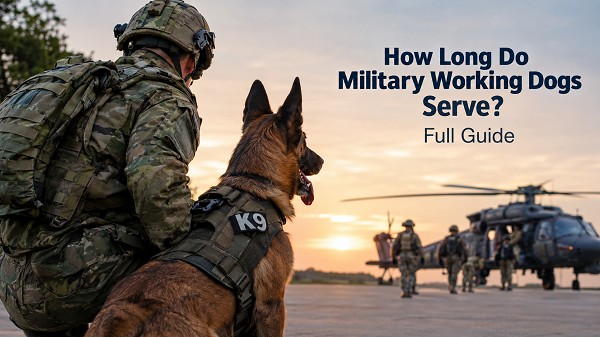
Most military working dogs (MWDs) serve between six and twelve years of active duty, retiring somewhere around nine to twelve years of age. The exact number depends heavily on the dog’s job. A detection dog with light patrol duties can often work into its low teens, while a dual-purpose patrol-and-bite dog usually breaks down physically several years sooner. There’s no single fixed “tour length” the way there is for a human service member, a dog’s career ends when its body or drive gives out, not when a contract expires.
Table of Contents
- Quick Answer: How Long Do MWDs Serve?
- From Puppy to Deployment: The Timeline Before “Service” Even Starts
- The Real Range: 6 to 12 Years, and Why Sources Disagree
- What Actually Determines How Long a Military Dog Serves
- Career Timeline at a Glance (Table)
- Real Military Working Dogs and How Long They Served
- The Laws Behind MWD Retirement: Robby’s Law and the 2016 NDAA
- What Happens When a Military Working Dog Retires
- Trainer’s Take: What Handlers Should Watch For As a Dog Ages
- How Military Dog Careers Compare to Police and Detection K9s
- Frequently Asked Questions
- Final Thoughts
Introduction
If you’ve ever watched footage of a Malinois fast-roping out of a helicopter or clearing a building ahead of a fire team and wondered, “how long can a dog actually keep doing that?”, you’re asking the right question. I’ve spent over 14 years around working and protection dogs, and the honest answer is messier than the “10 to 12 years” line you’ll find repeated across most articles on this topic. Let’s break down exactly what determines an MWD’s service length, what the numbers really mean, and what happens once the vest comes off for good.
From Puppy to Deployment: The Timeline Before “Service” Even Starts
Before you can even talk about how long a dog “serves,” you need to understand how long it takes to build a service-ready dog in the first place. This part gets skipped in most articles, but it matters, a chunk of a working dog’s life is already gone before it ever wears a military patch.
Here’s roughly how it plays out at the Department of Defense’s Military Working Dog (MWD) program, run by the 341st Training Squadron at Joint Base San Antonio-Lackland, Texas:
- Birth to 8 weeks: Puppies bred through the DoD’s own breeding program (Belgian Malinois only) are whelped and raised at the Military Working Dog Center. Puppy development specialists start imprinting them on sounds, surfaces, and objects almost immediately.
- 8 weeks to 7 months: Puppies go home with volunteer foster families in the San Antonio/Austin area for socialization, exposure to different people, environments, and everyday chaos a future MWD needs to shrug off.
- Around 7 months: Dogs return to Lackland for what trainers informally call “canine high school”, adolescent conditioning that lines up with the dog coming out of its gawky puppy phase.
- Around 12 to 18 months: Dogs (both DoD-bred and vendor-purchased) are formally evaluated for entry into the Military Working Dog Training Program.
- 90 to 120 days of formal training: Single-purpose detection dogs typically train for about 90 days; dual-purpose patrol-and-detection dogs, which make up the majority, train for around 120 days.
So by the time a dog is actually certified and shipped to an operational unit, it’s usually already 18 months to 2 years old. That’s before a single day of “service” has been logged. Only about 10–13% of MWDs come from the DoD’s own breeding program; the rest, roughly 85%, are purchased as adults from breeders in Germany, the Netherlands, and other parts of Europe, then put through the same qualification and training pipeline.
Not every dog makes it. Somewhere between 15% and 25% of candidates wash out during training, usually because they can’t reliably alert on detection odors or don’t have the nerve for patrol work. Washed-out dogs aren’t wasted, though, many stay on as training aids for handler students, and plenty are adopted out as pets.
The Real Range: 6 to 12 Years, and Why Sources Disagree
If you’ve been researching this topic, you’ve probably noticed the numbers don’t line up cleanly. Some sources say 10 to 12 years. Others say 6 to 7 years. A few say retirement age lands between 9 and 11. Here’s why and this is the part most articles gloss over.
- “10 to 12 years” usually refers to total time in the program, sometimes counted loosely from when the dog first arrives at Lackland, not from when it starts active operational deployment.
- “6 to 7 years” tends to describe actual working career length, the years a dog spends genuinely deployable and doing the job, once you subtract the 18-24 months of puppy-hood and training.
- “9 to 11 years old” is a retirement-age estimate, factoring in that most dogs don’t start real work until they’re roughly 2 years old.
Put those together and you get a coherent picture: a dog typically starts real operational work around age 2, works for somewhere between 6 and 10 years depending on its job and health, and retires somewhere between 9 and 12 years old. None of the individual numbers you’ll see floating around online are wrong, they’re just measuring different things. That’s the nuance competitors covering this topic almost never explain.
What Actually Determines How Long a Military Dog Serves
Retirement isn’t scheduled years in advance the way a human enlistment contract is. It’s triggered by a specific set of factors, and understanding them tells you a lot more than a flat number ever could.
Job Type: Patrol Work Ages a Dog Faster Than Detection
This is the single biggest variable, and it’s the one most “how long do MWDs serve” articles completely skip.
- Dual-purpose dogs (patrol + detection), the majority of the force, bite decoys, jump from vehicles, and absorb repeated impact through their joints over years of training and real-world apprehensions. That physical toll adds up. Hips, elbows, and spines wear down faster in dogs doing regular bite work.
- Single-purpose detection dogs (explosives or narcotics only) do far less high-impact physical work. A dog whose job is walking a perimeter and sniffing luggage or vehicles can often stay effective and pain-free, well past the point a patrol dog would need to retire.
Physical Health and Wear
Arthritis, hip dysplasia, and general joint degeneration are the leading causes of early retirement. Working dogs also deal with heat stress, dental damage from bite work (titanium replacement teeth aren’t unusual), and old injuries that catch up with them. A dog that had a rough deployment at age 4 might be functionally “older” than its birth certificate suggests.
Deployment Tempo and Combat Exposure
Dogs deployed repeatedly to combat zones face physical risk (IEDs, gunfire, extreme climates) and cumulative stress that dogs working stateside security posts simply don’t. A dog with multiple combat rotations may retire years earlier than a kennel-mate who spent its career on a domestic base.
Detection Reliability
If a dog’s alert accuracy starts slipping, false positives, missed odors, hesitancy, that’s a safety issue, not just a performance one. A drop in detection reliability, even in an otherwise healthy dog, can end a career on its own.
Temperament and Drive
Some dogs simply lose their “want to work” drive as they age, especially highly driven breeds like the Belgian Malinois once repetitive stress or minor pain starts dulling their enthusiasm for the job they used to love.
Career Timeline at a Glance
| Life Stage | Typical Age Range | What Happens |
|---|---|---|
| Whelping & early imprinting | Birth – 8 weeks | Raised at the MWD Center (DoD-bred dogs only) |
| Foster socialization | 8 weeks – 7 months | Volunteer foster families expose pups to real-world stimuli |
| Adolescent conditioning | ~7 months | Begins structured training (“canine high school”) |
| Program evaluation | 12–18 months | Assessed for entry into formal MWD training |
| Formal MWD training | 90–120 days | Obedience, detection, patrol/bite work certification |
| First operational assignment | ~18 months – 2 years | Paired with a handler, sent to a duty station or deployed |
| Active service | 2 – 8 to 12 years old | 6–10 years of operational work, varying by role and health |
| Retirement | 9 – 12 years old | Adoption, transfer, or continued care per Robby’s Law |
Real Military Working Dogs and How Long They Served
Numbers are useful, but real cases show how much variation exists in practice.
Lucca served roughly six years as a U.S. Marine Corps search dog, completing more than 400 separate missions in Iraq and Afghanistan before losing a leg to an IED in March 2012. She retired at that point, her career length was set by a single catastrophic injury, not by age or a schedule. In 2016, at age 12, she became the first U.S. Marine Corps dog awarded the PDSA Dickin Medal, the UK’s top honor for animal gallantry in conflict.
Lex, a German Shepherd Marine Corps dog, was wounded in the same attack that killed his handler, Corporal Dustin Lee, in Iraq. Lex became the first fully fit, active-duty MWD granted early retirement so his handler’s family could adopt him, a legal first that required a special provision, since the armed forces don’t typically release healthy dogs from service ahead of standard retirement age. He lived out his retirement with the Lee family until his death in 2012.
These two cases alone show the two extremes of “how long do MWDs serve”: one dog’s six-year career ended by injury, and another’s active service was cut short entirely by exceptional circumstances rather than age or wear. Neither fits neatly into a “10 to 12 years” answer.
The Laws Behind MWD Retirement: Robby’s Law and the 2016 NDAA
You can’t really answer “how long do military working dogs serve” without touching the legal side, because for most of U.S. military history, dogs simply weren’t allowed to retire at all.
Until November 2000, MWDs were legally classified as equipment, not personnel. When a dog was no longer useful, military policy called for euthanasia, or the dog was simply left behind in whatever country it was serving in. Of the roughly 4,900 dogs used in Vietnam, around 1,600 were euthanized and most of the rest were turned over to the South Vietnamese army, very few came home.
Robby’s Law (H.R. 5314, 2000), signed by President Clinton, changed that. It ended mandatory euthanasia for retiring MWDs and opened the door to adoption by former handlers, law enforcement agencies, and qualified civilians. It was a major step forward, but it still left a gap: dogs retired overseas were classified as “civilians” once released from service, which meant the military wasn’t obligated to fly them home. Handlers who wanted to adopt their former partners often had to personally cover the cost of transport, sometimes thousands of dollars.
The 2016 National Defense Authorization Act (NDAA) closed that gap. It legally required the Department of Defense to return all retiring MWDs to the United States at government expense, and it gave former handlers formal first priority for adoption, ahead of law enforcement or the general public. This provision is now codified in 10 U.S.C. § 2583. The change followed years of advocacy from groups like the American Humane Association, which had been privately funding the return trips of dozens of dogs a year before the law shifted that cost back onto the government.
What Happens When a Military Working Dog Retires
Retirement isn’t a quiet fade into a backyard nap for most of these dogs. About 300 MWDs are retired and adopted out annually, with roughly 100 of those going to law enforcement agencies that value a fully trained, combat-tested dog over starting from scratch with a green one. More than 90% of retiring MWDs are eventually adopted by their handlers when those handlers are willing and able.
Retired dogs commonly carry the physical bill for their careers: arthritis, hearing loss, old injuries, and joint problems from years of hard use. Behaviorally, the adjustment can be just as demanding. A dog trained to stay hyper-alert to threats for a decade doesn’t switch that off just because it’s sleeping on a couch now. Anxiety, hypervigilance, and difficulty settling into an unstructured home are common, which is part of why handler adoption, someone who already understands the dog’s training and triggers, tends to produce the smoothest transitions.
Trainer’s Take: What Handlers Should Watch For As a Dog Ages
I get asked a version of this question constantly, whether it’s about an actual MWD or a civilian protection dog doing similar work: how do you know it’s time?
In my experience, the warning signs show up in this order and it rarely starts with the dog refusing to work:
- Recovery time increases first. A dog that used to be ready to go again 20 minutes after a hard training rep starts needing an hour, then a full rest day.
- Subtle compensation in movement. Favoring a hip on cold mornings, hesitating before jumping into a vehicle it used to leap into without thinking.
- Drive stays high even as the body struggles. This is the dangerous stage, a driven dog will push through pain to keep working, which is exactly why regular veterinary joint checks matter more than watching for obvious limping.
- Detection or bite-work confidence dips. A split-second of hesitation on an odor the dog used to nail instantly, or a softer, less committed bite.
The takeaway for any handler, military or civilian: don’t wait for the dog to tell you it’s done. By the time a working dog is visibly struggling, it’s usually been compensating for months. Proactive joint support and honest performance tracking buy a good dog more working years and a better-quality retirement when the time comes.
How Military Dog Careers Compare to Police and Detection K9s
This is a comparison most articles on this topic skip entirely, but it’s genuinely useful context. A civilian police K9 often has a similar career arc, typically 6 to 9 years of active duty but without combat deployment, extreme climates, or IED exposure, many police dogs age out due to routine joint wear rather than acute injury. TSA and airport detection dogs, who do almost no bite work, frequently work the longest of any working-dog category, sometimes into their early teens, because their bodies simply take less punishment. If you’re weighing a working-dog career path or trying to understand why your own protection or detection dog seems to be slowing down sooner or later than expected, the type of work the dog does day to day tells you more than its breed or its age on paper.
If you want the fuller picture of how these dogs are actually trained before they ever reach this stage of their career, our guide on how military working dogs are trained walks through the certification process in detail. And if detection work specifically interests you, how search and rescue dogs work covers a related but distinct scent-based discipline that shares a lot of the same foundational training.
Frequently Asked Questions
How long do military working dogs typically serve?
Most MWDs serve between six and ten years of active operational duty, with total time in the program (including training) often cited as 10 to 12 years. The exact length depends heavily on the dog’s job, health, and deployment history.
What age do military working dogs retire?
Retirement typically happens between 9 and 12 years old, though a dog can retire earlier due to injury, illness, or a drop in detection reliability, or later if it stays healthy and effective in a lower-impact role like detection.
Can civilians adopt a retired military working dog?
Yes. Under Robby’s Law and the 2016 NDAA, retired MWDs can be adopted by former handlers (who get first priority), law enforcement agencies, and qualified civilian families. The Department of Defense adopts out roughly 300 dogs a year.
Do military working dogs get shipped home automatically when they retire overseas?
Yes, since the 2016 NDAA. Before that law, dogs retired overseas were classified as civilians and the military wasn’t required to pay for their return, handlers often covered that cost themselves.
Why do some military working dogs retire much earlier than others?
The biggest factors are job type (patrol/bite work wears a dog down faster than pure detection), injury (a single incident like an IED blast can end a career instantly), and deployment tempo. Genetics and individual drive also play a role in how well a dog holds up physically.
Final Thoughts
“How long do military working dogs serve?” doesn’t have one clean number, and honestly, any article that gives you just “10 to 12 years” and moves on is leaving out the part that actually matters. A dog’s service length comes down to the job it’s asked to do, the physical toll that job takes, and a fair bit of circumstance, an IED, a lucky assignment to a stateside post, a body that ages well. What’s consistent is what happens once the work is done: thanks to Robby’s Law and the 2016 NDAA, these dogs finally come home, and their former handlers get the first chance to give them the retirement they’ve earned.
If you’re a handler or an owner of a working or protection dog watching your own partner start to slow down, the actionable takeaway is simple: track subtle changes in recovery and movement before they become obvious limping, and don’t assume high drive means the body is keeping up. A joint-support supplement like Nutramax Cosequin Joint Health Supplement for Dogs is a reasonable, vet-commonly-recommended starting point for a working dog entering its senior years, alongside regular veterinary checkups.
For a deeper, ground-level look at reading a working dog’s drive, discipline, and true readiness, the same principles that decide when a military dog’s career winds down, my book Beyond the Bark goes into this in more depth than I can cover in a single article.
And if you want more breakdowns like this one delivered straight to you, subscribe to our weekly K9 newsletter for hands-on training insight, gear reviews, and working-dog research roundups every week.

Her work centres on obedience, detection, protection and operational readiness. She favours proven methods built on repetition, consistency and real-world conditioning, so that both dogs and handlers are prepared for high-pressure tasks.
Rofiat represented the Nigerian Army Dog Centre at the Nigerian Army Day Celebration (NADCEL) 2026, where she led demonstrations in obedience, explosive detection, agility and tactical movement. Through articles, training content and documentaries, she shares field-based insight into how structured training, clear communication and trust between handler and dog affect performance and reliability.
She is the author of Beyond the Bark: Inside a Pro Handler's Playbook for Raising the Ideal Dog, a practical guide that helps dog owners and handlers apply professional training principles in everyday situations.
- Local Dog Breeds: Temperament, Health & Training Guide - October 6, 2026
- How Long Do Military Working Dogs Serve? Full Guide - October 5, 2026
- National Puppy Day 2026: Date, Best Deals & Freebies - October 4, 2026