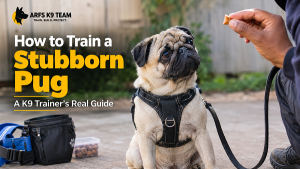
How to Train a Stubborn Pug: A K9 Trainer’s Real Guide
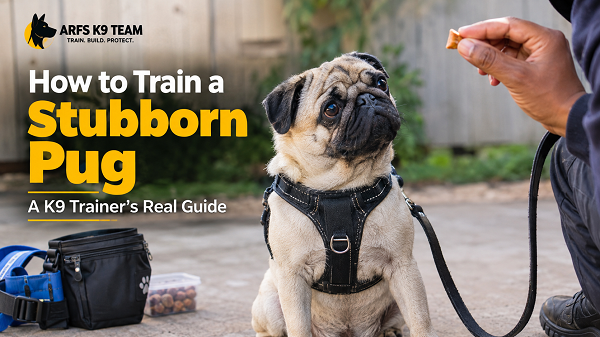
To train a stubborn pug, you need to stop fighting its personality and start working with it. Pugs aren’t disobedient, they’re independent thinkers with a low tolerance for boring repetition and a body that genuinely can’t handle harsh corrections. Use high-value food rewards, keep sessions to 5–10 minutes, train before meals when motivation is highest, and swap the collar for a harness. Most pugs learn basic commands within 2 to 4 weeks of consistent daily practice, though full “stubborn streak” management is an ongoing, lifelong relationship, not a one-time fix.
Table of Contents
- Why Pugs Act So Stubborn (It’s Not Really Stubbornness)
- The Health Factor Nobody Talks About
- What You Need Before You Start Training
- The 7-Step Framework for Training a Stubborn Pug
- Common Stubborn Behaviors and How to Fix Each One
- Mistakes That Make Pugs More Stubborn
- When to Bring in a Professional Trainer
- A Trainer’s Take: What I’ve Learned Working With Small, Independent Breeds
- FAQs
- Conclusion and Next Steps
Why Pugs Act So Stubborn (It’s Not Really Stubbornness)
Let’s clear something up right away: your pug isn’t ignoring you out of spite. It’s ignoring you because, from an evolutionary standpoint, nobody ever bred it to care what you think.
Pugs come from a very different job description than most “trainable” breeds. Border Collies were bred to read a shepherd’s every hand signal from 200 yards away. Labradors were bred to retrieve on command without hesitation. Pugs? They were never bred for herding, hunting, retrieving, scent work, guarding, or any working purpose beyond simply being a companion, so they never developed the instinct to take orders from a human the way working breeds do. Their entire “job” for over 2,000 years, dating back to Han dynasty China and later Dutch and English royal courts, was to sit on laps and look adorable. Nobody selectively bred a pug for its ability to down-stay on the first command.
This shows up clearly in the data. Canine psychologist Dr. Stanley Coren surveyed nearly 200 obedience judges across North America for his landmark book The Intelligence of Dogs, ranking breeds purely on working and obedience intelligence, how fast a dog learns a new command and how reliably it obeys on the first try. Pugs landed in the fifth of six tiers, classified as “fair working dogs” that typically need 40 to 80 repetitions to learn a new command and respond to a known command on the first try only about 40% of the time. For comparison, a Border Collie in the top tier can learn a new trick in under 5 reps and obeys on the first ask over 95% of the time.
So no, your pug isn’t broken. It’s just running a different operating system, one built for charm, not compliance.
Here’s the flip side, and this is the part most articles skip: that same low working intelligence often comes packaged with genuinely high adaptive intelligence, the ability to problem-solve, read your emotions, and figure out how to get what they want. Ask any pug owner who’s watched their dog learn to open a treat drawer or fake a limp for sympathy. That’s not a dumb dog. That’s a dog that’s decided training isn’t worth its time unless you make it worth its time.
For a deeper breakdown of why some breeds prioritize independent thinking over obedience, see our guide on Obedience vs. Instinct: How to Balance Drive and Control.
The Health Factor Nobody Talks About
This is the single biggest gap in almost every “pug training” article on Google’s first page right now, and it matters more than any obedience tip.
Pugs are extreme brachycephalic dogs, meaning their skulls are dramatically shortened relative to their soft tissue (tongue, soft palate, tonsils), which doesn’t shrink to match. This causes Brachycephalic Obstructive Airway Syndrome (BOAS), and the numbers are more serious than most owners realize.
A 2022 Royal Veterinary College study comparing 4,308 pugs against 21,835 dogs of other breeds found some striking figures:
- Pugs had significantly increased odds for 23 of 40 common disorders studied (57.5%), while having reduced odds for only 7
- Pugs were nearly 54 times more likely to be diagnosed with BOAS than other breeds, and over 51 times more likely to have narrowed nostrils (stenotic nares)
- Researchers estimate about 60% of owners fail to recognize the clinical signs of BOAS in their own dog, meaning many pugs are struggling to breathe and their owners don’t even know it
Why this matters for training specifically:
- Never use a slip collar or a choke/prong collar. A pug’s airway is already compressed; any pressure on the throat during a leash correction can trigger a full respiratory event. A well-fitted front-clip harness is non-negotiable, not a style choice.
- Keep training sessions in cool, shaded, or indoor environments. Pugs can’t pant efficiently to cool down, so a 10-minute training session in direct sun during summer can tip into heatstroke territory faster than most owners expect.
- Watch for open-mouth breathing, blue-tinged gums, or excessive snorting mid-session, that’s your dog telling you to stop, not being stubborn.
- Skip high-intensity recall or agility-style drills that require sprinting; a pug’s cardiovascular and respiratory limits are real, and “stubbornness” during a run is sometimes just physical distress in disguise.
Once you factor this in, a lot of “my pug refuses to listen” situations start to look less like defiance and more like a dog that’s physically uncomfortable and has learned that ignoring you gets it out of the activity faster.
What You Need Before You Start Training
Skip the fancy gear list you’ll find elsewhere. Here’s what actually moves the needle with this breed:
- A front-clip harness (never a collar for leash corrections)
- Pea-sized, high-value treats, boiled chicken, small cheese cubes, or freeze-dried liver work far better than dry kibble because pugs are famously food-motivated but also easily bored by low-value rewards
- A treat pouch so rewards happen within 1–2 seconds of the behavior (timing matters more with pugs than almost any other breed, since delayed rewards get lost in the shuffle of a short attention span)
- A clicker or a consistent marker word (“Yes!”) to pinpoint the exact right moment
- A quiet, low-distraction room for the first 2 weeks of any new command.
The 7-Step Framework for Training a Stubborn Pug
Step 1: Train Before Meals, Not After
This sounds small, but it’s the single most overlooked lever. A pug that’s just eaten has zero reason to work for a treat. Schedule 5–10 minute sessions about 30–45 minutes before a meal, when food motivation is at its peak. I’ve seen owners switch simply the timing of their sessions and cut their “he won’t focus” complaints in half within a week.
Step 2: Keep Every Session Under 10 Minutes
Given the 40–80 repetition learning curve mentioned earlier, cramming a 30-minute session in isn’t more effective, it’s counterproductive. Pugs check out mentally after roughly 8–10 minutes of focused work. Run 3 short sessions a day (morning, afternoon, evening) instead of one long one. You’ll get more total repetitions with a dog that’s actually paying attention in each one.
Step 3: Teach the “Watch Me” Command First
Before “sit” or “stay,” teach eye contact. Hold a treat to your nose, say “watch me,” and reward the instant your pug makes eye contact. This becomes your reset button for every future distraction, at the park, near the door, mid-tantrum. A pug that’s locked onto your face isn’t sniffing the neighbor’s dog or planting its feet at the end of the leash.
Step 4: Build the Core Command List, in This Order
- Watch me (focus)
- Sit
- Come
- Down
- Leave it
- Stay
Most pugs pick up “sit” and “watch me” within a week of daily short sessions. “Stay” and reliable “come” (especially outdoors, with distractions) typically take 3–6 weeks, sometimes longer if your pug is on the more independent end of the temperament spectrum. Don’t rush to command 3 until command 2 is solid at 80%+ reliability, pugs generalize poorly, so a command that works in your kitchen may need to be retaught almost from scratch at the park.
Step 5: Crate Train for Faster Housebreaking
Pugs are notoriously slow to housetrain compared to breeds like Labradors, partly because their small bladders and partly because, again, they don’t see the urgency in pleasing you. A crate (sized just big enough to stand, turn, and lie down) leverages a dog’s natural instinct not to soil its own sleeping space. Combine it with a strict schedule: out immediately after waking, after eating, and every 2–3 hours in between. Expect 8–16 weeks for full reliability, on the longer end of the toy-breed spectrum.
We cover this exact process step by step in How to Crate Train a Puppy: K9 Trainer Tips for Faster Results.
Step 6: Practice Leash Manners Indoors First
Start with the harness on indoors, with zero walking involved, just let your pug wear it during meals or play for a few days so it stops associating the gear with “work.” Then practice loose-leash walking in your living room or hallway before ever stepping outside, where smells and sounds will hijack your dog’s attention instantly.
Step 7: Socialize Early, But on the Pug’s Terms
Early exposure (ideally between 8–16 weeks of age) to different people, dogs, sounds, and surfaces reduces fear-based stubbornness later. But pugs, being brachycephalic, overheat and tire faster in group play than most breeds, so keep socialization sessions to 15–20 minutes and always have a shaded exit route.
Common Stubborn Behaviors and How to Fix Each One
| Behavior | What’s Actually Happening | The Fix |
|---|---|---|
| Freezes and won’t move on walks | Boredom, discomfort in heat, or low motivation | Switch to higher-value treats, shorten the walk, check for overheating |
| Ignores “come” outdoors | Command was never proofed around distractions | Retrain “come” in a fenced yard with distractions before trusting it off-leash |
| Barks instead of obeying | Frustration or overstimulation | Stay silent and still until the barking stops, then reward calm |
| Refuses to leave a stolen item | High-value guarding instinct, common in food-driven breeds | Trade up with something better rather than chasing or grabbing |
| Digs in heels during grooming/nail trims | Past negative association or sensory discomfort | Break grooming into 30-second sessions paired with treats over several days |
Mistakes That Make Pugs More Stubborn
- Repeating a command over and over. Saying “sit, sit, SIT” teaches your pug that the first two don’t count. Say it once, wait, then help physically guide the behavior if needed.
- Using punishment or a raised voice. Pugs are sensitive dogs; harsh correction tends to shut them down entirely rather than motivate compliance, and it does nothing for a dog with an already-compromised airway.
- Training only in one location. A “sit” that only works in your kitchen isn’t actually learned, it’s memorized to that specific room.
- Giving up after a few sessions. Given the 40–80 repetition benchmark discussed earlier, quitting after day 3 isn’t a fair test of whether your pug “can’t” learn something.
- Skipping the “why.” If your pug is refusing a specific activity every single time, rule out physical discomfort (breathing, joint pain, heat) before assuming it’s just being difficult.
When to Bring in a Professional Trainer
If you’ve run the framework above consistently for 4–6 weeks with no progress, or if the “stubbornness” is actually resource guarding, fear-based aggression, or severe separation anxiety, it’s time to call in help. In the US, a certified professional dog trainer (look for CPDT-KA or CCPDT credentials) typically charges $50–$150 per private session, or $200–$600 for a multi-week small-group obedience course. In the UK, expect to pay roughly £40–£90 per session through an APDT-accredited trainer. That’s a worthwhile investment if it prevents years of frustration or a behavior that escalates.
For the difference between correcting stubbornness and actually building trust-based leadership, our piece on Dog Dominance vs. Discipline: Professional K9 Training Secrets is worth a read, even though it was written with working dogs in mind, the leadership principles apply just as much to a 15-pound pug.
A Trainer’s Take: What I’ve Learned Working With Small, Independent Breeds
Most of my hands-on background is with working and protection breeds, dogs bred over generations to want a job and want direction. Pugs are the opposite end of that spectrum, and honestly, they teach you something different: that “obedience” isn’t one universal skill you install the same way in every dog. A method that gets a Belgian Malinois to heel in three reps will bore a pug into shutting down completely. The handlers who succeed with stubborn small breeds are the ones who stop measuring progress against a working-dog timeline and start measuring it against what actually motivates that individual dog. Slow down, shorten the sessions, raise the reward value, and stop mistaking a dog’s personality for a training failure.
FAQs
1. Are pugs really the hardest breed to train?
No. Pugs rank in the middle of the pack for trainability, not the bottom. Toy and terrier breeds like Afghan Hounds, Basenjis, and Bulldogs score lower on Coren’s obedience scale. Pugs are considered moderately challenging mainly because of their independent streak, not because they lack intelligence.
2. How long does it take to train a stubborn pug?
Basic commands like sit and watch me usually click within 1–2 weeks of daily 5–10 minute sessions. Reliable recall and full house training typically take 6–16 weeks. Ongoing behavior management (leash manners, impulse control) is really a lifelong, low-effort maintenance process rather than a fixed finish line.
3. Should I use a shock collar or e-collar on a stubborn pug?
No. Pugs are brachycephalic dogs with compromised airways and high sensitivity to stress. Aversive tools like shock, prong, or choke collars can cause both physical harm (airway distress) and emotional shutdown. Positive reinforcement with high-value treats is the professionally recommended approach for this breed.
4. Why does my pug listen to one family member but not another?
This usually comes down to consistency and reward timing, not favoritism. If one person always rewards promptly and uses the same command words, while another repeats commands or skips rewards, the pug learns that only one person’s cues actually matter. Get everyone in the household using identical words, hand signals, and reward timing.
5. Is it too late to train an older, set-in-its-ways pug?
Not at all. Adult and senior pugs can absolutely learn new commands, it just tends to take a bit more patience since you may be working against years of unintentional reinforcement of the “wrong” behaviors. The same short-session, high-value-reward method works at any age.
Conclusion: Your Next Steps
A stubborn pug isn’t a training failure, it’s a companion breed doing exactly what it was bred to do for over two thousand years: charm you rather than obey you. The path forward isn’t more force, it’s smarter timing. Train in short, high-value bursts before mealtime, protect that compressed airway with a harness and cool environments, teach “watch me” before anything else, and give your pug the 40–80 repetitions the breed typically needs instead of quitting at rep 10.
Start today with just one thing: swap the collar for a harness if you haven’t already, and run three 5-minute “watch me” sessions before your pug’s next three meals. That single change alone resolves more “stubbornness” complaints than any other single tip in this guide.
If you want more real, no-fluff training breakdowns like this one delivered weekly, subscribe to our newsletter for hands-on tips straight from the field. And if you’re building your training library, our recommended read, Beyond the Bark, digs deeper into reading canine body language and behavior, which pairs well with everything covered here.

Her work centres on obedience, detection, protection and operational readiness. She favours proven methods built on repetition, consistency and real-world conditioning, so that both dogs and handlers are prepared for high-pressure tasks.
Rofiat represented the Nigerian Army Dog Centre at the Nigerian Army Day Celebration (NADCEL) 2026, where she led demonstrations in obedience, explosive detection, agility and tactical movement. Through articles, training content and documentaries, she shares field-based insight into how structured training, clear communication and trust between handler and dog affect performance and reliability.
She is the author of Beyond the Bark: Inside a Pro Handler's Playbook for Raising the Ideal Dog, a practical guide that helps dog owners and handlers apply professional training principles in everyday situations.
- How to Train a Stubborn Pug: A K9 Trainer’s Real Guide - October 22, 2026
- Dog Hotel Prep: 7 Must-Haves Before Boarding - October 21, 2026
- How to Enter the COBA National Dog Championship - October 20, 2026