Maltipoo Potty Training Schedule: Pro Tips That Work
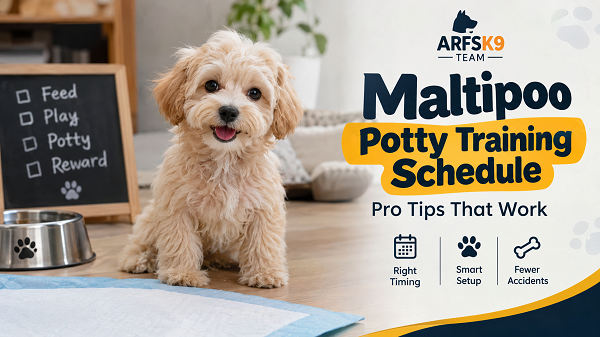
A Maltipoo puppy needs potty breaks every 1-2 hours between 8-12 weeks old, tapering to every 3-4 hours by 5-6 months. The general rule: a puppy can hold their bladder roughly one hour per month of age, plus one. Most Maltipoos are mostly reliable within 8-16 weeks of consistent training, though full reliability (zero accidents) often takes 4-6 months because of their small bladders and fast metabolism.
Table of Contents
- Why Maltipoos Are Trickier to Potty Train Than You’d Expect
- The Science Behind the Schedule (Bladder Rule Explained)
- Maltipoo Potty Training Schedule by Age
- Setting Up Your Potty Training System
- Pad Training vs. Outdoor-Only: Which Is Right for Your Maltipoo?
- 7 Pro Tips That Actually Speed Things Up
- Common Mistakes That Delay Housetraining
- Troubleshooting Regression and Accidents
- Trainer Note
- FAQs
- Conclusion
Why Maltipoos Are Trickier to Potty Train Than You’d Expect
Here’s something most articles won’t tell you upfront: small breeds like the Maltipoo are, on average, harder to housetrain than medium and large breeds. It’s not because they’re less intelligent, Maltipoos are sharp, food-motivated, and eager to please. It’s biology working against you.
A Maltipoo’s bladder is tiny. Their metabolism runs fast. And because they’re so small, a “mistake” often happens quietly in a corner of a big house long before you notice, which means you miss the chance to correct or redirect in the moment. Trainers who work with toy breeds see this constantly: owners assume their Maltipoo is “stubborn” or “slow to learn,” when really the dog just physically can’t hold it as long as a Labrador puppy can.
So here’s the thing, if you go in expecting a one-week fix, you’ll get frustrated. If you go in with a real schedule built around how a toy breed’s body actually works, you’ll see dramatically faster, more consistent results. That’s what this guide gives you.
The Science Behind the Schedule (Bladder Rule Explained)
Veterinarians and trainers use a simple rule of thumb for bladder capacity in puppies:
A puppy can typically hold their bladder for about one hour per month of age, plus one extra hour.
So a 3-month-old Maltipoo can usually hold it for roughly 3-4 hours at most and that’s the ceiling, not the target. In practice, you want to take them out well before they hit that limit. No dog, trained or not, should ever be expected to hold their bladder longer than 8 hours, and for a young Maltipoo puppy, that number is much lower.
This rule is why a random “take them out every 3 hours” schedule you find online often fails for Maltipoos specifically, it doesn’t account for their smaller-than-average bladder size relative to other toy and small breeds. Most puppies also need to eliminate about 15-30 minutes after eating or drinking, and almost immediately after waking from a nap.
Maltipoo Potty Training Schedule by Age
This is the part most guides gloss over, an actual schedule you can follow, broken down by developmental stage. Adjust by 15-30 minutes based on your individual puppy’s habits.
8-10 Weeks Old: The Foundation Stage
At this age, your Maltipoo has almost no bladder control. Expect a potty trip roughly every 45-60 minutes while awake.
| Time | Activity |
|---|---|
| 6:30 AM | Wake up → potty immediately |
| 7:00 AM | Breakfast |
| 7:20 AM | Potty break (after eating) |
| 8:00-9:00 AM | Potty break after play/nap |
| Every 45-60 min | Potty break during awake periods |
| After every nap | Potty break within 5 minutes of waking |
| 12:00 PM | Lunch, then potty 20 min later |
| Every 45-60 min (afternoon) | Continue rotation |
| 6:00 PM | Dinner, then potty 20 min later |
| 9:00-10:00 PM | Final potty break before bed, water bowl removed 2 hours before bedtime |
10-12 Weeks Old: Building the Pattern
Stretch breaks to every 60-90 minutes. This is when most Maltipoo puppies start “asking”, circling, sniffing the floor, or heading toward the door.
3-4 Months Old: Extending Control
Bladder rule applies: roughly 3-4 hours max, but aim for potty breaks every 2-3 hours. Overnight, most puppies can now go 4-5 hours without a break.
5-6 Months Old: Real Progress
Breaks every 3-4 hours during the day. Many Maltipoos at this stage are asking to go out reliably and having far fewer accidents but don’t relax the structure yet. This is also prime teething season, and stress or distraction can cause temporary regression (more on that below).
6+ Months Old: Near-Adult Reliability
Most Maltipoos can now hold it for 4-6 hours comfortably. By 8-12 months, many are fully reliable, matching adult bladder control of up to 6-8 hours (though 8 hours should still be an occasional maximum, not a daily habit).
Trainer’s honest number: Across the Maltipoos and other toy-breed mixes I’ve worked with, most owners see 80-90% reliability by the 4-month mark when the schedule above is followed consistently but full, “never an accident” reliability more commonly lands between 4 and 6 months, and sometimes up to 8 months for particularly small or stubborn individuals. Anyone promising a guaranteed 7-day fix for a toy breed is overselling it.
Setting Up Your Potty Training System
Before the schedule works, your setup needs to work. Here’s what actually matters:
1. Pick One Elimination Method and Commit
Confusing a puppy with pads AND grass at the same time in the early weeks slows learning. Choose one, master it, then transition later if you want.
2. Designate a Specific Spot
Whether it’s a patch of yard or a pad by the back door, consistency in location speeds up scent-association. Dogs return to where they’ve gone before because of residual scent, which is also why cleanup matters (see below).
3. Use an Appropriately Sized Crate
A crate that’s too big lets your Maltipoo potty in one corner and sleep in the other, defeating the purpose. It should be just large enough to stand, turn around, and lie down comfortably. Expect to spend roughly $30-$120 on a decent wire or soft-sided crate sized for a toy breed (Maltipoos typically top out around 5-20 lbs depending on the generation and parent sizes).
4. Invest in a Proper Enzymatic Cleaner
This one’s non-negotiable. Regular soap or household cleaner does NOT fully remove urine odor at the molecular level. If residual scent stays behind, your puppy’s nose will lead them right back to that spot. An enzymatic cleaner (available for $10-20) breaks down the actual uric acid crystals.
5. Keep a Potty Log for the First 2 Weeks
Jot down every successful potty trip and every accident, with time stamps. Patterns emerge fast, most owners discover their puppy has a very specific internal clock within 10-14 days.
Pad Training vs. Outdoor-Only: Which Is Right for Your Maltipoo?
This is a genuinely common dilemma for Maltipoo owners specifically, more so than for larger breeds and it’s one a lot of competing articles skip past too quickly.
Choose pad or litter-box training if:
- You live in an apartment or high-rise with no easy yard access
- You work long hours and need a backup indoor option
- Your climate has extreme heat, cold, or rain for large parts of the year
- Your Maltipoo is on the smaller end (under vaccination-complete age, roughly 12-16 weeks, when outdoor exposure carries more disease risk)
Choose outdoor-only if:
- You have consistent yard or nearby green space access
- You prefer to avoid a permanent indoor “potty zone”
- You’re comfortable with more frequent trips outside, including at night in the early weeks
A hybrid approach works too, many Maltipoo owners start on pads (since puppies typically can’t go outside safely until they’re fully vaccinated, usually around 12-16 weeks), then transition outdoors once the puppy’s shot series is complete. To transition, gradually move the pad closer to the exit door over 1-2 weeks, then start taking the puppy outside at the exact times they’d normally use the pad, and reward heavily for outdoor success.
7 Pro Tips That Actually Speed Things Up
- Reward within 3 seconds of the behavior. Dogs don’t connect a treat to an action that happened even 10 seconds earlier. Have treats in your pocket before you even step outside.
- Use a consistent verbal cue. Something like “go potty” said calmly and repeatedly (not as a command they must obey, but as an association) helps your Maltipoo learn to eliminate on cue, genuinely useful for travel, vet visits, and bad weather days later in life.
- Don’t rush back inside after they go. If every potty trip ends the moment your dog eliminates, some dogs learn to hold it to extend outside time. Let them sniff and play for a minute or two after success.
- Feed on a fixed schedule, not free-feeding. What goes in on a schedule comes out on a schedule. Free-feeding (leaving food out all day) makes elimination timing unpredictable and genuinely slows potty training progress.
- Supervise or confine, there’s no in-between. During active training weeks, your Maltipoo should either be under direct supervision (leash attached to you, “umbilical cord” style, works well for toy breeds) or in a confined, appropriately sized space. Free roam of the house before they’re reliable is the #1 cause of slow progress.
- Never punish an accident you didn’t catch in the act. Rubbing a nose in it, yelling, or scolding after the fact doesn’t teach the dog anything, it just teaches them to fear you, or worse, to hide when they need to go (making accidents harder to catch next time).
- Track weather and temperature for tiny dogs. Maltipoos have very little body mass and can get genuinely cold fast, which can make them reluctant to linger outside long enough to fully eliminate in winter. A properly fitted dog coat during cold-weather potty breaks can meaningfully speed up outdoor training in winter climates.
Common Mistakes That Delay Housetraining
- Inconsistent schedule on weekends. Puppies don’t understand “day off.” A schedule that holds Monday-Friday but falls apart Saturday and Sunday resets progress.
- Too much freedom, too soon. Giving full house access after just a few good days invites setbacks.
- Skipping the overnight routine. Many owners nail the daytime schedule but let overnight water and bathroom breaks slide, causing accidents that undo daytime progress.
- Switching methods mid-training. Jumping between pads, a yard, and a neighbor’s grass patch confuses the scent-association process.
- Not accounting for excitement or submissive urination. Some Maltipoo puppies, especially very young or timid ones, leak urine when overly excited or greeted enthusiastically. This isn’t a housetraining failure, it’s a separate, usually age-related behavior that typically resolves with maturity and calmer greetings.
Troubleshooting Regression and Accidents
If your Maltipoo was doing well and suddenly starts having accidents again, don’t panic, regression is extremely common and usually falls into one of these categories:
- Teething (4-7 months): Discomfort and distraction can cause temporary lapses in focus, including potty habits.
- A schedule change: New job hours, travel, moving house, or a new family member can throw off an established routine.
- A medical issue: Urinary tract infections are common in small breeds and can look exactly like a “training regression.” If accidents suddenly increase in frequency, or you notice straining, blood, or unusual urine odor, get your vet to check before assuming it’s behavioral.
- Adolescence (6-12 months): Yes, dogs go through a “teenage” phase too, and testing boundaries can extend to potty habits temporarily.
The fix in almost every regression case is the same: go back to a tighter version of the schedule for 1-2 weeks, increase supervision, and rule out medical causes with your vet if accidents persist beyond a few days.
Trainer Note
This guide draws on hands-on K9 handling and training experience, the same core principles of structure, timing, and positive reinforcement used in professional working-dog training translate directly to companion breeds like the Maltipoo, just scaled to a toy-sized bladder and a gentler pace. If you want a deeper, step-by-step framework on structuring a puppy’s day (not just potty breaks, but the full routine, crate time, meals, play, rest), check out our detailed guide on crate training a puppy, and if potty bell training interests you as a next step once the basics are down, we’ve also covered how to stop potty bell false alarms in detail.
If you’re still deciding whether a Maltipoo is even the right fit for your household before you commit to this whole journey, our dog breed selector tool can help you compare lifestyle needs against breed traits.
For owners who want a complete, structured resource covering behavior and training beyond potty basics, our e-book, Beyond the Bark, goes deeper into building obedience and communication with your dog from the ground up.
FAQs
How long does it take to fully potty train a Maltipoo?
Most Maltipoos show strong progress within 8-16 weeks of consistent training, but full reliability with no accidents typically takes 4-6 months, sometimes up to 8 months for smaller or more timid individuals. Consistency matters more than speed.
What age should I start potty training my Maltipoo puppy?
Start the moment you bring your puppy home, usually around 8-10 weeks old. Puppies are capable of learning basic elimination patterns from day one, even though full bladder control takes months to develop.
Are Maltipoos hard to potty train compared to other breeds?
Maltipoos aren’t hard to train because of low intelligence, they’re actually quick learners. The challenge is physical: their small bladder size and fast metabolism mean they need more frequent breaks and a tighter schedule than medium or large breeds.
Should I use pee pads or train my Maltipoo to go outside only?
Both work well. Pads are often the practical first step since puppies typically can’t safely go outside until they’re fully vaccinated around 12-16 weeks. Many owners start on pads, then transition to outdoor-only once vaccinations are complete.
Why does my Maltipoo keep having accidents even though they seem trained?
Sudden regression is usually caused by teething, a routine change, adolescence, or a medical issue like a urinary tract infection. If accidents increase suddenly or you notice straining or unusual urine, have your vet rule out a UTI before assuming it’s purely behavioral.
Conclusion
Potty training a Maltipoo isn’t about luck or a magic trick, it’s about matching your schedule to your puppy’s actual bladder capacity and staying consistent long enough for the habit to stick. Start with frequent breaks in the 8-10 week range, follow the age-based schedule above, set up a proper system (right-sized crate, enzymatic cleaner, one consistent method), and expect real reliability somewhere between 4 and 6 months.
The biggest lever you have isn’t punishment or fancy products, it’s consistency. Puppies who get taken out on a predictable schedule, rewarded within seconds of success, and supervised closely during the learning window get there faster, almost every time.
Want more real, trainer-tested guides like this delivered straight to your inbox every week? Subscribe to our newsletter for weekly training tips, breed guides, and gear reviews.

Her work centres on obedience, detection, protection and operational readiness. She favours proven methods built on repetition, consistency and real-world conditioning, so that both dogs and handlers are prepared for high-pressure tasks.
Rofiat represented the Nigerian Army Dog Centre at the Nigerian Army Day Celebration (NADCEL) 2026, where she led demonstrations in obedience, explosive detection, agility and tactical movement. Through articles, training content and documentaries, she shares field-based insight into how structured training, clear communication and trust between handler and dog affect performance and reliability.
She is the author of Beyond the Bark: Inside a Pro Handler's Playbook for Raising the Ideal Dog, a practical guide that helps dog owners and handlers apply professional training principles in everyday situations.
- Maltipoo Potty Training Schedule: Pro Tips That Work - October 30, 2026
- Pug Exercise Safety Guide: How Much Is Too Much? - October 29, 2026
- How Much Do Local Dog Groomers Cost? (2026 Price Guide) - October 28, 2026