How Working Dogs Are Conditioned for Harsh Environments

Working dogs are conditioned for harsh environments through gradual, repeated exposure, never sudden immersion. Heat, cold, terrain and noise are each introduced in small doses and increased only as the dog stays calm and its body copes. Research on dogs suggests partial heat adjustment takes roughly 10 to 20 days, while full adaptation can take much longer. The handler’s job is just as important: tracking temperature, hydration and behavior, and stopping the work before the dog hits its limit.
Table of Contents
- Why Harsh-Environment Conditioning Matters
- Heat: The Hardest Problem in Working-Dog Conditioning
- Why Hot Weather Hurts a Dog’s Nose
- How Handlers Cool and Hydrate a Working Dog
- Cold-Weather Conditioning
- Altitude and Airborne Work
- Terrain and Paw Conditioning
- Noise and Sensory Conditioning
- Mental Resilience and Nerve Strength
- A Safe Heat-Conditioning Plan for Active Dogs
- Conditioning Timelines at a Glance
- Trainer Note: Who’s Behind This Guide
- FAQs
- Conclusion
Introduction
Picture a Belgian Malinois stepping off a transport in 40°C heat, a bomb-detection Labrador working a crowded airport terminal, or a search dog crossing frozen ground at dawn. None of them were born ready for that. Somebody built that toughness, one small, carefully measured exposure at a time.
So how do working dogs stay sharp when the weather turns brutal? It isn’t luck, and it isn’t “toughening them up.” It’s a staged process that trains the dog’s body, paws, nose and nerves to cope, while the handler learns the exact signs that a dog is running out of margin.
I’ll walk you through how military working dogs (MWDs), police K9s, detection dogs and search teams get conditioned for heat, cold, altitude, rough terrain and noise. You’ll see what the research says (and where it runs thin), the timelines real programs use, and the mistakes that put dogs in the vet clinic. Whether you handle a working dog for a living or just want a hiking or sport dog that stays safe, you’ll leave with a plan you can use.
Why Harsh-Environment Conditioning Matters
Let’s start with the number that explains why this matters. A study of 92 military working dogs that died while deployed to Iraq and Afghanistan between 2001 and 2013 found that gunshot wounds caused 31.5% of deaths and blasts 26.1%. Heat stress or heat injury came third at 9.8%, which is nine dogs. Eight of those nine deaths happened in Afghanistan.
That’s a sobering figure for something that’s almost entirely preventable. Gunfire isn’t a conditioning problem. Heat is.
It gets clearer on the home front. In one study of US civilian law enforcement dogs, heat-related illness was the second most common cause of traumatic death, at roughly a quarter of deaths. And an analysis of working-dog deaths in the Journal of Special Operations Medicine found that most heatstroke cases with a known cause were confinement heat injuries, meaning dogs stuck in a hot vehicle or space, not dogs collapsing mid-search. That tells you something important: conditioning protects a dog on the job, but handler habits protect it everywhere else.
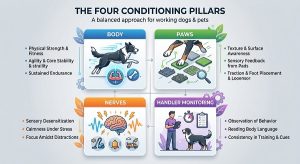
Conditioning for harsh environments has four goals:
- Building the heart, lungs and cooling system so the dog tolerates heat or cold longer
- Toughening paws, joints and confidence for specific terrain
- Teaching the brain to treat noise and chaos as background
- Giving the handler measurable ways to know when to stop
Every major program runs some version of this staged-exposure model, from the TSA’s canine program at Joint Base San Antonio-Lackland to border patrol search units and police academies. The details change. The principle doesn’t.
Heat: The Hardest Problem in Working-Dog Conditioning
Why dogs overheat so easily
Dogs cool mostly by panting. They have sweat glands in the paw pads, but that’s a tiny cooling system compared with ours. One research estimate puts panting at roughly 60% of a dog’s heat loss. When the air is hot and humid, panting works poorly because moist air can’t take on much more moisture. So a dog can be panting hard and still gaining heat.
Working dogs also generate far more heat than a pet on a walk. In a field study of seven Border Patrol BORSTAR dogs tracking in the hot, dry Texas desert near El Paso, peak core temperatures ranged from 39.95°C to 42.88°C (103.9°F to 109.2°F). Those are dogs doing normal, moderate tracking work. One dog hit a worrying temperature, got wet down and closely monitored, and recovered, but it finished the next track slowly. That’s why handlers who work hot climates monitor temperature instead of guessing.
What “heat acclimatization” really means
Heat acclimatization is the body’s adjustment after repeated exposure to exercise in the heat. In people, that means a lower heart rate, earlier sweating and a better fluid balance. In dogs, researchers are still working out the details, and I want to be honest about that, because a lot of articles (including the earlier version of this one) made it sound more settled than it is.
Here’s what we can say with reasonable confidence:
- In a small study of dogs given 30-minute exercise challenges on days 1, 7, 12, 15 and 19 of a 19-day period, the results suggested dogs can acclimate to consistent exercise in the heat over about that long. The authors said heat acclimation hasn’t been well studied in working dogs.
- A Purdue extension document on kennel temperature notes that partial acclimatization in small animals can take 10 to 20 days, with full acclimatization taking closer to 60. That’s general animal physiology, not a working-dog trial, so treat it as a rule of thumb.
- Long-term, a two-year study of 15 young Belgian Malinois imported from Europe to Israel followed what happens when high-intensity training is layered on top of seasonal heat. These dogs trained in hot conditions for at least nine months a year, which tells you how seriously that unit treats the climate.
My practical takeaway: plan on at least two to three weeks of gradual build-up before expecting a dog to work comfortably in a heat it’s never seen, and don’t consider it “done” after that. Fitness, hydration and acclimatization all feed heat tolerance, and you need all three.
Who’s at higher risk
Not every dog handles heat equally, and conditioning doesn’t erase that:
- Previous heat injury. A dog that’s had heatstroke often has a lower tolerance afterward. Treat it as a different dog with new limits.
- Breed and build. Belgian Malinois and Australian Shepherds have both shown up with higher rates of exertional heat illness in veterinary studies, and researchers have suggested a possible genetic link in Malinois. Those studies drew from referral hospitals, so they likely over-represent military and police dogs. Still, it’s a good reason to watch these high-drive dogs closely.
- Body condition. Extra weight, poor fitness or a thick dark coat all raise the heat load.
- Drive. The more driven the dog, the less likely it is to quit before it’s in trouble. High-drive dogs don’t slow down on their own.
Why Hot Weather Hurts a Dog’s Nose
Here’s a gap most conditioning articles skip, and it’s a big one for detection and search work: a dog can’t pant and sniff at full efficiency at the same time.
Detection dogs sniff in short, rapid bursts. Once a dog starts panting hard to cool down, its sniffing drops. A 2018 review in Frontiers in Veterinary Science pulled together studies showing that after strenuous exercise, certified detection dogs found less on scent tests, and that panting and olfaction have an inverse relationship. The authors also noted that better physical conditioning may help, because a fitter dog needs less panting to recover.
Researchers who tracked four detection dogs searching for cheetah scat in northern Kenya reached a practical conclusion: working in the heat is possible and useful, but it needs extra care. They also recommended resuming a search only after the dog stops panting. A 2024 study in PLOS ONE found detection accuracy dropped in hot, humid conditions and that dogs’ skin temperature predicted their performance.
Honest caveat: the evidence isn’t perfectly consistent. A conservation-dog study found only weak statistical evidence of temperature and humidity effects on performance. But the direction is clear enough for handlers to act on.
What this means for conditioning a detection dog:
- Train in the heat, not just survive it. A dog that only does easy searches in cool weather hasn’t been conditioned for hot ones.
- Build recovery rhythm. Teach the dog to settle and stop panting during breaks, then restart the search.
- Schedule smart. Plan hard searches for the cooler parts of the day and shaded areas where possible.
- Treat a heavily panting dog as a dog with a degraded nose. If it’s missing finds, it may be overheating rather than distracted.
How Handlers Cool and Hydrate a Working Dog
The head dunk: what the research found
In 2024, researchers at the University of Pennsylvania’s Working Dog Center tested four field-friendly cooling methods in a randomized crossover study published in the Journal of the American Veterinary Medical Association. Twelve working dogs ran until their core temperature reached 40.6°C (105°F), then got one of four treatments:
- Chemical ice packs on the neck
- A wet neck towel (about 22°C)
- Wet towels under the armpits
- A trained, voluntary head dunk into about 22°C (72°F) water, with a little water swallowed
The head dunk won. It produced the lowest average core temperature in the first five minutes, kept dogs cooler over the next 35, and was the only method that stopped the temperature from rising again right after exercise. All four methods eventually brought dogs back to baseline.
Now the part that often gets dropped: the dunk was a trained behavior. The dogs went for the water on their own, usually for a toy or food reward. The researchers said it suits dogs with a normal mental state who can pause their panting. A staggering, collapsing or confused dog needs a vet, not a bucket. So if you want this option in the field, you have to teach it ahead of time as part of conditioning.
Water immersion and the alcohol myth
A separate crossover study compared partial water immersion, rubbing isopropyl alcohol on the paw pads, and doing nothing. Both treatments cooled dogs better than nothing, but water immersion cooled them more efficiently than alcohol. So the old “alcohol on the paws” trick isn’t useless, it’s just weaker than water, and it uses a bottle you have to carry. If you have water, use water.
Hydration: getting dogs to drink more
Handlers often say “just give them water.” The research suggests it’s not that simple, because dogs don’t always drink enough on their own.
In the BORSTAR study, seven dogs got four different pre-exercise drink strategies: plain water, chicken-flavored water, a chicken-flavored electrolyte drink, and a subcutaneous electrolyte injection. The strategies had limited effects on blood and urine measures, but all three alternatives got dogs taking in more total fluid than plain water. Dogs drank the whole flavored electrolyte portion every time. In a related study of vehicle-screening dogs at a Texas checkpoint, dogs given a flavored electrolyte solution drank more than twice as much per hour as dogs given plain water (about 15.6 mL/kg/h versus 7.0).
One more detail worth knowing: the dogs given chicken-flavored water had higher creatine kinase, a muscle marker, at the end of the second track. The authors weren’t sure why, so I’d treat that as a reason to talk with your vet before changing your hydration routine, not as a rule.
Practical hydration habits that follow from this:
- Teach your dog to drink from a collapsible bowl on cue. Don’t wait until the first hot deployment to find out it won’t.
- Offer water before, during and after hard work, not only at the end.
- Ask your vet about a flavored, dog-safe electrolyte option for hot work.
- Keep a cooling kit in the vehicle: cool water, a bucket or bowl for the head dunk, and towels.
For gear that supports all this, see our breakdown of which dog cooling vests actually work.
Warning signs to act on fast
- Heavy, noisy panting that doesn’t ease with rest
- Bright red or very pale gums, thick drool
- Stumbling, glazed look, ignoring commands
- Sudden slowdown or refusal to continue
If you see these, stop work, cool the dog and get veterinary help. Don’t wait for it to look worse.

Cold-Weather Conditioning
Heat gets the headlines, but cold brings its own risks and needs its own conditioning.
Wet is the real enemy
Veterinary advice for police K9s keeps coming back to one idea: keep the dog dry. A dry working dog with a good coat usually stays warm enough while it’s moving. The danger rises when a dog gets soaked, which happens when it tracks through wet snow or falls through ice, because wet fur loses its insulation fast.
Temperature guidelines
Vets generally advise caution once the temperature falls below freezing (0°C or 32°F), and say the risk of frostbite and hypothermia climbs at about -6°C (20°F) and below, especially for dogs that stay out a long time. Mild hypothermia can start when a dog’s body temperature drops below roughly 37°C (98°F). Wind chill and dampness make every number worse. Puppies, older dogs, thin-coated dogs and dogs with joint problems struggle the most.
Ears, tails and toes freeze first, because they have little insulation and plenty of exposed surface.
How cold conditioning works
It follows the same staged logic as heat training:
- Short, repeated sessions in the cold, lengthened gradually as the dog stays bright and moving
- Footing practice on ice, crusted snow and slush, because slipping and hesitation cost more energy than the cold itself
- Gear introduced early. If boots or a jacket will be needed on the job, teach the dog to wear and work in them before the cold season, not on the day
- Post-work routine: towel dry, check feet, warm shelter
Boots, balm and the honest trade-offs
Here’s a debate worth knowing about. Some K9 veterinarians point out that boots protect against ice, abrasive surfaces and de-icing salt, which can burn pads. Others note that boots can hinder a police dog’s performance. One K9 veterinarian has also said dogs don’t need pad “moisturizers,” because their paw pads are pretty robust. Both views can be true. Use boots for long work on abrasive, icy or salted surfaces. Skip them if they slow a dog that doesn’t need them.
Handler tips that cost almost nothing:
- Trim long hair between the pads to cut ice balling
- Rinse and check paws after exposure to de-icing chemicals
- Offer water in cold, dry air. Dogs lose moisture breathing hard and may not look thirsty
- Know your hard stop. If the conditions are too severe, leaving a dog home is good handling, not weakness
For boots, jackets and other gear worth owning, see our guide to essential K9 training equipment.
Altitude and Airborne Work
This is elite territory, and I’ll be straight with you: the best-documented material here comes from secondary sources and special-operations reporting, not peer-reviewed dog studies.
What’s reported: special operations dogs that jump with handlers go through pressure-chamber conditioning and wear their gear in wind tunnels before a real jump. For high-altitude jumps, dogs wear custom oxygen masks and insulated suits. One widely repeated record is a man-dog jump from more than 30,100 feet by instructor Mike Forsythe and his dog, Cara, both on oxygen.
For the rest of us working or hiking with dogs at elevation, the research on dogs is thin, so I borrow the human rule of thumb: go up gradually, give the body time, and watch for fatigue, slow recovery and loss of appetite. A dog that’s fine at sea level isn’t guaranteed to cope at height.
Terrain and Paw Conditioning
A dog that’s rock-solid on grass can freeze on a metal grate, slick tile or loose rubble. That’s not stubbornness. It’s a confidence and balance gap you have to train.
A standard progression looks like this:
- Stable ground first: grass, packed dirt, gravel
- Unstable surfaces: sand, mud, shallow water, uneven rock
- Elevated and confined spaces: stairs, ladders, narrow platforms, tunnels
- Slick and industrial surfaces: wet tile, metal grating, polished concrete
- Debris fields: especially for disaster search work
Pads toughen with repeated, moderate exposure to rough ground, the way a runner builds calluses. Rushing it gives you cracked pads, limping and missed work. Mix in surfaces your dog will face (hot pavement, gravel, ice) in short sessions, and check feet after every outing.
Balance and strength work helps too. A fitness program for working dogs usually builds from varied-terrain walking and short trot intervals into balance work and core exercises, with the goal of more strength and endurance and a lower injury risk. For a deeper look at how much work a dog needs, read how often you should exercise a working dog.
Noise and Sensory Conditioning
Physical toughness means little if the dog shuts down at the first helicopter or gunshot. The goal isn’t a fearless dog. It’s a dog for whom loud, chaotic things become irrelevant.
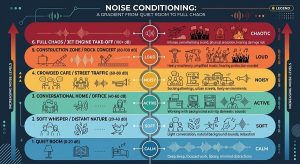
Habituation, step by step
The Marine Corps K9 unit at Quantico described a simple method in a base news article. Their handler starts a new recruit with blanks fired from a pistol about 500 yards away, then moves the sound progressively closer. Until the dog is comfortable, that training happens at least three times a week. After the dog loses its fear, the unit keeps it that way, with obedience sessions at the ranges during live fire at least five times a month. The key lesson is the last one: noise tolerance fades without maintenance.
Real programs layer sensory challenges the same way, adding one thing at a time:
- Skill learned in a quiet place
- Distant, low-volume noise
- Movement and unfamiliar people
- Crowds, vehicles, machinery
- Combinations of all of the above
TSA’s Canine Training Center in San Antonio built 17 indoor training venues that mimic real transport environments, including an airport gate, checkpoint, baggage claim, a light rail car, and an aircraft interior, so dogs meet the chaos before they deploy. About 83% of dogs that enter the program graduate, and the dogs are evaluated for health, character and behavior before they’re even purchased.
The “gunfire equals bite” trap
Here’s a mistake I see discussed by police K9 trainers. If a dog only ever hears gunfire right before a bite, it can learn “gunfire means bite” and start hunting for a bite when it hears a shot, whatever the source. Practitioners recommend mixing in other noises and practicing obedience under occasional gunfire, with the dog complying calmly, so the shot alone never triggers a response. The goal is neutrality, not excitement.
Protect the ears you’re training
Noise conditioning builds tolerance, but it doesn’t make ears immune. Military working dogs can develop noise-induced hearing loss, and options for canine hearing protection are still limited. Reported helicopter cabin noise sits at 106 dBA or more. If your dog works around that, ask your vet about hearing protection and limit unnecessary exposure.
Mental Resilience and Nerve Strength
You can build the most heat-tolerant, sure-footed dog in the world, and it still fails if it can’t handle pressure. That’s why selection comes before conditioning. Programs screen for nerve strength first: Can the dog cross a slick floor without hesitating? Stay steady through a sudden bang? Work in an unfamiliar, crowded space?
If the nerve isn’t there, no amount of training fixes it. That’s part of why even strong programs expect to wash out some candidates. TSA’s roughly 80 to 83% graduation figure counts as a good result, which means about one in five dogs doesn’t make it. Be wary of any program that promises a 100% success rate.
Mental conditioning includes:
- Independent problem-solving on long, multi-stage searches
- Delayed rewards: staying engaged when the payoff isn’t immediate
- Obedience under pressure, practiced during noise and time stress, not only in calm yards
- Novelty exposure: regularly meeting new people, vehicles, surfaces and places
Reward-based work carries all of this. Dogs that link hard work with play and praise push through discomfort more willingly than dogs worked mainly with pressure.
If you want the foundation behind this, Beyond the Bark: Inside a Pro Handler’s Playbook for Raising the Ideal Dog walks through the systems professional handlers use, from the puppy stage to advanced obedience and operational readiness.
A Safe Heat-Conditioning Plan for Active Dogs
This is where most competing articles stop at theory. Here’s a conservative progression for a healthy, adult working, sport or hiking dog. It’s my suggested starting point built around the 10 to 20 day research window, not a protocol from a single study, so adjust it to your dog.
Before you start: get a vet check, especially for older dogs, dogs with a past heat injury, and flat-faced breeds. Skip structured heat conditioning for puppies, seniors and any dog that’s had heatstroke unless your vet agrees. Learn your dog’s resting heart rate and normal behavior so you can spot a change.
Week 1: Easy exposure. Short, low-intensity sessions (walking, light search work) in warm but not extreme conditions, in the shade where possible. Same time each day. Water on hand every session.
Week 2: Add a little at a time. Lengthen sessions slightly or raise the intensity, but not both on the same day. Practice the cooling routine, including the voluntary head dunk, so it’s a calm habit before you need it.
Week 3: Work it into real tasks. Add hot-weather versions of the work the dog actually does. Track recovery: how quickly does panting settle and the dog look bright again?
Ongoing: keep exposure regular. There’s no good dog-specific data on how fast heat tolerance fades, so treat a long layoff as a reason to rebuild gradually.
Stop rules, always:
- Stop at the first signs of heavy panting that won’t settle, stumbling or a glazed look
- Skip hard work when it’s hot and humid, because panting works poorly in damp air
- Never leave a dog in a parked vehicle, even briefly. Confinement is where many heat deaths happen
- Never sacrifice the dog’s recovery for the schedule
Conditioning Timelines at a Glance
| What | Timeline | Source / note |
|---|---|---|
| Partial heat adjustment | About 10 to 20 days | Rule of thumb from animal-physiology guidance and a 19-day dog study |
| Fuller heat adaptation | Longer, possibly around 60 days | General animal guidance, not working-dog specific |
| Seasonal heat plus endurance training | Up to 2 years studied | Belgian Malinois in an Israeli military unit |
| Noise habituation (Quantico example) | At least 3 sessions a week until comfortable, then regular maintenance | Marine Corps K9 unit |
| TSA conventional explosives detection teams | 11 weeks | TSA program reporting |
| TSA passenger screening teams | 16 weeks | TSA program reporting |
| TSA dog graduation rate | About 80 to 83% | TSA fact sheet and program reporting |
Trainer Note: Who’s Behind This Guide
This article was written and reviewed by Rofiat Muritala, a military K9 handler and certified dog trainer with over 14 years of hands-on experience in military working dogs and security operations. Rofiat represented the Nigerian Army Dog Centre at NADCEL 2026, leading obedience, explosive detection, agility course and tactical movement demonstrations, and works with the ARFS K9 Team on dog selection, foundational training, behavior shaping and operational performance evaluation. She’s the author of Beyond the Bark: Inside a Pro Handler’s Playbook for Raising the Ideal Dog. The research in this piece draws on published veterinary studies and official program data, alongside handler experience.
FAQs
1. How long does it take to heat-acclimatize a working dog?
Partial adjustment takes roughly 10 to 20 days of gradual, regular exercise in warm conditions, based on a 19-day dog study and general animal guidance. Full adaptation takes longer, and researchers say dog-specific data are limited. Build up slowly and keep exposure regular.
2. What temperature is dangerous for a working dog?
Working dogs can run much hotter than pets. BORSTAR dogs tracking in the desert peaked between 39.95°C and 42.88°C (103.9°F and 109.2°F). The Penn Vet cooling study treated 40.6°C (105°F) as the point to begin cooling. On the cold side, vets urge caution below 0°C (32°F), with risk climbing around -6°C (20°F), especially if the dog is wet or the wind is strong.
3. What’s the fastest way to cool an overheated working dog?
For a dog that’s alert and can pause panting, a trained voluntary head dunk in cool water (about 22°C) produced the fastest early cooling in a 2024 JAVMA study. Partial water immersion also works well. A dog that’s collapsed, confused or can’t stop panting needs emergency veterinary care.
4. Do all working dog breeds handle harsh environments equally well?
No. Coat, body condition, breed, past heat injury and individual drive all change tolerance. The TSA program uses five breeds: German Shepherds, Labrador Retrievers, German Shorthaired Pointers, German Wirehaired Pointers and Belgian Malinois. Veterinary studies have flagged Malinois and Australian Shepherds for higher exertional heat illness risk, so high-drive dogs need extra monitoring.
5. Can a family or hiking dog benefit from this kind of conditioning?
Yes, at a gentler pace. Gradual heat and cold exposure, step-by-step noise and terrain introduction, and reward-based confidence building work for any healthy active dog. Check with your vet first, and skip structured heat work for puppies, seniors and flat-faced breeds.
Conclusion
Working dogs don’t walk into extreme heat, cold, noise or rough terrain already built for it. They get there through staged exposure: heat in small doses over weeks, cold work with strict limits, terrain that builds confidence along with paws, and noise introduced from a distance and closed in on slowly.
The research gives us a few clear lessons. Heat is the top preventable danger, so plan for weeks of build-up. A panting dog is a dog with a weaker nose, so train detection work in realistic heat. Teach cooling and drinking before you need them, because a trained head dunk beats a panicked scramble. And keep noise tolerance alive with regular maintenance.
If you handle a working dog, remember the rule that holds across all of this: never skip the gradual step to save time, and treat “knowing when to stop” as part of the training.
Want more field-tested K9 advice every week? Join our weekly articles roundup by subscribing to the newsletter at https://arfsk9team.com.ng/newsletter/.
Sources and further reading
- Causes of Death in Military Working Dogs During Operation Iraqi Freedom and Operation Enduring Freedom, 2001-2013, Military Medicine (academic.oup.com/milmed/article/183/9-10/e467/4934979)
- Parnes et al. (2024), Voluntary head dunking after exercise-induced hyperthermia rapidly reduces core body temperature in dogs, JAVMA (doi:10.2460/javma.24.06.0368)
- A Randomized Cross-Over Study Comparing Cooling Methods for Exercise-Induced Hyperthermia in Working Dogs in Training, Animals (pmc.ncbi.nlm.nih.gov/articles/PMC10705156)
- A Randomized Cross-Over Field Study of Pre-Hydration Strategies in Dogs Tracking in Hot Environments, Frontiers in Veterinary Science (pmc.ncbi.nlm.nih.gov/articles/PMC7283960)
- Evaluation of Three Hydration Strategies in Detection Dogs Working in a Hot Environment, Frontiers in Veterinary Science (pmc.ncbi.nlm.nih.gov/articles/PMC5662554)
- Detection Dogs Working in Hot Climates: The Influence on Thermoregulation and Fecal Consistency, Animals (pmc.ncbi.nlm.nih.gov/articles/PMC11393967)
- Jenkins et al. (2018), review of factors affecting canine olfaction, Frontiers in Veterinary Science (frontiersin.org/journals/veterinary-science/articles/10.3389/fvets.2018.00056/full)
- Environmental effects on explosive detection threshold of domestic dogs, PLOS ONE (journals.plos.org/plosone/article?id=10.1371/journal.pone.0306817)
- Environmental and Physiological Factors Associated With Stamina in Dogs Exercising in High Ambient Temperatures (pmc.ncbi.nlm.nih.gov/articles/PMC5600973)
- Two years of combined high-intensity physical training and heat acclimatization affect lymphocyte and serum HSP70 in purebred military working dogs, Journal of Applied Physiology (journals.physiology.org/doi/full/10.1152/japplphysiol.00090.2014)
- TSA Canine Training Center fact sheet (tsa.gov/news/press/factsheets/tsa-canine-training-center) and HSToday’s “Inside TSA’s Explosives Detection Canine Training Center”
- Marine Corps Base Quantico, “Military K9s show how habituation overcomes dogs’ fear of noise”
- Police Magazine, “Winter Weather Tips for K9s”

Her work centres on obedience, detection, protection and operational readiness. She favours proven methods built on repetition, consistency and real-world conditioning, so that both dogs and handlers are prepared for high-pressure tasks.
Rofiat represented the Nigerian Army Dog Centre at the Nigerian Army Day Celebration (NADCEL) 2026, where she led demonstrations in obedience, explosive detection, agility and tactical movement. Through articles, training content and documentaries, she shares field-based insight into how structured training, clear communication and trust between handler and dog affect performance and reliability.
She is the author of Beyond the Bark: Inside a Pro Handler's Playbook for Raising the Ideal Dog, a practical guide that helps dog owners and handlers apply professional training principles in everyday situations.
- Dog Agility Course Layout: Easy DIY Setup - October 7, 2026
- Local Dog Breeds: Temperament, Health & Training Guide - October 6, 2026
- How Long Do Military Working Dogs Serve? Full Guide - October 5, 2026