Akita Dog Breed Guide: Temperament, Health & Cost
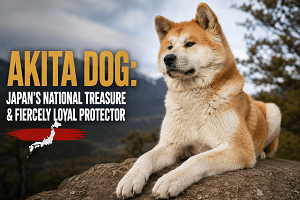
Is the Akita a good guard dog? Yes, but it’s a personal protector, not an alarm system. Akitas are quiet, watchful and fiercely devoted to their own people. They’re also reserved with strangers, often dog-aggressive, and strong-willed. That makes them a poor fit for first-time owners. Plan for 10–14 years of life, 1–2 hours of daily exercise, heavy seasonal shedding, a few breed-specific health risks, and early, steady socialisation. Rules on Akita ownership also differ by country. In Ireland, for example, the Japanese Akita must be muzzled in public.
Table of Contents
- What Is an Akita Dog?
- Akita History: From Mountain Hunter to Natural Monument
- The Real Hachikō Story (Facts vs. Myths)
- Japanese Akita vs. American Akita
- Akita Temperament: Are Akitas Good Guard Dogs?
- Akitas with Kids, Strangers and Other Dogs
- How to Train an Akita: A Realistic Timeline
- Exercise, Grooming and Climate
- Akita Health Problems and Lifespan
- How Much Does an Akita Cost?
- Akita Laws and Insurance
- Is an Akita Right for You?
- Handler’s Reality Check
- FAQs
- The Bottom Line
Introduction
Ever seen a dog stare at a stranger, say nothing, and still make the stranger rethink his plans? That’s the Akita.
Most online guides tell you the Akita is “loyal and protective” and stop there. That’s the nice half of the story. The other half is a big, independent dog that picks its own battles, often can’t stand other dogs, and gets restricted by law in some countries. Plenty of Akitas end up in rescue because owners fell for the Hachikō movie and skipped the homework.
In this guide, you’ll learn where the Akita really comes from, what Hachikō’s story actually says (some popular versions get it wrong), and how the two Akita types differ. You’ll also get honest answers on guarding ability, training, health, cost and legal limits. Whether you’re a casual owner or a professional handler, you’ll know whether this breed fits your life.
What Is an Akita Dog?
The Akita is a large spitz-type dog from the mountains of northern Japan. It has a thick double coat, a plush tail curled over the back, small erect ears and a calm, dignified face. Official breed data puts the typical height at about 61–71 cm (24–28 in) and weight at about 31–59 kg (70–130 lb). PDSA lists 61–71 cm and 31–59 kg, while other vet-reviewed sources give 70–130 lb.
Also known as Akita Inu (inu means “dog” in Japanese), the breed is a true working dog. It was built to hunt, guard and endure cold. If you want to understand why these instincts never fully go away, read our guide on what defines a working dog.
Akita History: From Mountain Hunter to Natural Monument
The Akita’s story has more twists than most breeds.
The early years. The breed comes from Akita Prefecture in northern Honshu. A medium-sized hunting dog called the Matagi Inu lived in the same region, and it’s considered distinct from the Akita Inu. Over time, Akitas became larger guardians and hunting dogs of the region.
The mixing years. Things got messy next. Akitas were outcrossed to Tosa fighting dogs and other imported breeds, so the type became very inconsistent. Japanese breeders noticed they were losing the original dog.
The rescue. The mayor of Odate organised the Akita Inu Hozonkai (preservation society) to protect the original Akita as a Japanese natural treasure. It was founded in 1927. In 1931, the Japanese government designated the breed a national monument.
World War II. This almost ended the breed. Food shortages and a government order to collect dogs for their fur, used in military clothing, crushed Akita numbers. Some Akitas were crossed with German Shepherds to dodge the order to cull non-military dogs, and Morie Sawataishi’s breeding work is credited with saving the breed.
The trip to America. Helen Keller visited Akita Prefecture in July 1937, asked about Hachikō, and received a puppy named Kamikaze-go. When he died of distemper, Japan sent his older brother Kenzan-go as an official gift in July 1938. After the war, American servicemen preferred the larger, bear-like Akitas and German Shepherd types, so those are the dogs they took home. That’s how two different Akitas were born.
| Year | What happened |
|---|---|
| 1927 | Akita Inu Hozonkai founded to preserve the breed |
| 1931 | Akita declared a natural monument of Japan |
| 1937–38 | Helen Keller receives Kamikaze-go, then Kenzan-go |
| WWII | Breed nearly lost to shortages and fur orders |
| 1999 | FCI recognises Japanese Akita and American Akita as separate breeds (the AKC still uses one standard) |
The Real Hachikō Story (Facts vs. Myths)
Everyone knows Hachikō. Not everyone knows the details, and some popular retellings (including older versions of this article) get them wrong.
What’s true:
- Hachikō was born on 10 November 1923 on a farm near Odate. The name means “Hachi” (eight) plus a respectful suffix, and the “eight” is thought to refer to his place in the litter.
- Professor Hidesaburō Ueno took him to Shibuya in 1924, and Hachikō met him at Shibuya Station after work every day.
- Ueno died on 21 May 1925, and from then until 8 March 1935 Hachikō returned to the station almost every day. That’s nearly ten years.
- A bronze statue went up at Shibuya Station in April 1934, and Hachikō himself attended the unveiling. That statue was melted down during the war, and a replacement was unveiled in 1948.
What popular versions get wrong:
- He didn’t die at 13. He was 11. He died on 8 March 1935.
- It wasn’t “just a worm infection.” In 2011, scientists determined he likely died of a filaria infection and cancer. The analysis found cancer affecting his lungs and heart, plus filariasis caused by Dirofilaria immitis, which is heartworm.
- He didn’t wait in one place with no help. Some accounts say he moved to Asakusa after Ueno’s death but still made the roughly 8 km trip to Shibuya Station. Kind locals and station staff fed him too.
Why it matters to owners: Hachikō’s ashes rest beside Professor Ueno’s at Aoyama Cemetery. His loyalty was real, but it was a bond built over one year of daily routine. Akitas attach to people through consistency. If you’re the one who feeds, walks and trains your Akita, you become that person.
Japanese Akita vs. American Akita
The two types look alike at a glance but differ in build and attitude.
| Feature | Japanese Akita (Akita Inu) | American Akita |
|---|---|---|
| Build | Lighter, fox-like face | Heavier bone, broader head |
| Colours | More limited palette | Wider range of colours and markings |
| Temperament | Reserved and dignified, with a subtle guard instinct | Bolder, with a strong and overt guard instinct |
| Recognition | Separate breed under FCI | Separate breed under FCI; same breed under AKC |
Color and build comparisons come from breed guides noting the Japanese type is slimmer and fox-faced, while the American type is larger with more colour variation.
Which should you pick? Choose by the temperament you can handle, not the one that looks cooler. A reserved Japanese-type dog can be easier to read. An American-type dog can be a more imposing guardian but needs a handler who stays calm under pressure.
Akita Temperament: Are Akitas Good Guard Dogs?
Yes, with caveats.
The Akita Club of America says Akitas are natural guardians who need no training to become guard dogs, and that when one barks you should pay attention. That quiet-then-serious style is typical. Wood Green notes their quiet nature makes them excellent guards without being noisy.
Here’s how I’d break down the Akita as a protector:
- Alert and discriminating: it watches strangers closely and decides what’s normal.
- Personal protector first: it focuses on your family, more than on property lines.
- Low-volume warning system: you’ll get a stare, a rumble, then action. Barking isn’t its main tool.
- Independent decision-maker: One guide describes Akita intelligence as decision-making intelligence, meaning the dog judges situations itself, which suits guarding but makes it unsuitable for service dog work.
That last point explains why you don’t see Akitas on police K9 teams the way you see Malinois and German Shepherds. Police and military dogs must switch on and off on command, work around crowds and gunfire, and let a handler override their instincts. An Akita often wants to make its own call. If you’ve read our piece on obedience vs. instinct, you know this is exactly the type of dog that needs a clear off-switch trained in.
Handler’s warning: a natural guard dog without training is a liability. Teach the basics first. Our guide to basic protection commands for the family pet covers the control commands every guarding breed needs.
Akitas with Kids, Strangers and Other Dogs
With strangers
Akitas are affectionate with their families but tend to be reserved around strangers. They won’t gush over visitors. Introduce guests slowly, and never force greetings.
With children
Akitas can be gentle and devoted with their own kids, but a few cautions matter:
- Their size means they can knock small children over.
- Food and bone guarding is a known issue, so teach children never to approach an Akita that’s eating or chewing.
- Visiting children are a higher risk than family children, because the dog doesn’t “know” them.
Never leave any large dog alone with young children. That rule isn’t breed-specific, but it matters more with a breed this powerful.
With other dogs
This is where many Akita homes struggle. In one analysis based on owner-reported survey data from 142 Akita owners, the Akita ranked 6th out of 124 breeds for aggression toward other dogs. Treat that as a warning sign, not a precise measure, since owner surveys have limits.
The Akita Club of America says Akitas can live peacefully with a dog of the opposite sex, though some prefer being the only dog. Wood Green similarly says they do best with no other pets, or with one dog of the opposite sex.
My rule of thumb: one Akita, no other same-sex dogs, and careful introductions to any other pet. Cats and small animals are risky because of the breed’s hunting past.
How to Train an Akita: A Realistic Timeline
Akitas are smart and independent. They’re described as eager to please but with a strong independent streak, so they need firm boundaries and plenty of positive reinforcement.
What doesn’t work: harsh corrections. Some older breed-club advice recommends physical “scruff shaking.” I don’t recommend it. It risks fear, defensive aggression and a damaged bond. Dominance myths cause the same problems, which we cover in dominance vs. discipline.
What works: short sessions, high-value rewards, clear rules, and boring consistency.
| Age | Focus | Handler tips |
|---|---|---|
| 8–16 weeks | Safe socialisation, handling, name, crate, sit/down | Meet many people, surfaces and sounds. Keep dog-to-dog meetings calm and brief. |
| 4–6 months | Recall on a long line, loose-leash walking, “leave it” | Practise around mild distractions. Begin muzzle conditioning with treats. |
| 6–12 months | Duration, distance, distractions, place/settle | Keep socialising with calm, neutral dogs. Avoid dog-park chaos. |
| 12–24 months | Maturity testing | Expect stubbornness and dog-selectivity. Stay consistent. |
| 2+ years | Maintenance | Refresh commands weekly. Keep rules unchanged. |
Honestly, reliable obedience takes the better part of a year, and Akitas never become robots. That’s fine. You want a thinking dog that chooses to listen.
Quick wins:
- Teach a rock-solid “leave it” and “out” (release an item) early.
- Condition a basket muzzle as a happy habit. It helps with vet visits, and it’s legally required in some places.
- Practise calm greetings with the dog sitting before it meets anyone.
- Keep the dog on a lead in public, always. The Akita Club of America warns that an Akita should under no circumstances be allowed to roam the neighbourhood.
If you want a deeper, step-by-step foundation, my book Beyond the Bark: Inside a Pro Handler’s Playbook for Raising the Ideal Dog walks through the same leadership, socialisation and communication principles I use with working dogs, adapted for everyday owners.
Exercise, Grooming and Climate
Exercise. PDSA lists a minimum of 2 hours per day for Akitas. Many owners manage with 60–90 minutes of walking, sniffing and training. Mix physical work with brain work. Puppies need shorter, gentler outings until their joints mature. A common vet rule is about five minutes per month of age per session.
Grooming. Akitas are heavy shedders and “blow” their undercoat completely about twice a year. During those weeks, brush daily with an undercoat rake and expect fur everywhere. Bathe only when needed.
Climate. PetMD notes Akitas can be sensitive to heat because of their thick coat and do best in cooler climates. In a hot country, exercise at dawn and dusk, provide shade and cool water, and never leave the dog in a car or an unventilated room.
Talking. Don’t panic if your Akita grumbles and mumbles. The Akita Club of America calls this “talking” an endearing trait, and says you’ll learn to tell it from growling.
Akita Health Problems and Lifespan
Lifespan: The typical range is 10–14 years. PDSA’s breed page lists the average as under 10 years. Sources disagree, so plan for roughly a decade and hope for more.
The big health issues:
| Condition | What it is | What to watch for |
|---|---|---|
| Bloat (GDV) | Stomach twists and fills with gas, which can turn fatal within minutes. | Restlessness, swollen belly, unproductive retching. Go to an emergency vet immediately. |
| Hypothyroidism | Common in Akitas, and treated with lifelong oral thyroid hormone. | Weight gain, lethargy, hair loss, skin problems |
| Sebaceous adenitis (SA) | A skin-gland disease causing hair loss, scaling and infections. It has no cure. | Dry, flaky skin and thinning hair, often over the head, neck and back |
| VKH-type syndrome | Affects skin and eyes, often showing as colour loss around the nose and eyes. | Pale patches, eye changes |
| Hip dysplasia | Joint problem common in large breeds | Bunny-hopping, stiffness, trouble standing up |
A Swedish study of sebaceous adenitis found that an autosomal recessive mode of inheritance is suggested for the Akita. Translation: responsible breeders should screen and avoid breeding affected lines.
Money matters. One 2026 cost guide estimates emergency bloat surgery and hospitalisation at $3,000–$8,000 or more, hypothyroidism medication at roughly $30–$60 a month, and SA management at roughly $50–$150 or more a month. Treat these as rough guides, because prices vary widely by country.
Bloat-prevention habits:
- Feed several smaller meals and avoid raised food bowls.
- Skip hard exercise right before and after meals.
- Ask your vet about a preventive stomach-tacking procedure (gastropexy), which some vets offer at neutering.
Senior care. Akitas are generally considered seniors at about 7–8 years, and thyroid tests should be interpreted using breed-specific knowledge. If a result looks borderline, ask your vet to check it against Akita norms.
How Much Does an Akita Cost?
Prices swing a lot by country and breeder, and sources disagree:
- Dogster’s 2026 guide puts breeder puppies at $1,000–$3,000, sometimes more for show quality.
- Another guide says $1,000–$2,000 from a breeder who health-tests both parents, and $250–$600 for a rescue adult.
- Some American Akita breeders charge far more. One experienced breeder quotes $3,500 to $5,000 for a well-bred American Akita puppy.
What the price should include: health-tested parents (hips, thyroid, eyes), early socialisation, vaccinations, a written contract, and a breeder who’ll take the dog back for life. A very cheap puppy often costs more later in vet bills.
Running costs: PDSA estimates a minimum of about £105 per month in the UK. Add a large-breed insurance policy if you can get one, a good basket muzzle, a sturdy fence and a training budget.
Consider rescue. Akita-specific rescues often place adult dogs that are already trained and assessed. That can be the smarter choice for a first-time Akita owner who has dog experience.
Akita Laws and Insurance
Ownership rules vary a lot, so check before you buy.
- Ireland: The Japanese Akita is on the restricted breeds list. These dogs must be kept on a short, strong lead (not over 2 metres), muzzled in public, led by someone over 16, and wear a collar with the owner’s details. Failure to comply can bring an on-the-spot fine of up to €300.
- United Kingdom: The Akita isn’t on the banned list. Northern Ireland, for example, bans Pit Bull Terriers, Dogo Argentinos, Fila Brasileiros and Japanese Tosas. Don’t confuse the Tosa with the Akita.
- United States and elsewhere: Rules depend on the state, city, landlord or housing association. Some landlords and insurers restrict large guarding breeds. Ask your insurer or landlord in writing before bringing the dog home.
If you’re unsure how the law treats American-type Akitas in your area, ask your local dog warden or council directly.
Is an Akita Right for You?
An Akita may suit you if:
- You’ve owned or handled strong-willed breeds before
- You want a quiet, loyal personal guardian
- You can offer a single-dog (or opposite-sex pair) home
- You have a secure fence and a cool environment
- You’ll commit to socialisation, training and grooming for 10+ years
An Akita probably doesn’t suit you if:
- This is your first dog
- You have, or plan to get, another dog of the same sex
- You live in a rental with breed restrictions
- You hate shedding
- You want a dog that welcomes every guest
- You can’t afford emergency vet bills
Handler’s Reality Check
I’m a Nigerian Army military working dog instructor and handler with more than 14 years at the Nigerian Army Dog Centre. My training covers obedience, patrol and explosive detection. Here’s what that experience says about Akitas:
- Control beats courage. A guard dog that can’t be called off is dangerous. Teach “out,” “leave it” and a reliable recall before you test any protective instinct.
- Socialisation is a skill, not a party. Short, calm, structured exposure beats dog-park chaos every time.
- Quiet dogs deserve respect. When an Akita goes still and stares, it’s communicating. Learn to read it, and give it space.
- Equipment matters. A well-fitted harness or flat collar, a strong lead and a basket muzzle are standard for large guarding breeds.
Frequently Asked Questions
1. Are Akitas good guard dogs?
Yes. Akitas are alert, quiet and strongly protective of their families. They guard people more than property, and they need training and tight control to stay safe in public.
2. How long do Akitas live?
Most sources say about 10–14 years, though some UK data puts the average under 10. Good breeding, a healthy weight and regular vet checks help.
3. Are Akitas good with kids?
Many are gentle with their own family’s children. But their size, food guarding and wariness of visitors mean supervision is essential. Never leave any large dog alone with young children.
4. Do Akitas bark a lot?
No. Akitas are known as quiet dogs, and they tend to bark only when something matters. Many “talk” with grumbles and mumbles instead.
5. Are Akitas banned anywhere?
They aren’t banned in the UK or the US as a breed. However, the Japanese Akita is a restricted breed in Ireland (muzzle and short lead in public), and some landlords and insurers restrict them. Always check local rules first.
The Bottom Line
The Akita earns its title as Japan’s national treasure. It’s dignified, loyal and brave, and its history is as dramatic as any breed’s. But it’s also strong-willed, selective with other dogs and demanding to train. Treat its guarding instinct as something to manage, not something to show off.
Your action plan:
- Decide between Japanese and American type, and read your local dog laws.
- Choose a breeder who health-tests (hips, thyroid, eyes), or an Akita rescue.
- Start socialising and training at 8 weeks, and condition a muzzle early.
- Plan for 1–2 hours of daily exercise, heavy seasonal shedding and a vet fund.
- Learn bloat warning signs before you need them.
Want more handler-tested advice? Subscribe to our weekly articles roundup newsletter and get new guides straight to your inbox. And if you’re raising a strong-willed dog right now, grab Beyond the Bark for a practical, handler-built training playbook.

Her work centres on obedience, detection, protection and operational readiness. She favours proven methods built on repetition, consistency and real-world conditioning, so that both dogs and handlers are prepared for high-pressure tasks.
Rofiat represented the Nigerian Army Dog Centre at the Nigerian Army Day Celebration (NADCEL) 2026, where she led demonstrations in obedience, explosive detection, agility and tactical movement. Through articles, training content and documentaries, she shares field-based insight into how structured training, clear communication and trust between handler and dog affect performance and reliability.
She is the author of Beyond the Bark: Inside a Pro Handler's Playbook for Raising the Ideal Dog, a practical guide that helps dog owners and handlers apply professional training principles in everyday situations.
- Westminster Dog Show 2026: Winners & Full Results - October 17, 2026
- 10 K9-Approved Tricks to Teach Your Dog (Step-by-Step) - October 16, 2026
- COBA National Dog Championship 2026: Full Guide - October 15, 2026