XL Bully vs Pocket Bully vs Micro Bully: Key Differences
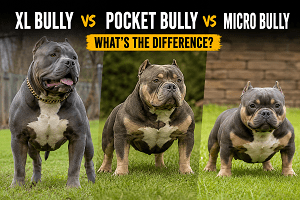
The three names describe size, but only two of them are official. The XL Bully is the tallest American Bully type, with registry heights of roughly 19 to 23 inches. The Pocket Bully is the shortest recognized type, at about 13 to under 17 inches. The Micro Bully is not an official variety at all. It’s a seller’s label for dogs that sit below Pocket height, and no major registry sets a standard for it. Size also decides the law: in the UK, only dogs that reach 20 inches (males) or 19 inches (females) at the withers can be treated as XL Bully type.
Table of Contents
- Why these names confuse so many buyers
- XL Bully vs Pocket Bully vs Micro Bully at a glance
- What is an American Bully?
- XL Bully: the tall one
- Pocket Bully: the compact one
- Micro Bully: the label with no standard
- How to measure a bully correctly
- Does size change temperament?
- Health risks compared
- What do they really cost?
- The law in 2026: UK, Ireland and what changed this year
- XL Bully vs Pit Bull
- How to choose: a handler’s buyer checklist
- Training a bully type: what works
- FAQs
- Conclusion
Why These Names Confuse So Many Buyers
You scroll through a breeder’s page and see “Micro,” “Pocket,” “XL” and sometimes “XXL” in the same row. Same breed? Different breeds? Is the smallest one a bargain, or a trap?
Here’s the problem. Some of these names come from real registries. Others come from marketing. Mix them up and you can overpay for a label, buy a dog with health problems, or, in the UK, end up owning a dog that’s legally restricted.
I work with working dogs for a living, and the first thing we teach new handlers is this: never judge a dog by its name. Judge it by structure, nerves and function. This guide gives you the real numbers, the real rules as of October 2026, and a checklist you can take to any breeder.

XL Bully vs Pocket Bully vs Micro Bully at a Glance
| Feature | XL Bully | Pocket Bully | Micro Bully |
|---|---|---|---|
| Official status | Recognized size variety (ABKC); defined by height in UK law | Recognized size variety (ABKC and UKC) | Not recognized by UKC or ABKC |
| Height (registry) | Males about 20 to 23 in; females about 19 to 22 in | Males 14 to under 17 in; females 13 to under 16 in | No standard; usually sold as shorter than Pocket |
| Build | Tall, heavy, broad, muscular | Short, compact, blocky | Very short and wide; varies by seller |
| Typical use | Companion | Companion, apartment-friendly | Companion (and a lot of social media hype) |
| Main concern | Strength, management, legal restrictions in the UK and Ireland | Choose structure, not just shortness | Extreme conformation, unclear ancestry, weak evidence on health |
| Can a UK owner legally buy one now? | No (ban on sale and breeding since 31 Dec 2023) | Yes, but check local rules | Yes, but check local rules |
Registry heights vary slightly between sources, and the UKC and ABKC organize their size divisions a little differently. Always read the current standard from the registry named on the dog’s papers.
What Is an American Bully?
The American Bully is a modern companion breed. Breeders in the United States built it in the 1990s from bully-type foundation dogs, mainly American Pit Bull Terriers and American Staffordshire Terriers, with other bulldog and mastiff blood mixed in. They wanted a calmer, stockier, more people-focused dog than the athletic terrier.
The American Bully Kennel Club (ABKC) formed in 2004 to register and show the breed. The United Kennel Club (UKC) recognized it in 2013.
Two facts matter for this article:
- The ABKC separates varieties by height, not by weight. That’s why “my dog weighs 100 pounds” tells a judge nothing about whether he’s an XL.
- Dogs are shown as Standard until about one year old. After that they move into their size variety. A puppy sold as “future Micro” or “future XL” is a guess, not a fact.
The ABKC once had an “Extreme” class for exaggerated dogs and later dropped it. That tells you something: even the breed’s own registry decided that pushing the look too far was a problem.
XL Bully: The Tall One
The XL is the same breed type as the Standard American Bully, just on a bigger frame. Registry standards place adult males at roughly 20 to 23 inches at the withers and females at roughly 19 to 22 inches. Britannica lists typical XL weights of about 80 to 140 pounds, though weight swings with bone, muscle and body fat.
Dogs taller than the XL range are sometimes sold as “XXL.” Like “Micro,” that’s not an official variety.
What an XL is like to live with: A well-bred, well-raised XL can be gentle, goofy and deeply attached to its family. But you’re managing a strong, heavy dog. Pulling on lead, jumping up, and rough play all carry more force at 100 pounds than at 40. Early training matters more here than with a smaller dog, not because XLs are “worse,” but because mistakes cost more.
The UK twist: The “XL Bully” you read about in the news is a legal type, not just a registry size. More on that below.
Pocket Bully: The Compact One
The Pocket is an official variety. Under the standards cited by UKC and ABKC sources, Pocket males measure 14 inches to under 17 inches at the withers, and Pocket females 13 inches to under 16 inches. A Pocket should look like a smaller American Bully, with the same broad head, deep chest and heavy bone, in a shorter frame.
Breeders often describe Pockets as easier to house and handle. That’s partly true. A smaller dog fits a flat better and is easier to lift into a car or hold in an emergency. But small does not mean low-effort. These are muscular dogs with real energy and real strength for their size. They still need daily exercise, training and socialization.
What to watch for: A Pocket should get its size from genetics, not from dwarfism. Very short, bowed legs, a rolling gait or trouble getting up are red flags, not “cute.”
Micro Bully: The Label With No Standard
Here’s the part most articles skip. “Micro Bully” is not an official UKC or ABKC variety. There’s no agreed height, weight, bloodline or body type. One seller uses the word for a dog shorter than Pocket height. Another uses it for a normal Pocket with a wide chest. Another uses it on a puppy they hope stays small.
You’ll see “Micro” paired with “Exotic” and “Teacup” too. Those labels are just as loose. Small sources quote a range of about 13 to 16 inches for Micros, but that’s a seller habit, not a rule.
Veterinary and welfare groups have raised concerns about the extremes of this look. The UK Brachycephalic Working Group has flagged Micro and Exotic Bully types as a welfare concern, while also noting there isn’t much solid population data yet. That last point is important. Nobody can honestly tell you a Micro Bully’s “average lifespan” or “typical health problems,” because no good research follows dogs under that label.
My plain advice: if you love the compact look, look for a registered Pocket with sound structure and good parent health records. You’ll get a smaller dog with an actual standard behind it.
How to Measure a Bully Correctly
Height claims mean nothing if the measuring is sloppy. The UK government and the registries all measure at the withers, the highest point of the shoulders just behind the neck. Here’s how to do it right:
- Stand the dog on a flat, non-slip surface with all four feet square under the body.
- Let the head sit in a natural position. Don’t hold it up or push it down.
- Place a flat object, like a hardcover book, across the top of the shoulder blades.
- Measure from the floor to the underside of the book, using a ruler or tape held straight up.
- Measure two or three times and take the average.
- Wait until the dog is fully grown. Most bullies finish growing in height around 12 to 18 months, and fill out for longer.
Why puppy size promises fail: Adult size comes from many genes at once, and nutrition, illness and neutering age all play a part. Even pups from the same litter end up different. A breeder who “guarantees” an exact adult height is promising more than biology allows.
Does Size Change Temperament?
Short answer: not by itself. Temperament comes from genetics, early socialization, training, health and management. A Pocket from nervous parents can be harder to live with than an XL from stable ones.
What size does change is consequence. A fearful, overexcited or poorly trained 100-pound dog can injure someone by accident or on purpose. A 40-pound dog with the same problem usually does less damage. That’s why handlers and regulators care about size even when they agree that temperament is mostly about breeding and raising.
Both registries expect friendly, stable dogs. The UKC standard treats aggression toward people as a serious fault, and the ABKC describes the breed as people-loving. A good breeder tests for that. Ask about the parents’ behavior around strangers, children and other dogs, not just their looks.
In working-dog programs, we don’t wait for problems to show up. We test nerves, recovery from surprise, and willingness to work with a handler before we invest in training. Pet buyers can borrow that idea: spend an hour watching the parents react to a loud noise, a new person and a slippery floor. You’ll learn more than from any pedigree.
If you’re worried about the training approach, my article on dominance vs discipline explains why calm, consistent leadership beats harsh “alpha” methods with strong breeds like these.
Health Risks Compared
Bullies are not all-or-nothing healthy or unhealthy. Risk goes up as the body moves further from balanced proportions.
| Area | XL Bully | Pocket Bully | Micro Bully |
|---|---|---|---|
| Joints and weight | Heavy frame puts strain on hips, elbows and knees, especially if overweight | Knee problems (patellar luxation) and joint wear possible | Higher concern if legs are very short or bowed |
| Breathing and heat | Broad head can restrict airflow; heat care needed | Same, usually milder | Highest concern when the muzzle is very short |
| Skin and eyes | Skin folds and allergies are common in bully types | Same | Deep folds and prominent eyes raise risk |
| Teeth and bite | Normal | Some crowding | Crowding and bite problems more likely when the jaw is very short |
| Breeding | Large pups, some assisted births | Some assisted births | Reports of artificial insemination and surgical delivery being used routinely |
| Evidence | Breed-level data, limited | Breed-level data, limited | Very little label-specific research |
A few practical points I’d tell any buyer:
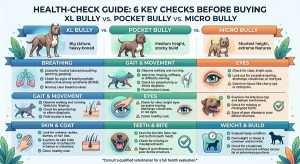
- Listen to the dog breathe. Loud, constant breathing at rest is not “normal for bullies.” Ask a vet to check the airway.
- Watch the dog walk on a hard, level floor, not just on a thick carpet or a table. Look for skipping, stiffness or a rolling back end.
- Keep the dog lean. Extra weight hurts joints and breathing in every size. Rib padding you can’t feel is too much.
- Treat heat seriously. Walk early or late, carry water, and never leave a bully in a parked car.
- Ask about the mother. How many C-sections has she had? Did she mate naturally? Breeders who dodge this question are telling you something.
The International Collaborative on Extreme Conformations in Dogs (ICECDogs) puts the principle simply: a dog should be able to breathe, move, see, eat and reproduce without avoidable suffering. If a breeder’s “look” breaks that rule, walk away.
Inbreeding is another quiet risk. Bullywatch has pointed out that the XL Bully lines in the UK trace back to a small group of dogs imported around 2014 to 2015, so many are closely related. Small founder pools make hidden inherited problems more likely.
What Do They Really Cost?
Prices swing wildly, and a high price does not prove health. Some price guides place American Bully puppies anywhere from about $1,500 to over $10,000, depending on variety, color, pedigree and the breeder’s marketing. Yearly running costs in the guides I reviewed fall around $1,000 to $2,000 before emergencies.
Here’s how I’d break down a realistic budget:
- Puppy price: Large range. “Rare color” and “Micro” labels often add money without adding quality.
- Food: Often about $100 to $250 a month for a large, active bully; less for a Pocket.
- Routine vet care: Roughly $600 to $1,200 a year in several ownership estimates.
- Emergency care: Can reach thousands quickly. Airway surgery, cruciate repairs and C-sections are the expensive ones.
- Training: Budget for a good puppy class and a few private sessions. It’s cheaper than fixing problems later.
- Insurance: Check exclusions first. Some insurers limit or exclude bully breeds or pre-existing breathing and skin conditions.
The smart question isn’t “how cheap can I get a Micro?” It’s “what will this dog cost me at year three if the breathing or joints go wrong?”
The Law in 2026: UK, Ireland and What Changed This Year
This is where most older articles on the first page of Google are stale or incomplete, so read this part carefully. Rules changed in 2026.
What the UK means by “XL Bully”
UK law doesn’t ban a registry variety. It bans a type. To be treated as XL Bully type, a dog must first meet a minimum height: adult males from 20 inches (51 cm) and adult females from 19 inches (48 cm) at the withers. Then it must also match a substantial number of the physical traits in the government’s conformation standard. The standard itself describes the XL Bully type as larger and more muscular than other American Bully types such as Micro, Pocket, Standard and Classic.
What this means for you:
- A true Pocket or Micro Bully, which stays well under 17 inches, does not meet the height rule, so it isn’t XL Bully type. The height check comes first. If the dog is under the minimum, no further assessment is needed.
- A tall Standard American Bully can sit close to the line, since Standard males run up to about 20 inches. Police experts assess these cases by looking at the full standard, not just height.
- Other UK-recognized breeds may share some traits, which the government’s own guidance admits.
Timeline by nation
| Place | Illegal to sell, breed, give away | Illegal to own without exemption |
|---|---|---|
| England and Wales | 31 December 2023 | 1 February 2024 |
| Scotland | 2024 | 1 August 2024 |
| Northern Ireland | 2024 | 31 December 2024 |
All XL Bullies in public places must be on a lead and muzzled. Exemption holders must also keep microchipped and neutered dogs at the registered address. New exemptions are no longer available through the normal application route, and in England, Wales and Scotland only a court can authorize one now.
Ireland has also brought in its own XL Bully type rules, using the same 51 cm and 48 cm height thresholds.
What changed in 2026
Many blog posts, including the earlier version of this one, still say owners need third-party public liability insurance. That has changed.
- From 1 July 2026: Third-party public liability insurance is no longer a legal condition of the Certificate of Exemption. Owners had to keep cover until 30 June 2026.
- From 1 November 2026 (less than a month away): In England and Wales, it becomes an offence to leave a child under 12 in close contact with an XL Bully or other banned-type dog in a private place, such as a home or garden, without adult supervision.
All other exemption conditions still apply: lead, muzzle, microchip, neutering, same address. Keeping the certificate on hand matters too. You must show it within five days if police or a council dog warden ask.
Why did the UK act?
Before 2021, the UK saw about three fatal dog attacks a year. By early 2024, there had been at least 23 since the start of 2021, with at least 10 involving dogs identified as or suspected to be XL Bullies. The ban started after the death of Ian Price in 2023 and earlier cases such as 10-year-old Jack Lis in 2021. Government figures showed more than 35,000 dogs registered for exemption, while estimates of the total XL Bully type population in England and Wales ranged from 50,000 to 100,000.
It’s still debated. The BVA, RSPCA, Battersea and The Kennel Club have all argued that breed bans should give way to rules aimed at breeders and owners, and a 2024 BBC-based report noted attacks had not clearly fallen. I’ll leave that policy argument to you. What matters for owners: follow the law where you live, and check it again before you buy, move or travel.
Not in the UK? Your area may have its own breed-specific rules, or housing and insurance limits that use “American Bully,” “pit bull type” or weight and height. Get written confirmation from your landlord and insurer before you bring a dog home.

XL Bully vs Pit Bull
People swap these names constantly. They’re related but not identical.
- The American Pit Bull Terrier is an older, more athletic terrier-type dog. It’s lighter and leggier.
- The American Bully came later, bred for a heavier, broader, more companion-focused build.
- In the UK, Pit Bull Terrier type has been banned since 1991. XL Bully type was added later. Both are judged on type and measurements, not on papers alone.
Because lookalikes are common, ask for registry papers and parent details instead of trusting a seller’s description. If you want to understand how breeds are grouped in the first place, see our guide to the 7 types of dogs.
How to Choose: A Handler’s Buyer Checklist
Here’s what I’d do before putting down a deposit on any bully type:
- Decide your real needs. Flat or house? Kids? First dog? Hot climate? That narrows size faster than a name does.
- Ask which registry defines the label. For “Pocket” or “XL,” you’ll get an answer. For “Micro,” you’ll get a story.
- Request both parents’ registration and adult heights, measured at the withers.
- See the mother in person. Watch her breathe, walk and react to strangers.
- Ask for health records: hips, elbows, knees, heart, eyes, and any airway or skin history.
- Ask about C-sections and artificial insemination. Routine use is a warning sign.
- Get a written contract with a return clause.
- Have your own vet examine the puppy within a few days of purchase, or before if possible.
- Check local law and insurance in writing.
- Walk away from pressure. If a seller rushes your deposit, push back or leave.
Red flags: guaranteed adult size, “rare color” premiums, dismissing noisy breathing, hidden parents, refusing a vet check, and “clear DNA” claims that skip function. A DNA test covers specific variants only. It can’t clear a dog of every structural or inherited problem.
Consider adoption. A moderately built adult from a reputable rescue comes with a known temperament, and you skip the guessing about puppy size. Just make sure you meet the dog first and budget for vet care.
Training a Bully Type: What Works
Whatever the size, the training plan looks the same. Strong, people-loving dogs do best with early structure and calm repetition.
- Start socialization early. Between about 8 and 16 weeks, safely expose the puppy to new people, surfaces, sounds and other vaccinated dogs. Good early experiences protect against fear later.
- Teach the basics well: sit, down, place, loose-lead walking and a reliable recall. In working-dog training, we don’t call a dog “trained” until the behavior holds when the dog is excited, tired or distracted.
- Build calm on purpose. Mat training and crate time teach the dog to switch off. My guide to crate training a puppy walks through the steps.
- Use rewards and clear rules. Harsh corrections can make a strong dog more unpredictable, not less.
- Match exercise to the body. Short, cool walks, scent games and low-impact play suit most bullies. Skip weighted chains and forced running to “build muscle.” They damage growing joints.
- Plan for muzzle comfort if you live under UK rules. Muzzle training is a skill. Start with treats and short sessions so the dog sees it as normal gear.
- Teach control around family and visitors. Control and obedience matter more than any intimidating look. Our guide to basic protection commands for the family pet shows how to build a dog that is an asset, not a liability.
Never leave young children alone with any dog, whatever its size or label. That’s good practice everywhere, and from 1 November 2026 it’s the law for banned types in England and Wales.
Want the full playbook? My book, Beyond the Bark: Inside a Pro Handler’s Playbook for Raising the Ideal Dog, breaks down the same principles professional handlers use to build stable, obedient, reliable dogs, whatever the breed. If you’re bringing home a strong bully type, it’ll help you skip the beginner mistakes.
About the Author and How This Guide Was Researched
Author: Cpl. Rofiat Muritala is a Nigerian Army military working dog instructor and handler with more than 14 years of experience at the Nigerian Army Dog Centre. Her work covers dog selection, foundation training, behavior shaping and performance evaluation, including obedience, K9 patrol and explosive detection courses.
How we built this guide: We compared the current top search results on bully sizes, checked size standards against ABKC and UKC descriptions, read the UK government’s XL Bully conformation standard, and reviewed 2026 updates from Defra-related and welfare-organization sources. Where sources disagree on a number, we say so. We don’t invent disease rates or lifespans where no research exists.
What we cover that most top results skip: how the UK legal height test relates to Pocket and Micro dogs; the 1 July 2026 insurance change and the 1 November 2026 child-supervision rule; a measuring method; a side-by-side health table; and a buyer checklist.
Medical note: This article is general education, not veterinary or legal advice. Talk to your vet about your dog’s health and check official government sources for current law.
Frequently Asked Questions
1. What is the difference between an XL Bully, Pocket Bully and Micro Bully?
The difference is mainly height and official status. XL Bullies are the tallest, at roughly 19 to 23 inches. Pocket Bullies are the shortest recognized type, at about 13 to under 17 inches. Micro Bullies are an unofficial label for dogs sold as smaller than Pocket, with no registry standard behind them.
2. Is a Micro Bully a real breed?
No. “Micro Bully” is not a separate breed or an official variety under the UKC or ABKC. It’s a marketing term with no agreed height, weight or ancestry. If you want a compact dog, a registered Pocket American Bully has a published standard.
3. Are Pocket Bullies and Micro Bullies banned in the UK?
No. UK law targets the XL Bully type, which must be at least 20 inches (males) or 19 inches (females) at the withers. Pocket and Micro dogs fall well below that. They can still face housing, insurance or local rules, so check before you buy.
4. How tall is an XL Bully under UK law?
Adult males must measure at least 20 inches (51 cm) and adult females at least 19 inches (48 cm) at the withers to count as XL Bully type. Height alone doesn’t decide it. The dog must also match a substantial number of the traits in the government’s conformation standard.
5. Which is healthier: XL, Pocket or Micro Bully?
No size is automatically healthy. The risk rises with extreme conformation: very short muzzles, bowed legs, deep skin folds and crowded teeth. Micro-labeled dogs raise the most concern, but good research on them is limited. Judge the individual dog’s breathing, movement, skin, eyes, teeth and parent health records.
Conclusion: Judge the Dog, Not the Label
Here’s the whole thing in a few lines.
- XL Bully: the tallest type, with strong legal restrictions in the UK and Ireland.
- Pocket Bully: the shortest official type, with published height limits.
- Micro Bully: an unofficial label with no standard and little research behind it.
- Size shifts the consequences of poor training, not the need for it.
- Prices don’t prove health. Records, structure and the breeder’s honesty do.
- The law moved in 2026. Insurance is no longer required, and a child-supervision rule starts on 1 November 2026 in England and Wales.
Your next steps: measure any dog at the withers the right way, ask which registry backs the label, see the mother, get a vet check, and confirm local law and insurance in writing. Then start training on day one.
A good bully, whatever its height, is a stable, sound, well-handled dog. Choose structure and temperament first and the name second.
Get Weekly K9 Tips in Your Inbox
Liked this guide? Join our weekly articles roundup for practical training, breed and safety advice from working-dog handlers. Subscribe to the ARFS K9 Team newsletter here.
Sources Reviewed
- UK government XL Bully conformation standard and Defra guidance; DAERA (Northern Ireland) conformation standard
- PDSA, Dogs Trust, RSPCA and Wood Green updates on the 2026 exemption changes
- Britannica and Wikipedia entries on the American Bully; ABKC and UKC standards as summarized by third parties
- Petful veterinary review of the Micro American Bully (Dr. Pippa Elliott, BVMS, MRCVS)
- BBC, CBS News and veterinary-sector reports on UK attack figures and exemption numbers
- UK Brachycephalic Working Group and ICECDogs position statements

Her work centres on obedience, detection, protection and operational readiness. She favours proven methods built on repetition, consistency and real-world conditioning, so that both dogs and handlers are prepared for high-pressure tasks.
Rofiat represented the Nigerian Army Dog Centre at the Nigerian Army Day Celebration (NADCEL) 2026, where she led demonstrations in obedience, explosive detection, agility and tactical movement. Through articles, training content and documentaries, she shares field-based insight into how structured training, clear communication and trust between handler and dog affect performance and reliability.
She is the author of Beyond the Bark: Inside a Pro Handler's Playbook for Raising the Ideal Dog, a practical guide that helps dog owners and handlers apply professional training principles in everyday situations.
- Westminster Dog Show 2026: Winners & Full Results - October 17, 2026
- 10 K9-Approved Tricks to Teach Your Dog (Step-by-Step) - October 16, 2026
- COBA National Dog Championship 2026: Full Guide - October 15, 2026