Working-Line German Shepherd Puppies: Hidden Truths
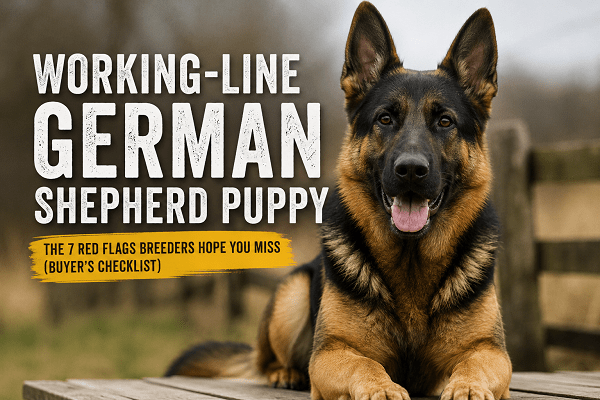
Most breeders won’t tell you that a working-line pedigree doesn’t guarantee a working dog. Even the U.S. military’s own breeding program says roughly half of its puppies don’t make the cut, and puppy drive tests at 7 to 8 weeks are poor predictors of adult behavior. The things that actually protect you are health-tested, titled parents (hips, elbows and the DM gene test), a breeder with a track record, a written return clause, and honest answers about how many of their puppies really work.
Table of Contents
- What “Working Line” Really Means (And the Pedigree Trap)
- The Washout Truth: How Many Working-Line Puppies Actually Make It
- Puppy Drive Tests: What They Can and Can’t Tell You
- How to Read a German Shepherd Pedigree (IGP, BH, AD, KKl and More)
- Health Tests Breeders Skip or Downplay
- A Real Timeline: When Working-Line Puppies Are Ready for What
- What Does a Working-Line German Shepherd Puppy Really Cost?
- 12 Questions That Expose a Weak Breeder
- Who Should Not Buy a Working-Line Puppy
- Buy a Puppy, Adopt, or Take a Started Dog?
- Why You Can Trust This Guide
- Your Action Plan Before You Pay a Deposit
- Frequently Asked Questions
Introduction: The Story Behind the Sales Pitch
Ever watched a working-line German Shepherd lock onto a toy like nothing else in the world exists? That intensity is why police units, sport clubs and serious protection-dog owners go looking for these dogs. It’s also why so many breeders put the words “working line” in the ad and let the buyer fill in the rest.
Here’s the problem. “Working line” isn’t a protected term. Anyone can use it. And buying a working-line German Shepherd puppy is a bet on genetics, health and temperament that you can’t fully check until the dog is a year or two old.
In this guide you’ll learn:
- What “working line” really means, and why a pedigree can mislead you
- How many working-bred puppies actually become working dogs, using real program data
- What puppy drive tests can and can’t predict
- How to read a German Shepherd pedigree, including IGP, KKl and hip/elbow ratings
- The health tests that matter, with real prevalence numbers
- Honest cost ranges, plus 12 questions to ask any breeder
I’ve kept this global. Whether you’re in the US, UK, Europe or anywhere else, the same logic applies. Let’s get into it.
What “Working Line” Really Means (And the Pedigree Trap)
The German Shepherd was created in the late 1800s by Captain Max von Stephanitz, who wanted a dog bred for work first and looks second. Over the next century the breed split. Some breeders kept selecting for drive, nerve and trainability. Others selected for the show-ring look, including the sloped topline you see in many American and European show lines.
Today most people sort working-line dogs into three families:
| Line | What it’s known for | Watch out for |
|---|---|---|
| West German working | Balanced, versatile sport and service dogs | Big range between kennels |
| East German (DDR) | Strong, sturdy, disciplined, thick-boned dogs | Hard to find true DDR pedigrees |
| Czech working | High drive, intense, athletic, often lighter in build | Too much dog for most homes |
These are generalizations. A good kennel in any line can produce a stable dog, and a poor kennel in any line can produce a mess.
The Pedigree Trap
Here’s what I want you to remember: a working title in the pedigree tells you the parents passed a test. It doesn’t tell you what your puppy will do.
Breeders often mix lines, then sell the litter as “working quality” because the paperwork has some German names and a few titles. And titles aren’t equal. In the SV system, even show-oriented breeding dogs need a performance title (at least IGP1) plus hip and elbow certification to earn a breed survey. So an IGP1 on paper can be the minimum entry ticket, not proof of a powerhouse. Look for the level of the titles, the scores, and, best of all, the dogs themselves.
Working Line vs Show Line: The Honest Comparison
| Working line | Show line | |
|---|---|---|
| Bred for | Drive, nerve, trainability, work | Structure, movement, breed-ring appearance |
| Energy and focus | Very high; needs a job | Usually lower and easier to live with |
| Best home | Experienced handler, sport or service role | Active family, first-time owners |
| Common trade-off | Hard to manage if under-exercised | Less intensity for protection or sport |
If you want to understand the bigger picture of why these dogs behave differently, our guide on what it means for a dog to be a working dog is a good place to start.
The Washout Truth: How Many Working-Line Puppies Actually Make It
This is the number almost no breeder wants to say out loud. Even professionals with all the resources in the world lose a lot of puppies.
- The U.S. Department of Defense runs its own military working dog breeding program at Lackland Air Force Base in Texas. An Air Force article says around 50 percent of its puppies aren’t selected for the program because they lack the personality and drive the job needs.
- A program manager at Lackland has reported that about 47 percent of the Belgian Malinois puppies born there went on to become military working dogs, and a program leader has said only about 40 to 50 percent make it. (That program is mostly Malinois, but the lesson applies to any working-bred pup.)
- Research on guide and service dog organizations reports that training failure rates of 50 to 70 percent are typical.
So if a breeder tells you every puppy is “working quality,” that’s a sales line, not a statistic.
What That Means for You
The washouts aren’t broken dogs. They’re usually too soft, too unfocused, too friendly or too sensitive for the job. Many become fantastic pets or sport dogs. But the odds matter:
- If you need a dog for real patrol or detection work, plan for the possibility that your pup won’t make it. Many agencies buy adult dogs that are already proven for exactly this reason.
- If you want a protection-minded companion or sport dog, the pressure is lower, but a working-line puppy can still turn out to have more or less drive than you wanted.
Puppy Drive Tests: What They Can and Can’t Tell You
A lot of breeders sell on puppy testing. “We test every pup at 6 weeks!” It sounds scientific. Sometimes it is useful. But the research is more sobering than the marketing.
- A study of 630 German Shepherds found that puppy tests were not good predictors of adult behavior or service-dog performance.
- A study of 465 puppies in a guide dog program found low predictability. The most useful thing the test revealed was which pups were likely to fail, not which would succeed.
- A review of the field concluded that the predictive validity of early tests for specific traits in adult pet dogs is limited, and a longer-term study found puppy temperament scores unreliable for predicting adult temperament.
- Some studies of working-dog candidates have found modest predictive value, especially when tests are repeated and combined with other measures.
In plain language: a puppy test at 7 to 8 weeks is a snapshot. It’s worth something, especially for spotting very fearful or very flat pups. It’s not a crystal ball.
What to Ask Instead
- How do the parents behave? Nerve and drive are heritable. Meet them, or watch current video.
- How have this breeder’s past puppies turned out at 18 to 24 months? Ask for names of owners you can call.
- Is there a plan to re-evaluate? Good breeders and trainers recheck pups at 12 to 16 weeks and again in adolescence.
- What’s the return or rehoming policy if the dog isn’t what was promised?
Treat any drive-testing claim as one data point, not a guarantee. And when a breeder says puppies are “tested”, ask what exactly was done, by whom, and what the results showed for each puppy in the litter.
How to Read a German Shepherd Pedigree (IGP, BH, AD, KKl and More)
A German pedigree looks like alphabet soup. Here’s the short decoder for the letters you’ll see most.
| Letters | Meaning | Why it matters |
|---|---|---|
| IGP (formerly IPO/Schutzhund) | Three-part sport: tracking, obedience, protection | Shows the dog can work under judge’s eyes |
| BH | Companion dog / temperament test | Basic social stability and obedience |
| AD | Endurance test | Fitness and soundness for sustained work |
| HGH | Herding utility dog | Accepted in place of IGP for some breed surveys |
| KKl (Körklasse) | Breed survey, “recommended for breeding” | Dog passed SV conformation, temperament, health and title checks |
| HD / ED ratings (“normal”, “fast normal”, “noch zugelassen”) | SV hip and elbow results | Joint health of the parents |
A few details that most pedigree explainers miss:
- Breed survey (Körung) isn’t easy to pass. For an SV breed survey, the dog must be at least 2 years old, have passed an endurance test and a temperament test, scored “good” or better at a breed show, earned at least an IGP1 and have certified hips and elbows. That makes a KKl in the pedigree a meaningful health-and-character filter.
- KKl1 and KKl2 no longer exist. Since 2012, there’s just “KKl.” If someone is selling you “KKl1 parents” they’re using old language.
- Titles can be earned under different organizations. SV, WUSV, FCI and national clubs all award them. Ask which organization and which judge, and check them on the club’s database when you can.
- IGP1 minimum age is 18 months. So a breeder who says a 10-month-old dog already has an IGP3 is not telling the truth about the sport.
Also be wary of made-up titles. If a breeder rattles off initials you can’t find in the SV, WUSV, FCI or your national kennel club’s rules, ask for the full name and the official source. Real titles are easy to verify.
Health Tests Breeders Skip or Downplay
Working-line breeders are often proud of drive and quieter about health. Don’t let them be. Here are the tests that really matter.
Hip and Elbow Dysplasia
In a large study covering 60 breeds, about 18.9 percent of German Shepherds evaluated through OFA had hip dysplasia and about 17.8 percent had elbow dysplasia. (OFA is a voluntary registry, so real-world numbers can be higher or lower.)
The good news? Screening works. In Switzerland, the prevalence of hip dysplasia in German Shepherds dropped from about 46 percent in 1995 to 1999 to about 18 percent in 2010 to 2016. That’s what happens when breeders actually test and select.
What to ask for:
- Hip and elbow certificates for both parents, from OFA (excellent, good or fair), SV, PennHIP or an equivalent official scheme. Don’t accept “their hips are fine” or “the vet said so.”
- A look at the registry result yourself, not only a photo.
- Remember that OFA gives a final grade at 24 months, and about 95 percent of animals carrying the dysplasia genes show evidence on x-rays by 2 years of age. Hip dysplasia develops in most dogs between 2 and 6 months. So a pup’s hips can look fine for a long time.
Degenerative Myelopathy (DM)
First, a correction I see all over the internet: it’s degenerative myelopathy, not “myelitis.” DM is an adult-onset spinal cord disease that slowly causes hind-leg weakness and eventually paralysis. There’s no cure.
It’s linked to a mutation in the SOD1 gene that’s common in German Shepherds. In a Japanese registry study of 541 German Shepherds, 61 percent were clear, 34 percent were carriers and 5 percent had two copies (the “at risk” genotype). Numbers vary by country and line, but the point stands: carriers are very common.
Here’s the part that matters for buyers:
- Carrier-by-clear matings produce no affected puppies, only carriers.
- Carrier-by-carrier matings are predicted to produce 25 percent at-risk puppies.
- At-risk dogs may develop DM, though not every one does, and it usually appears years later.
- The test is cheap. The UC Davis veterinary genetics lab lists the DM test at $55 per dog.
Because the test is so inexpensive, a breeder who doesn’t test for DM has no good excuse. A good breeder can simply avoid carrier-by-carrier pairings.
Other Things Worth a Conversation
- Bloat (GDV) risk in deep-chested dogs. Ask about family history and feeding routines.
- EPI and skin and gut issues, which show up in some lines.
- Temperament health: fearfulness, noise sensitivity, and poor recovery after stress. Ask what the breeder does about them.
Here’s a simple cost picture. A budget pup might save you $1,000 to $1,500 up front. A single hip replacement can run several thousand dollars per hip. Health testing isn’t a luxury. It’s the cheapest insurance you’ll ever buy.
A Real Timeline: When Working-Line Puppies Are Ready for What
Breeders love to say puppies can “start training at 8 weeks.” That’s partly true and mostly misleading. Here’s a timeline built from real standards and program data instead of marketing numbers:
| Age or stage | What’s actually happening |
|---|---|
| 7.5 to 8 weeks | Earliest age a puppy should leave the litter |
| 8 to 16 weeks | Socialization, name games, crate and household routines, play with a toy, confidence on new surfaces |
| 2 to 6 months | Window when hip dysplasia develops in most dogs, so avoid heavy impact and slippery floors |
| About 12 to 18 months | Adolescence: drive, fear and focus can all change. Many handlers see “new” behavior here |
| 18 months | Minimum age to compete in IGP1 |
| 24 months | Final OFA hip and elbow grade; minimum age for an SV breed survey |
| 100 to 120 days after selection | How long the U.S. military says dual-certification training takes for dogs already chosen for the program |
A few honest takeaways:
- Never take a puppy before about 8 weeks. Research on puppy testing says a pup should not be adopted before 7.5 to 8 weeks.
- Real working-dog maturity takes time. A one-year-old dog is still a teenager.
- Training length depends on the job. One example from the Air Force: a military working dog completed 184 training days after arriving at the training school.
If you want to understand the daily workload that comes with these dogs, read our guide on how often to exercise a working dog. The short version: most working dogs need at least one to two hours of exercise plus real mental work.
What Does a Working-Line German Shepherd Puppy Really Cost?
Prices depend heavily on country, bloodline and breeder reputation, so treat any figure as a ballpark. In general:
- General German Shepherd puppy prices run from a few hundred dollars up to a few thousand for AKC puppies, and listings for working-line pups often start around $1,100 and go well into the thousands.
- Puppies from titled, health-tested, breed-surveyed parents usually land in the low-to-mid thousands in the US and Europe. Imports and top-titled lines can cost more.
- Adult dogs that are already trained and hip-certified can cost $11,000 or more.
What You’re Really Paying For
| Cost item | Why it matters |
|---|---|
| Parent health testing (hips, elbows, DM) | Lowers your risk of joint disease and DM |
| Titles and breed surveys | Time, travel and training cost the breeder money |
| Quality early raising | Home-raised, socialized pups have a better start |
| Support and contract | A good breeder answers questions for years |
Why a Very Cheap Pup Is a Red Flag
A $500 “working-line” puppy from an ad usually means no health testing, no proven parents and no support. Pet-quality can still be fine. But if the price is far below the market, ask what got skipped.
Don’t Forget the Rest of the Budget
The puppy is only the start. Plan for quality food, vet care, insurance, sturdy gear, a secure yard or kennel setup, and training. If you want the dog for protection or sport, professional training can cost far more than the puppy. Always get written quotes from the trainer before you buy.
12 Questions That Expose a Weak Breeder
You won’t find a perfect breeder. But if the answers are vague on five or more of these, walk away.
Health
- Have both parents had OFA, SV or equivalent hip and elbow results? Can I see the certificates?
- Were both parents DM tested? What were the results, and how did you plan the pairing?
- What health problems have appeared in your dogs and their relatives?
Pedigree
- What titles do the parents and grandparents hold, from which organization, and can I verify them?
- Are the parents breed surveyed (KKl)?
- Can I meet the dam, and the sire if he’s local?
Raising and temperament
- Are the pups raised in the house, with noises, surfaces, people and other safe dogs?
- Did you test the puppies? What exactly did you test, and what did each pup score?
- How have your past puppies turned out at 2 years old?
Contract and support
- What does your contract guarantee, for how long, and what happens if the dog develops a genetic problem?
- Will you take the dog back if I can’t keep it?
- Will you help with training questions after I take the pup home?
The One Question That Reveals the Most
“Can I speak to two or three owners whose dogs are now over 18 months old?”
A proud breeder will give you names. A nervous one will change the subject.
Red Flags
- Puppies sold before 8 weeks
- Several litters on offer at once with no clear parents
- No visits, no video of the parents, only stock photos
- Pressure to pay a deposit immediately
- “Working papers” but no titles you can check
- Health guarantee that excludes everything
Who Should Not Buy a Working-Line Puppy
I’d rather lose a sale than watch a dog and family fail. A working-line German Shepherd puppy is probably the wrong choice if:
- This is your first dog and you have no experienced mentor or club nearby
- You want a calm couch companion
- You can’t give daily exercise, training and mental work
- You have very young children and little time to supervise
- You’re hoping the dog will “guard” without training or control
If that’s you, a well-bred show-line or West German line dog may suit you much better. You can compare options in our Doberman vs German Shepherd protection breed comparison.
Buy a Puppy, Adopt, or Take a Started Dog?
There’s no single right answer.
- Puppy: Best if you want to build the bond from day one and you’re ready for the unknowns. Risk: you won’t know the adult dog until he’s grown.
- Adult or started dog from a reputable program: Often the safest route for a specific job. You can see the real temperament, hips and drive. Cost is higher, but the risk is lower.
- Rescue or program washouts: Dogs that don’t make the military program are offered for adoption, and many are wonderful companions. They may not suit serious work, but they can be great for active homes.
If your goal is a pet or a sport hobby, adoption and rescue are worth serious consideration.
Why You Can Trust This Guide
This article was written from a handler’s point of view and checked against published sources: OFA and peer-reviewed dysplasia data, DM genetics studies, SV and USCA breed survey rules, published research on puppy temperament testing, and U.S. military puppy program reports.
Rofiat Muritala is a Nigerian Army military working dog instructor and handler with more than 14 years of experience at the Nigerian Army Dog Centre. Her background covers dog selection, foundation training, behavior shaping and performance evaluation in real operational settings, and she’s the author of Beyond the Bark: Inside a Pro Handler’s Playbook for Raising the Ideal Dog.
I’m not a veterinarian or a breeder. For health decisions, talk to your vet, and always verify any breeder’s claims yourself.
Your Action Plan Before You Pay a Deposit
- Define the job. Pet, sport, protection or professional work? Be honest.
- Pick the line to match. Working line only if you can handle the drive.
- Find a club first. Visit IGP or obedience clubs, meet dogs, and ask who raised them.
- Verify everything. Hip and elbow results, DM results, titles, breed survey.
- Meet the parents and talk to owners of older dogs from the same breeder.
- Get it in writing. Health guarantee, return clause, support.
- Budget for the full picture. Vet, gear, food, training and insurance.
- Plan for the unknowns. Re-evaluate the puppy at 12 to 16 weeks and again in adolescence.
The truth isn’t that working-line German Shepherds are bad dogs. It’s that they’re serious dogs, and the best way to get a good one is to buy slowly and ask hard questions.
Want more straight talk like this? Subscribe to our weekly articles roundup newsletter at https://arfsk9team.com.ng/newsletter/ and get new K9 guides in your inbox.
If you want to go deeper on raising a confident, well-mannered dog, grab my e-book, Beyond the Bark.
Frequently Asked Questions
1. What is the difference between working-line and show-line German Shepherd puppies?
Working-line puppies are bred for drive, nerve and trainability so they can do jobs like sport, police or protection work. Show-line puppies are bred mainly for structure, movement and appearance. Working lines usually have higher energy and need more training and exercise.
2. How many working-line German Shepherd puppies become working dogs?
No one number fits every kennel, but even the U.S. military says about half of the puppies in its breeding program don’t make the program, and guide and service dog groups report failure rates of 50 to 70 percent. Be cautious of any breeder who claims every pup is working quality.
3. Do puppy drive tests really work?
They help a little, mostly to spot pups that are very fearful or flat, but studies show tests at 7 to 8 weeks are poor predictors of adult behavior. Use them as one clue alongside parent temperament, titles, health tests and the breeder’s track record.
4. Which health tests should working-line German Shepherd parents have?
At minimum: hip and elbow certification from OFA, SV, PennHIP or an equivalent scheme, plus a DM (degenerative myelopathy) DNA test. A carrier-by-carrier mating is predicted to produce 25 percent at-risk puppies, so ask how the breeder planned the pairing.
5. How much is a working-line German Shepherd puppy?
It varies by country and breeder. Many listings for working-line pups start around $1,100, and puppies from titled, health-tested parents typically cost more, often in the low-to-mid thousands, with imports higher. A very low price often means skipped testing.
Sources Referenced
- U.S. Air Force (AETC / Laughlin AFB) article on military working dog selection and washout
- Lackland military working dog puppy program reports
- Duffy and Serpell (2012), predictive validity of puppy temperament evaluation in guide/service dogs
- Wilsson and Sundgren, puppy testing in 630 German Shepherds, as reviewed in PLOS ONE (2014)
- Robinson, Thompson and Ha (2016), Journal of Applied Animal Welfare Science
- PLOS ONE (2017), long-term genetic selection and hip and elbow dysplasia in 60 breeds
- Ohlerth et al. (2019), hip dysplasia prevalence in Switzerland, Frontiers in Veterinary Science
- Maki et al. (2022), SOD1 and DM in German Shepherds, Animals
- OFA and UC Davis Veterinary Genetics Laboratory DM information
- GSDCA, USCA and SV breed survey rules

Her work centres on obedience, detection, protection and operational readiness. She favours proven methods built on repetition, consistency and real-world conditioning, so that both dogs and handlers are prepared for high-pressure tasks.
Rofiat represented the Nigerian Army Dog Centre at the Nigerian Army Day Celebration (NADCEL) 2026, where she led demonstrations in obedience, explosive detection, agility and tactical movement. Through articles, training content and documentaries, she shares field-based insight into how structured training, clear communication and trust between handler and dog affect performance and reliability.
She is the author of Beyond the Bark: Inside a Pro Handler's Playbook for Raising the Ideal Dog, a practical guide that helps dog owners and handlers apply professional training principles in everyday situations.
- Westminster Dog Show 2026: Winners & Full Results - October 17, 2026
- 10 K9-Approved Tricks to Teach Your Dog (Step-by-Step) - October 16, 2026
- COBA National Dog Championship 2026: Full Guide - October 15, 2026