How to Crate Train an Aggressive Dog (Safe, Fast Steps)
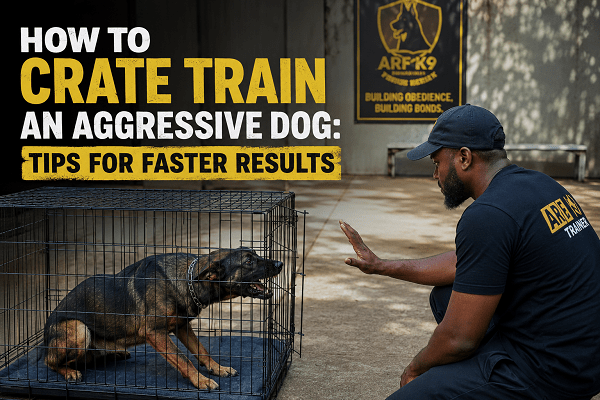
To crate train an aggressive dog, start with a vet check, muzzle conditioning and a safe door setup. Then reward calm behavior near the crate, then inside it, and add the closed door one second at a time. Never force the dog in or punish a growl. Most aggressive or reactive dogs need about 3 to 8 weeks to settle in a closed crate, and some need longer. If your dog has bitten and broken skin, get a qualified behavior professional involved before you start.
Table of Contents
- Introduction
- Should This Dog Be Crated at All?
- Know What Kind of Aggression You’re Dealing With
- Safety Setup: The Handler’s Protocol
- Choosing the Right Crate
- Muzzle Conditioning: Do This First
- Step-by-Step: How to Crate Train an Aggressive Dog
- Crate Guarding: The Treat-and-Retreat Fix
- 9 Ways to Get Faster Results
- Realistic Timeline and Progress Checkpoints
- Troubleshooting Table
- Multi-Dog Homes and Kids
- Mistakes That Make Aggression Worse
- When to Call a Professional
- From the Handler’s Notebook
- FAQs
- Conclusion
Introduction
You hold the crate door, your dog stiffens, his eyes go hard, and a low growl rolls out. Now what?
If you’re trying to crate train an aggressive dog, you already know this moment. Most guides skip it. They tell you to “make the crate fun,” but they never explain what to do when your dog is scared, guarding, or ready to bite.
This guide does. I’ll show you how to size up your dog first, set up the crate so nobody gets hurt, and move in small steps that actually work. You’ll also learn when a crate is the wrong tool, because sometimes it is. And you’ll see the timelines, costs, and troubleshooting fixes that most articles leave out.
One thing up front: a crate doesn’t fix aggression. It’s a management and safety tool. Used well, it gives your dog a calm place to decompress and keeps everyone safe while you do the real behavior work.
Should This Dog Be Crated at All?
Before you buy anything, answer three questions honestly.
1. Has a vet checked for pain or illness?
Sudden guarding or snapping in an adult dog often has a medical cause. Veterinary sources note that resource guarding may be caused by an underlying medical issue, especially when it starts suddenly in an adult dog. Ear infections, joint pain, and thyroid problems can all shorten a dog’s fuse. Book the vet visit first.
2. Does the dog panic in the crate?
There’s a big difference between a dog who grumbles and a dog who panics. Drooling, frantic digging, bloody paws, or breaking out are signs of true confinement distress or separation anxiety. In that case, forcing crate time makes things worse. Use a gated room or a pen, and get professional help.
3. How serious is the bite history?
Behavior professionals often use the Dunbar bite scale, which runs from Level 1 (no skin contact) to Level 6 (fatal). At Level 4 or higher (deep puncture wounds), don’t DIY. Hire a veterinary behaviorist or certified behavior consultant before you start any crate work.
If your dog passes all three checks, keep reading.
Know What Kind of Aggression You’re Dealing With
“Aggressive dog” isn’t one diagnosis. The cause decides the plan. Here’s how I break it down:
| Type | What it looks like | What the crate does | Special focus |
|---|---|---|---|
| Fear-based | Backing away, then lunging when cornered | Becomes a safe retreat if introduced slowly | Never trap or reach in |
| Resource/crate guarding | Stiffens or growls over the crate, bed, or chew | Can increase guarding if you hover | Treat-and-retreat, no hands in crate |
| Barrier frustration | Barking, lunging at the door when people pass | Can feed frustration if the door faces traffic | Cover crate, change location |
| Over-arousal/high drive | Spinning, mouthing, snapping during handling | Teaches calm exits and an “off switch” | Exercise first, calm release |
| Redirected aggression | Bites whoever is nearest when excited | Prevents rehearsal while the dog settles | Use a leash and a barrier at the door |
Why does this matter? A fearful dog and a guarding dog can both growl at the crate, but they need opposite handling. The fearful dog needs more distance and time. The guarder needs you to stop approaching.
Want the bigger picture before you go further? Our guide on proven techniques for training aggressive dogs effectively explains how handlers assess fear, territory, and reactivity first.

Safety Setup: The Handler’s Protocol
In K9 work, we plan for the worst moment before it happens. Do the same at home.
Your safety checklist:
- Put the crate in a low-traffic room. A quiet corner works better than a hallway.
- Use a crate with a door you can open from behind. Stand behind the door like a shield, not in front of the opening.
- Add a long light cord to the door latch so you can open it from a few feet away.
- Use a drag line (a light leash) only while the door is open and you’re watching. Remove it before you close the door. Never leave a dog crated with a leash or collar on, because of strangulation risk.
- Never reach into the crate to grab a tense dog.
- Keep kids and other pets out of the training area.
- Use treat tubes or a tossed-treat method so your hand never goes near the dog’s face.
- Plan an exit route for yourself.
The AKC also recommends taking your dog’s collar off in the crate for safety.
Here’s a rule I teach every new handler: if you can’t open the door without risking your hands, the setup isn’t ready. Fix the setup, not the dog.
Strong, reactive dogs also need better control gear outside the crate. I explain what military handlers look for in our guide to the best tactical K9 harness.
Choosing the Right Crate
Size matters, but so does strength.
| Crate type | Best for | Watch out for | Approx. cost (US) |
|---|---|---|---|
| Wire crate | Calm, mildly reactive dogs; good airflow | Open sides raise visual stress; cover three sides | $40 to $120 |
| Plastic airline crate | Fearful dogs who want a “den” | Less airflow; harder to see the dog | $60 to $200 |
| Heavy-duty/reinforced crate | Strong, escape-prone, high-drive dogs | Expensive and heavy | $200 to $600+ |
| Soft-sided crate | Not suitable for aggressive dogs | Can be torn or bitten through | Skip it |
Prices are rough ranges and vary by country and brand.
Sizing rule: Your dog should be able to stand, turn around, and lie flat. Anything bigger can feel unsafe to a nervous dog, and anything smaller creates pressure.
For many dogs, a partly covered crate helps. It cuts down on what they see and reduces barrier frustration. Leave one side open for airflow.
Muzzle Conditioning: Do This First
Many owners hear “muzzle” and picture punishment. Flip that thought. A muzzle that your dog loves is a safety tool that gives you freedom to train.
Veterinary behavior writers describe a well-fitted basket muzzle as one that lets the dog pant, drink, and take treats while preventing bites. It protects you, your dog, and anyone nearby.
How to condition a basket muzzle (1 to 2 weeks):
- Show the muzzle, feed a treat through the front. Do 5 to 10 reps, then put it away.
- Let the dog push their nose in for peanut butter or cheese. Don’t fasten anything yet.
- Add one second of the strap behind the ears. Treat, then remove.
- Build up to 5, 10, then 30 seconds while you feed treats through the basket.
- Practice during calm moments like watching TV, so the muzzle predicts good things.
Some trainers prefer a tube-style muzzle for certain feeding exercises, but a basket muzzle is the standard for crate work.
A good basket muzzle costs roughly $25 to $50. Fit it carefully, because a poorly fitted muzzle causes stress and rubbing.
Step-by-Step: How to Crate Train an Aggressive Dog
Short sessions. Tiny steps. End on a win. Here’s the sequence I use.
Step 1: Reward calm behavior near the crate (Days 1 to 3)
Don’t ask the dog to enter yet. Just toss treats on the floor near the crate while the door is open or removed. If the dog stiffens, stares, or growls, move farther away. Distance is your friend.
Step 2: Teach a “marker” word
Pick a word like “Yes.” Say it the instant your dog does something right, then deliver a treat. This tells the dog exactly what earned the reward.
Step 3: Reward tiny moves toward the crate (Days 3 to 7)
Reward a glance at the crate. Then a step toward it. Then one paw in. Then two. Don’t lure with your hand in the crate. Toss treats in, and let the dog choose.
Step 4: Teach “in and out” with the door open
Reward entry. Release with a cue like “Free” and let the dog walk out calmly. A calm exit matters as much as a calm entry. If your dog bursts out like a cannon, you’re rewarding a stressed exit. Ask for a pause first.
Step 5: Feed meals near, then in, the crate (Week 1 to 2)
Place the bowl just outside. Over several meals, move it a few inches closer, then just inside, then toward the back. Move at your dog’s pace. If he stops eating, go back a step.
Step 6: Close the door for one second (Week 2)
This is where many plans fail. Close the door, mark, treat through the bars (or by tube), and open it. Then 2 seconds. Then 5. Then 10. Open the door before tension appears, not after. If you wait for the growl, you’ve waited too long.
Step 7: Add duration, then distance (Weeks 2 to 4)
Once your dog is relaxed behind a closed door for 30 seconds, begin to:
- Stay beside the crate for 30 seconds, then 1 minute, then 5.
- Step back one stride, then two, then walk out of sight for 5 seconds.
- Offer a safe chew (like a stuffed rubber toy) only if your dog isn’t guarding it.
Step 8: Generalize (Weeks 4 and on)
Practice in different rooms, at different times, and with different people (when the dog is ready). Dogs don’t generalize well. A dog who’s calm in the living room at 6 pm may still react in the bedroom at midnight.

Crate Guarding: The Treat-and-Retreat Fix
Crate guarding is one of the most common problems I see. The dog sees people approach his crate as a threat to his space. So the fix is to teach him the opposite: people approaching means good things.
The method is called treat-and-retreat. Behavior consultants describe it as putting the dog in his crate and tossing a treat in, which teaches the dog that people approaching his crate is actually great. journeydogtraining
How to do it:
- Stand at a distance where your dog stays loose and relaxed.
- Walk one step closer, toss a high-value treat into the crate (or beside it), and walk away.
- Repeat. If the dog stiffens, you moved too close. Back up.
- Over days, shorten the distance a little at a time.
- Never reach into the crate, stare, or loom over the dog.
Pair this with a “no-interruption” rule. Nobody touches, calls, or pokes the dog in his crate. Not kids, not guests, not you. One behavior consultant puts it plainly: leave him alone when he’s in the crate and avoid cornering him. journeydogtraining
Why does this work so well? Aggression around a crate often shows up because the dog feels pressured, cornered, or overwhelmed while confined. Remove the pressure, and the guarding often fades. spiritdogtraining
9 Ways to Get Faster Results
You can’t rush trust. But you can remove the things that slow it down.
- Exercise first. A tired dog learns faster. Give a 20 to 30 minute walk or sniff session before training.
- Train in short bursts. Aim for 2 to 5 minutes, several times a day.
- Use high-value treats. Chicken, cheese, or liver beat kibble.
- Keep the same routine. Same cue, same spot, same sequence.
- Make the crate predict good things only. No baths, nail trims, or scolding after crate time.
- Use a covered crate to cut visual triggers.
- Keep a training log. Note date, step, stress signs, and result. Patterns show up fast.
- Move back a step the moment you see stress. Going back isn’t failing. It’s how you go faster later.
- Train when you’re calm. Dogs read your body language. If you’re tense, they feel it.
Here’s the insight I share most: speed comes from clarity, not pressure. A dog who knows exactly what earns a reward learns in days. A dog who’s confused or frightened takes weeks.
Realistic Timeline and Progress Checkpoints
Every dog is different, so treat these ranges as guides. They come from the kinds of dogs I’ve worked with, not a guarantee.
| Phase | Typical time | Goal | Move on when… |
|---|---|---|---|
| Muzzle conditioning | 1 to 2 weeks | Happy muzzle wearing | Dog pushes nose in eagerly |
| Crate comfort (door open) | 3 to 7 days | Enters and exits calmly | Loose body, soft eyes |
| Meals near/in crate | 1 to 2 weeks | Eats relaxed | Finishes the whole meal |
| Door closed, short | Weeks 2 to 3 | 30 to 60 seconds, calm | No growl, stare, or lunge |
| Duration with handler in room | Weeks 3 to 5 | 10 to 30 minutes | Settles and lies down |
| Handler out of sight | Weeks 5 to 8 | 30+ minutes | Quiet, relaxed breathing |
| Generalization | 2 to 3+ months | Reliable in many settings | Same calm response everywhere |
The traffic-light check:
- 🟢 Green (advance): Soft eyes, loose body, normal breathing, voluntary entry, sleeps.
- 🟡 Yellow (hold): Panting, lip licking, yawning, tense jaw, ignores treats. Stay at this step.
- 🔴 Red (go back): Hard stare, stiff body, growl, lunge, frantic digging. Go back two steps and add distance.
One important point: don’t leave a dog crated for long periods. Most adult dogs shouldn’t be crated for more than about 4 to 6 hours at a time, and aggressive dogs often need much less to start. Long confinement can hurt a dog’s mental state. Wikipedia’s crate training entry notes that extended confinement can make dogs more reactive or intolerant of new situations.
Troubleshooting Table
| Problem | Likely cause | What to try |
|---|---|---|
| Dog growls when you approach the crate | Crate guarding | Treat-and-retreat; stop approaching; keep distance |
| Dog freezes at the crate door | Fear of confinement | Remove the door; feed outside; go back a step |
| Dog explodes out when released | Over-arousal | Ask for a pause; open slowly; release on cue |
| Dog barks and lunges at passersby | Barrier frustration | Cover the crate; move it away from traffic |
| Dog refuses treats | Too stressed | Increase distance; use higher-value food; end session |
| Dog was calm, now reacts again | Rushed a step or trigger changed | Go back two steps; check for pain; reduce triggers |
| Dog panics and injures himself | Confinement distress | Stop. Use a pen or gated room; call a pro |
| Dog fine alone, reacts to guests | Visitor trigger | Crate away from the door; cover; give a chew in advance |
Multi-Dog Homes and Kids
Multiple dogs: Use a crate-and-rotate system. Secure one dog behind a closed door before you move the other. Place yourself between them if needed, and block line of sight with a gate or a cover. Never let two dogs meet near a crate. A crate is a resource, and resources start fights.
Children: Make the crate a no-go zone for kids. No hands, no peeking, no “hide and seek.” Many bites to children happen when kids approach a dog in his own space. In the US alone, the CDC has often cited about 4.5 million dog bites a year, with children the most common victims. Teach kids early that a dog in his crate is a dog on a break.
For household obedience that supports this, our guide on dominance vs. discipline explains why calm structure beats intimidation.
Mistakes That Make Aggression Worse
Skip these, and you’re already ahead of most owners:
- Forcing the dog in. Force teaches the dog that the crate means panic.
- Punishing a growl. A growl is a warning. Remove it, and you may get a bite with no warning. Training guides on resource guarding warn that punishing communication can lead to a dog skipping straight to biting.
- Closing the door too soon. Many dogs seem fine until they realize they’re stuck.
- Using the crate as punishment. The crate must predict good things.
- Reaching in. Your hand is the fastest way to a bite.
- Skipping the vet. Pain is a common hidden trigger.
- Using “alpha” tactics. The science here is clear. A 2009 study led by Dr. Meghan Herron found that confrontational methods, such as hitting or kicking, triggered aggressive responses in roughly four in ten dogs. A 2020 Portuguese study of 92 dogs found that dogs trained with aversive methods showed more stress behaviors and a more pessimistic outlook than dogs trained with rewards. The American Veterinary Society of Animal Behavior (AVSAB) also advises against punishment-based training for dogs with behavior problems.
When to Call a Professional
Call a pro right away if:
- Your dog has broken skin (Dunbar Level 3 or above), especially deep punctures.
- The aggression is sudden or getting worse.
- You have small children at home.
- You feel afraid of your own dog.
- Two weeks of careful work show no improvement.
Who to look for:
- Veterinary behaviorist (DACVB): A vet with specialist training. They can rule out medical causes and prescribe medication if needed.
- Certified applied animal behaviorist (CAAB) or Certified Dog Behavior Consultant (CDBC, IAABC): Experts in behavior change.
- Experienced K9 trainer with aggression-specific credentials: Experience alone isn’t enough. Ask for case examples and methods.
Expect to pay roughly $100 to $300 per consult with a behavior consultant, and more ($300 to $600+) for a first veterinary behaviorist visit. It’s a lot of money, but it costs far less than a bite lawsuit or a lost dog.
Anyone who tells you to “dominate” or “show him who’s boss” isn’t the right fit. Walk away.
From the Handler’s Notebook
In my 14 years at the Nigerian Army Dog Centre, I’ve learned that the dogs who look the most dangerous often just feel the most trapped. I once worked with a young German Shepherd who’d lunge the second a kennel door moved. For the first week, we didn’t ask him to enter anything. We sat 5 meters away and tossed meat. By week three, he walked into the kennel himself and lay down.
The lesson I took away: the dog’s pace is the pace. When we rushed, he bit the air. When we slowed down, he learned in half the time.
My team’s rule in the field is simple: control the environment first, then train the dog. Owners can use the same rule at home.
Want the full playbook? Everything I teach about structure, calm obedience, and handler mindset is in my book, Beyond the Bark: Inside a Pro Handler’s Playbook for Raising the Ideal Dog. It’s a good next step if you’re raising a reactive or high-drive dog.
Frequently Asked Questions
1. Can you crate train an aggressive dog?
Yes, in most cases. Crate training doesn’t cause aggression on its own, and many aggressive or reactive dogs learn to use a crate well when the process is slow, safe, and reward-based. The key is to rule out pain first and to avoid forcing the dog into the crate.
2. Should I force my aggressive dog into the crate?
No. Forcing a frightened or defensive dog makes the crate a source of panic and can trigger a bite. Use treats, distance, and small steps so your dog chooses to enter.
3. How long does it take to crate train an aggressive dog?
Most dogs need about 3 to 8 weeks to settle in a closed crate, and 2 to 3 months to stay calm in different places. Dogs with a bite history, past trauma, or crate guarding often take longer. Move on only when your dog shows soft eyes and a loose body.
4. Why does my dog growl in the crate?
Growling means your dog feels uncomfortable, trapped, or protective of his space. Treat it as information, not bad behavior. Back up, add distance, stop approaching the crate, and check with your vet if the growling is new.
5. Is a muzzle necessary for crate training an aggressive dog?
It’s not always required, but it’s strongly recommended if your dog has bitten or if you need to open the door close up. A well-conditioned basket muzzle lets you train safely and builds confidence for both of you.
Conclusion
Learning how to crate train an aggressive dog isn’t about winning a fight with your dog. It’s about changing how your dog feels about the crate, and keeping everyone safe while that change happens.
Here’s what to remember:
- Check the basics first. See a vet, and decide if a crate fits your dog.
- Match the plan to the type of aggression. Fear, guarding, and frustration need different handling.
- Build safety into the setup. Use a door cord, no hand-in-crate rule, and muzzle conditioning.
- Move in tiny steps. Reward calm, open the door before tension rises, and go back a step when you see stress.
- Skip punishment. A growl is a warning you want to keep.
- Call a professional early if there’s a serious bite history.
Your next step today: Take the crate door off, sit across the room, and toss your dog five treats near it. That’s it. That’s session one.
Want weekly handler-tested training tips in your inbox? Subscribe to our weekly articles roundup newsletter here, and you’ll never miss a new guide.
If you’re also bringing home a new pup, don’t miss our companion guide on how to crate train a puppy: K9 trainer tips for faster results.

Her work centres on obedience, detection, protection and operational readiness. She favours proven methods built on repetition, consistency and real-world conditioning, so that both dogs and handlers are prepared for high-pressure tasks.
Rofiat represented the Nigerian Army Dog Centre at the Nigerian Army Day Celebration (NADCEL) 2026, where she led demonstrations in obedience, explosive detection, agility and tactical movement. Through articles, training content and documentaries, she shares field-based insight into how structured training, clear communication and trust between handler and dog affect performance and reliability.
She is the author of Beyond the Bark: Inside a Pro Handler's Playbook for Raising the Ideal Dog, a practical guide that helps dog owners and handlers apply professional training principles in everyday situations.
- Dog Agility Course Layout: Easy DIY Setup - October 7, 2026
- Local Dog Breeds: Temperament, Health & Training Guide - October 6, 2026
- How Long Do Military Working Dogs Serve? Full Guide - October 5, 2026