Is the Mini Husky Dog Breed Suited for Agility Work?
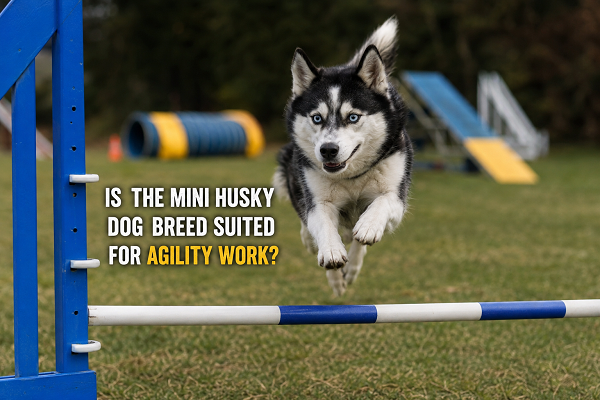
Yes, a Mini Husky can do agility. Its light frame, endurance, and speed suit the sport, and most Minis land in the 12-inch or 16-inch jump class. The real challenge is focus, not fitness. Plan on 18 to 24 months of motivation-based training before a first trial, and expect a dog that negotiates every instruction.
Table of Contents
- Introduction
- What Is a Mini Husky (and What Isn’t)?
- Can a Mini Husky Compete? Rules and Registration
- Mini Husky Jump Height: Where Your Dog Lands
- The Physical Case for Mini Husky Agility
- The Mental Case: Temperament and Focus
- Obstacle by Obstacle: What Comes Easy and What Doesn’t
- Mini Husky vs Border Collie vs Sheltie
- Injury Risk: What the Research Really Says
- An 18 to 24 Month Training Roadmap
- 7 Tips for Training a Mini Husky in Agility
- Heat, Feet, and Gear
- Real-World Proof: Huskies Doing Agility
- Is Agility Right for You? A Quick Checklist
- Trainer’s Take
- FAQs
- Conclusion
Introduction
Picture a Husky tearing around a fenced yard. It’s fast, it turns on a dime, and it looks like it was born to run a course. So when people ask me if a Mini Husky can do agility, the body part of the answer is easy. Yes.
The brain part is where the arguments start.
A Husky was bred to run in a team and make its own calls on the trail. A Border Collie was bred to watch the shepherd’s hand. Both are smart, but they use that intelligence in different directions. On an agility course, that difference decides whether you get a clean run or a dog that leaves for a tunnel you didn’t ask for.
In this guide, you’ll learn:
- What a “Mini Husky” really is, since the name causes a lot of confusion
- How to register and enter trials in the US and UK
- Which jump class your dog will land in
- How the Husky mind helps and hurts you on course
- What the injury research says (it surprised me)
- A month-by-month training plan you can follow
Let’s get into it.
What Is a Mini Husky (and What Isn’t)?
Here’s the first thing to settle, because it affects health, temperament, and where you can compete.
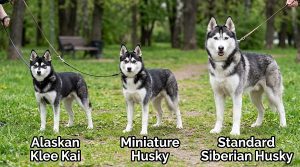
“Mini Husky” is not an official breed. It usually means a Siberian Husky bred smaller than the show standard. The standard Siberian Husky stands about 20 to 23.5 inches and weighs roughly 35 to 60 pounds, while Mini Huskies typically measure 13 to 17 inches and weigh 15 to 35 pounds. Breeder Bree Normandin is usually credited with creating the first miniature version in the 1990s by breeding the smallest of her Siberians. ewashspiritdogtraining
Now the confusing part. The term gets stretched to cover three different dogs:
- A Siberian Husky bred small. Same breed and temperament, just a smaller frame.
- An Alaskan Klee Kai. This is a separate small spitz breed. Breeds like the Klee Kai are sometimes called “miniature Huskies”, but they’re not the same dog. hepper
- A mixed-breed “mini” sold as a Husky. Some puppies marketed this way are crosses with unpredictable size and drive.
Why does this matter for agility? Because the more mixed the dog, the less you can predict its drive, size, and health. Ask the breeder for parent photos, adult sizes of earlier litters, and health clearances. A Mini from tested Siberian parents is a much safer bet than a “rare mini” with no paperwork.
Can a Mini Husky Compete? Rules and Registration
Good news: you don’t need a pedigree.
In the United States: The AKC says any dog registered with the AKC can take part, including All-American dogs registered as Canine Partners. That’s your route if your Mini isn’t a registered purebred Siberian. The AKC’s beginner title, the Agility Course Test, is open to dogs at least 15 months old. Other groups, including UKC, NADAC, and USDAA, also run agility, and their rules differ. Check each rulebook before you enter. akcakc
In the United Kingdom: The Kennel Club requires that your dog is registered either on the Breed Register or the Activity Register, and that dogs only enter shows once they turn 18 months and, for smaller dogs, have been officially measured. The Activity Register is the door for Minis without Breed Register papers. thekennelclubthekennelclub
Elsewhere in Europe and beyond: Many clubs allow mixed breeds and run fun-level classes. Ask your local club what they require.
Handler tip: Register your dog and get measured before you pay for trial entries. I’ve seen people save entry money for months, then find out their dog needed paperwork first.
Mini Husky Jump Height: Where Your Dog Lands
This is where the Mini Husky gets a real advantage, so let’s make it simple.
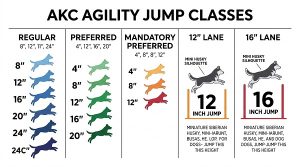
Quick answer: In AKC agility, jump height depends on your dog’s height at the withers, not its breed. A Mini Husky measuring 14 inches or under jumps 12 inches. A Mini measuring over 14 and up to 18 inches jumps 16 inches.
The AKC uses these regular classes: 8 inches for dogs 11 inches and under, 12 inches for dogs up to 14 inches, 16 inches for dogs up to 18 inches, 20 inches for dogs up to 22 inches, and 24 inches for dogs over 22 inches.
| Dog | Typical height at withers | Likely AKC class (Regular) | Preferred class* |
|---|---|---|---|
| Small Mini Husky | 13–14 in | 12 in | 8 in |
| Larger Mini Husky | 15–17 in | 16 in | 12 in |
| Standard Siberian (female) | 20–22 in | 20 in | 16 in |
| Standard Siberian (large male) | 22–23.5 in | 24 in | 20 in |
*The AKC’s Preferred program is for senior dogs or dogs that have suffered injuries, drops the jump one height division, and gives five extra seconds to finish the course. akc
A standard Siberian often competes in the 20-inch or 24-inch classes against Border Collies and Shelties on the taller end of the sport. A Mini competes in smaller height classes, which generally means shorter jumps and tighter courses. In the UK, the sport uses size categories (small, medium, intermediate, large) instead of inches, and your dog gets officially measured into one.
The Physical Case for Mini Husky Agility
Let’s start with what works in your favor.
Endurance. Siberians were built to trot for long distances. Even in a smaller body, that stamina means your Mini won’t tire halfway through a long training session. Most dogs fade before their brain does. Huskies often do the opposite.
A light, efficient stride. Huskies move with less bounce and more glide. That’s great for tunnels, straight lines, and long run-ups. It’s less great for tight collection, so you’ll work on shortening stride before jumps.
Hindquarter drive. Strong rear power helps with take-offs and A-frame climbs.
Size. Mini Huskies are lighter and usually more nimble than standard Siberians. On a technical course with tight turns, that helps. Lighter dogs also put less body weight through their joints on every landing, though as you’ll see below, jump height isn’t the whole injury story.
The Mental Case: Temperament and Focus
Now the honest part. I’d rather you hear it from me than discover it mid-run.
Huskies were bred to run away from the handler, in a team, and decide for themselves when the trail got tricky. Agility asks for the exact opposite: stay connected, read my cues, wait for my direction.
Here’s what that looks like on course:
- The dog decides. You point to the weaves; your Husky picks the tunnel.
- Scent and sight pull hard. A bird, a smell on the wind, or another dog can erase your cue.
- Selective hearing. Huskies are much less impressed by “because I said so” than by “there’s a reward.”
- Talking. Many Huskies grumble, whine, or howl when excited. It’s not defiance. It’s just how they process arousal.
None of this means “no.” It means your method must change. You can’t out-stubborn a Husky. You have to out-interest it.
If your dog has strong drive and you want to understand how to channel it, our Blue Heeler training guide on fixing nipping and drive covers drive control ideas that carry over to any high-energy breed.
Obstacle by Obstacle: What Comes Easy and What Doesn’t
Most articles stop at “Huskies are smart but stubborn.” Here’s the practical version. These ratings come from my handler experience with independent-minded working dogs, so treat them as a guide, not a rulebook.
| Obstacle | Mini Husky outlook | What helps |
|---|---|---|
| Tunnels | Usually loved. Risk: your dog “takes” them without being asked | Teach “tunnel” as a cue, and reward when you send, not when the dog grabs it |
| Jumps | Good, but the dog may skip or run around bars if bored | Keep sessions short, lower bars, reward after each clean jump |
| Weave poles | Slowest to learn; needs drive and focus | Use channel or guide-wire methods and keep sessions under 5 minutes |
| A-frame / dog walk | Confident climbers, but fast descents need control | Teach a “target” nose-touch at the bottom of the contact |
| Teeter-totter | The bang and the movement can worry some dogs | Introduce slowly and use a low, stable surface first |
| Pause table | Boring for an independent dog | Make the table a reward station, not a punishment |
If you’ve never seen the equipment up close, spend one session just playing near it, with no commands and no pressure.
Mini Husky vs Border Collie vs Sheltie
| Trait | Mini Husky | Border Collie | Sheltie |
|---|---|---|---|
| Original job | Team sled pulling | Livestock herding | Herding |
| Handler focus | Moderate; built through training | Very high | High |
| Speed | Fast and steady | Explosive | Fast and precise |
| Independent decisions | High | Low | Low to moderate |
| Typical AKC class | 12 or 16 in | 20 or 24 in | 12 or 16 in |
| Training style that works | Motivation and games | Almost anything | Gentle and clear |
Bottom line: if your only goal is the top of the podium, a herding breed gets you there with less friction. But if you want a fun, bonding sport with a dog that’s a character, a Mini Husky is a strong choice.
Injury Risk: What the Research Really Says
This section is where I want to correct something you’ll see repeated online: “lower jumps = safer dogs.” It’s more complicated.
A 2022 study in Frontiers in Veterinary Science looked at nine experienced Border Collies jumping a 20-inch bar and a 16-inch bar. The result: there was no significant difference in landing force between the two heights. The authors suggested that other factors likely matter just as much as height. frontiersinfrontiersin
The same paper also reports some numbers every agility owner should know. It cites surveys finding that up to 42% of agility dogs are injured during their careers, with the forelimbs affected in up to 60.5% of cases, and the shoulder being the most common site. frontiersin
What this means for your Mini Husky:
- Don’t assume a smaller jump makes your dog injury-proof. It’s one factor among many.
- Repetition matters. Cut down on drilling jumps. Ten clean, rewarded jumps beat fifty tired ones.
- Fitness matters. Build core and hind-end strength before you ask for speed.
- Keep it fun and fresh. Tired dogs get sloppy, and sloppy landings hurt.
- Warm up and cool down, every session.
One caveat: that study used Border Collies only, so we can’t say for sure how it applies to a Mini Husky. But it’s a good reason to build good habits instead of trusting the number on the jump bar.
For a plan to build the right base fitness, read our guide on how often to exercise a working dog.
An 18 to 24 Month Training Roadmap
Here’s the timeline I’d follow. Your own vet should always confirm your dog’s readiness.
Phase 1: 8 weeks to 6 months, foundations only
No jumping, no weaves, no contacts. You’re building:
- Name response and eye contact
- A rock-solid recall (use a long line in open areas)
- Nose targeting (“touch”)
- Calm time in a crate or on a mat
- Confidence on new surfaces and around noise
A calm base starts at home, so our guide on how to crate train a puppy is a good first step.
Phase 2: 6 to 12 months, play with equipment on the ground
- Tunnels (straight, short)
- Jump bars on the floor
- Flat “weave” shaping without a full set
- Walking over low, wide boards
Phase 3: 12 to 15 months, light jumping
The AKC advises that puppies shouldn’t jump competitively until about 12 to 15 months, because growth plates aren’t closed until at least 12 months. Start with low bars and short grids. Ask your vet to confirm readiness first.
Phase 4: 15 to 24 months, sequences and contacts
- Short sequences of 3 to 5 obstacles
- A-frame, dog walk, teeter, pause table
- Full weave poles
- A first practice trial or fun run
Phase 5: 18 to 24 months, first competition
Most Mini Huskies are ready for a first trial in this window if training has been steady and weekly. Entry costs are small compared with training time. One club’s 2026 entry form listed $23 for a dog’s first run of the day, though fees vary by club and country.
Total expected time: 18 to 24 months of regular training. That’s normal for most breeds. What changes with a Husky is the patience per session, not the calendar.
7 Tips for Training a Mini Husky in Agility
- Find out what your dog loves. Some Huskies work for food; others only for a tug toy or a squeaky ball. Test several rewards before you start.
- Keep sessions to 5 to 10 minutes. Stop while the dog still wants more.
- Train recall first. A dog that can’t come back can’t safely run a course.
- Start in a fenced area. Don’t test your recall in an open field.
- Skip harsh corrections. Huskies tend to shut down or push back. Reward-based training works better with this breed.
- Turn equipment into a game. Make the tunnel a chase game before you ever ask for a “send.”
- Use the talking. If your dog is vocal, redirect that energy into forward motion instead of fighting it.
Three focus games to try this week
- The Name Game: Say your dog’s name once. When it looks at you, reward right away. Repeat in different rooms and places.
- Collar Grab: Touch your dog’s collar, then feed. This teaches that being touched mid-play is good news (handy on the start line).
- Choose to Wait: Hold a treat in a closed hand. Reward only when the dog backs off and looks at you. It builds impulse control without a fight.
Heat, Feet, and Gear
Heat. That thick double coat was built for Arctic cold. Train in the cool parts of the day, bring water, and rest often. Watch for heavy panting, drooling, or slowing down.
Feet. The classic Siberian Huskies For Dummies advice is to avoid hard surfaces like concrete, which can damage a Husky’s feet, and to use booties if you pursue the sport seriously. Check paw pads after every session.
Gear. You don’t need a full course at home. Start with:
- A long line (15 to 30 feet) for recall work
- A flat or well-fitted harness for training
- A set of jump bars or low cavaletti poles
- A play tunnel
- Toys and treats your dog truly loves
Real-World Proof: Huskies Doing Agility
If you’re wondering whether Huskies can compete at a high level, yes. Meet Nanuk, a standard Siberian Husky and his first-time handler Rusty. Nanuk earned his MACH (Master Agility Champion) title in November 2016, took fourth place at the AKC Agility Invitational in Orlando a month later, and won the breed medallion as top-scoring Siberian Husky. By 2018, they were chasing a fifth MACH. Rusty’s own words capture the bond: it was bittersweet because Nanuk was his very first agility dog.
Siberian Huskies still show up in AKC Agility Invitational results sheets, so this is not a one-time fluke.
Remember, Nanuk jumped the tougher 24-inch class. A Mini Husky jumping a lower height has no physical reason it can’t do the same, as long as the focus and fitness are in place.
Is Agility Right for You? A Quick Checklist
Answer yes or no:
- Can you train 3 to 5 days a week in short sessions?
- Are you willing to use rewards and games instead of corrections?
- Do you have, or can you find, a safe fenced training space?
- Can you stay patient when your dog ignores a cue it knew yesterday?
- Do you have an agility club or trainer within reach?
4 or 5 yes answers: Go for it.
2 or 3: You can still do it, but plan for a slower start and get an instructor.
0 or 1: Consider whether another activity fits better.
If agility isn’t a fit, try these
- Canicross or bikejoring (running with your dog, which is classic Husky territory)
- Rally obedience (focus and fun without big jumps)
- Scent work (builds focus and works the brain)
- Fast, straight-line dog sports such as lure coursing or dash-style events
Trainer’s Take
I’m Cpl. Rofiat Muritala, and I’ve spent over 14 years as a military working dog instructor and handler at the Nigerian Army Dog Centre. In 2026 I led obedience, detection, and agility demonstrations at the Nigerian Army Day Celebration (NADCEL). That work taught me one lesson that applies to every breed: a dog’s biggest strength is often its biggest training problem. A Husky’s independence is exactly that.
If you want a practical, structured guide to the relationship and focus work behind this, my book Beyond the Bark walks through the same principles I use with professional dogs.
How this article was researched: rules and jump heights come from the AKC and the UK Kennel Club, injury statistics from a peer-reviewed 2022 study in Frontiers in Veterinary Science, and the competition example from a published AKC competitor profile. Check current rulebooks before you enter any trial, as rules change.
FAQs
1. Can a Mini Husky compete in AKC agility?
Yes. A registered purebred can enter, and so can mixed or unregistered-pedigree dogs through the AKC Canine Partners program. Your dog will usually jump in the 12-inch or 16-inch class, depending on its measured height.
2. How old does a Mini Husky need to be for agility?
Foundation games can start at 8 to 12 weeks. For competition, the AKC’s beginner agility title is open at 15 months, and the UK Kennel Club requires 18 months. Full-height jumping should wait until your vet confirms growth plates have closed, usually 12 to 18 months.
3. Are Mini Huskies harder to train for agility than standard Siberians?
No. Size doesn’t change temperament. They share the same independent, reward-driven personality, so the training approach is the same.
4. What is the biggest mistake owners make?
Skipping recall and focus work and heading straight to equipment. Without a strong recall and handler focus, even a fast, fit Husky will leave the course.
5. Is a Mini Husky better for agility than a standard Siberian Husky?
Physically, often yes, because of the lower jump class and lighter frame. Mentally, they’re the same. Neither will match a Border Collie for natural handler focus, but both can succeed with the right training.
Conclusion
So, is the Mini Husky suited for agility work? Yes, with honest conditions.
- Body: Fast, light, and enduring, with a friendlier jump class than a standard Husky.
- Brain: Independent, so you must train with rewards, short sessions, and games.
- Rules: Get registered and measured first. AKC is 15 months, UK Kennel Club 18 months.
- Safety: Don’t treat jump height as the whole answer. Build fitness, limit repetition, and protect growth plates.
- Timeline: Expect 18 to 24 months from puppy to first trial.
Your next step this week: pick one reward your dog loves, play the Name Game for five minutes a day, and book a trial class at a local club to watch how the sport really works.
Want more guides like this in your inbox? Subscribe to our weekly articles roundup newsletter.

Her work centres on obedience, detection, protection and operational readiness. She favours proven methods built on repetition, consistency and real-world conditioning, so that both dogs and handlers are prepared for high-pressure tasks.
Rofiat represented the Nigerian Army Dog Centre at the Nigerian Army Day Celebration (NADCEL) 2026, where she led demonstrations in obedience, explosive detection, agility and tactical movement. Through articles, training content and documentaries, she shares field-based insight into how structured training, clear communication and trust between handler and dog affect performance and reliability.
She is the author of Beyond the Bark: Inside a Pro Handler's Playbook for Raising the Ideal Dog, a practical guide that helps dog owners and handlers apply professional training principles in everyday situations.
- How to Enter the COBA National Dog Championship - October 20, 2026
- K9 Advantix Dosage Chart & Safety Guide for Dogs - October 19, 2026
- How to Set Up & Use Bousnic Dog Training Collar - October 18, 2026