King Shepherd vs Malinois: Which One Is Better
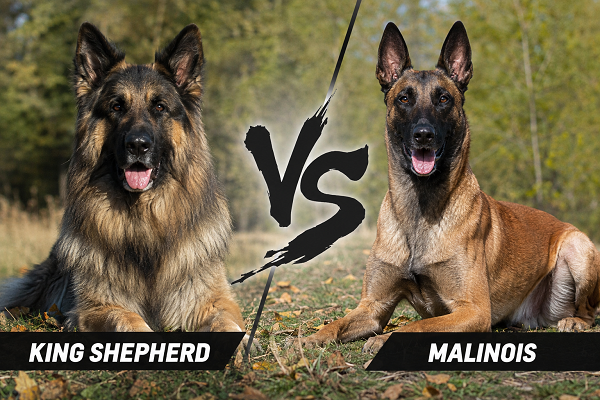
Neither breed is objectively “better,” they’re built for opposite lives. A King Shepherd is the better pick if you want a large, calm, low-drama guardian that’s content lounging by the door and only springs into action when something’s genuinely wrong. A Belgian Malinois is the better pick if you want (or need) a dog with elite working drive, the kind used by the U.S. Secret Service and military K9 units worldwide, and you’re prepared to give it a real job, not just a backyard. Pick based on your energy level and daily schedule, not on which dog looks tougher in photos.
Table of Contents
- Introduction
- Quick Comparison Table
- Where Each Breed Actually Comes From
- Size and Physical Build
- Temperament: Gentle Giant vs Relentless Drive
- Trainability and Intelligence
- Exercise Needs and Daily Life
- Guard Dog vs Protection Dog: Which One Actually Protects Better?
- Health and Lifespan
- Cost of Ownership Compared
- Family Life: Kids, Other Pets, and Apartments
- Which One Should You Actually Choose?
- FAQs
- Conclusion
Introduction
If you’ve ever stood in a breeder’s driveway trying to decide between a gentle giant and a dog that looks like it’s permanently plugged into an electrical socket, you already understand the real question here. It’s not “which dog is stronger” or “which dog would win a fight.” It’s “which dog fits the life I actually live.” I’ve placed, trained, and evaluated both types of dogs over the years, and I can tell you the number one reason working dogs get rehomed isn’t aggression or health, it’s a mismatch between the dog’s drive and the owner’s daily routine.
In this guide, I’ll walk you through exactly how these two breeds differ: size, temperament, trainability, real protection ability, health and lifespan, and what each one actually costs to own over a lifetime. By the end, you’ll know which dog belongs in your home, and just as importantly, which one doesn’t.
Quick Comparison Table
| Category | King Shepherd | Belgian Malinois |
|---|---|---|
| Origin | United States, developed in the 1990s | Belgium, developed in the 1800s as a herding breed |
| Recognized by AKC | No (recognized by ARBA, APRI, DRA) | Yes, since 1959 |
| Male height | Up to roughly 29–31 inches | 24–26 inches |
| Male weight | 130–150 lbs | 60–80 lbs |
| Coat | Thick, medium-to-long double coat | Short, dense, low-maintenance double coat |
| Energy level | Moderate | Very high, needs a real job |
| Trainability | High, eager to please | Extremely high, but needs an experienced handler |
| Guarding style | Size-based deterrence, watchful | Active, trained protection and apprehension |
| Lifespan | 10–14 years | 12–15 years |
| Puppy price (reputable breeder) | $1,250–$3,500 | $800–$3,000 (pet quality) |
| Best for | Families wanting a calm, imposing companion | Active handlers wanting a true working partner |
Beebiepet Heavy-Duty Tactical Dog Harness (X-Large) — built for big-boned breeds like the King Shepherd, with MOLLE webbing and a four-point adjustment system that actually holds up to a 140-pound dog leaning into a leash.
Where Each Breed Actually Comes From
You can’t understand how these two dogs behave without knowing why they were bred in the first place, and the backstories couldn’t be more different.
The King Shepherd is a genuinely young breed. American breeders Shelley Watts-Cross and David Turkheimer developed it in the early 1990s by crossing German Shepherds with the Shiloh Shepherd, itself a larger, calmer offshoot of the GSD developed in the 1970s. Some lines also carry Alaskan Malamute or Great Pyrenees, which explains the thicker coat and heavier bone structure you see in a lot of King Shepherds today. The whole point of the project was to keep the German Shepherd’s intelligence and loyalty while dialing down the intensity and reducing the hip problems that plague the parent breed. It worked, mostly. The King Shepherd isn’t recognized by the AKC, but it is recognized by the American Rare Breed Association, the American Pet Registry, and the Dog Registry of America.
The Belgian Malinois, by contrast, has been quietly perfecting itself for close to 150 years. It’s one of four Belgian Shepherd varieties (alongside the Groenendael, Tervuren, and Laekenois), developed in the Malines region of Flanders in the late 1800s as a farm dog that could herd, guard property, and work long hours without quitting. That working-farm DNA never got bred out, it got sharpened. When European police and military units went looking for a dog that combined a German Shepherd’s trainability with more speed, more bite drive, and fewer structural health issues, the Malinois was already sitting there, ready-made for the job.
That history matters more than most buyers realize. A King Shepherd was bred to relax. A Malinois was bred to work until somebody tells it to stop.
Size and Physical Build
On paper, the King Shepherd wins the size contest outright. Males commonly reach 130 to 150 pounds and stand up to 29 to 31 inches at the shoulder, putting them solidly in giant-breed territory alongside dogs like the Great Dane or Bernese Mountain Dog. Females typically run 90 to 110 pounds. That’s a genuinely large animal, broad-chested, thick-boned, and covered in a dense double coat that comes in sable, black and tan, or solid black.
The Malinois looks almost delicate by comparison, and that’s deceptive. Males stand 24 to 26 inches and weigh 60 to 80 pounds; females are smaller still, at 40 to 60 pounds. But a Malinois is built like a middleweight boxer, square-proportioned, lightly boned, and covered in a short, weatherproof coat that sheds seasonally but needs almost no grooming maintenance. Pound for pound, the Malinois is one of the most athletic dogs in existence, capable of vertical leaps and directional changes that a heavier King Shepherd simply can’t match.
If raw size and presence at the door matter most to you, the King Shepherd wins. If you need a dog that can clear a six-foot fence or keep pace with a sprinting suspect, the Malinois wins every time.
Temperament: Gentle Giant vs Relentless Drive
This is where the two breeds genuinely part ways, and it’s the single most important factor in this whole comparison.
King Shepherds are, almost without exception, described the same way by owners and breeders: calm, affectionate, and steady. They were deliberately selected for a gentler nervous system than the German Shepherd, and it shows. Most King Shepherds are reserved but not fearful around strangers, patient with children, and content to spend a big chunk of the day simply being near their family rather than actively working. Their protective instinct is real, but it tends to show up as watchfulness and size-based deterrence rather than trained aggression. A King Shepherd doesn’t need much encouragement to bark at an unfamiliar car in the driveway; it needs a lot of encouragement to actually do bite work.
The Malinois runs on an entirely different operating system. Handlers and trainers describe the breed’s drive using words like “relentless,” “obsessive,” and “intense,” and none of that is marketing exaggeration. A Malinois that isn’t given a job, whether that’s detection work, agility, structured obedience, or serious daily exercise, will often find its own job, and you probably won’t like it. Chewed drywall, escaped yards, and destroyed furniture are common complaints from first-time Malinois owners who underestimated what “high energy” actually means in this breed. This isn’t a flaw; it’s exactly the trait that makes the Malinois so valuable to police and military units. It’s a mismatch problem when that same trait lands in a home that expected a German Shepherd with a shorter coat.
Here’s a distinction I stress with every client considering a Malinois: drive and aggression are not the same thing. A well-bred, well-socialized Malinois is not inherently aggressive toward people, its intensity is about work, prey, and problem-solving, not hostility. But that intensity, undirected, reads as chaos in a normal household. If you want a deeper look at how trainers tell the difference between genuine working drive and reactive behavior, I’ve broken that distinction down in Dog Obedience vs. Instinct: How to Balance Drive and Control.
Trainability and Intelligence
Both breeds are genuinely smart, but “smart” plays out differently depending on what you’re training for.
King Shepherds inherit the German Shepherd’s eagerness to please, and they’re generally easy to train through basic obedience, house manners, and even moderate protection work. The catch is motivation: a King Shepherd trains well because it wants to make you happy, not because it’s chasing an internal drive to work. That makes them forgiving of an inconsistent training schedule but also means training sessions need to stay upbeat and reward-based, since a bored or under-stimulated King Shepherd can get stubborn fast.
The Malinois is frequently ranked among the top five most trainable dog breeds in the world, and it’s a favorite of professional trainers precisely because it learns new commands in a handful of repetitions. The difference is that a Malinois isn’t training for approval, it’s training because the work itself is the reward. This makes them extraordinarily capable in the hands of an experienced handler and genuinely difficult in the hands of a first-time owner who doesn’t yet understand timing, consistency, and drive-channeling. In my experience, a Malinois that “ignores” a command is far more often dealing with high arousal, an incomplete training foundation, or an unclear cue, not defiance. Getting the equipment and technique right from day one makes a measurable difference here; my rundown of Essential K9 Training Equipment Every Working Dog Handler Needs covers what actually earns its place in a training bag versus what’s just marketing.
Exercise Needs and Daily Life
This is the practical detail that ends more King-Shepherd-vs-Malinois debates than anything else.
A King Shepherd needs a solid 60 to 90 minutes of exercise and mental engagement daily, a couple of decent walks, some yard time, occasional training drills. It’s a real commitment, but it’s manageable around a normal work schedule.
A Malinois needs closer to two hours of structured physical and mental work daily, and “structured” is doing a lot of work in that sentence. A leisurely walk barely registers. These dogs were built to herd livestock across open fields for hours, then guard property overnight, and that stamina hasn’t gone anywhere just because the dog now lives in a suburban house. Owners consistently report that a tired-out Malinois is a well-behaved Malinois, and an under-exercised one becomes destructive, anxious, or vocal within days. If you’re weighing whether your schedule can realistically support that level of activity, my step-by-step breakdown of How Often Should You Exercise a Working Dog lays out what “enough” actually looks like by breed and job type.
Heavy-Duty Aviation-Aluminum Flirt Pole — specifically built to hold up to Malinois-strength tugging and lunging, a genuinely useful tool for converting that relentless prey drive into 15 minutes of productive exercise.
Guard Dog vs Protection Dog: Which One Actually Protects Better?
This is where people most often confuse two very different jobs.
A King Shepherd is, functionally, an excellent watchdog and deterrent. Its size alone discourages most opportunistic intruders, and it will reliably bark to alert you when something’s off. What it generally won’t do, without extensive specialized training, is engage a threat. King Shepherds simply weren’t bred with the sharp bite drive and controlled aggression that formal protection work requires, and most breeders will tell you that outright.
A Belgian Malinois is a working protection and apprehension dog by design, and the numbers back that up. The breed has become the default choice for elite security work worldwide: it’s used by the U.S. Secret Service, branches of the U.S. military, and law enforcement agencies across nearly every continent. The breed’s global reputation got a huge public boost in 2011, when a Malinois named Cairo accompanied Navy SEAL Team Six on the raid that resulted in Osama bin Laden’s death. More recently, a Secret Service Malinois named Hurricane became one of the most decorated K9s in American history after stopping an intruder who jumped the White House fence toward the residence. Even India’s Central Reserve Police Force has shifted roughly 90% of its canine units to Malinois in recent years, citing faster training timelines and longer peak-performance windows compared to older go-to breeds.
That said, a Malinois isn’t automatically a protection dog just because it’s a Malinois. Real personal protection or police-level bite work requires months of professional, purpose-built training through recognized programs, and a Malinois without that training is simply a very driven pet, not a trained protector. If you’re curious what separates a genuinely capable protection prospect from a dog that just looks intense, my comparison of protection-suited breeds in Is a Giant Schnauzer a Good Protection Dog? covers that evaluation process, and the trade-offs, in more depth.
Bottom line: if you want a dog whose presence alone discourages trouble, the King Shepherd does that job well and asks little in return. If you want a dog capable of trained apprehension work, the Malinois is in a different league entirely, but only with real investment in professional training.
Health and Lifespan
Both breeds are reasonably healthy for their size, but they carry different risk profiles.
King Shepherds typically live 10 to 14 years. As a large, deep-chested breed, they’re prone to hip and elbow dysplasia (inherited from the German Shepherd side, though generally to a lesser degree), and gastric dilatation-volvulus, or bloat, a genuine emergency that can develop when a large dog exercises too soon after eating. Surgery for hip or elbow dysplasia can run $4,000 or more per joint, and bloat treatment can climb past $7,500 including hospitalization. Because the breed is relatively new and outcrossed, it does benefit from some hybrid vigor compared to purebred German Shepherds.
Belgian Malinois typically live 12 to 15 years, slightly longer than the King Shepherd on average, and are considered a fairly healthy breed overall. Their main risks are hip and elbow dysplasia, progressive retinal atrophy, and, more concerning, an elevated risk of certain cancers compared to some other working breeds. Responsible breeders screen parent dogs through the Orthopedic Foundation for Animals to reduce dysplasia risk, and it’s worth asking for that documentation regardless of which breed you choose.
In both cases, buying from a breeder who provides OFA hip and elbow certification on the puppy’s parents is the single biggest thing you can do to reduce your odds of an expensive orthopedic surgery down the road.
Large-Breed Glucosamine & Chondroitin Joint Chews with Omega-3 — a reasonable, low-cost preventive step for either breed once they hit middle age, when hip and elbow wear starts to show up on both sides of this comparison.
Cost of Ownership Compared
Sticker price is only the beginning with either breed. Here’s a realistic side-by-side.
| Cost Category | King Shepherd | Belgian Malinois |
|---|---|---|
| Puppy price (reputable breeder) | $1,250–$3,500 | $800–$3,000 (pet quality); $3,400–$9,000+ for working/show lines |
| Annual food cost | $700–$1,000 (large-breed food volume) | $500–$800 |
| Annual vet care | $400–$600 | $400–$600 |
| Training investment | Moderate, basic obedience usually sufficient | Higher, structured training strongly recommended |
| Lifetime cost estimate | Roughly $18,000–$25,000 | Roughly $21,000–$30,000 |
| Biggest cost risk | Orthopedic surgery, bloat emergency | Cancer treatment, behavioral training for undirected drive |
Notice that the Malinois isn’t necessarily cheaper to buy, but it’s often more expensive to raise responsibly, because skipping structured training with this breed tends to cost you later in destroyed property, training rehabilitation, or a rehoming situation. The King Shepherd’s biggest financial risk sits on the veterinary side, given its size and joint load.
Family Life: Kids, Other Pets, and Apartments
King Shepherds are generally an easier fit for families with young children. Their calmer temperament, patience, and lower reactivity make them well-suited to the chaos of a household with kids, though their sheer size means any interaction with toddlers should still be supervised, a 140-pound dog can knock a child over without any bad intent at all. They typically do fine with other pets when raised together and are not a realistic option for apartment living given their size and exercise needs.
Malinois can absolutely live with children and other animals, but it takes more deliberate work. Their intensity during play can overwhelm a smaller dog or an unprepared child, and same-sex aggression toward other dogs shows up in some individuals. Families that succeed with a Malinois tend to be ones who commit early to structured socialization and who give the dog a genuine outlet for its drive, sport, structured play, or a working role, rather than expecting it to self-regulate like a lower-energy breed would. Apartments are a hard no for this breed unless you have serious daily access to off-leash exercise and mental work elsewhere.
Neither breed is a good match for a first-time dog owner looking for a low-maintenance pet. Both reward experienced handlers who understand structure, consistency, and (for the Malinois especially) drive management.
Which One Should You Actually Choose?
Run through this honestly before you commit to either breed:
Choose the King Shepherd if:
- You want a calm, affectionate, imposing family guardian
- Your household includes young kids or other pets
- You can commit to 60–90 minutes of daily exercise, not two-plus hours
- You want a dog that’s satisfied with a job description of “watch the house and love the family”
- You’re a first-time large-breed owner, though not necessarily a first-time dog owner
Choose the Belgian Malinois if:
- You have real experience with high-drive working breeds
- You can offer two-plus hours of structured daily exercise and training
- You want or need genuine working or protection capability
- You’re prepared to invest in professional training, not just basic obedience classes
- You have an active lifestyle, running, hiking, dog sports, that the dog can join
If you’re still unsure which category you fall into, it’s worth talking to a working-dog trainer honestly about your actual daily schedule, not the schedule you wish you had. I’ve watched too many Malinois end up in rescue because an owner fell in love with a YouTube video of a police dog and didn’t account for what that same drive looks like with nowhere to go. For a broader look at what handling any high-drive working dog actually demands day to day, my guide How to Become a K9 Dog Handler: Complete Guide is a useful read even if you’re not pursuing K9 work professionally, the mindset transfers directly to home ownership of a working-line dog.
FAQs
1. Can a King Shepherd be trained for protection work like a Malinois?
To a degree, but it’s not a natural fit. A King Shepherd can be trained in basic protection and controlled bite work, but the breed lacks the sharp, sustained bite drive that formal police and military programs require. Most professional protection-dog programs simply don’t use King Shepherds for this reason, they’re bred for a gentler temperament, not trained aggression.
2. Is a Belgian Malinois too much dog for a family pet?
For most first-time or moderately active families, yes. The Malinois needs two-plus hours of structured daily exercise and mental work, and without it, the same drive that makes it an elite working dog turns into destructive or anxious behavior at home. Experienced owners with an active lifestyle can absolutely make it work as a family dog, but it’s not a casual commitment.
3. Which breed is easier to train, King Shepherd or Malinois?
Both are highly trainable, but for different reasons. A King Shepherd trains well because it wants to please you, forgiving basic mistakes in timing or consistency. A Malinois learns commands faster but needs precise, confident handling, since its drive can spiral into frustration or fixation if training is inconsistent or unclear.
4. Which breed lives longer, King Shepherd or Malinois?
Belgian Malinois generally have a slight edge, living 12 to 15 years on average compared to 10 to 14 years for King Shepherds. The King Shepherd’s larger size puts more strain on joints over a lifetime, which is a factor in most large-breed longevity differences.
5. Is a King Shepherd or Malinois better for a first-time dog owner?
Neither is ideal for a true first-time dog owner, but if you had to choose one, the King Shepherd is more forgiving. Its calmer temperament and lower daily exercise ceiling make early mistakes less costly than they would be with an under-exercised, under-trained Malinois.
A Note From the Author
I’m Rofiat Muritala, a veteran military K9 handler and certified trainer with over 14 years of hands-on experience across obedience, detection, protection, and operational readiness work with military working dogs. I represented the Nigerian Army Dog Centre at NADCEL 2026, leading obedience, explosive detection, agility, and tactical movement demonstrations. I’ve worked hands-on with German Shepherd and Malinois-type working lines throughout my career, and I’ve fielded more “which breed should I get” questions from prospective owners than I can count. The comparison in this article reflects both published breed data and what I’ve personally seen play out in real households and working programs, not just marketing copy from a breeder’s website.
Conclusion
The King Shepherd and Belgian Malinois aren’t really competing for the same job, and that’s the whole point of this comparison. One is a large, steady, affectionate guardian built to make a family feel safe without asking for much in return. The other is a compact, relentless working athlete built to do a specific job at an elite level, and it needs a handler who can meet that intensity daily.
If you’re drawn to the idea of a big, loyal dog snoozing by the front door and springing up only when something’s genuinely wrong, get the King Shepherd. If you’re drawn to the idea of a dog that can outwork almost any breed alive and you’re ready to be the kind of owner that dog deserves, the Malinois will reward you like nothing else. Just be honest about which owner you actually are before you bring either one home.
If you want to go deeper into the training mindset and drive-management principles that apply to any serious working or protection-line dog, I put everything I’ve learned over 14 years of hands-on K9 work into my e-book, Beyond the Bark: Inside a Pro Handler’s Playbook for Raising the Ideal Dog. It walks you through the same foundational thinking professional K9 trainers use, broken down for regular dog owners.
Editorial transparency note: This article combines current breed data from veterinary and kennel-club sources with pricing and health-cost figures pulled from multiple 2025–2026 breeder, insurance, and pet-cost publications. Internal links were selected for direct topical relevance (protection-breed comparison, drive management, training equipment, exercise needs, and handler mindset) rather than inserted for link count. Amazon product recommendations were chosen specifically for suitability to each breed’s build and drive level, not from a generic “top products” list.

Her work centres on obedience, detection, protection and operational readiness. She favours proven methods built on repetition, consistency and real-world conditioning, so that both dogs and handlers are prepared for high-pressure tasks.
Rofiat represented the Nigerian Army Dog Centre at the Nigerian Army Day Celebration (NADCEL) 2026, where she led demonstrations in obedience, explosive detection, agility and tactical movement. Through articles, training content and documentaries, she shares field-based insight into how structured training, clear communication and trust between handler and dog affect performance and reliability.
She is the author of Beyond the Bark: Inside a Pro Handler's Playbook for Raising the Ideal Dog, a practical guide that helps dog owners and handlers apply professional training principles in everyday situations.
- How to Enter the COBA National Dog Championship - October 20, 2026
- K9 Advantix Dosage Chart & Safety Guide for Dogs - October 19, 2026
- How to Set Up & Use Bousnic Dog Training Collar - October 18, 2026