K9 Security Dog Handler Training Tips (Field-Tested Guide)
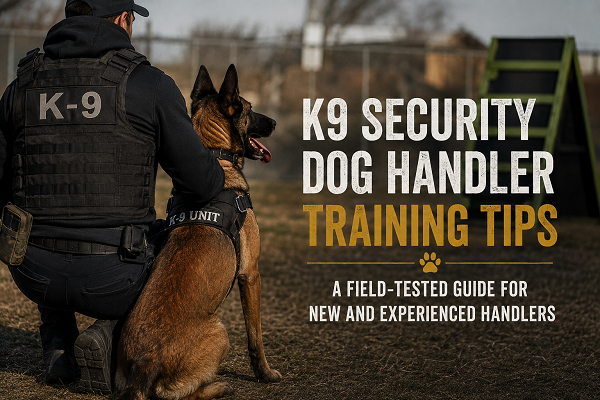
Effective K9 security handler training combines structured obedience work, drive-channeling drills (like controlled tug and bite-and-out sequences), scenario-based patrol or detection practice, and consistent handler self-discipline, typically requiring 12 to 20+ weeks of team training before certification, plus ongoing weekly maintenance sessions for the life of the dog’s career.
Table of Contents
- Introduction
- Why Handler Training Is Its Own Discipline
- How K9 Handler Certification Actually Works
- Building the Handler-Dog Bond From Day One
- 10 Field-Tested Training Tips for K9 Security Handlers
- Common Mistakes That Get Handlers (and Dogs) in Trouble
- Essential Gear Every Handler Should Own
- Realistic Training Timelines and Costs
- Staying Sharp: Ongoing Training and Handler Fitness
- Recommended Training Gear (Handler-Tested Picks)
- Meet the Trainer Behind This Guide
- FAQs
- Conclusion
Introduction
If you’ve ever stood at the end of a leash while a 70-pound Malinois locks onto a decoy across a training field, you already know something most people never learn: the dog isn’t the hard part. You are.
That’s not a knock on you. It’s just the truth every K9 instructor eventually tells every rookie handler. The dog comes with instinct, drive, and if you picked well, solid nerves. What the dog doesn’t come with is timing, consistency, or the judgment to know when to push and when to back off. That’s on you, and it’s why handler training matters just as much as dog training, if not more.
In this guide, you’ll learn what separates a competent handler from a great one, how certification actually works in the US and UK, what a realistic training timeline and budget look like, the gear that actually earns its keep, and the mistakes that get handlers (and their dogs) hurt or decertified. I’ve pulled in real numbers, real programs, and real examples, not just generic “be consistent” advice you could get from any blog.
Why Handler Training Is Its Own Discipline
Here’s the thing most first-time handlers get wrong: they think “K9 training” means training the dog. It doesn’t. It means training a team, and the human half of that team has just as much homework to do.
Think about it this way. A dog reads body language before it reads words. It picks up on tension in your grip, hesitation in your voice, the half-second delay before you give a command. If you’re anxious, your dog gets anxious. If you’re inconsistent about when you correct a behavior, your dog stops trusting the rules exist at all. Professional trainers call this “reading down the leash,” and it’s the single most underrated skill in the entire field.
This is why serious K9 programs, whether it’s a police department, a private security firm, or a military unit, don’t just evaluate the dog before deployment. They evaluate the team. The USPCA (United States Police Canine Association), one of the most respected certifying bodies in North America, tests handler-dog pairs together using a multi-judge scoring system rather than a simple pass/fail, specifically because a great dog paired with a shaky handler is still a liability on the street.
If you want a deeper look at how foundational obedience and drive work get built before a dog is ever deployed, our Ultimate Guide to Basic Training Techniques for Military K9s breaks that process down step by step.
How K9 Handler Certification Actually Works
Certification standards vary by country, and honestly, that trips up a lot of handlers who assume there’s one global standard. There isn’t. Here’s what it actually looks like in the two markets most of you reading this will care about.
United States
Most law enforcement agencies require officers to complete at least one to two years as a regular patrol officer before they’re even eligible to apply for a K9 unit position. Once selected, handlers typically go through a dedicated academy, Utah’s POST K9 program, for example, runs an 8-week in-residence course covering patrol, detection, and tracking disciplines, with out-of-state tuition running around $2,175 per course.
From there, certification is usually handled by one of several recognized bodies:
- USPCA (United States Police Canine Association), uses a multi-evaluator point system rather than simple pass/fail
- NAPWDA (North American Police Work Dog Association)
- NPCA (National Police Canine Association)
- NNDDA (National Narcotic Detector Dog Association)
Annual recertification is standard practice, and most reputable programs also expect quarterly proficiency checks in between.
Salary matters too, since it shapes how much handlers can invest in ongoing training. K9 handler pay varies widely by state, canine deputies in Illinois report a median income around $86,130 a year, while California K9 handlers average closer to $104,160, well above the roughly $51,000 national average for general patrol officers.
United Kingdom and Europe
Private security dog handling in the UK runs on a different track entirely. There’s no standalone SIA (Security Industry Authority) dog-handling licence, instead, handlers need a frontline SIA licence (Security Guarding or Door Supervision) plus a NASDU (National Association of Security Dog Users) qualification.
- NASDU Level 2 (General Purpose Dog Handler): minimum 50–60 guided learning hours, often delivered as an intensive 5-day course
- NASDU Level 3: an additional 100 guided learning hours on top of Level 2, for a combined minimum of 150 GLH
These programs are built around BS 8517-1, the British Standard code of practice for security dogs, which also sets welfare requirements, hydration, rest, shade, and documented welfare checks before, during, and after every deployment. Skip those and you’re not just cutting corners, you’re risking a breach of the Animal Welfare Act 2006.
Most handlers combining SIA and NASDU training are deployment-ready within three to six months, a timeline that lines up closely with what US dual-purpose K9 programs report as well.
Building the Handler-Dog Bond From Day One
Every experienced handler I’ve talked to says some version of the same thing: the certification test isn’t what makes a good team. The hundreds of unglamorous hours before it do.
A working line dog like a Belgian Malinois or a working line German Shepherd, isn’t bred to relax. It’s bred to work, and if you don’t give it a job, it’ll invent one, usually something you won’t like (destroyed furniture, obsessive fence-running, reactivity toward strangers). The bonding process starts by becoming the source of everything that dog wants: food, play, structure, release.
A few things that build trust fast, based on what actually works in the field:
- Feed by hand during early sessions. It sounds basic, but it wires the dog to associate your presence with good things happening.
- Use one consistent marker word or clicker sound. Confusion kills trust faster than almost anything else.
- Let the dog “win” tug sessions on your terms, not its own. Structured tug work, where the dog only gets the toy on command and gives it up calmly every time, teaches bite mechanics and reinforces that you control the resource, not the dog.
- Read body language, don’t just react to behavior. A stiff posture, raised hackles, or a tucked tail tells you something is happening before the dog acts on it.
If you’re working with a high-drive breed specifically, our piece on how to stop Belgian Malinois biting and manage drive goes deep into structured tug protocols that professional trainers actually use.
10 Field-Tested Training Tips for K9 Security Handlers
I’ve organized these roughly in the order a new handler should focus on them, though in practice you’ll be working several at once.
- Master your timing before you worry about commands. A correction or reward delivered even half a second late teaches the dog the wrong lesson entirely. Practice your timing with a clicker on inanimate tasks before you ever apply it to real training.
- Keep sessions short and end on success. Ten to fifteen minutes of focused work beats an hour of drilling a tired, frustrated dog. Working dogs, especially Malinois and working line Shepherds, actually need 60 to 90+ minutes of combined physical and mental work daily, but that should be broken into multiple focused blocks, not one marathon session.
- Use structured tug work to channel prey drive. Ten to fifteen minutes of rule-based tug, twice a day, does more to resolve a biting or nipping problem than an hour of unstructured off-leash play. The rule is simple: one toy, on command only, calm release every time.
- Train in real environments, not just the training yard. A dog that’s rock-solid in obedience at the training field can fall apart at a noisy checkpoint or a crowded venue. Rotate locations deliberately, parking structures, retail entrances, loading docks, anywhere your dog will actually work.
- Never punish a dog during or after a mistake in detection or patrol work. Handlers are taught to redirect and reset, not correct harshly, because punishment around detection work can suppress the exact alert behavior you’re trying to build.
- Log every session. Most certifying bodies, NASDU included, require documented training and welfare records. Beyond compliance, a written log shows you patterns, the days your dog struggles with focus, the triggers that spike reactivity, that you’d otherwise miss.
- Cross-train your backup handler relationship. Dogs form strong bonds with one person, but operational reality means another handler may need to step in. Rotating in a secondary handler occasionally (under supervision) prevents total performance collapse if you’re unavailable.
- Build in deliberate “boring” time. A dog that only gets attention during high-drive work never learns to settle. Practice calm-down protocols, a place command, a mat, structured downtime near activity, so your dog can shift out of work mode without a fight.
- Test yourself under fatigue, not just your dog. A tired, distracted handler makes worse decisions than a tired dog follows. If you’re training for patrol or protection work, simulate stress: run a short sprint, then immediately handle a scenario. This mirrors real deployment conditions far better than fresh-off-the-couch drills.
- Recertify like it matters, because it does. Annual or quarterly proficiency checks aren’t bureaucratic box-ticking, they catch skill decay before it becomes a liability in the field. Treat every recert like the first one.
Common Mistakes That Get Handlers (and Dogs) in Trouble
I’ve watched handlers; good, well-meaning people, make the same handful of mistakes over and over. Here’s what to avoid:
- Rushing the bonding phase. Skipping foundational trust work to get to “the exciting stuff” (bite work, detection) almost always backfires later.
- Inconsistent commands. Using “down” one day and “lie down” the next confuses even a sharp dog. Pick your vocabulary and stick to it across every handler who works that dog.
- Over-relying on equipment instead of relationship. A prong collar or e-collar is a tool, not a substitute for clear communication. Handlers who lean on corrective gear without building drive and trust tend to plateau fast.
- Ignoring heat and fatigue risk. Working dogs overheat faster than people assume, especially in hot climates or during summer patrol shifts. Skipping cooling breaks and hydration checks is one of the most preventable ways handlers put their dogs at risk.
- Neglecting their own physical conditioning. Handlers who can’t keep pace with a dog during a foot pursuit or an agility obstacle aren’t just underperforming, they’re a safety risk to themselves, the dog, and the public.
- Not documenting incidents and near-misses. Whether it’s a missed detection or a bite incident, thorough documentation protects the handler legally and gives trainers real data to fix the problem.
Essential Gear Every Handler Should Own
Good training technique matters more than good gear, but the wrong gear can undo months of solid work, a leash that snaps mid-pursuit or a harness that chafes under a vest isn’t just inconvenient, it’s a liability.
At minimum, a working handler should have:
- A durable tactical leash and matching collar or harness rated for the dog’s pulling strength
- A reward pouch or treat bag that keeps rewards accessible without breaking focus
- A reliable marker tool (clicker or verbal marker, consistently applied)
- Bite sleeves or tugs appropriate to the dog’s training stage (soft for beginners, progressing to bite-suit-grade material for advanced work)
- A basic K9 first aid kit, since injuries in the field are a matter of when, not if
- Weather protection, cooling vests for hot climates, insulated gear for cold-weather deployments
For a full breakdown of what a working K9 unit needs beyond the basics, including muzzles, tracking accessories, and evacuation gear, check out our detailed Essential K9 Training Equipment guide.
Realistic Training Timelines and Costs
People searching for handler training tips almost always want to know two things: how long, and how much. Here’s the honest answer.
Timeline:
- Single-purpose detection dogs (explosives or narcotics only): typically ready for certification in 12–16 weeks of structured team training
- Dual-purpose patrol and detection dogs: usually need 16–20 weeks before certification, since they’re mastering two skill sets at once
- UK security dog teams (NASDU pathway): most handlers are deployment-ready within 3–6 months when combining SIA and NASDU training
Cost:
- US academy-based K9 handler courses run anywhere from roughly $2,000 to $2,500+ for out-of-state or non-agency-sponsored tuition (Utah POST’s out-of-state fee, for example, sits around $2,175)
- UK NASDU Level 2 commercial courses commonly run as 5-day intensive programs, typically priced in the low-to-mid hundreds of pounds depending on provider
- Ongoing costs; vet care, gear replacement, recertification fees, continued education, often exceed the initial training cost over a dog’s working life
Not every dog makes the cut, either. Industry testing suggests only roughly 5–15% of dogs evaluated, including rescue and shelter dogs pulled for potential, actually have the combination of drive, nerve stability, and health needed to become a working security or police K9. Selection matters as much as training.
Staying Sharp: Ongoing Training and Handler Fitness
Certification is a checkpoint, not a finish line. Most working teams train several hours a week for the entire career of the dog, USPCA-certified teams, for instance, are generally expected to maintain roughly four hours of weekly training, while serious protection-sport (IGP/Schutzhund) handlers often train with a club two to three times a week plus daily 10–20 minute solo sessions at home. That adds up to hundreds of hours logged well before a team ever reaches its first real certification trial, let alone maintains it year over year.
Your own fitness matters here too. A handler who’s out of shape can’t keep pace during a foot pursuit, can’t safely manage a dog in defense drive, and fatigues faster during long patrol shifts, which, as we covered above, leads directly to worse decision-making. Build your own conditioning routine alongside your dog’s training, not as an afterthought.
If you’re weighing whether a working-line or show-line dog fits your program and lifestyle, our comparison on Working Line vs Show Line GSD Training Differences lays out the real time and energy commitment each path requires.
Recommended Training Gear (Handler-Tested Picks)
If you’re outfitting yourself or a new team, these are the kinds of tools that consistently show up in working handlers’ kits:
- VEBE Tactical Police K9 Training Leash — A bungee-style tactical leash built for control during patrol-style drills. The elastic give absorbs sudden pulls without yanking your shoulder or the dog’s neck, and the belt-attachment option frees up a hand when you need it most.
- PetSafe Clik-R Training Clicker — Simple, no-battery, no-app marker training tool. If your timing needs work (and every new handler’s does), a clicker forces precision in a way a verbal marker alone doesn’t.
- Magnetic Treat Pouch with Built-In Clicker — One-handed access to rewards is non-negotiable during real training reps. The magnetic closure keeps treats from spilling mid-drill, which matters more than it sounds like it would.
- RedLine K9 Bite Suit Tug Toy — Made from genuine bite-suit material, this is a serious step up from a pet-store tug for dogs progressing into structured bite and drive work.
If you want to go deeper than gear and actually study the mindset and step-by-step framework professional handlers use to build a career-ready K9, our recommended reading is the handler’s field guide available on Amazon, a practical companion for anyone serious about doing this right.
Meet the Trainer Behind This Guide
This guide draws on insight from the ARFS K9 Team’s applied training experience, work rooted in real dog selection, foundational training, behavior shaping, and performance evaluation in operational environments. Rather than relying on theory alone, our approach centers on proven methods: repetition, consistency, and real-world conditioning that prepares both handlers and dogs for high-pressure work. If you’re building or refining your own handler skills, our guide on what it means for a dog to be a working dog is a solid next read for understanding the bigger picture of K9 careers.
FAQs
1. How long does it take to become a certified K9 security handler?
Most handlers reach certification readiness in 12–20 weeks of structured team training, though US law enforcement K9 handlers typically also need one to two years of prior patrol experience before they’re even eligible to apply. UK security dog handlers combining SIA and NASDU training are usually deployment-ready within three to six months.
2. What’s the biggest mistake new K9 handlers make?
Rushing the bonding and foundational obedience phase to get to “exciting” work like bite training or detection. Handlers who skip this step almost always hit performance and trust issues later, and it takes far longer to fix than to build correctly the first time.
3. Do you need law enforcement experience to become a security dog handler?
Not always. Private security K9 handling, especially in the UK under NASDU/SIA standards, doesn’t require a law enforcement background, though most employers expect handlers to already hold a relevant SIA licence and demonstrate strong obedience and control fundamentals. US police K9 roles, by contrast, almost always require prior patrol officer experience first.
4. How much does K9 handler training cost?
In the US, academy-style courses run roughly $2,000–$2,500+ for out-of-state or independent trainees. UK NASDU Level 2 courses are commonly delivered as 5-day intensive programs. Ongoing costs; gear, vet care, recertification, often exceed the initial training investment over the dog’s working life.
5. Can any dog become a working security or police K9?
No. Industry testing suggests only about 5–15% of dogs evaluated for the role, including rescues, have the right combination of drive, nerve stability, and health. Temperament and drive matter far more than breed alone.
Conclusion
If there’s one thing I hope sticks with you after reading this, it’s that handler training isn’t a supporting act to dog training, it’s the main event. The best working dog in the world can’t compensate for a handler with sloppy timing, inconsistent commands, or a habit of skipping the boring foundational work in favor of the flashy stuff.
Start with the bond. Get your timing right before you worry about advanced drills. Log everything. Train in real environments, not just the training yard. Respect the certification process instead of treating it as a hoop to jump through, and keep training long after you’ve passed. That’s the actual difference between a handler who looks good on paper and one their dog and their team, can trust in a real situation.
Whether you’re just starting the application process or you’re a few years in and looking to sharpen your fundamentals, the handlers who last in this field are the ones who never stop treating it like day one.

Her work centres on obedience, detection, protection and operational readiness. She favours proven methods built on repetition, consistency and real-world conditioning, so that both dogs and handlers are prepared for high-pressure tasks.
Rofiat represented the Nigerian Army Dog Centre at the Nigerian Army Day Celebration (NADCEL) 2026, where she led demonstrations in obedience, explosive detection, agility and tactical movement. Through articles, training content and documentaries, she shares field-based insight into how structured training, clear communication and trust between handler and dog affect performance and reliability.
She is the author of Beyond the Bark: Inside a Pro Handler's Playbook for Raising the Ideal Dog, a practical guide that helps dog owners and handlers apply professional training principles in everyday situations.
- How to Enter the COBA National Dog Championship - October 20, 2026
- K9 Advantix Dosage Chart & Safety Guide for Dogs - October 19, 2026
- How to Set Up & Use Bousnic Dog Training Collar - October 18, 2026