How to Stop a Puppy From Biting (K9 Trainer Method)
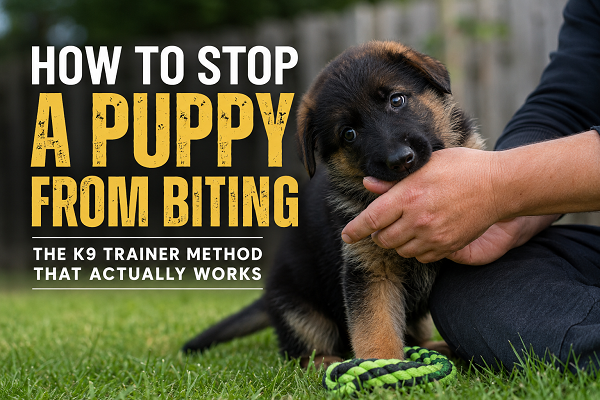
To stop a puppy from biting, you don’t punish the bite, you manage the mouth. Redirect every nip onto an appropriate chew or tug toy, end play the instant teeth touch skin, and give your puppy the physical outlet its age and energy level actually need. Most puppies drop the worst of the mouthing between 4 and 6 months old once teething ends, provided the household stays consistent. This is the same core principle K9 handlers use with working breeds before any formal bite work ever begins: manage the drive, don’t suppress it.
Table of Contents
- Why Your Puppy Is Biting (It’s Not What You Think)
- The Puppy Biting Timeline: What’s Normal, Age by Age
- The K9 Trainer Method, Explained
- Step-by-Step: How to Stop a Puppy From Biting
- The Redirection Toolkit Professional Handlers Actually Use
- 7 Mistakes That Make Puppy Biting Worse
- When Puppy Mouthing Crosses Into a Real Problem
- High-Drive vs. Low-Drive Puppies: Why Breed Matters
- Trainer Note: Who’s Behind This Advice
- FAQs
- Conclusion & Action Plan
Introduction
If you’ve ever raised a puppy, you know the exact moment I’m talking about. You reach down to scratch behind its ears, and instead of a lick, you get a mouthful of needle-sharp teeth. Or maybe it’s worse than that, your sleeve is soaked, your hand has little half-moon marks on it, and you’re starting to wonder if you brought home a shark instead of a dog.
Here’s the good news: almost every puppy does this, and almost every puppy grows out of it. I’ve spent over a decade working with military and security K9s, dogs bred specifically for high bite drive, dogs whose whole job depends on their mouth and I can tell you the exact same principles that stop a Malinois from shredding your couch cushions are what stop a Labrador puppy from turning your hand into a chew toy. The method doesn’t change. Only the intensity does.
In this guide, I’ll walk you through why puppies bite in the first place, what’s actually normal at each age, and the specific K9-trainer method for redirecting that behavior instead of just yelling “no” and hoping for the best (spoiler: yelling doesn’t work, and I’ll explain why). By the end, you’ll have a clear, step-by-step plan you can start using today.
Why Your Puppy Is Biting (It’s Not What You Think)
Let’s clear something up right away: puppy biting is not aggression. It’s mouthing, and it’s one of the most normal behaviors in canine development. Puppies explore the world through their mouths the same way human toddlers explore it through their hands. Combine that with teething discomfort, an total lack of impulse control, and a nervous system that hasn’t matured yet, and you get a small animal that bites everything, your fingers, your shoelaces, the corner of your coffee table, your kid’s stuffed animal.
There are actually a few different drivers behind it, and figuring out which one you’re dealing with changes how you respond:
- Teething discomfort. Puppies lose their baby teeth and grow in 42 adult teeth typically between 12 and 24 weeks of age, according to veterinary dental references from the American Veterinary Dental College. Chewing relieves the ache the same way a teething ring helps a human infant.
- Exploration. A puppy’s mouth is packed with nerve endings. Mouthing an object tells the puppy what it is, how hard it is, whether it moves.
- Play behavior carried over from the litter. Puppies learn “bite inhibition”, how hard is too hard, by playing with littermates. If a pup bites another pup too hard, the bitten puppy yelps and stops playing. That feedback loop is how dogs learn to soften their mouths. Puppies removed from litters too early (before 7-8 weeks) often have noticeably worse bite inhibition as adults, which is one reason reputable breeders won’t release puppies before that age.
- Overstimulation and overtiredness. This one surprises a lot of new owners. A puppy that’s had zero nap time and too much visual stimulation (kids running around, new environments, guests) will often get “mouthy” right before a meltdown, the same way an overtired toddler gets clingy or cries for no obvious reason.
- Prey drive. In higher-drive working breeds; Belgian Malinois, German Shepherds, Dutch Shepherds, biting is also tied to genetically selected prey drive. This is the instinct that makes a dog chase, grab, and hold, and it shows up earlier and more intensely in these breeds than in, say, a Cavalier King Charles Spaniel. If you’re raising a working breed, we cover this in depth in our guide on how to stop Belgian Malinois biting and channel drive the right way, which digs into the difference between prey drive, defense drive, and simple frustration.
Knowing why your puppy bites matters because it tells you what kind of outlet the dog actually needs. A teething puppy needs something to chew. An overtired puppy needs a nap, not a training session. A high-drive puppy needs structured outlets like tug and retrieve games, not just a stern “no.”
The Puppy Biting Timeline: What’s Normal, Age by Age
One of the most common questions I get from owners is “is this normal for this age, or do I have a problem dog?” Here’s a realistic timeline based on what I see across breeds, both working lines and companion breeds:
| Age | What’s Typically Happening | What To Expect |
|---|---|---|
| 8–10 weeks | Just left the litter, mouth exploration is constant | Frequent, soft nipping; low bite pressure |
| 10–16 weeks | Baby teeth are needle-sharp; teething begins | Peak biting intensity; hardest phase for most owners |
| 4–6 months | Adult teeth coming in, jaw pressure increasing | Fewer bites overall, but the ones that connect hurt more |
| 6–9 months | Adolescence; testing boundaries, impulse control still developing | Biting usually declines sharply with consistent training |
| 9–18 months | Most dogs have full impulse control developing | Mouthing during play may persist in high-drive breeds unless redirected into tug/retrieve outlets |
A stat worth knowing: trainers and breeders commonly report that most puppies show a real, noticeable drop in mouthing intensity by 9 to 12 months of age when the household has been consistent, and full impulse control tends to settle in somewhere between 18 months and 3 years, depending on the breed and the individual dog. That’s a long runway, and it’s exactly why so many owners give up on training too early, they expect a two-week fix for something that’s really a maturation process.
The K9 Trainer Method, Explained
So here’s the thing about working dog training that most pet owners never hear about: professional handlers don’t try to eliminate a dog’s drive to bite. They can’t, and honestly, they wouldn’t want to, that instinct is exactly what makes a detection dog persistent or a protection dog effective later in life. What handlers do instead is channel the behavior onto acceptable targets and build impulse control around when biting is and isn’t appropriate.
That’s the entire philosophy behind the K9 trainer method, and it applies just as well to a family Goldendoodle as it does to a police K9 candidate. It rests on three pillars:
- Redirect, don’t just correct. Every time your puppy’s mouth ends up on skin or clothing, you immediately offer an appropriate alternative, a tug toy, a chew, a flirt pole. You’re not punishing the drive to bite; you’re pointing it somewhere useful.
- Bite inhibition through consequence, not fear. When a bite connects too hard, the interaction stops. Not with yelling, not with a swat, with a calm, boring withdrawal of attention. Dogs, like most social animals, hate having the fun end. That’s the lesson, delivered without a shred of intimidation.
- Structured outlets on a schedule. Working dogs get scheduled bite work, tug sessions, and obedience drills specifically so the drive has somewhere planned to go. Pet puppies need the same thing on a smaller scale, 10 to 15 minutes of structured tug or fetch, two to three times a day, does more to reduce random nipping than any correction ever will.
This is a fundamentally different mindset than the old-school approach of holding a puppy’s mouth shut or “alpha rolling” it, techniques that have fallen out of favor for good reason. Research on canine behavior consistently shows that punishment-based corrections increase fear and can actually increase bite risk long-term, because a dog that’s afraid of consequences stops giving warning signals before it reacts. You want a dog that communicates, not one that’s learned to suppress the warning signs.
Step-by-Step: How to Stop a Puppy From Biting
Here’s the actual, practical method. I use a version of this with every young dog I work with, whether it’s a family pet or a future working K9.
Step 1: Manage the Environment First
Before you train anything, remove the setup for failure. Keep a chew toy or tug toy within arm’s reach in every room your puppy spends time in. A puppy that’s mouthing your hand because there’s genuinely nothing else to chew isn’t misbehaving, it’s doing exactly what puppies do when there’s no better option nearby.
Step 2: Redirect the Instant Teeth Touch Skin
The moment you feel teeth on skin, calmly present a toy. Don’t yank your hand away fast, that can actually trigger a chase-and-grab response in higher-prey-drive puppies. Instead, freeze your hand, let the bite go slack (puppies often loosen their grip on something that stops moving), then swap in the toy at the same spot.
Step 3: If the Bite Was Hard, End the Interaction
This is the part almost every new owner skips, and it’s the single most important piece of bite inhibition training. If your puppy bites down hard enough to hurt, stand up, step behind a baby gate, or place the puppy in its crate or pen for 30 to 60 seconds. No yelling. No physical correction. You’re teaching a consequence, play stops, not delivering a punishment.
Step 4: Reward Calm Mouths
This gets overlooked constantly. When your puppy licks instead of nips, or takes a treat gently, mark it, a quick “yes!” or a clicker and reward. Puppies repeat what gets reinforced, and a lot of owners only ever react to the biting, never to the good behavior sitting right next to it.
Step 5: Give the Drive a Job
Twice a day, run a structured 10-15 minute session of tug-of-war with clear rules (a “take it” and “drop it” cue), flirt pole work, or fetch. A puppy that’s had a legitimate outlet for its chase-grab-bite instinct has dramatically less motivation to use your hands as a substitute for the rest of the day.
Step 6: Get Consistency From Everyone in the House
If your kids let the puppy mouth their sleeves during rough play, but you correct the same behavior, your puppy gets a mixed signal and the whole process takes roughly twice as long to resolve. Every person interacting with the puppy needs to run the same playbook, same redirect, same “game over” response to hard bites.
Step 7: Track Progress by Frequency and Force, Not Perfection
Don’t expect zero mouthing in week one. Instead, track whether the bites are getting softer and less frequent over a two-week window. If they’re trending down, the method is working, even if your puppy still nips occasionally. If you want a deeper breakdown of foundational drive-shaping exercises used with working breeds, our guide to basic training techniques used with military K9s covers many of the same redirection and impulse-control drills scaled up for operational dogs.
The Redirection Toolkit Professional Handlers Actually Use
Not all chew toys are created equal for this job. Here’s what actually works, based on what handlers reach for:
- Rope tugs or fleece tugs — great for satisfying the “grab and pull” instinct without risking your hands.
- Frozen washcloths — soak a washcloth, twist it, and freeze it. The cold numbs sore gums during peak teething (10-16 weeks) far better than most plastic teething toys.
- Rubber chew toys with texture (like a Kong or similar) — durable enough to survive a determined teething puppy and satisfying enough to hold attention.
- Flirt poles — a toy on a rope attached to a pole, essentially a giant cat teaser for dogs. Excellent for burning off prey drive in higher-energy breeds without any risk to your hands or clothing.
- Snuffle mats or food puzzles — redirect mouthy energy into a calm, mentally tiring activity, which is especially useful in the evening when overtired puppies tend to get their most bitey.
Avoid toys that closely resemble household objects (an old sock, a shoe) since this teaches the puppy that those categories of objects are fair game, a lesson you’ll regret later when it’s your good shoes on the line.
7 Mistakes That Make Puppy Biting Worse
I see the same errors constantly, across every breed:
- Yelling “no” repeatedly. To a lot of puppies, especially high-energy ones, a raised voice reads as exciting, not corrective. It can actually escalate the behavior into a game.
- Pulling your hand away fast. This mimics prey behavior and can trigger a stronger chase-and-bite response, particularly in high-prey-drive breeds.
- Physical corrections (holding the muzzle shut, swatting, “alpha rolls”). These techniques are outdated, damage trust, and are associated with increased fear-based aggression later in life according to modern behavioral science.
- Inconsistent household rules. As mentioned above, mixed signals from different family members slow progress dramatically.
- Skipping structured exercise. An under-exercised puppy has pent-up energy that comes out as mouthing, chewing, and general chaos. This is doubly true for working breeds.
- Letting rough play with hands become the norm as a young puppy, then being surprised when a 60-pound adolescent dog still thinks hands are toys.
- Expecting a fast fix. Bite inhibition and impulse control are developmental processes, not switches you flip in a weekend. Owners who quit the method after three days because “it’s not working” usually just haven’t given it enough time.
When Puppy Mouthing Crosses Into a Real Problem
Most puppy biting is completely normal and resolves with consistency. But there are a few signs worth taking seriously enough to call in a certified trainer or veterinary behaviorist:
- Biting accompanied by stiff body language, growling, or snapping directed at family members over resources (food, toys, resting spots)
- Bites that break skin and draw blood repeatedly past 6 months of age
- Biting triggered by fear, cowering, ears pinned, tail tucked, followed by a snap
- A sudden change in biting behavior in an older puppy or adult dog, which can sometimes indicate pain (dental issues, ear infections, joint pain)
None of this is meant to alarm you, the overwhelming majority of puppy mouthing is developmentally normal. But if you’re seeing guarding behavior or fear-based biting rather than simple exploratory mouthing, that’s a different training conversation, and it’s worth getting hands-on professional support rather than trying to solve it from a blog post.
High-Drive vs. Low-Drive Puppies: Why Breed Matters
Not every puppy bites with the same intensity, and it’s not a reflection of “bad” behavior, it’s genetics doing exactly what it was bred to do.
Higher-drive breeds — Belgian Malinois, German Shepherds, Dutch Shepherds, Border Collies, working-line Labradors, were bred with strong prey and grip instincts. Breeders and trainers commonly report that these puppies show obvious chase-grab-tug behavior by 8 weeks of age, noticeably earlier and more intensely than companion breeds. If you’re raising a working-line puppy, the crate-and-house-manners foundation actually starts alongside bite inhibition work from day one; our comparison of working line vs. show line German Shepherd training differences breaks down exactly how the training intensity and timeline shifts depending on which type of puppy you bring home.
Lower-drive companion breeds — many toy breeds, some spaniels, several giant breeds, still mouth as puppies, but the intensity and duration tend to be shorter, and the same redirection method resolves it faster in most cases.
The takeaway: if you brought home a working breed and the mouthing feels more intense than what your neighbor’s puppy is doing, you’re probably not doing anything wrong. You’re just dealing with more horsepower, and the method needs more repetition and more structured outlets to match it.
Trainer Note: Who’s Behind This Advice
This guide draws on field-tested methods used with military and security working dogs, adapted for family puppies. The redirection-first, punishment-last approach outlined here reflects current best practice among certified professional trainers and mirrors guidance published by major veterinary behavior organizations, which have moved away from dominance-based corrections in favor of positive, consequence-based training. If you’re working with a young working-breed puppy specifically, pair this guide with a certified trainer experienced in drive-based work, bite inhibition training for a future protection or detection dog benefits from professional eyes on the process early.
FAQs
1. At what age do puppies usually stop biting?
Most puppies show a real drop in biting frequency and intensity between 6 and 9 months old, once the adult teeth are fully in and consistent training has been applied. Full impulse control typically isn’t complete until somewhere between 18 months and 3 years, depending on the breed.
2. Is it normal for my puppy to bite really hard sometimes?
Yes, especially during the 10-16 week teething window when baby teeth are sharpest and jaw control is still developing. Hard bites should still be met with an immediate, calm end to play so the puppy learns bite pressure has consequences.
3. Should I ever use a firm “no” or physical correction?
A calm, low-key verbal marker is fine, but physical corrections (muzzle holds, swats, alpha rolls) are outdated and linked to increased fear and aggression risk later in a dog’s life. Redirection and consequence-based training (ending play) work better and build more trust.
4. My puppy only bites certain family members. Why?
This usually comes down to inconsistency, if one person allows rough hand play and another doesn’t, the puppy learns different rules for different people. It can also relate to excitement level; kids running and squealing tend to trigger more mouthing than calm adults.
5. When should I worry that biting is more than normal puppy behavior?
If biting is paired with growling, stiff body language, or guarding around resources, or if hard bites are still happening consistently past 6 months of age despite consistent training, it’s worth consulting a certified trainer or veterinary behaviorist to rule out fear-based or resource-guarding aggression.
Conclusion & Action Plan
Puppy biting feels overwhelming in the moment, especially during that 10-16 week teething stretch when it seems like your hands never get a break. But this is one of the most predictable, well-understood parts of raising a dog, and it responds extremely well to a consistent, redirect-first method, the same core approach professional K9 handlers use with dogs whose entire job depends on their mouth.
Here’s your quick-start plan: keep a toy within reach everywhere your puppy goes, redirect the instant teeth touch skin, end play calmly when a bite is too hard, reward the soft mouth when you see it, and give your puppy a real structured outlet, tug, fetch, or a flirt pole, twice a day. Get everyone in the household running the same rules. Track progress over two-week windows, not single sessions.
Stick with it, and most puppies show real, noticeable improvement well before their first birthday. If you’re raising a higher-drive breed, expect the process to take a bit more repetition and a bit more structured outlet time but the method doesn’t change, and it works.
Have a puppy biting question we didn’t cover here? Reach out to the ARFS K9 Team through our contact page, we work with both family pets and working-line puppies and are happy to point you toward the right next step.

Her work centres on obedience, detection, protection and operational readiness. She favours proven methods built on repetition, consistency and real-world conditioning, so that both dogs and handlers are prepared for high-pressure tasks.
Rofiat represented the Nigerian Army Dog Centre at the Nigerian Army Day Celebration (NADCEL) 2026, where she led demonstrations in obedience, explosive detection, agility and tactical movement. Through articles, training content and documentaries, she shares field-based insight into how structured training, clear communication and trust between handler and dog affect performance and reliability.
She is the author of Beyond the Bark: Inside a Pro Handler's Playbook for Raising the Ideal Dog, a practical guide that helps dog owners and handlers apply professional training principles in everyday situations.
- How to Enter the COBA National Dog Championship - October 20, 2026
- K9 Advantix Dosage Chart & Safety Guide for Dogs - October 19, 2026
- How to Set Up & Use Bousnic Dog Training Collar - October 18, 2026