How to Start Search and Rescue (SAR) Dog Training at Home
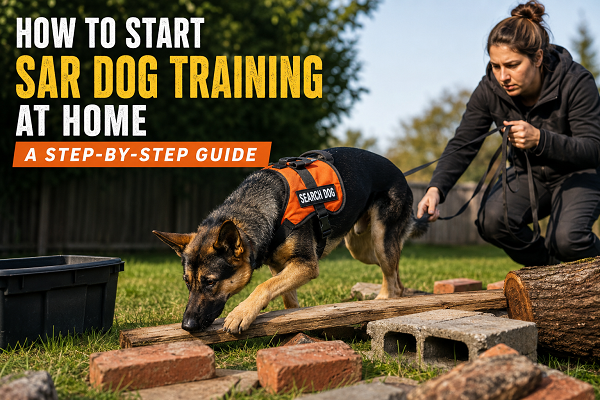
You can absolutely start SAR (search and rescue) dog training at home, but only the foundation. Home training covers rock-solid obedience, focus games, basic scent work, fitness, and exposure to noise and new environments. Certification-level tracking, cadaver work, and disaster search skills require a mentor and an established SAR team, because you can’t test yourself and you can’t replicate a real search scenario in your backyard. Most dogs need 6 months to 2 years of combined home and team training before they’re ready for certification.
Table of Contents
- What Is a Search and Rescue Dog, Exactly?
- Is Your Dog Actually Cut Out for SAR Work?
- What You CAN Train at Home (And What You Can’t)
- Step-by-Step: Starting SAR Dog Training at Home
- How Long Does SAR Dog Training Actually Take?
- What Does It Actually Cost?
- Certifications and Standards You Should Know
- 5 Mistakes That Sink Beginner SAR Teams
- Real Dogs, Real Missions: Why This Work Matters
- Trainer Insight
- FAQs
- Conclusion
Introduction
So you’ve watched a search dog work a debris pile on the news, or maybe you’ve seen a video of a Labrador zig-zagging through the woods with its nose in the air, and you thought: my dog could do that.
Honestly? A lot of dogs could. I’ve met plenty of “regular” family dogs, rescue mutts included, that had the drive and the nose for this work. What most people don’t realize is that SAR dog training doesn’t start in a disaster zone or a wilderness training exercise. It starts on your living room floor, in your backyard, and on your evening walks.
In this guide, I’ll walk you through exactly what you can train at home right now, what you genuinely cannot do without a team, how long the whole process realistically takes, what it costs (with real numbers, not vague estimates), and the mistakes that send most beginner SAR hopefuls back to square one. By the end, you’ll know precisely where to start tonight and when it’s time to pick up the phone and call a local SAR unit.
What Is a Search and Rescue Dog, Exactly?
Before you train for it, it helps to know what “SAR dog” actually covers, because it’s not one job. It’s a whole family of specialties, and most handlers eventually pick a lane rather than trying to master all of them.
- Air-scent (live find): The dog works off-leash, nose up, catching human scent carried on the wind, and leads the handler to the person. This is the classic wilderness search image.
- Trailing/tracking: The dog follows a specific person’s scent trail from a known starting point, usually nose-down, often on a long line.
- Human Remains Detection (HRD/cadaver): The dog is trained on the distinct scent of deceased human remains rather than living scent.
- Urban/disaster search: The dog searches rubble and collapsed structures for live victims, working on unstable footing, often navigating ladders and tight spaces.
- Water search: The dog detects human scent rising from submerged remains, working from a boat or shoreline.
- Avalanche search: Common in mountain regions of Europe and North America, these dogs locate buried victims under snow within critical rescue windows.
Here’s the thing most first-page articles skip: a single dog is rarely trained in all six disciplines. Most working SAR dogs specialize in one or two, because each discipline demands a different scent picture, a different search pattern, and different physical conditioning. If you’re just starting out, pick a lane once you and a mentor have assessed your dog’s natural strengths, don’t try to build a generalist from day one.
Is Your Dog Actually Cut Out for SAR Work?
I’ll be straight with you: not every dog can do this, and that’s not a knock on your dog. SAR work asks for a specific combination of traits that show up naturally in some dogs and just don’t in others.
Traits SAR teams actually look for:
- High food or toy drive — the dog needs to work for a reward with real intensity, not just mild interest
- Independent problem-solving — the dog has to make search decisions away from the handler, not wait for instructions every few seconds
- Nerve stability — calm around loud noises, unstable surfaces, strange smells, and chaotic environments
- Physical stamina — searches can run for hours over rough terrain
- Sociability — comfortable meeting strangers, since the dog is literally trained to find and approach people
- Recovery speed — bounces back quickly from a startling event instead of shutting down
Breeds you’ll commonly see in SAR units worldwide include Labrador Retrievers, Border Collies, German Shepherds, Belgian Malinois, Golden Retrievers, and Dutch Shepherds. But breed is a loose predictor, not a guarantee. Mixed-breed and shelter dogs work SAR successfully too, and organizations like the National Disaster Search Dog Foundation (SDF) in California specifically pull dogs from shelters and owner-surrenders because they’ve found high-drive, ball-obsessed “problem dogs” often make outstanding search candidates. If you’re weighing breed traits for working roles more broadly, our breakdown of police dog breeds and their real K9 roles covers similar drive-and-temperament thinking that applies here too.
Here’s a stat worth knowing before you get emotionally attached to the idea: even in highly selective government detection-dog breeding programs, washout rates hover around 50%. In general volunteer SAR programs, industry estimates put the number of dogs with the full combination of drive, nerve, and health needed for certification at somewhere between 5% and 15%. That’s not meant to discourage you, it’s meant to set realistic expectations so a “no” from a mentor later doesn’t feel like a personal failure. It’s a numbers game, and most working teams have a story about a dog that didn’t make it before the one that did.
Quick honesty check before you start: if your dog is reactive around strangers, shuts down around loud noise, or has zero interest in food or toys, SAR probably isn’t the right path, and that’s completely fine. There are other rewarding jobs, like scent work sport, tracking titles, or nose work classes, that let a dog use its brain without the operational pressure of a real search.
What You CAN Train at Home (And What You Can’t)
This is the part most guides gloss over, and it’s the reason so many well-meaning owners get frustrated three months in. Home training builds the engine. It does not build the certification.
You CAN absolutely train at home:
- Off-leash obedience: sit, down, stay, recall, and a rock-solid “leave it”
- Engagement and focus games in increasingly distracting environments
- Basic hide-and-seek scent games using toys, treats, or a “helper” person
- Introduction scent imprinting (pairing a specific scent with reward, using a scent kit)
- Physical conditioning: hiking, swimming, ladder and balance work, obstacle exposure
- Desensitization to noise, crowds, elevators, uneven footing, and strange surfaces
- Crate training and calm confinement (essential for transport and staging areas)
- Building a bombproof “search” cue and a clear “find” alert behavior
You genuinely CANNOT do alone at home:
- Certification testing (every credible certifying body requires independent evaluators)
- Realistic large-area searches with unknown “victims” (you know where your training helper is hiding; that defeats the purpose)
- Human Remains Detection scent material (this is tightly controlled and usually only accessible through an established team with proper permits)
- Structural collapse/rubble training (needs a purpose-built rubble pile or training facility)
- Mission-realistic stress inoculation (a real search environment has variables no backyard can replicate)
If you want a structured, day-by-day framework for building that foundation before you ever set foot at a team training day, I put together a companion resource covering the exact drills, milestones, and record-keeping system I use with new handlers. Check out the K9 handler training guide on Amazon if you want something to work through step by step alongside this article.
Step-by-Step: Starting SAR Dog Training at Home
Here’s the actual sequence I’d walk a new handler through, starting the day you decide to try this.
Step 1: Get Brutally Honest With a Temperament Assessment
Before you spend six months training, spend one week testing. Take your dog to a busy park, a hardware store, near construction noise, and around unfamiliar dogs and people. Watch for recovery time after a startle, willingness to approach strangers, and how hard your dog will work for a toy or treat it can’t immediately reach. Write down what you observe. This baseline matters later when a mentor asks about your dog’s history.
Step 2: Build Obedience That Holds Under Pressure
Not living-room obedience, distraction-proof obedience. Your dog needs a recall that works when there’s a rabbit thirty feet away, and a “stay” that holds when a stranger walks past. Practice in parking lots, around other dogs, near loud equipment. This single step is where most beginner SAR dogs either shine or stall out, because search work is obedience training wearing a costume.
Step 3: Turn Up Engagement and Focus
Play tug or fetch games that reward your dog for checking in with you, not just chasing the toy. A dog with strong “handler focus” is easier to direct in a real search. Five to ten minutes a day of engagement games, twice daily, builds this faster than most people expect.
Step 4: Introduce Basic Scent Games
Start absurdly simple. Hide a favorite toy or a treat pouch in an easy spot and let your dog find it, celebrating loudly when they do. Over one to two weeks, increase difficulty: different rooms, outdoor spaces, elevated hides, hides behind obstacles. This builds scenting confidence and teaches your dog that using their nose is a rewarding job, which is the entire foundation of every SAR discipline.
Step 5: Add a “Helper” Search Game
Once your dog reliably finds objects, add a person into the game. Have a family member walk a short distance away and hide in a simple spot (behind a tree, around a corner) while you hold your dog. Release your dog with a search cue and let them find the person, who rewards them enthusiastically on arrival. This is the earliest version of a live-find search, and it’s the game most professional SAR programs start puppies on.
Step 6: Layer in Real-World Distraction and Terrain
Take training sessions to different surfaces: gravel, sand, grass, tile, metal grates. Walk your dog near traffic, crowds, and construction sites (safely, from a distance at first). SAR dogs need to work through chaos, not around it, so exposure now saves you months of setbacks later.
Step 7: Build Physical Fitness Together
SAR searches can run for hours over rough ground. Start a consistent hiking and conditioning routine, gradually increasing distance and elevation. This benefits you as much as your dog, since handlers hike right alongside their dogs for the full duration of a real search.
Step 8: Find a Mentor and a Local Team Before You “Certify” Anything
This is non-negotiable, and every credible SAR resource says the same thing. Contact a local SAR unit (search NASAR’s team directory or your state emergency management office) and ask to observe a training day. Most teams require several months of “support” involvement, acting as a hidden subject, helping with logistics, before they’ll evaluate your dog. This isn’t bureaucracy for its own sake; it’s how you learn techniques a blog post genuinely can’t teach, and how your dog gets exposed to real training scenarios you can’t build alone.
How Long Does SAR Dog Training Actually Take?
This is where expectations and reality tend to diverge the most, so let’s use real numbers instead of vague promises.
| Program Type | Typical Timeline | Notes |
|---|---|---|
| Home foundation (obedience, focus, basic scent) | 2–4 months | Can start immediately, no team needed |
| Volunteer, owner-trained SAR team (most common path) | 1.5–2 years to certification | Weekly team training plus daily home practice |
| Professional program (e.g., National Disaster Search Dog Foundation) | 10–12 months | Full-time training staff, FEMA-track certification |
| FEMA Canine Search Team certification (live find) | Dog must be 18+ months old minimum | Requires Foundation Skills Assessment first, then formal evaluation |
A widely cited peer-reviewed field study on lowland search dogs found a baseline success rate of 76.4%, with an effectiveness rate of 62.9% once false alerts were factored in, a useful reminder that even fully trained search dogs aren’t perfect, and that’s exactly why standardized certification testing exists. Don’t chase a 100% pass rate as your personal benchmark; chase steady, measurable improvement instead.
What Does It Actually Cost?
Nobody talks about this enough, and it’s a big reason handlers burn out. SAR is almost always volunteer work. You are not paid, and in most regions, you fund everything yourself.
- Basic gear (harness, first aid, GPS, radio, boots, backpack): roughly $500–$1,500 to start
- First two years of training and travel (CARDA-reported range): $2,000–$4,000
- Professional-track training program cost (SDF-style, fully funded programs): around $75,000 per dog-handler team, almost always covered by the nonprofit, not the handler, if you’re accepted
- Owner-purchased, pre-trained SAR-ready dog: can run up to $10,000, though this is uncommon since most SAR dogs are owner-trained from a young age
- Annual maintenance costs (fuel, vet care, food, recertification fees): commonly a few thousand dollars a year, ongoing
If those professional-program numbers make your eyes widen, that’s normal, and it’s exactly why the volunteer, owner-trained route (a local team plus home training) is how the vast majority of SAR handlers actually get started.
Certifications and Standards You Should Know
Once your home foundation is solid and you’ve joined a team, you’ll start hearing acronyms constantly. Here’s a plain-English cheat sheet:
- NASAR (National Association for Search and Rescue): A US-based organization offering SAR Tech training and resources; a common entry point for handler-side education.
- ARDA (American Rescue Dog Association): One of the oldest US volunteer SAR dog organizations, focused on live-find and disaster work.
- ASTM International standards (F1847, F1848, F1879, F2209): These are the technical guides that define minimum skills, team classifications, and obedience/agility demonstration standards used across the US SAR community and referenced directly in FEMA’s canine position qualifications.
- FEMA Canine Search Team Certification (CE-LF/CE-HRD): The gold standard for US disaster response deployment; requires the dog to be at least 18 months old and involves a Foundation Skills Assessment before the full certification evaluation.
- AKC Search and Rescue titles (SAR-U1, SAR-U2, SAR-W): The American Kennel Club recognizes FEMA/SUSAR-certified deployable dogs with U1 and U2 titles, and offers a Wilderness SAR title (SAR-W) requiring at least five real wilderness SAR deployments plus certification from a recognized SAR body.
- INSARAG (International Search and Rescue Advisory Group): The UN framework many countries outside the US reference for urban search and rescue classification, useful if you’re training somewhere without a FEMA-equivalent system.
If you’re the type who likes structure and wants to understand how larger, professional-style K9 programs are built from the ground up (useful context even for a single-dog SAR journey), our guide on how to start a military K9 training program breaks down program objectives, breed selection, and facility standards that overlap more than you’d expect with serious SAR team-building.
5 Mistakes That Sink Beginner SAR Teams
I’ve watched enthusiastic new handlers stall out for the same handful of reasons, over and over.
- Doing “searchy things” too early. Letting your dog freelance-search in unstructured settings before obedience is solid can teach bad habits (chasing wildlife, ignoring recalls) that take months to undo. Walk your dog in the environments it’ll search in before you ask it to search there.
- Skipping the mentor step because “we’re doing fine on our own.” Self-training without outside eyes means nobody catches small errors, like unconsciously cueing your dog toward the hide, before they become ingrained habits.
- Underestimating the handler’s own fitness and skills. Map reading, compass and GPS use, radio communication, and canine first aid are just as much a part of certification as your dog’s nose work. Teams wash out handlers just as often as dogs.
- Trying to train every discipline at once. Splitting focus between air-scent, trailing, and HRD work early on slows progress in all three. Pick one lane with your mentor’s guidance.
- Not tracking training data. Handlers who log session details (duration, distraction level, success rate, environmental conditions) consistently see measurable performance gains over those who train “by feel.” A simple notebook or spreadsheet works fine; you don’t need fancy software.
Real Dogs, Real Missions: Why This Work Matters
Numbers and steps are useful, but they don’t quite capture why people put years into this work for zero pay. A search dog can cover ground that would take twenty to thirty human searchers to match, and can detect scent under rubble, snow, or water that no camera or sensor can reliably find.
The National Disaster Search Dog Foundation, founded after the 1994 Northridge earthquake exposed a shortage of FEMA-certified canine teams in the US, has since trained and certified more than 200 dog-handler teams, almost entirely using shelter and owner-surrendered dogs. Its FEMA certification rate has climbed from roughly 15% in its early years to around 85% today, a direct result of refined selection and training methods, not luck.
That kind of track record is a good reminder that a “difficult” shelter dog with obsessive ball drive and boundless energy, the kind that gets returned to rescues for being “too much”, is sometimes exactly the dog a SAR program is looking for. If you’re considering a rescue dog for working roles, our piece on how K9 units evaluate rescue dogs for real search work shows how departments and teams spot that potential.
Trainer Insight
Written and reviewed based on hands-on working-dog training experience, including obedience, detection, and operational K9 deployment work with ARFS K9 Team.
The single biggest thing I’d tell anyone starting this journey: SAR training rewards patience over intensity. I’ve seen handlers push six months of progress into six frantic weeks and burn their dog out on scent work before it ever properly enjoyed the game. The dogs that go the distance are the ones whose handlers treated the whole thing, obedience, fitness, scent games, mentorship, as a long, steady relationship rather than a race to a certification badge. If you take one thing from this article, let it be that.
FAQs
1. Can I train my own dog for search and rescue without joining a team?
You can build the entire foundation at home: obedience, focus, basic scent games, and fitness. But every credible certification path (FEMA, NASAR-aligned teams, AKC titles) requires evaluation by an independent, trained assessor, so you’ll need to join a local SAR team before your dog can become operational.
2. What age should my dog be to start SAR training?
Foundational games like hide-and-seek and obedience can start as early as puppyhood, often from 8–12 weeks. Most formal certification programs, including FEMA’s CE-LF process, require the dog to be at least 18 months old before the official evaluation.
3. What breeds make the best search and rescue dogs?
Labrador Retrievers, Border Collies, German Shepherds, Belgian Malinois, and Golden Retrievers are common, but temperament and drive matter far more than breed. Mixed-breed and shelter dogs regularly succeed in SAR programs, including many trained by the National Disaster Search Dog Foundation.
4. How much does it cost to train a search and rescue dog?
Expect to spend roughly $2,000–$4,000 in your first two years as a volunteer handler (gear, travel, training fees), separate from ongoing food and veterinary costs. Fully funded professional programs can cost around $75,000 per team, though that cost is typically covered by the nonprofit organization, not the individual handler.
5. How long does it take for a dog to become a certified SAR dog?
Most volunteer, owner-trained teams take 1.5 to 2 years from the start of formal training to certification. Full-time professional programs can compress this to 10–12 months. Either way, plan for months, not weeks.
Conclusion
Starting SAR dog training at home isn’t a myth, and it isn’t a shortcut either. It’s the honest first stage of a process that, if you and your dog have what it takes, could eventually put you both in the field finding people who genuinely need to be found. Start with the temperament check, build obedience that holds up under real distraction, layer in simple scent games, get physically fit alongside your dog, and reach out to a local SAR team long before you think you’re “ready.” The dogs and handlers who make it aren’t the ones who rushed. They’re the ones who treated every walk, every hide-and-seek game, and every obedience rep as one more brick in a foundation built to last two years or more.
If you’re serious about this path, your very next action shouldn’t be buying gear, it should be finding your local SAR team’s contact page and asking to observe a training day. Everything else in this guide gets you ready for that conversation.
Related reading: Top Police Dog Breeds and Their Real K9 Roles | How to Start a Military K9 Training Program | Giant Schnauzer vs. Malinois for Protection | Fort Collins K9 Police Dogs: Breeds & Tactical Training | Roanoke Police Rescue Dog: How K9 Units Train Them

Her work centres on obedience, detection, protection and operational readiness. She favours proven methods built on repetition, consistency and real-world conditioning, so that both dogs and handlers are prepared for high-pressure tasks.
Rofiat represented the Nigerian Army Dog Centre at the Nigerian Army Day Celebration (NADCEL) 2026, where she led demonstrations in obedience, explosive detection, agility and tactical movement. Through articles, training content and documentaries, she shares field-based insight into how structured training, clear communication and trust between handler and dog affect performance and reliability.
She is the author of Beyond the Bark: Inside a Pro Handler's Playbook for Raising the Ideal Dog, a practical guide that helps dog owners and handlers apply professional training principles in everyday situations.
- Dog Hotel Prep: 7 Must-Haves Before Boarding - October 21, 2026
- How to Enter the COBA National Dog Championship - October 20, 2026
- K9 Advantix Dosage Chart & Safety Guide for Dogs - October 19, 2026