E-Collar EZ-900 Easy Educator Review (2026): Worth It?
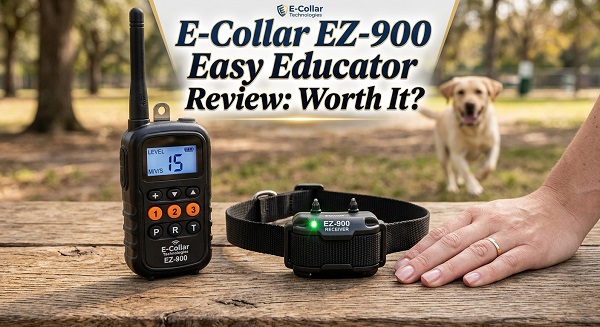
The E-Collar EZ-900 Easy Educator is a waterproof, half-mile remote dog trainer for dogs from 5 pounds up. It gives you 100 levels of “blunt” stimulation, a boost setting from 1 to 60, vibration and tone options, and a night light, all from a small bar-shaped remote. It’s a solid pick for off-leash recall and obedience work with a normal-temperament dog and a handler who’s willing to learn it properly. It costs $249.99 on the maker’s site, so it’s not the cheapest Educator, and some owners find the button programming clunky. Skip it for fearful or aggressive dogs unless a qualified trainer is guiding you.
Table of Contents
- What Is the E-Collar EZ-900 Easy Educator?
- EZ-900 Specs at a Glance
- EZ-900 Features Explained
- What Owners Like and Don’t Like
- Is the EZ-900 Right for Your Dog?
- EZ-900 vs ET-300 vs PE-900
- How to Set Up and Fit the EZ-900
- How to Find Your Dog’s Working Level
- Common EZ-900 Mistakes
- Are E-Collars Legal Where You Live?
- Price and Where to Buy
- How We Reviewed the EZ-900
- FAQs
- Final Verdict
Introduction
Ever stood in a park watching your dog sprint toward a squirrel, a road, or another dog, shouting a recall word that might as well be in another language? I’ve seen that moment ruin more good dogs than any bad breeding ever did.
That’s why remote trainers exist. But the e-collar market is confusing. E-Collar Technologies alone sells the EZ-900, ET-300, PE-900 and more, and the product pages all sound the same. Reviews online often read like ads, or they trash the whole category without explaining anything.
So here’s what this guide does. You’ll see exactly what the EZ-900 Easy Educator does, what it doesn’t do, what real owners complain about, how it stacks up against its siblings, and how to fit and introduce it safely. You’ll also learn where these collars are restricted, because that matters if you live in or ship to parts of Europe, the UK or Australia.
What Is the E-Collar EZ-900 Easy Educator?
The EZ-900 is a remote training collar from E-Collar Technologies, a company based in Garrett, Indiana. The maker says it assembles the unit in the USA. It’s part of the “Educator” line, which the brand pitches as lower-stimulation, more controlled training tools.
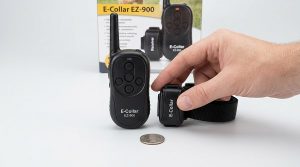
You get two parts: a handheld transmitter (the remote) and a receiver that sits on a strap around your dog’s neck. When you press a button, the receiver sends a vibration, a tone, or an electrical stimulation, depending on the mode you chose.
How the EZ-900 Delivers Stimulation
E-Collar calls the sensation “blunt” and says its COS (Control of Stimulation) technology avoids the sharp, head-jerking feel some collars produce. Treat that as the manufacturer’s claim. I can’t verify it from a spec sheet, and dogs differ a lot in how they react.
What matters in practice is that you can start very low, watch your dog, and move up one step at a time. We’ll cover exactly how in the working-level section below.
What’s in the Box
Contents vary a little by seller, so check your listing. Typical kits include:
- Waterproof receiver
- Waterproof transmitter
- A 3/4-inch Biothane strap (about 30 inches long, cut to fit)
- Two sets of contact points (5/8-inch and 3/4-inch) and a removal tool
- Dual battery charger
- Owner’s manual with training tips
- Lanyard, and on some kits a belt clip
The Amazon version we link below also lists a PetsTEK clicker in the kit.
Who the Maker Built It For
E-Collar’s own product page tags the EZ-900 for normal-temperament dogs and intermediate experience level. It says the collar works on normal-temperament dogs up to 150 pounds. That “intermediate” tag is worth noticing. This isn’t a plug-and-play toy. You need patience with the manual.
EZ-900 Specs at a Glance
| Spec | EZ-900 Easy Educator |
|---|---|
| Range (advertised) | 1/2 mile (about 0.8 km) |
| Stimulation levels | 100 (some retailers cite 256 underlying steps) |
| Boost level | Adjustable, 1 to 60 |
| Stimulation modes | 5: Momentary, Momentary Boost, Continuous, Continuous Boost, InstaStim |
| Vibration modes | 7 (set via computer interface) |
| Tone options | 4, with volume control (via computer interface) |
| Receiver size and weight | About 2.0 x 1.5 x 1.1 in, 2.4 oz |
| Minimum dog size | 5 lb |
| Dogs per system | Up to 2 |
| Charge time | About 2 hours (lithium polymer) |
| Night light | Yes, solid or flashing, controlled from the remote |
| Waterproof | Yes (receiver and transmitter) |
| Manufacturer price | $249.99 (checked October 2026) |
Sources: E-Collar Technologies product page and retailer listings. Always confirm specs against the manual that ships with your unit.
EZ-900 Features Explained
A spec table only tells you so much. Here’s what each feature means when you’re standing in a field with a dog 200 yards away.
100 Levels and “Lock and Set”
The EZ-900 has a stimulation dial and 100 levels. That fine resolution matters because most dogs respond at the low end of any scale. “Lock and Set” lets you lock the level so a bumped dial can’t jump your dog from a 12 to a 40. There’s also a maximum stimulation setting that caps how high the dial can go.
I love safety features like these. Most accidental over-correction comes from a handler fumbling a dial, not from bad intent.
Boost 1 to 60
Boost is a second level you pre-program. You hit it when your normal level gets ignored, like when your dog is locked onto a deer trail. Set it with care. A boost you’ve never tested on your dog is a number you shouldn’t trust in an emergency.
Five Stimulation Modes (Including InstaStim)
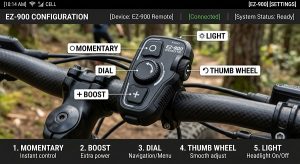
You can choose a quick pulse, a boosted pulse, continuous stimulation for up to 10 seconds, or continuous boost. The fifth mode, InstaStim, builds stimulation gradually using the thumb wheel, with no button press. One owner on an Amazon listing said they liked the thumb wheel for setting the level and picked the EZ-900 because of it. Another said the instant mode wouldn’t work on the unit they got, so test every mode on day one.
Vibration, Tapping and Tone
This is where the EZ-900 stands out from simpler collars. Through the computer interface, you can customize:
- Seven vibration modes: high, medium and low continuous vibration, three tapping-sensation settings (one second on, one second off), and a mode that pairs vibration with stimulation.
- Four tone options: high, medium and low tones, plus a tone-then-stimulation mode.
Why does that matter? Because many handlers use tone or vibration as the main cue and keep stimulation as a backup. That’s a gentler way to work, and it’s often what a dog that already knows its commands needs most.
Night Light and Lost-Transmitter Beeper
The remote controls a light on the receiver, solid or flashing, so you can find your dog after dark. There’s also a beeper that helps you find a misplaced transmitter. If you walk dogs at dusk or hunt, you’ll use that light more than you expect.
Biothane Strap and Waterproofing
Biothane is a coated webbing that wipes clean and doesn’t soak up mud. E-Collar offers 14 strap colors and bungee and quick-snap styles. One owner on a retailer page said their collar handled saltwater exposure every weekend through the summer. That’s one report, not a lab test, but it matches the waterproof design.
Computer Interface (And Its Quirks)
The EZ-900 series software lets you program button modes, vibration patterns and tones. Here’s what most reviews skip: the original version runs on Windows and needs an older Java 8 (32-bit) install. Mac owners have had success running it through Parallels, per E-Collar’s own notes. The company also points to a redesigned interface tool at ez-interface.com.
That explains why one buyer complained the software felt dated. If you hate tinkering with old software, factor that in.
What Owners Like and Don’t Like
I read owner feedback across several retailers. These are individual reports, not a statistical sample, but the patterns are useful.
What Owners Like
- Compact, light receiver. At 2.4 ounces it works on small dogs and stays comfortable on big ones.
- Waterproof and tough. Owners mention rain, rivers and saltwater without trouble.
- Fine control. The dial and lock feature let you stay at low levels.
- Off-leash freedom. One owner on E-Collar’s own site said it gave their dog off-leash freedom. A professional trainer on another listing said they chose it partly because many of their clients refused “shock” collars and the low-level tapping and vibration modes suited them.
- Customer service. One owner on the maker’s page said a replacement part shipped within hours of contacting support. Take testimonials on a company’s own site with a grain of salt, though.
What Owners Don’t Like
- Clunky programming. One buyer said holding the Program button to set modes felt ridiculous, and that boost needs two button presses.
- Dated software. Windows-only and older Java, as covered above.
- Belt clip. A buyer called it too tight to clip onto a normal pocket.
- Battery and pairing complaints. One Amazon buyer said they had to charge the collar almost daily. Another had a remote stop pairing after two months, though they later updated their review upward. Others report no problems, so this looks like unit-to-unit variation, but it’s worth knowing.
- “Get the pro instead.” At least one retailer review said the EZ has fewer features than the PE-900 and recommended paying more for the Pro. Another Amazon owner called the PE-900 far superior but pricier.
- Price. At $249.99 direct, it costs more than the ET-300, which lists at $219.99 on the same site.
So here’s the thing: the EZ-900 isn’t flawless. It rewards handlers who read the manual and test everything before the first real session.
Is the EZ-900 Right for Your Dog?
I’ll be blunt, because no review should dodge this part.
Dogs and Handlers It Suits
- Normal-temperament adult dogs that already know basic commands and need reliability at distance
- Hunting, hiking and farm dogs that work out of reach of a leash
- Small dogs from 5 pounds, thanks to the 2.4-ounce receiver, and large dogs up to 150 pounds
- Households with two dogs (the system expands to two)
- Handlers who like to tinker with settings and plan to use tone and vibration first
Dogs and Situations to Skip
- Fearful dogs. Stimulation added to fear can make a dog more anxious. Dogs Trust, a UK charity, warns that dogs may not link a shock to any specific behavior and can become anxious about the whole situation. Work on confidence first.
- Aggressive or reactive dogs. Some sellers pitch e-collars for aggression. I’d never do that without a qualified behaviorist watching. A mistimed press can make a reactive dog worse.
- Young puppies. Many trainers wait until a dog is well past puppyhood and knows its commands. Check your manual for age guidance and ask your vet.
- Dogs with neck injuries or skin problems. The contact points press on the neck skin.
- Nuisance barking. The EZ-900 isn’t a bark collar. E-Collar sells a separate bark-specific model.
Build the Foundation First
No collar fixes weak training. A remote only works when your dog already understands what the cue means. If your basics are shaky, start with a solid obedience plan. Our e-book, Beyond the Bark, walks through the handler-style foundation work that makes any tool, including this one, more effective.
EZ-900 vs ET-300 vs PE-900
This is the question I see most. All three come from E-Collar Technologies, and all three advertise a half-mile range. Here’s how the EZ-900 compares with the ET-300 Mini Educator, using the maker’s own product pages.
| Feature | EZ-900 Easy Educator | ET-300 Mini Educator |
|---|---|---|
| Manufacturer price (Oct 2026) | $249.99 | $219.99 |
| Remote shape | Bar-shaped, one-handed | Compact, round per owners |
| Range | 1/2 mile | 1/2 mile |
| Stimulation levels | 0 to 100 | 0 to 100 |
| Boost | 1 to 60 | 1 to 60 |
| Vibration and tone | 7 vibration modes, 4 tones (PC-programmable) | Tapping sensation and tone |
| Computer customization | Yes | Not in the manual’s feature list |
| Lock and Set | Yes | Yes |
| Night light | Yes | Yes |
| Two-dog option | Expandable to 2 | Separate ET-302 model |
My take: If you want simple and cheaper, the ET-300 covers the core job. Pick the EZ-900 if you want the extra vibration and tone options and don’t mind the software.
The PE-900 Pro Educator sits above both. Retailer listings describe it as expandable to three dogs, with a belt clip and storage box in the kit, and owners describe it as having more control over button programming. If you work several dogs or want that extra control, ask yourself whether the Pro’s extra cost is worth it before you buy the EZ.
How to Set Up and Fit the EZ-900
The numbered steps below follow E-Collar’s general guidance for its Educator line. Your EZ-900 manual is the final word.
- Charge both units fully. E-Collar’s Educator manuals list about two hours.
- Pair and test. Read the manual’s pairing steps, then test each mode with the collar in your hand, not on your dog.
- Turn the level down. E-Collar’s manuals for related models advise keeping the level below 5 whenever you’re not actively training, to avoid accidental presses.
- Pick the contact points. The 5/8-inch points suit most coats. Thick or very short coats may need longer or different points.
- Fit it high on the neck. Place the receiver below the jaw and ears, with the points touching skin, not just fur.
- Check the snugness. E-Collar’s guidance is snug enough for steady contact but loose enough that you can slip one finger under the strap.
- Limit wear time. E-Collar’s manuals for related Educator models say never wear the receiver more than 12 hours a day. I treat that as a hard ceiling and use far less. Take it off after sessions and check the skin.
How to Find Your Dog’s Working Level
This is the single most important step, and the one new owners rush.
The working level is the lowest setting where your dog just notices the sensation. You’re looking for a tiny sign, like an ear flick, a head turn or a pause. You never want a yelp, a flinch, or a frozen dog.
Step by Step
- Let your dog wear the collar switched off for a few days during meals, walks and play. You want it to feel boring.
- Start at the lowest level. Press the momentary button once while your dog is relaxed and distracted by something calm.
- Watch closely. No reaction? Go up one level and try again.
- Stop at the first subtle reaction. Note that number.
- Test again on a different day and in a different place. Excitement raises the number you need. A calm kitchen might need a 6 while a busy park needs a 12.
- Pair that level with a command your dog already knows.
If your dog shows stress, stop. Drop the level, or switch to tone or vibration and revisit your training plan.
A Simple Recall Plan
Here’s the rough shape I use with handlers. These timelines are rules of thumb from training practice, not guarantees. Dogs vary.
- Week 1 to 2: Collar conditioning on a long line. Tone or low level, then call, then reward.
- Week 3 to 4: Add distance and mild distractions on the long line.
- Week 5 onward: Short off-leash sessions in safe areas, tone first, stimulation only as the backup you’ve already tested.
If your dog isn’t reliable on the long line, don’t go off-leash. The collar adds clarity. It doesn’t replace the work.
Want gear to go with it? Our guide to K9 training equipment covers long lines, leashes and the basics a handler should carry.
Common EZ-900 Mistakes
- Starting at a high level. It creates fear, not learning.
- Wearing the receiver too low. The points never touch skin, so the dog gets no clear signal.
- Using it before the dog knows the command. The collar can’t teach what a word means.
- Leaving it on all day. That risks neck irritation and makes the collar a constant background feeling.
- Never testing boost. Learn what boost feels like in a calm setting.
- Skipping the lock. Use Lock and Set, then double-check the number before each session.
- Ignoring body language. Learn the early stress signs, like lip licking, a lowered tail or a stiff body. Our guide to the best dog training collars for working dogs compares other tools if you decide a remote isn’t right for your dog.
Are E-Collars Legal Where You Live?
This is the section most EZ-900 reviews leave out, and for a global audience it’s essential.
The Debate in Plain Terms
Animal-welfare groups argue that shock-based training can harm welfare. The UK Kennel Club has cited University of Lincoln research from 2019 that found welfare was compromised even with professional e-collar trainers, and that the collars were no more effective than positive reinforcement. Supporters, including groups like the UK’s Association of Responsible Dog Owners, say responsible use at low levels is safe and that bans would hurt dogs, livestock and wildlife. Both sides have real people behind them. You should know the debate before you buy.
Where Rules Differ
- Wales: E-collars are banned under the Animal Welfare (Electronic Collars) (Wales) Regulations 2010.
- England: Regulations were drafted to ban remote-controlled shock collars from February 1, 2024, but they never came into force. Retailer and campaign sources I found from 2025 and 2026 say no ban is in force, though the government has said it remains committed to one. Check the latest status before you buy.
- Scotland and Northern Ireland: Sources I found say neither has a ban in force. Scottish guidance says it doesn’t condone shock collars.
- Europe and elsewhere: One trainer-association tracker lists bans or restrictions in Germany, Austria, Switzerland, France, Spain, the Nordic countries, the Netherlands and Slovenia, several Australian states and territories, and Colombia. It also lists Flanders in Belgium as due to take effect in 2027.
- United States: E-collars remain legal.
Laws change, and some of my sources are trainers or retailers with a stake in the topic. Check your own national and local rules before you buy or ship an e-collar. Even where it’s legal, general animal-cruelty laws still apply.
Price and Where to Buy
E-Collar lists the EZ-900 at $249.99 on its own site, and the same page shows free ground shipping over $25 in the lower 48 states. Some retailers list it near $229.99. Prices shift, so check before you buy.
A warning from my search: I saw a listing at a shockingly low price on an unfamiliar website. If the deal looks too good to be true, it usually is. Buy from the maker, a known retailer, or Amazon with a seller you trust, and register your product afterward so warranty claims go smoothly.
Check the current price of the E-Collar EZ-900 Easy Educator on Amazon
That Amazon version includes the PetsTEK clicker. If you’d rather compare, pair this review with our Bousnic dog training collar review to see how a budget option stacks up on safety.
How We Reviewed the EZ-900
Here’s my honest approach, because trust matters in a product review.
This review draws on E-Collar Technologies’ product pages and owner’s manuals, owner reviews from several retailers, legal and welfare sources, and more than a decade of handler experience with remote tools in working-dog settings. We built the fit, working-level and recall guidance from E-Collar’s published instructions plus standard training practice.
We didn’t run a lab test, and we can’t verify the maker’s marketing claims on stimulation feel. Where a point comes from one owner, I say so. I also link to the manual, because it beats any blog, mine included.
About the author: Rofiat Muritala is a veteran military K9 handler and certified trainer with 14+ years of experience. She writes about working dogs, K9 security and practical training for handlers and pet owners worldwide.
FAQs
What’s the difference between the EZ-900 and the PE-900?
Both advertise a half-mile range and 100 stimulation levels. Retailer listings describe the PE-900 Pro Educator as expandable to three dogs, with extra kit items like a belt clip and storage box. Owners also describe the Pro as giving more control over buttons. The EZ-900 expands to two dogs and relies more on the computer interface for customizing vibration and tone modes.
Is the EZ-900 a shock collar?
Yes, it can deliver electrical stimulation, which E-Collar calls “blunt.” It also offers tone, vibration and tapping modes, so you can train without stimulation if you choose. The collar is a tool, and results depend on how you use it.
How far does the EZ-900 really work?
The maker advertises a half mile, which is about 0.8 kilometers. That figure assumes clear conditions. Hills, thick woods and buildings can shorten real range, so test the range in your own terrain before you rely on it.
Can I use the EZ-900 on two dogs?
Yes. The system is expandable to two dogs. A one-dog transmitter can be converted with replacement parts, or you can buy the two-dog EZ-902 version, which costs more. Locking a separate level for each dog helps prevent mix-ups.
How long does the EZ-900 take to charge, and is it waterproof?
E-Collar lists a charge time of about two hours using lithium polymer batteries. Both the receiver and transmitter are waterproof. Battery life reports vary, with one Amazon buyer complaining of near-daily charging, so check your unit’s runtime during the first week.
Final Verdict: Should You Buy the EZ-900?
Buy the EZ-900 if you have a normal-temperament dog that already knows its commands, you want a compact, waterproof remote with fine control and gentle tone and vibration options, and you’re ready to read the manual and learn the settings. Skip it if you want the cheapest option, you hate fiddly software, or your dog is fearful or aggressive and needs a behavior professional first.
Here’s what to do next:
- Check that e-collars are legal where you live.
- Build solid command training before you add a remote.
- Condition your dog to the collar switched off for a few days.
- Find the lowest working level and test every mode, including boost.
- Use tone or vibration first. Keep stimulation as the tested backup.
- Keep wear time short and check the neck after every session.
Want more practical training breakdowns like this one? Subscribe to our weekly articles roundup newsletter at https://arfsk9team.com.ng/newsletter/ and get new guides in your inbox every week.

Her work centres on obedience, detection, protection and operational readiness. She favours proven methods built on repetition, consistency and real-world conditioning, so that both dogs and handlers are prepared for high-pressure tasks.
Rofiat represented the Nigerian Army Dog Centre at the Nigerian Army Day Celebration (NADCEL) 2026, where she led demonstrations in obedience, explosive detection, agility and tactical movement. Through articles, training content and documentaries, she shares field-based insight into how structured training, clear communication and trust between handler and dog affect performance and reliability.
She is the author of Beyond the Bark: Inside a Pro Handler's Playbook for Raising the Ideal Dog, a practical guide that helps dog owners and handlers apply professional training principles in everyday situations.
- E-Collar EZ-900 Easy Educator Review (2026): Worth It? - November 24, 2026
- How Much Exercise Does a Great Dane Need Daily? - November 23, 2026
- How to Safely Approach Stray Dogs: 5 Field Rules - November 22, 2026