How Are Military Working Dogs Trained? Full Guide
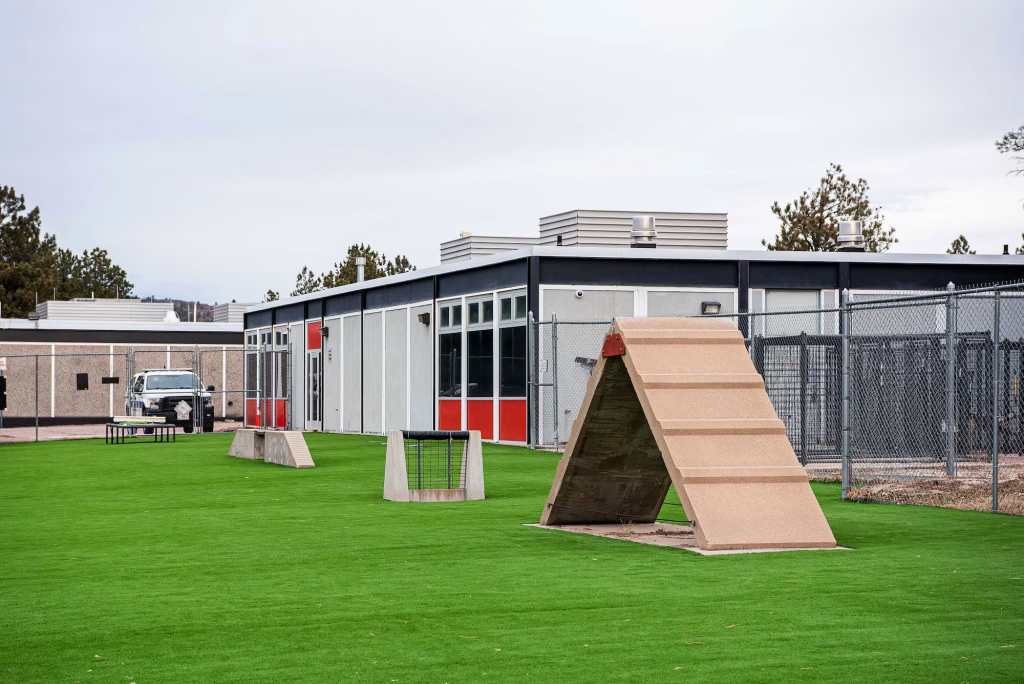
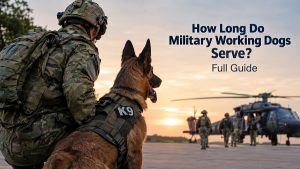
Military working dogs are trained in stages. First, the military picks dogs with the right nerves and drive, usually Belgian Malinois, German Shepherds and Dutch Shepherds around 12 to 36 months old. Next, the dogs go through roughly 2 to 6 months of initial training in obedience, scent detection and patrol work, using toy-based rewards. Then each dog is paired with a handler, trains as a team, passes certification, and keeps training every single week of its career.
Table of Contents
- Introduction: Why This Training Is So Different
- The Short Answer: Military Dog Training at a Glance
- Step 1: How the Military Finds and Picks Its Dogs
- Step 2: Drive and Temperament Testing
- Step 3: Foundation Obedience and Environmental Confidence
- Step 4: Role Training (Detection, Patrol, Tracking)
- Step 5: Handler Training and Team Pairing
- Step 6: Combat Conditioning and Certification
- How Long Does It Take, and What Does It Cost?
- How Countries Compare: US, UK and Nigeria
- The Part Most Guides Skip: Welfare, Washouts and Retirement
- Myths About Military Dog Training
- What Pet and Security Dog Owners Can Copy
- Why You Can Trust This Guide (Trainer Note)
- Frequently Asked Questions
- Final Thoughts
Introduction: Why This Training Is So Different
Ever watched a military working dog (MWD) walk calmly through a noisy crowd, then explode into action when its handler gives one word? It looks like magic. It isn’t. It’s a long, structured process that starts before the dog ever sees a training field.
So how are military working dogs trained? Short version: the military picks the right dog first, builds a rock-solid obedience base, adds a job like bomb detection or patrol, then trains the dog and handler together until they work as one unit.
The problem is that most articles on this topic stay vague. They say dogs learn to detect explosives and stop there. In this guide, I’ll walk you through each stage in plain English. You’ll also get real numbers on timelines, costs, sourcing and washout, plus a look at welfare problems that most guides ignore.
I’m writing this the way I’d explain it to a new recruit at the dog centre. Whether you’re a curious dog lover, a future handler, or someone who owns a high-drive working breed, you’ll walk away knowing what really happens.
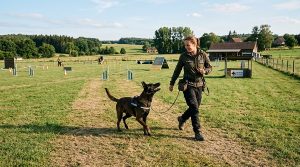
The Short Answer: Military Dog Training at a Glance
Here’s the whole journey on one table. Bookmark this part.
| Stage | What happens | Typical timeframe |
|---|---|---|
| 1. Sourcing | Buyers evaluate hundreds of dogs, mostly adult dogs from European breeders | Ongoing, only a fraction pass |
| 2. Testing | Drive, nerve and health checks | Days to weeks |
| 3. Initial training | Obedience, odor imprinting, patrol skills | About 2 to 6 months (varies by role and program) |
| 4. Handler course | Handlers learn to read and run the dog | About 55 days in the US, 7 weeks in the UK |
| 5. Team training | Dog and handler train together at their unit | First months of service, then daily |
| 6. Certification | Practical tests, repeated on a schedule | Ongoing for the dog’s career |
Timelines differ by country, by branch and by role. A narcotics dog may qualify faster than a dual-purpose patrol and explosives dog. I’ll explain why below.
Step 1: How the Military Finds and Picks Its Dogs
This is the stage nobody talks about, but it decides almost everything.
The US Department of Defense runs its dog program through the Air Force’s 341st Training Squadron at Joint Base San Antonio-Lackland in Texas. The squadron trains about 350 dogs a year for all four branches. It also buys most of them from abroad. Air Force data reported by Military Times showed that 407 of the 427 dogs bought in 2019 were born overseas, mostly in Europe.
Why Europe? Breeders there have long histories of producing sport and police lines of Belgian Malinois, German Shepherds and Dutch Shepherds. Supply is limited, though. A Senate Armed Services Committee report warned that the number of overseas breeders is finite and demand is rising, so prices keep climbing. The military also runs a small in-house Malinois breeding program at Lackland.
And here’s a stat that surprises people. In one long-running account from the 341st’s leadership, buyers travel overseas and look at hundreds of dogs aged 12 to 36 months, and only about one third of the dogs they view get purchased. Two out of three dogs don’t even make it onto the plane.
Which breeds make the cut?
The big four are Belgian Malinois, German Shepherd, Dutch Shepherd and Labrador Retriever (mostly for detection work). I covered why these breeds dominate in our guide on what breeds are used as military working dogs, so I won’t repeat it here. The short version: they combine speed, courage, a strong nose and a deep need to work.
Step 2: Drive and Temperament Testing
A dog can look amazing and still fail. Testing is where we find out what’s inside.
Here’s what evaluators look for:
- Nerve strength: Does the dog stay steady around gunfire, slippery floors, strange smells and loud crowds? Or does it freeze or bolt?
- Prey drive: Will the dog chase and fight for a ball or rubber toy for a long time? This is the engine of nearly all military training.
- Hunt drive: Does the dog keep searching even when it doesn’t find the toy straight away?
- Social balance: Can it ignore strangers and other dogs without being scared or aggressive?
- Recovery: After a scare, how fast does it bounce back?
- Physical soundness: Hips, elbows, heart, eyes and joints get checked, because a dog that breaks down at 4 years old wastes a big investment.
A handler at Kirtland Air Force Base explained that evaluators test whether dogs are really timid or highly aggressive. That’s the sweet spot we want: neither extreme. We want a confident dog that’s hungry to work and stays clear-headed.
In my experience as an instructor, the dogs that struggle most aren’t the wild ones. They’re the dogs that look brilliant for two weeks and then crack the first time the pressure rises. Nerve beats flash every time.
Step 3: Foundation Obedience and Environmental Confidence
Before a dog learns to find a bomb, it has to learn to listen. Obedience is the base layer for everything else.
The core commands
Every military dog needs instant, reliable responses to:
- Sit
- Down
- Stay
- Heel (walk at the handler’s side)
- Recall (come back immediately)
- Out (let go of an object or a bite)
Trainers teach these with markers and rewards, then raise the difficulty bit by bit: more distance, more noise, more distraction. If you’d like to see how these same ideas apply to protection work, read Essential Protection Dog Commands Every Owner Should Master.
Play is the paycheck
Here’s something that surprises most owners: military dogs aren’t mainly paid with treats. For detection work, the reward is a rubber Kong toy, not food. An older National Geographic feature also described a repetition-and-reward system where the dog earns a ball or rubber chew toy.
A Kirtland handler put it nicely. Making the dogs tough is a gentle process built around play, and handlers use games to prepare dogs for real-world situations. The dog thinks it’s playing the best game on earth. The handler knows it’s a security sweep.
Environmental conditioning
Next, the dog meets the world. Trainers expose dogs to:
- Gunfire and blank-fire simulations
- Crowds, vehicles and aircraft noise
- Metal stairs, grated floors and slippery surfaces
- Heat, rain, dust and darkness
The goal isn’t a dog that’s brave. The goal is a dog that’s neutral. It sees the loud thing, shrugs, and goes back to work.
Step 4: Role Training (Detection, Patrol, Tracking)
Once the foundation is solid, the dog gets a job. Most US military dogs end up as dual-purpose dogs, meaning they handle patrol work and detection. A handler at Nellis Air Force Base said most of their dogs are bomb-detection dogs, but they must switch between detection mode and bite mode whenever needed.
Detection training (explosives and narcotics)
This is where the nose gets its education. The usual steps:
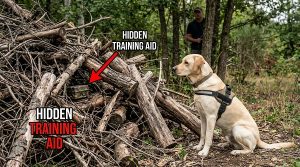
- Odor imprinting. The dog learns that one target odor equals a reward. Trainers pair the scent with a toy and a marker, again and again, until the dog hunts for it on purpose.
- Alert training. Explosive dogs usually learn a passive response, like sitting or staring at the source, so they never paw or dig at a device.
- Increasing difficulty. Hides move from open ground to vehicles, luggage, buildings and cluttered rooms.
- Distraction and blind tests. Trainers add food, animals and other odors. Then they run blind tests where even the handler doesn’t know where the odor sits. This stops the handler from accidentally cueing the dog.
A 341st commander once told reporters that detection dogs averaged 98 percent accuracy. Take that as a rough guide, not a guarantee. Real-world accuracy depends on the environment, the odor, the handler and the weather. I dug into this in our article on how accurate military dogs are at detecting explosives.
Patrol and apprehension training
Patrol dogs learn to guard, search buildings, bark on command and bite a suspect when told. The key word is control. A good patrol dog does three things well:
- Engages only on command
- Lets go immediately when told to out
- Stays calm and watchful when no bite is needed
Handlers train this with bite sleeves, suits and tug equipment so the dog builds a full, calm grip safely.
Tracking and search
Tracking dogs follow human scent over fresh and aged trails, across grass, concrete and sand. Trainers add cross-trails, wind changes and night work so the dog learns to stay on the right scent when everything gets messy.
Step 5: Handler Training and Team Pairing
Here’s the truth most guides leave out: you’re not just training the dog. You’re training the human too.
- US: Handlers attend the Military Working Dog Handler Course at the 341st. The course runs 55 days, according to Task & Purpose. Special operations units run their own separate selection and training.
- UK: Soldiers do Initial Trade Training at the Defence Animal Training Regiment in Melton Mowbray. The seven-week course covers dog safety, husbandry, kennel management and basic veterinary care. Handlers even practice first aid on life-sized dog mannequins.
Why does this matter? Because a dog is only as good as its handler. Handlers learn to:
- Read tiny changes in behavior (ear set, breathing, tail, head turn)
- Time rewards within a second
- Run safe, systematic search patterns
- Spot early signs of stress, heat injury and fatigue
- Do emergency first aid on the dog
An Air Force handler in the UAE said it simply: it’s the handler’s job to read the dog’s change in behavior, because dogs smell very differently from humans. If you miss the signal, the nose is wasted.
After the course, the pair moves to a unit and keeps training together. Bonding isn’t cute extra stuff. It’s what makes the team reliable.
Step 6: Combat Conditioning and Certification
Before a team deploys, it faces scenario-based testing. That can include:
- Helicopter and vehicle movement
- Night operations
- Working in body armor or cooling vests in hot climates
- Gunfire, blasts and flash-bang exposure
- Obedience under heavy distraction
- Detection accuracy in a mix of locations
Certification isn’t a one-time badge. Teams must prove themselves again and again. At Nellis, handlers said that between missions their days fill up with training across many scenarios and environments.
Gear matters here too. If you’re building a kit for a working dog, check our list of tactical K9 gear every working dog should have.
How Long Does It Take, and What Does It Cost?
Let me clear up the confusion. You’ll see 60 days, 100 days and six months online, and they all come from real sources. The numbers differ because they describe different programs, roles and years.
- A Joint Base San Antonio-Lackland article describes a 60 to 90 day program where dogs learn to detect explosives and drugs and to protect their handler.
- An older National Geographic piece described a hundred-day program at Lackland, worked five days a week.
- A later industry report says the basic course takes about six months.
- A handler stationed in the UAE said training can take as little as two months or as long as six, depending on how fast the dog improves.
So the honest answer to how long it takes to train a military working dog is roughly 2 to 6 months of initial schooling, plus months of team training and a career of ongoing practice. And remember, the dog is often already about 18 months old when it starts at Lackland.
What does it cost?
It isn’t cheap. A 2017 squadron study reported in a defense training publication put the cost of each dog sent to a unit at about $42,000, with training alone at around $20,000. Prices have only risen since then as European supply tightens. Meanwhile, even dogs bought from US vendors cost about $3,500 more on average, because many vendors import dogs from Europe and add a markup.
Here’s the point: that price is why militaries care so much about picking the right dog early. Every washout is expensive.
How Countries Compare: US, UK and Nigeria
Most top-ranking pages only talk about the US. Here’s a wider view.
| United States | United Kingdom | Nigeria | |
|---|---|---|---|
| Main training site | 341st Training Squadron, JBSA-Lackland, Texas | Defence Animal Training Regiment, Melton Mowbray | Nigerian Army Dog Centre |
| Scale | About 350 dogs trained a year; roughly 1,600 dogs across the services | About 1,400 military working animals and 400 handlers trained each year (all species) | Smaller, role-focused programs |
| Typical roles | Dual-purpose patrol and detection, narcotics, explosives | Protection, arms and explosives search, counter-IED, drugs search | Patrol, detection, security and demonstrations |
| Handler course | About 55 days | 7 weeks (plus later specialist courses) | Instructor-led, unit-based |
The UK’s Canine Training Squadron is home to around 200 working dogs training in roles like force protection, arms and explosives searches, counter-IED work and drug searches.
The tools differ, but the core principles match everywhere: pick the right dog, build obedience, use drive-based rewards, train the team together, and never stop practicing. We showed this at the Nigerian Army Day Celebration (NADCEL) 2026, where our team ran public demonstrations of obedience, explosive detection, agility and tactical movement.
The Part Most Guides Skip: Welfare, Washouts and Retirement
This is where I can add real value, because the glossy articles never mention it.
Washouts are normal
Not every dog passes, even after being selected. Some dogs wash out during school. Some of them go on to become practice dogs for brand-new handlers. That’s not a failure of the dog’s heart. It just means the job didn’t fit.
A 2026 welfare report changed the conversation
In February 2026, the Pentagon’s Inspector General published an evaluation of canine welfare. The findings were hard to read. Inspectors found that 10 of 12 kennels they visited were aging and unsatisfactory, and that four working dogs died over three years because of those conditions. At Lackland, they saw stress behaviors linked to a lack of enrichment time, and 22 dogs suffered heat injuries. The Texas Standard also reported that 22 percent of the 520 dogs at Lackland in 2023 had an internal disease. The Air Force agreed with the recommendations and said it is working to fix the issues.
Why should a trainer care? Because welfare and performance are the same thing. A dog that’s sick, stressed or bored can’t smell, focus or work safely. The report backs up something I’ve always believed: dogs need real exercise, social time and mental work every day, not just training sessions.
Retirement
Military dogs don’t just disappear when they stop working. A US law passed in 2000 lets handlers and, after them, qualified civilians adopt retired military dogs. At Lackland and other bases, handlers get the first chance to adopt, and then the public can apply. Dogs with health problems often retire earlier than planned.
Myths About Military Dog Training
Myth 1: Military dogs are trained to be aggressive all the time. No. Good programs train control. A dog that bites without a command is a danger, not an asset.
Myth 2: It’s all about harsh corrections. Modern programs rely heavily on rewards, play and clear markers. I wrote more about this in our piece on dominance vs. discipline.
Myth 3: Any German Shepherd can do it. Not even close. Buyers reject about two out of three dogs they look at. The genes, the nerves and the drive have to line up.
Myth 4: Training stops after graduation. It never stops. Daily training is the job.
Myth 5: Military dogs are just dogs who obey. They’re problem-solving athletes, and the best teams build trust over years.
What Pet and Security Dog Owners Can Copy
You don’t need a military budget to use military thinking. Here’s what works at home or on a private security team:
- Choose the dog carefully. Temperament matters more than looks.
- Make training feel like play. Find the toy or game your dog loves and use it as the paycheck.
- Teach out early. Letting go on command is a safety skill.
- Add distractions slowly. Change one thing at a time: place, noise, distance.
- Train a little every day. Ten focused minutes beat one long weekend session.
- Protect rest and welfare. Exercise, sleep, vet care and mental work all count.
- Train the human. Your timing and body language decide how fast your dog learns.
If you want a practical, handler-written playbook for applying these ideas at home, my book, Beyond the Bark: Inside a Pro Handler’s Playbook for Raising the Ideal Dog, walks you through it step by step.
Why You Can Trust This Guide (Trainer Note)
Written by: Cpl. Rofiat Muritala, Military Working Dog instructor and handler at the Nigerian Army Dog Centre, with more than 14 years of experience.
Experience: Dog selection, foundational training, behavior shaping and performance evaluation in real operational settings.
Qualifications: Advanced obedience, K9 patrol and advanced explosive detection certification courses.
Public demonstrations: Represented the Nigerian Army Dog Centre at NADCEL 2026, leading demos in obedience, explosive detection, agility and tactical movement.
Author: Beyond the Bark: Inside a Pro Handler’s Playbook for Raising the Ideal Dog.
How this article was researched: Facts and figures come from US and UK military sources, Inspector General reporting, and defense and news outlets. The sources are listed at the end so you can check them yourself.
Frequently Asked Questions
1. How long does it take to train a military working dog?
Initial schooling usually takes about 2 to 6 months, depending on the program and the dog’s role. After that, the dog and handler train together at their unit, and training continues for the dog’s whole career.
2. What breeds are used as military working dogs, and at what age do they start?
Belgian Malinois, German Shepherds, Dutch Shepherds and Labradors are the most common. Many dogs start formal training at around 18 months old, and buyers typically assess dogs between about 12 and 36 months.
3. Are military working dogs trained with harsh methods?
Modern programs rely mostly on rewards, especially toys and play, with clear structure and controlled corrections. The goal is reliability and clear thinking, not fear.
4. What happens to dogs that fail military training?
Dogs that don’t meet the standard are washed out. Some become practice dogs for new handlers, and others are placed in other roles or adopted into homes.
5. Can a civilian train a dog to military standards?
You can use the same methods, such as selection by temperament, drive-based rewards, solid obedience and daily practice. Matching official military certification requires a formal program and controlled testing, but the principles work for any serious dog owner.
Final Thoughts
So, how are military working dogs trained? Slowly, carefully and with a lot of play. The military picks only the dogs with the right nerves and drive, builds obedience first, adds a job like detection or patrol, then trains the dog and handler as a team. Certification keeps everyone honest, and the training never ends.
Here’s what to take away:
- Selection decides most of the outcome. Two out of three candidate dogs get rejected.
- Rewards and play drive the training, not fear.
- Initial schooling takes about 2 to 6 months, but real readiness takes much longer.
- Handlers need training as much as dogs do.
- Welfare isn’t optional. It’s part of performance.
If you own a working breed, start with one thing this week: pick a toy your dog loves and build a 10-minute daily game around one skill, like out or a simple scent search.
Want more guides like this? Subscribe to our weekly articles roundup newsletter at arfsk9team.com.ng/newsletter and get new K9 training, breed and gear tips in your inbox.
Sources
- Military Times / Air Force Times, What would it take for the U.S. military to buy American when it comes to military working dogs? (2020): militarytimes.com
- Halldale, K9 Warriors – Defense Animal Training, US Style: halldale.com
- Joint Base San Antonio, Training for military working dogs: jbsa.mil
- Task & Purpose, Military working dog handler course, and Conditions in kennels for military working dogs led to 4 deaths, IG says: taskandpurpose.com
- DoD Inspector General, Evaluation of the DoD Military Working Dog Program’s Management of Canine Welfare (February 2026): DODIG-2026-057
- Texas Standard, Inspectors say aging and understaffed military kennels are endangering working dogs’ health: texasstandard.org
- UK Army / Forces News, Defence Animal Training Regiment pages: army.mod.uk, forcesnews.com
- Kirtland and Nellis Air Force Base handler features: kirtland.af.mil, nellis.af.mil
- National Geographic, Dogs of War (older; figures are dated): via vspa.com

Her work centres on obedience, detection, protection and operational readiness. She favours proven methods built on repetition, consistency and real-world conditioning, so that both dogs and handlers are prepared for high-pressure tasks.
Rofiat represented the Nigerian Army Dog Centre at the Nigerian Army Day Celebration (NADCEL) 2026, where she led demonstrations in obedience, explosive detection, agility and tactical movement. Through articles, training content and documentaries, she shares field-based insight into how structured training, clear communication and trust between handler and dog affect performance and reliability.
She is the author of Beyond the Bark: Inside a Pro Handler's Playbook for Raising the Ideal Dog, a practical guide that helps dog owners and handlers apply professional training principles in everyday situations.
- Local Dog Breeds: Temperament, Health & Training Guide - October 6, 2026
- How Long Do Military Working Dogs Serve? Full Guide - October 5, 2026
- National Puppy Day 2026: Date, Best Deals & Freebies - October 4, 2026