How Accurate Are Military Explosive Detection Dogs?
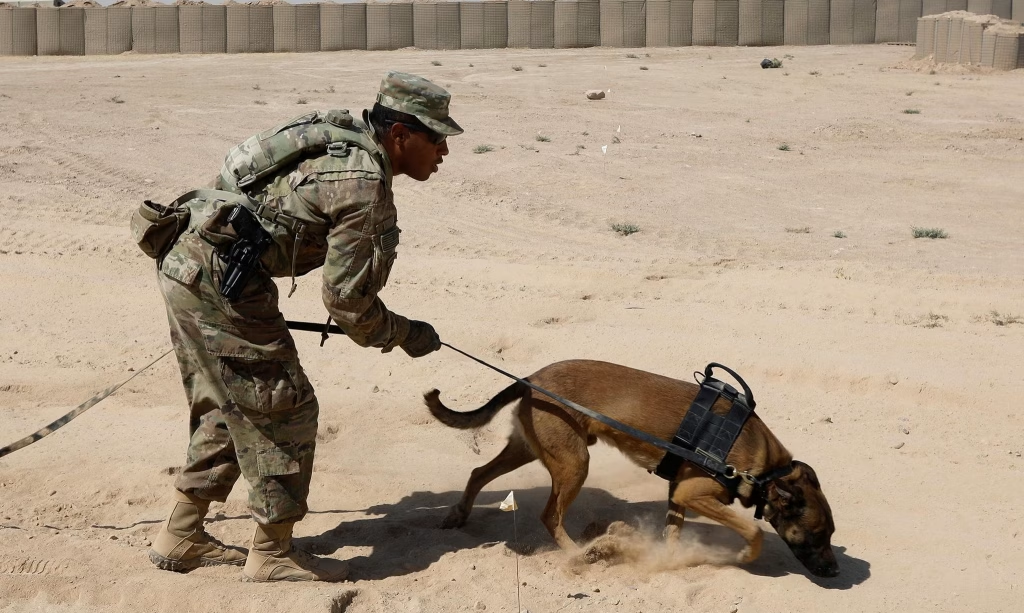
How accurate are military explosive detection dogs? Military explosive detection dogs must typically hit about 95% accuracy to certify, and in Afghanistan and Iraq, patrols using dogs found roughly 80% of IEDs compared with about 50% for technology alone. But accuracy is not one fixed number. A 2025 study of 56 US detection teams found none met the strict 90% correct-alert, under 10% false-alert standard, and TSA airport teams passed about 87% of certification tests in 2013 to 2015. Real accuracy depends on training quality, odor variety, handler skill, fatigue and weather.
Table of Contents
- The Honest Answer: Accuracy Numbers Side by Side
- Why a Dog’s Nose Is So Good (and Where It Stops)
- Where the 90–98% Numbers Come From
- Field Results: What Dogs Did in Afghanistan and Iraq
- The 2025 Black Box Study: A Reality Check
- What TSA Test Failures Teach Us
- 8 Real Reasons Explosive Detection Dogs Miss
- False Alerts: Why Dogs Alert on Sharpies
- Dogs vs Machines: Who Wins?
- Can Dogs Smell Through Metal, Boxes and Water?
- How Top Programs Keep Accuracy High
- 7 Questions to Ask Before Hiring a K9 Detection Team
- Cost and Career Length
- How We Researched This Article
- FAQs
- Conclusion
Introduction: Why One Percentage Doesn’t Tell the Truth
Ever seen a headline saying bomb dogs are 98% accurate and wondered who counted? Or read the opposite: dogs failing airport tests dozens of times? Both stories are real. That’s the problem.
If you’re a dog owner curious about K9 work, a handler building your own program, or a business thinking about hiring explosive detection dogs, you need more than a single number. You need to know how accuracy is measured, who measured it, and what makes it rise or fall.
In this guide, you’ll learn the real numbers from military statements, government records and peer-reviewed research. You’ll see why even certified dogs miss targets, what causes false alerts, and how professional programs keep teams sharp. At the end, you’ll get a practical checklist you can use to judge any detection team.
One honest note first: exact combat results are not public, and nobody can count the bombs a dog never found. So I’ll tell you what the evidence shows, and where it runs out.
1. The Honest Answer: Accuracy Numbers Side by Side
Here’s every major figure in one place, so you can compare them fairly.
| Source | What was measured | Result |
|---|---|---|
| US military certification rule (reported by author Rebecca Frankel in Scientific American) | Minimum score to certify an explosive detection dog | 95% accuracy (drug dogs: 90%) |
| JIEDDO, Pentagon counter-IED task force, 2010 | IEDs found by US forces in Iraq and Afghanistan | About 50% with technology, about 80% when dogs joined patrols |
| NBC News analysis of TSA records, 2013 to mid-2015 | Annual airport K9 certification tests | 87% average pass rate; 52 test failures; Atlanta 97% |
| 2025 Frontiers in Veterinary Science black box study | 56 US teams on the OSAC Standard 092 protocol | Best team 88% correct with 6% false alerts; no team met the 90% pass mark |
| 2021 case study (Animals journal) | Two certified dogs searching a suspicious bag | Both missed 13 kg of explosive |
| Lackland training commander, after 9/11 (National Geographic) | Detection accuracy of trained dogs | 98% (an official statement, not an independent test) |
See the pattern? Controlled certification gives high numbers. Independent, tougher testing gives lower and more varied numbers. And field results can’t be fully measured at all.
So the fair answer is this: well-trained teams are highly reliable, but “accurate” always depends on the test, the explosive, the setting and the team.
2. Why a Dog’s Nose Is So Good (and Where It Stops)
The science is why dogs became the backbone of bomb detection.
- Dogs have close to 300 million olfactory receptors. Humans have roughly 5 to 6 million.
- Research measures canine sensitivity down to parts per trillion.
- A dog can walk, sample air and follow an odor trail all at once. A machine usually can’t.
That’s why researchers describe canine detection as one of the most widely used and effective tools for finding explosive threats in the field.
But here’s the thing most articles skip. A dog doesn’t smell “bombs.” It smells chemical vapors that escape from explosive material, and it only alerts to odors it was taught to recognize. If the odor is different from training (a different mix, a much bigger amount, a tightly sealed package), the dog can walk right past it. Keep that in mind, because it explains almost every failure we’ll cover.
3. Where the 90–98% Numbers Come From
Most high percentages you see online come from certification tests. Those are controlled exams with known rules.
Military standard. According to Rebecca Frankel’s reporting, military regulations require explosive detection dogs to hit 95% accuracy to certify. Staying at that level takes at least four hours of explosive detection training every week.
Civilian and police standards. The OSAC standard (ANSI/ASB Standard 092, published December 2022) asks for a 90% correct alert rate and under 10% false alerts. It uses at least about 113 g (a quarter pound) of each required explosive and tests rooms, vehicles, parcels, luggage and an odor recognition line-up. Another widely used certifier, NAPWDA, requires 91.6% and allows just one miss.
What these tests can’t tell you. A certificate proves a team passed one exam on one day. It doesn’t prove the dog will find a hidden device in a hot, windy market after eight hours of work.
4. Field Results: What Dogs Did in Afghanistan and Iraq
The strongest real-world number comes from the Pentagon’s own counter-IED group. In 2010, Lt. Gen. Michael Oates, then commander of JIEDDO, said US forces were locating only about 50% of IEDs in Iraq and Afghanistan. When patrols took dogs along, that rose to about 80%. His summary: dogs were the best detectors the military had.
Why did dogs help so much?
- Metal detectors hit on everything. Marines in Helmand said there was so much scrap metal that detectors beeped constantly. Dogs ignore metal and follow explosive odor.
- Homemade explosives often have little or no metal. Marines noted that dogs can pick up what metal detectors miss.
- Speed. One Marine handler reported his dog finding three IEDs in under an hour.
The Marine Corps even changed its breed strategy. After an Auburn University study highlighted the Labrador’s hunting drive and controllability, the Corps built an IED detection dog program with Labradors trained on 17 homemade-explosive odors. A typical infantry battalion went from 13 dogs to 34.
Now the limit. Frankel points out that nobody knows whether certification-level accuracy carries into combat. There’s simply no way to count bombs that went undetected, unless one goes off after a team cleared the area. So treat the 80% figure as strong evidence that dogs add huge value, not as a precise success rate for any single dog.
For more on how these teams learn their jobs, read our guide on how military working dogs are trained.
5. The 2025 Black Box Study: A Reality Check
This is the part most competing articles miss, and it’s the most useful new research on the topic.
In 2025, researchers from Florida International University, Texas Tech and others published a “black box” test of explosive detection teams in Frontiers in Veterinary Science. A black box study measures results without trying to explain them. Here’s the setup:
- 56 canine and handler teams from law enforcement, government agencies and private companies
- Three US locations, two days each, in 2024 and 2025
- Searches followed the OSAC Standard 092, plus tougher real-world scenarios
- Six required explosive types, with distractors like food, tape and cleaning wipes
The headline: no team met the certification threshold. The top team scored 88% correct with a 6% false alert rate. Seven more teams scored above 70%. The other 46 fell below that.
What else they found:
- Test performance predicted real-world performance. Teams that did well on the standard also did well in realistic scenarios. That’s good news for certification.
- Explosive type mattered. One explosive was found 87%, 74% and 64% of the time across the three trials. Another had the lowest detection rate everywhere.
- Closed parcels were hard. In one trial, only 5% of teams found the target in taped boxes on day one. By day two it jumped to 67%. Many handlers said they never trained with sealed boxes.
- Practice helped fast. Several teams improved a lot on day two, which suggests nerves and unfamiliar setups cost points on day one.
Important context: this study tested mostly police, government and private teams, not military units, and the OSAC standard is tougher than many older certifications. Still, it shows how big the gap can be between “certified” and “tested hard.”
6. What TSA Test Failures Teach Us
Airport dogs are a useful comparison because their results became public through a records request.
An NBC News investigation of TSA records found that between January 2013 and June 2015, K9 teams failed annual certification tests 52 times at major US airports. Teams either missed planted explosives or gave too many false alarms. The average pass rate was 87%. Atlanta scored 97%, while Los Angeles had 21 failures and Washington Dulles had 10. TSA said the pass rate improved to 93% in the second half of 2015.
Why the failures? A former TSA training official explained the problem in simple terms: the team’s job is to find explosives, but the dog’s real goal is the toy in the handler’s pouch. And real explosives almost never turn up, so dogs can lose interest unless handlers set up frequent training finds.
That lesson applies everywhere. Rare finds create boredom. Boredom creates misses.
If you want to see how detection work differs across agencies, our breakdown of military working dogs vs police K9s covers it.
7. 8 Real Reasons Explosive Detection Dogs Miss
Dogs don’t fail randomly. Research and field reports point to the same causes again and again.
- Limited odor variety in training. Teams that only train on one sample of an explosive may not alert to a similar one. The black box authors say training with multiple samples improves generalization.
- Quantity surprises. In the 2021 case study, two certified dogs missed 13 kg of explosive in a bag. The dogs had been trained on much smaller amounts. After specific training on the larger sample, their alert rates improved.
- Rare explosives, rare practice. Some required explosives are hard and expensive to get. Teams may only meet them once or twice a year at certification.
- Sealed packaging. Cardboard and other materials trap vapor, so less odor escapes. Dogs can still find sealed targets, but only if they’ve practiced it.
- Hard physical work. In a treadmill study cited by the 2025 paper, dogs’ accuracy for weak odors dropped from about 87% to below 45% after moderate exercise. Panting and over-excitement also hurt sampling.
- Heat, wind and humidity. These change how odor travels. Hot days also tire dogs faster.
- Handler error. The dog may alert correctly, but the handler misreads it, or cues the dog without meaning to. The handler’s call is the final result.
- Fatigue and low motivation. Long shifts, boring searches and weak reward systems all shrink search effort.
8. False Alerts: Why Dogs Alert on Sharpies
A false alert means the dog says “explosive” when there isn’t one. It’s less dangerous than a miss, but it costs time, trust and sometimes evacuations.
In the 2025 study, the average false alerts weren’t random. They clustered around everyday training items. Sharpie markers caused the most, followed by anti-static bags, dryer sheets, isopropanol wipes, rubber bands, latex gloves and even taco seasoning. Many of these are used by handlers during training, like marking containers or cleaning training aids. Empty training aid containers also triggered alerts, possibly because dogs link that container smell with rewards.
The fix is simple but takes discipline:
- Train with blanks and distractors in every session, not just targets.
- Keep training aids clean and handle them with fresh gloves.
- Reward only correct finds, so dogs don’t learn to guess.
- Track false alerts in a log, the same way you track finds.
One more thing worth knowing. The authors suggest some teams lean toward calling alerts more freely. In a real bomb threat, that’s often the smarter trade: a few extra false alarms are better than clearing an area that still holds a device.
9. Dogs vs Machines: Who Wins?
Short answer: dogs usually win in the field, but the best security uses both.
| Factor | Detection dog | Machine detector |
|---|---|---|
| Mobility | Walks any terrain, goes off-leash | Often fixed or limited reach |
| Metal confusion | Ignores scrap metal | Can alarm constantly in metal-rich areas |
| Non-metal devices | Can detect explosive odor | Metal detectors miss them |
| Fatigue | Tires, needs rest cycles | Runs continuously |
| Consistency | Varies with training and day | Consistent when calibrated |
| Cost | High upfront, ongoing training | Varies, needs maintenance |
The Pentagon spent years trying to build a sensor as good as a dog’s nose. A DARPA program called Dog’s Nose started in 1997, and in 2010 the commander of JIEDDO still said nothing in the arsenal beat a dog. Machines have improved since, but dogs remain the standard against which new sensors are judged.
The smart approach is layers: dogs for fast, flexible searching, plus technology and human checks for backup.
To see how dogs are used against smuggling and concealment, check out how K9 units uncover hidden compartments.
10. Can Dogs Smell Through Metal, Boxes and Water?
People love this question, so let’s answer it plainly.
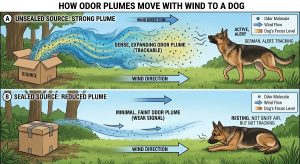
Dogs don’t smell through a sealed barrier. They smell vapor that leaks out. Every container has tiny gaps, seams and surfaces where odor can escape, and dogs are good at finding those leaks. But research shows packaging such as cardboard holds back vapor, which makes detection harder. Tighter seals, wind and cold also reduce what’s available to smell.
So the honest answer is: sometimes yes, but less reliably, and only with training on sealed items. I’d avoid any article that promises dogs can find anything inside anything. I haven’t seen solid public data on underwater or deeply buried targets that I’d trust enough to quote a number.
11. How Top Programs Keep Accuracy High
The US Department of Defense trains nearly all its military working dogs at the 341st Training Squadron at Joint Base San Antonio-Lackland in Texas.
- Selection is tough. Dogs are mostly Belgian Malinois and German Shepherds, bought at 1 to 3 years old. Reports say only about half of the dogs assessed make it through training.
- The course is about 120 training days, roughly six months in practice.
- Rewards drive the work. Training starts with a toy or ball as the reward, so the dog hunts for the game.
- Ongoing training never stops. Once a dog reaches its unit, handlers keep working detection, building searches and noise exposure.
Here’s the weekly rhythm I’d recommend for any detection team, based on those principles:
- Train detection at least four hours a week. That’s the military benchmark.
- Use multiple sources of each odor. Different batches, forms and amounts.
- Practice sealed items. Taped boxes, bags, vehicle voids.
- Run blind searches. Someone else hides the target so the handler doesn’t know.
- Include blanks and distractors every time.
- Schedule finds regularly, even for dogs on quiet posts.
- Manage heat and workload. Rest before the dog is tired, not after.
- Keep a training log with finds, misses and false alerts.
Accuracy is a team stat. The best dog in the world still needs a handler who reads body language and doesn’t cue. If you want a practical guide to building that kind of bond, our ebook Beyond the Bark walks through the handler-first training principles we use.
12. 7 Questions to Ask Before Hiring a K9 Detection Team
If you manage security for a venue, company or event, don’t just ask for a certificate. Ask these:
- Which certification standard did the team pass, and when? Look for recognized standards like OSAC 092 or a national police association.
- Were blanks and distractors part of the test?
- Which explosives are they trained and tested on?
- How often do they train, and can you see the logs?
- Is the handler tested too? The handler makes the final call.
- How long do dogs work before resting? Fatigue and heat cut accuracy.
- What’s the backup plan? Good teams work with other screening, not alone.
A team that answers these openly is usually the real deal.
13. Cost and Career Length
Numbers vary depending on how costs are counted, so here are the ranges reported by US military sources:
- Purchase price for a dog bought for DoD: about $5,500 to $6,500
- Training a military working dog: roughly $20,000
- Cost of a dog delivered to an operational unit (a 2017 squadron study): about $42,000
- Total program cost reported by JBSA for a trained dog: up to $150,000
- Dogs in US military service: about 2,500
Career length depends on health and work. Many serve around nine years, and some work up to 12. After service, many are adopted by their handlers.
14. How We Researched This Article
Who wrote and reviewed it: Cpl. Rofiat Muritala is a Nigerian Army military working dog instructor and handler with more than 14 years at the Nigerian Army Dog Centre. She holds advanced obedience, K9 patrol and advanced explosive detection certifications, and she led an explosive detection demonstration at the Nigerian Army Day Celebration (NADCEL) 2026.
Sources used:
- Karpinsky et al., Explosive detection canines in the field: a multi-site black box validation study, Frontiers in Veterinary Science, 2025
- Case study on detection dog generalization to a large explosive quantity, Animals (MDPI), 2021
- NBC News TSA K9 certification records, reported 2016
- JIEDDO statements, 2010
- Rebecca Frankel, War Dogs, adapted in Scientific American
- US Marine Corps and Joint Base San Antonio-Lackland releases
Limits: Combat detection data is classified or simply unmeasurable. Where a number is an official claim rather than an independent test, we’ve said so.
15. Frequently Asked Questions
Are military explosive detection dogs 100% accurate?
No. Even certified teams miss targets or give false alerts. Military certification asks for about 95%, and independent testing shows wide variation between teams.
What is the success rate of bomb sniffing dogs in real operations?
There’s no exact public figure. The best evidence is JIEDDO’s 2010 statement that patrols with dogs found about 80% of IEDs versus about 50% without them.
Why do bomb dogs fail certification tests?
Common causes are limited odor variety, rare practice with certain explosives, sealed containers, fatigue, boredom and handler error. TSA teams failed 52 tests in 2013 to mid-2015 for these kinds of reasons.
Can dogs detect homemade explosives?
Yes, if they’re trained on those odors. Marine IED dogs were trained on 17 homemade-explosive odors. Dogs don’t automatically know a new mix.
How often should detection dogs be tested?
Best practice is regular recertification plus weekly training and blind checks. Military guidance cites at least four hours of explosive training per week to maintain proficiency.
16. Conclusion: What to Take Away
Military explosive detection dogs are among the most effective tools we have, and the data backs that up. Patrols with dogs found far more IEDs than technology alone, and certification standards ask for 90% to 95% accuracy. But the same research shows that accuracy slips when training is narrow, targets are sealed, dogs are tired or handlers cue by accident.
Here’s what to do with that:
- Handlers: train with many odor sources, sealed items, blanks and blind hides, every week.
- Security buyers: ask for standards, logs and handler testing, not just a certificate.
- Everyone else: remember that a dog and handler are one detection system, and it’s only as strong as its training.
Want more field-tested K9 guides like this? Subscribe to our weekly articles roundup newsletter and get new posts straight to your inbox.

Her work centres on obedience, detection, protection and operational readiness. She favours proven methods built on repetition, consistency and real-world conditioning, so that both dogs and handlers are prepared for high-pressure tasks.
Rofiat represented the Nigerian Army Dog Centre at the Nigerian Army Day Celebration (NADCEL) 2026, where she led demonstrations in obedience, explosive detection, agility and tactical movement. Through articles, training content and documentaries, she shares field-based insight into how structured training, clear communication and trust between handler and dog affect performance and reliability.
She is the author of Beyond the Bark: Inside a Pro Handler's Playbook for Raising the Ideal Dog, a practical guide that helps dog owners and handlers apply professional training principles in everyday situations.
- Dog Hotel Prep: 7 Must-Haves Before Boarding - October 21, 2026
- How to Enter the COBA National Dog Championship - October 20, 2026
- K9 Advantix Dosage Chart & Safety Guide for Dogs - October 19, 2026