PTSD in Military Dogs: Real Signs, Causes & Treatment
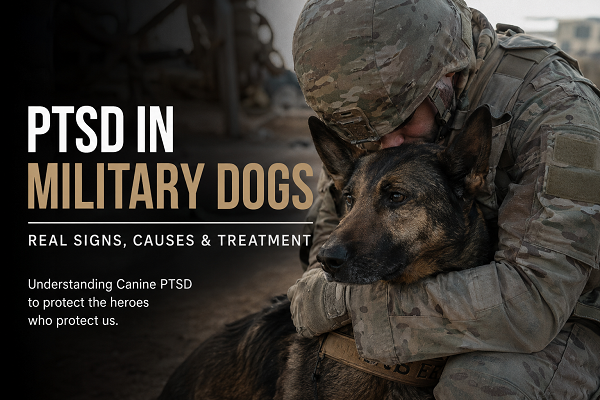
Canine PTSD (C-PTSD) is a recognized behavioral condition affecting an estimated 5% of U.S. military working dogs, first formally identified in 2010 by military veterinarians at Lackland Air Force Base. Signs include hyper-vigilance, avoidance of previously neutral places, sudden aggression, and failure to perform trained tasks. With structured treatment, usually a 16-week protocol combining desensitization, routine, and sometimes medication, roughly half of affected dogs return to active duty, and nearly all can be rehabilitated for a safe, comfortable retirement.
Table of Contents
- What Is PTSD in Military Dogs?
- How Common Is Canine PTSD? (The Real Numbers)
- Why Working Dogs Develop PTSD
- Signs and Symptoms of Canine PTSD
- A Real Case: What C-PTSD Looks Like in the Field
- How Vets Diagnose C-PTSD
- Treatment and Recovery: What Actually Works
- Prevention: What Handlers and Trainers Can Do
- Life After Service: Retirement, Adoption, and Robby’s Law
- Canine PTSD Around the World
- A Note From an Experienced Handler
- Frequently Asked Questions
- Final Thoughts
Introduction
If you’ve ever watched a military working dog (MWD) work a checkpoint, you know they don’t look like ordinary pets. They move with purpose. They read a room or a road faster than any human ever could. So when I first heard a veteran handler say, “he’s just not the same dog since Kandahar,” it stopped me cold. Because that’s not a training problem. That’s trauma.
I’ve spent over a decade around working K9s, and I can tell you this isn’t a rare, fringe topic anymore. It’s documented, studied, and taken seriously by military veterinarians on both sides of the Atlantic. This guide breaks down exactly what canine PTSD is, why it happens, how to spot it early, and most importantly, what actually works to help these dogs heal.
What Is PTSD in Military Dogs?
Canine Post-Traumatic Stress Disorder, or C-PTSD, is the term U.S. military veterinarians adopted in 2010 to describe a cluster of behaviors in working dogs that closely mirror the diagnostic criteria for PTSD in humans. It’s not a loose comparison dreamed up by dog lovers, it came out of a real clinical review at the Daniel E. Holland Military Working Dog Hospital at Joint Base San Antonio-Lackland, Texas, the primary veterinary referral center for the entire U.S. military working dog program.
Dr. Walter Burghardt, the hospital’s chief of behavioral medicine at the time, led a case series that evaluated 14 MWDs showing a consistent pattern: hyper-responsiveness to specific stimuli, avoidance of places or objects that used to be neutral, changes in how the dog related to its handler, and critically, failure at tasks the dog had already mastered and certified on. Every dog in that study had been cleared of behavioral issues before deployment, which is what made the post-deployment shift so telling.
Here’s the key distinction I always explain to new handlers: every dog gets startled. Not every dog develops PTSD. A normal stress response fades once the danger passes. With C-PTSD, the alarm system stays switched on for weeks or months after the trigger is gone. The dog isn’t choosing to disobey, its nervous system has been rewired by repeated exposure to extreme threat.
How Common Is Canine PTSD? (The Real Numbers)
This is the part most articles gloss over, so let’s get specific.
- Roughly 5% of U.S. military working dogs deployed by American combat forces have been estimated to develop C-PTSD, according to Dr. Burghardt’s early figures, out of an active deployed population of around 650 combat-deployed dogs at the time of that estimate.
- A follow-up review found the diagnosis had touched about 68 dogs by 2017, with the affected share of the roughly 1,600-dog Department of Defense working dog population settling closer to 4.25% over a seven-year tracking window, down from the initial estimates but still significant.
- Of the dogs formally diagnosed, treatment outcomes split roughly down the middle: about 50% returned to operational duty after a structured 16-week evaluation and treatment period, while the rest were transitioned to less demanding roles or made available for adoption.
- Even though 4–5% sounds small, C-PTSD has been identified as the single leading cause of lost deployability among military working dogs, meaning it sidelines more dogs from active service than physical injury in many reporting periods.
- On the human side, for comparison, PTSD has been documented in roughly 14–16% of U.S. service members following deployment, and in about 2.9% of German military personnel within a year of returning from deployment abroad. Dogs and their handlers, in other words, are living through the same operational stress, just processing it differently.
Those numbers matter because they tell you this isn’t anecdotal. It’s tracked, published, and factored into how the military plans deployability and retirement timelines for its dogs.
Why Working Dogs Develop PTSD
Military working dogs are asked to do things most animals and most humans, never encounter. A few of the biggest risk factors I’ve seen discussed by veterinary behaviorists and confirmed in my own work with detection and patrol dogs:
- Combat exposure. Gunfire, mortar fire, and especially IED blasts are the most consistently cited triggers. Dogs have extraordinarily sensitive hearing (they detect frequencies up to roughly 45,000 Hz, compared to about 20,000 Hz for humans), which means combat noise hits them harder than we often assume.
- Loss, injury, or reassignment of a handler. The dog-handler bond is not sentimental fluff, it’s an operational safety mechanism. When that bond is severed suddenly, through injury, death, or a mid-deployment reassignment, dogs can show grief-like withdrawal that compounds existing stress.
- Extended high-alert operations. Detection and patrol dogs often work in a state of sustained vigilance for hours at a time, searching for explosives or tracking threats with zero margin for error. That kind of chronic hypervigilance, without adequate downtime, wears down a dog’s stress-regulation system the same way it does in human special operators.
- Harsh or inconsistent handling. Dogs trained with heavy-handed correction, rather than clear, consistent, reward-based communication, tend to show a lower threshold for trauma responses later on.
- Repeated deployments without recovery time. A dog that goes from one high-stress rotation straight into another, without a real decompression period, doesn’t get the chance to reset. This is one of the most preventable risk factors, and it’s one I push hard on with every handler I train.
It’s worth remembering that the majority of military dogs today are Belgian Malinois and German Shepherds, breeds specifically selected for high drive and resilience. Roughly 13% of DoD working dogs are bred in-house through the military’s own breeding program at Lackland, with the rest sourced from vetted breeders in the U.S. and Europe. Even genetically selected, high-drive dogs are not immune. If anything, their intense work ethic can mask early symptoms, because a driven dog will often push through discomfort long after a less motivated dog would have shown visible distress.
Want to understand how these dogs are actually trained to handle stress in the first place? Our guide to K9 training methods used by the military breaks down the conditioning process step by step.
Signs and Symptoms of Canine PTSD
Early detection is everything. The dogs I’ve seen recover fastest were the ones whose handlers caught the shift within the first few weeks, not months later.
Behavioral and emotional signs
- Sudden aggression or irritability that’s out of character for the dog
- Withdrawal from handlers, other dogs, or people the dog previously trusted
- Refusal to enter spaces, vehicles, or terrain that resemble a traumatic incident
- Excessive barking, whining, or pacing with no obvious trigger
Physical and physiological signs
- Hyper-vigilance, the dog can’t settle, constantly scanning for threats
- Exaggerated startle response to loud noises, sudden movement, or specific smells
- Changes in sleep patterns, including restlessness or difficulty settling at night
- Loss of appetite or unusual eating changes
Performance-related signs
- Reduced focus or accuracy during detection work
- Slower response time to commands the dog knows well
- Refusal to perform previously certified tasks
- Increased safety risk to the handler due to unpredictable reactions
One detail that trips up a lot of handlers: symptoms don’t always show up right after the traumatic event. Veterinary behaviorists have documented cases where onset was delayed by weeks or even months, which is exactly why unexplained behavior changes, even subtle ones, deserve a proper evaluation rather than being written off as “a bad week.”
If you’re noticing early warning signs in any working or companion dog, our breakdown of 7 warning signs your dog is struggling with anxiety is a useful companion read, anxiety and C-PTSD share overlapping symptoms, and telling them apart matters for treatment.
A Real Case: What C-PTSD Looks Like in the Field
Numbers only tell part of the story, so let’s talk about a dog whose case is publicly documented: Lucca, a German Shepherd–Belgian Malinois mix who served with the U.S. Marine Corps for six years, completed over 400 missions across two tours in Iraq and one in Afghanistan, and is credited with zero human casualties on her watch. In March 2012, while leading a patrol in Afghanistan, Lucca stepped on an IED and lost her left front leg.
What’s less talked about than her Dickin Medal (the animal world’s equivalent of the Victoria Cross, awarded to fewer than 70 animals since 1943) is the adjustment period that followed. Dogs who’ve been through blast exposure and traumatic injury, like Lucca, often carry both the physical and psychological aftermath and it’s the combination of consistent handler care, gradual reintroduction to normal life, and patience that determines how well they settle into retirement. Lucca’s case is a reminder that recovery is possible even after catastrophic trauma, but it depends heavily on the structure and support a dog receives afterward.
How Vets Diagnose C-PTSD
Dogs can’t tell us what happened to them, so diagnosis relies on a structured process, usually led by a veterinary behaviorist:
- Full medical review — ruling out pain, illness, or neurological issues that could explain behavior changes before anything is labeled psychological.
- Deployment and incident history — cross-referencing behavior changes against known combat exposure, blasts, or handler loss.
- Controlled observation — watching how the dog responds to specific stimuli (sounds, environments, objects) in a monitored setting.
- Baseline comparison — checking pre-deployment behavioral records, since MWDs are behaviorally screened before they’re ever deployed. A documented shift from “cleared and stable” to “reactive and avoidant” is one of the strongest diagnostic markers.
This process mirrors, in structure, how PTSD is diagnosed in humans, ruling out other causes, then matching a consistent pattern of hyper-arousal, avoidance, and functional impairment against a known traumatic trigger.
Treatment and Recovery: What Actually Works
Since 2010, dogs diagnosed with C-PTSD at military veterinary hospitals have generally followed a standardized 16-week treatment and evaluation window. Here’s what’s actually in that protocol, based on published veterinary behavioral medicine reports:
1. Systematic desensitization and counter-conditioning
The dog is gradually, carefully reintroduced to trigger stimuli, sounds, environments, situations, at an intensity low enough not to provoke panic, paired with positive experiences. Done properly under professional guidance, this is one of the most effective tools available. Done carelessly (throwing a dog back into a loud or chaotic environment “to get it over with”), it can make symptoms significantly worse.
2. Environmental and social enrichment
Structured play, novel but low-stress environments, and predictable daily routines help rebuild a dog’s sense of safety. Consistency isn’t a soft add-on here, it’s treatment.
3. Positive reinforcement retraining
Rehabilitation programs lean almost entirely on reward-based training rather than correction. A dog already living in a heightened threat-response state doesn’t benefit from added pressure; it needs to relearn that effort and calm behavior lead to good outcomes.
4. Medication, when clinically necessary
For moderate to severe cases, veterinary behaviorists have used anxiolytic medications combined with beta-blockers for acute and sub-acute symptoms, and in some chronic cases, tricyclic antidepressants or SSRIs. This is always paired with behavioral therapy, never used as a stand-alone fix, partly because some medications can dull a detection dog’s scenting ability, which limits their use in dogs still expected to return to operational work.
5. Handler bonding and trust rebuilding
This is the piece that doesn’t show up in a treatment chart but matters enormously in practice. A steady, predictable handler who doesn’t punish fear responses gives the dog something to anchor to. In my own experience training working dogs, the recovery timeline nearly always tracks with the strength and consistency of that human-dog relationship.
The outcome: published figures put full return-to-duty rates at around 50% after the 16-week protocol. The remaining dogs are typically not euthanized, they’re transitioned to lower-stress roles, kept in supportive environments, or made available for adoption once deemed safe.
For a deeper look at how professional programs structure retraining and stress conditioning, see K9 training methods used by the military.
Prevention: What Handlers and Trainers Can Do
Treating C-PTSD after it develops is possible, but prevention is far more effective and far cheaper, both financially and emotionally. A single fully trained Belgian Malinois represents a total investment that can run well past $20,000–$30,000 once breeding, training, and years of veterinary and handler support are factored in, so protecting that investment (and the dog’s welfare) starts long before deployment.
- Build in real decompression time between operations. Dogs need downtime that’s actually restful, not just a change of task.
- Use balanced, reward-based training from day one. Dogs trained through trust rather than fear show more resilience under real stress.
- Track behavior changes as a matter of routine, not reaction. Handlers who log mood, appetite, and responsiveness daily catch shifts weeks before a crisis moment.
- Gradual, controlled exposure to stressors during training, rather than sudden immersion, builds a dog’s tolerance the same way it does for human special operations training.
- Protect the handler-dog bond. Minimizing unnecessary reassignments, and giving dogs time to adjust to a new handler when reassignment is unavoidable, reduces one of the most common trauma triggers.
A well-trained working dog isn’t just obedient, it’s mentally stable under pressure. That stability is built, not assumed.
Life After Service: Retirement, Adoption, and Robby’s Law
Most military working dogs retire between 10 and 12 years old, and their post-service life has changed enormously over the past 25 years.
Before November 2000, retired or “excess” military dogs were frequently euthanized, officially classified as equipment rather than personnel, with no legal pathway to adoption. That changed with Robby’s Law (H.R. 5314), signed by President Clinton in November 2000, named after a Belgian Malinois whose handler fought unsuccessfully to adopt him before the law passed in time. Robby died just over two months after the legislation was signed, but the law now guarantees that MWDs deemed suitable are made available for adoption rather than destroyed.
Under the current adoption order of precedence:
- Former handlers get first priority and more than 90% of retiring MWDs are adopted by their own handler when that handler is able to take them.
- Law enforcement agencies are next in line for dogs still capable of working roles.
- Civilian families can adopt dogs not claimed by handlers or law enforcement, though the process is thorough, often involving a waiting period of close to a year and a detailed screening process, since these are not typical shelter dogs.
Handlers and adopters need to go in with realistic expectations. A retired MWD, especially one with a C-PTSD history, may still show:
- Delayed reactions to environmental triggers, sometimes appearing months into retirement
- A need for structured routine even in civilian life
- Sensitivity around small children, strangers, or chaotic households
None of that makes these dogs unadoptable, it means their new home needs to understand what they’re taking on. Programs modeled on places like the National Intrepid Center of Excellence (NICoE) at Walter Reed National Military Medical Center, which pairs service dog training with veteran PTSD treatment, show just how powerful the dog-human trauma-recovery relationship can be in both directions.
Considering adopting a retired working or protection-trained dog? Understanding the difference between military working dogs and police K9s will help you set realistic expectations for temperament and training background before you commit.
Canine PTSD Around the World
This isn’t only a U.S. phenomenon. Militaries across NATO and allied nations run their own detection, patrol, and protection dog programs, and canine trauma has been documented well beyond Lackland:
- Germany’s Bundeswehr has tracked PTSD in roughly 2.9% of military personnel within a year of returning from deployment, and separate dog-assisted intervention pilot studies in German military hospitals have shown measurable stress-reduction benefits for soldiers working alongside dogs, a two-way relationship that researchers are still actively studying.
- The UK’s Ministry of Defence operates its own military working dog units through the Royal Air Force Police and Army, with similar behavioral screening and retirement pathways, though public reporting on C-PTSD prevalence specifically is less standardized than in the U.S.
- International detection and explosive-ordnance dog units, including those working with NATO forces, generally follow comparable welfare and rest-period standards, since the underlying stress physiology of a working dog doesn’t change by nationality.
The consistent thread across every program: dogs exposed to sustained combat-level stress, wherever they serve, carry a real risk of trauma and the most successful programs are the ones that plan for that risk instead of treating it as a surprise.
A Note From an Experienced Handler
I’ve trained and handled working dogs for over a decade, including representing a national K9 unit at a major military demonstration where I led obedience, explosive detection, agility, and tactical movement showcases. Here’s the honest truth I share with every new handler I mentor: the dogs that struggle most aren’t the “weak” ones. They’re often the most driven. A high-drive dog will keep pushing through pain and fear long after a less motivated dog would have shut down, which means their symptoms get missed until they’re serious.
If you’re a handler, trainer, or K9 professional, the single best habit you can build is treating behavior tracking as seriously as you treat task certification. A dog’s mental state is a working part of its equipment, the same as its harness or its nose. Ignore it, and eventually it fails you both.
For handlers who want a structured, field-tested approach to raising and training a dog capable of handling real-world pressure, my book Beyond the Bark: Inside a Pro Handler’s Playbook for Raising the Ideal Dog walks through the exact principles I use, from foundational obedience to building the kind of resilience that protects a dog’s mental health long before deployment ever becomes a factor.
Frequently Asked Questions
Do military dogs fully recover from PTSD?
Many do show substantial improvement with consistent treatment, and published figures show around half of diagnosed dogs return to full operational duty after a structured recovery period. Others improve enough for a stable retirement or lower-stress role but may need ongoing management of triggers for life. Full recovery depends heavily on how severe the trauma was and how early treatment started.
What are the first signs of PTSD in a working dog?
The earliest signs are usually subtle: a slight drop in focus during tasks, mild reluctance to enter a familiar space, or a change in how the dog settles at night. These often show up before more obvious symptoms like aggression or refusal to work, which is why daily behavior tracking matters so much.
How is canine PTSD different from general anxiety in dogs?
PTSD is tied to a specific identifiable traumatic event or period, while general anxiety usually doesn’t have one clear origin and tends to be more diffuse. A dog with PTSD often shows very targeted triggers connected to the trauma; an anxious dog may react broadly to novelty or uncertainty.
Can regular pet dogs get PTSD too, not just military dogs?
Yes. Trauma-related stress responses have been documented in dogs that survived abuse, natural disasters, car accidents, or long-term neglect, such as in puppy mill rescues. The underlying stress mechanism is the same one seen in military working dogs, it’s just triggered by different events.
What should I do if I notice trauma symptoms in my dog?
Contact a veterinarian or a certified veterinary behaviorist as soon as possible rather than waiting to see if it resolves on its own. Early intervention consistently produces better outcomes, and a professional can rule out medical causes before starting a behavioral treatment plan.
Final Thoughts
Military working dogs aren’t equipment, and the data backs up what handlers have known for years: they carry real psychological weight from what they see and survive in service. An estimated 4–5% develop diagnosable PTSD, and it remains one of the leading reasons dogs lose deployability, ahead of many physical injuries.
The good news is this isn’t a hopeless diagnosis. With early recognition, a structured 16-week treatment approach, patient handler bonding, and when needed, medical support, roughly half of affected dogs return to full duty, and the rest can go on to live stable, comfortable lives in retirement or adoption. Robby’s Law made sure these dogs have a future beyond service instead of being discarded, and organizations from Lackland to Walter Reed’s NICoE continue proving just how much these animals can heal when they’re given the chance.
If you handle, train, or are considering adopting a working or protection dog, take behavior changes seriously from day one. Track them. Don’t wait for a crisis to ask for help. These dogs give everything on the job, the least we owe them is paying attention when something’s wrong.

Her work centers on applied training across obedience, detection, protection, and operational readiness, with a strong focus on Military Working Dogs (MWDs) and security K9 programs. Rather than relying on theory alone, Rofiat emphasizes proven training methods built on repetition, consistency, and real-world conditioning principles that prepare both dogs and handlers for high-pressure tasks.
Through articles, training content, and documentaries, she shares experience-based insights from the field, highlighting how structured training, clear communication, and trust between handler and dog directly impact performance and reliability.
Drawing from years of frontline experience, she is also the author of “Beyond the Bark: Inside a Pro Handler’s Playbook for Raising the Ideal Dog,” a practical guide designed to help dog owners and handlers apply professional training principles in everyday situations.
She remains committed to responsible K9 development, continuous skill refinement, and practical education for handlers, trainers, and dog professionals.
- Essential Dog Agility Equipment for Home Training - September 13, 2026
- Saint Bernard Breed Dog: 5 Easy Obedience Training Tips - September 12, 2026
- How to Stop Puppy Biting Fast: 5 Proven Steps - September 12, 2026