Borzoi vs Greyhound: Which Sighthound Fits You?
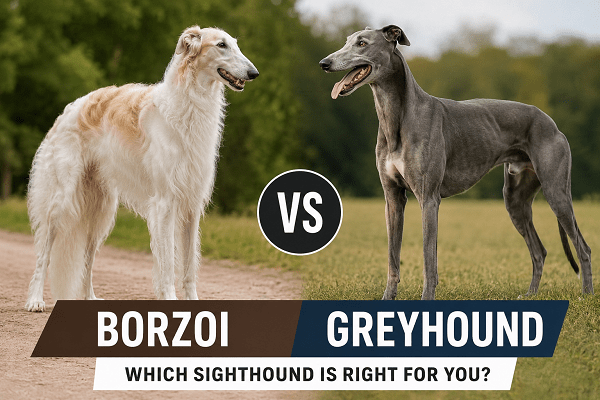
The Greyhound is usually the easier everyday sighthound; short coat, lower grooming needs, and a famously lazy indoor personality that suits first-time owners and smaller homes. The Borzoi is the more specialized choice; taller, longer-coated, more independent, and better suited to owners who have space, patience for grooming, and experience with a dog that thinks for itself. Neither breed needs a ton of daily exercise, but both need secure fencing, because their prey drive doesn’t switch off just because they’re calm on your sofa.
Table of Contents
- Borzoi vs Greyhound at a Glance
- Where These Two Breeds Actually Came From
- Is a Borzoi Just a Long-Haired Greyhound? Busting the Myth
- Temperament and Personality
- Size and Build: What the Breed Standards Say
- Speed and Prey Drive: Which One Is Really Faster?
- Exercise and Lifestyle Fit
- Grooming and Coat Care
- Training and First-Time Ownership
- Health and Lifespan: What the Data Shows
- Bringing Home a Rescue Greyhound? Learn the 3-3-3 Rule
- Living With Cats and Small Pets
- The Real Cost of Owning Each Breed
- Which Breed Is Right for You?
- Trainer’s Take: Why This Comparison Matters
- FAQs
- Conclusion
Introduction
Here’s the thing about choosing between a Borzoi and a Greyhound: most articles compare them like they’re two flavors of the same dog. They’re not. Yes, they’re both sighthounds. Yes, they both look like they stepped out of a Renaissance painting. But live with one of each for a year and you’ll notice how differently they move through a day, a house, and a relationship with you.
The problem most people run into is that “sighthound” gets treated as a personality type instead of a hunting style. Sighthounds, a group that also includes the Whippet, Saluki, and Afghan Hound, were bred to spot movement and chase it down using raw speed rather than scent tracking. That shared trait explains why both breeds nap most of the day and then explode after a squirrel with zero warning. It does not explain how they’ll behave with your kids, your cat, your grooming schedule, or your Saturday mornings.
In this guide, I’ll walk you through real differences in temperament, size, speed, exercise needs, grooming, training, health, and cost, using breed standards, veterinary research, and known behavior patterns rather than guesswork. I’ll also answer the questions people search for most, including a few myths worth clearing up. By the end, you’ll know which sighthound actually fits your life, not just your Pinterest board.
Borzoi vs Greyhound at a Glance
| Trait | Borzoi | Greyhound |
|---|---|---|
| Origin | Russia, developed for wolf hunting | Ancient breed, likely North African/Egyptian origins |
| AKC recognition | 1891 | 1885 |
| Height (male) | 28+ inches, commonly 30–34 inches | 28–30 inches |
| Weight (male) | 75–105 lbs | 60–88 lbs |
| Coat | Long, silky, wavy or flat | Short, smooth |
| Top speed | Roughly 35–40 mph | Roughly 40–45 mph |
| Grooming | High — regular brushing, prone to matting | Low — occasional brush, easy upkeep |
| Temperament | Independent, dignified, quieter with people | Gentle, affectionate, surprisingly cuddly |
| Median lifespan | Around 9–13 years | Around 11–12 years |
| Best for | Experienced owners with space and patience for coat care | First-time sighthound owners wanting a calmer, lower-maintenance dog |
The short version: if you want the more “hands-off” sighthound that still looks striking, the Greyhound usually wins. If you want a taller, more dramatic dog and don’t mind the extra grooming and independence, the Borzoi is worth the investment.
Where These Two Breeds Actually Came From
Understanding the history here isn’t trivia, it explains almost everything about their personalities today.
The Greyhound is one of the oldest documented dog breeds on record. Depictions resembling Greyhounds appear in Egyptian tombs dating back roughly 4,000–5,000 years, and the breed was prized by nobility long before it ever saw a racetrack. Modern Greyhound racing began in the early 20th century in the United States, and for decades the breed’s public image was tied almost entirely to the track. As welfare concerns closed racetracks across the US, UK, and Australia over the past two decades, large numbers of retired racers were rehomed through adoption groups, which is part of why so many Greyhounds available today are ex-racers rather than dogs bred purely as pets.
The Borzoi’s story is very different. Bred by Russian aristocracy for centuries to course wolves, foxes, and hare across open terrain, the Borzoi (formerly called the Russian Wolfhound in English until 1936) was historically a status symbol as much as a working hunter, dogs were often gifted between nobility rather than sold. The breed nearly vanished after the Bolshevik Revolution, when much of Russia’s aristocratic dog-breeding infrastructure was destroyed. A small number of exported dogs in Britain, Canada, and the US kept the breed alive. In 1924, the Borzoi was named the national dog of Russia, and it remains one of the more visually distinctive hound breeds worldwide.
That history matters because it shapes temperament. A dog bred to work independently, sight prey, and make split-second decisions on open land (Borzoi) tends to behave differently from a dog bred for generations to sprint on command around a fixed track and then rest in a kennel (Greyhound).
Is a Borzoi Just a Long-Haired Greyhound? Busting the Myth
This is one of the most common questions people search before buying, and the short answer is no, not directly. The Borzoi is not a Greyhound with a longer coat; it’s a distinct breed with its own separate development in Russia, built from regional Russian sighthound lines rather than descending from the English Greyhound lineage. They share a common sighthound ancestry the way cousins share a great-grandparent, not the way a long-haired and short-haired version of the same dog would.
Visually, though, the confusion makes sense. Both have the arched loin, tucked waist, deep chest, and long legs typical of coursing hounds, what’s sometimes called the sighthound “S-curve.” The Borzoi is simply built on a larger, more dramatic frame with a coat that completely changes the silhouette. If you squint at a shaved Borzoi, you will see a Greyhound-shaped dog underneath all that hair but genetically and historically, they developed on separate continents with separate purposes.
Temperament and Personality
Greyhounds have earned their reputation as gentle giants, and it’s well deserved. Many retired racing Greyhounds transition into pet life surprisingly well because track life already conditioned them to value soft bedding, quiet routines, and downtime over constant activity. Owners frequently describe them as “velcro dogs” that lean into affection and want to be near their people, even if they’re not the type to demand constant play.
Borzoi personalities run more reserved. They’re intelligent and deeply loyal, but they express affection on their own terms rather than seeking it out constantly. If you’ve ever handled a Borzoi, you know they can seem almost cat-like, content in a room with you, but not necessarily draped across your lap. This isn’t coldness; it’s the temperament of a breed developed to work with minimal direct handler input while hunting.
For families who want a dog that reads the room, settles fast, and enjoys physical affection, the Greyhound is typically the easier personality to live with. If you appreciate a more aristocratic, self-possessed companion and don’t need constant validation from your dog, the Borzoi’s quieter devotion can be just as rewarding, arguably more so, because it feels earned.
Size and Build: What the Breed Standards Say
According to the AKC breed standard, male Borzoi must stand at least 28 inches at the withers with no upper height limit, and most modern show Borzoi run closer to 30–34 inches. Weight ranges from 75 to 105 pounds for males and 60 to 85 pounds for females, though the standard specifically calls for a lean, athletic look rather than bulk. Females run about 2 inches shorter and 15–20 pounds lighter than males.
Greyhounds are typically a bit more compact. AKC references put males at roughly 28–30 inches tall and 60–70 pounds, with females at 27–28 inches and 60–65 pounds, though UK veterinary data has recorded average weights closer to 32 kg (about 70 lbs) for males and 27 kg (about 60 lbs) for females. Either way, a Greyhound is a lean, aerodynamic sprinter’s body, while a Borzoi is a taller, more architecturally dramatic frame draped in a flowing coat.
In daily life, size shapes more than looks. A Borzoi takes up considerably more sofa space, needs a bigger crate, and requires a taller fence to keep contained. A Greyhound, while still a large dog, is often easier to manage in tighter apartments simply because of its narrower profile and shorter coat.
Speed and Prey Drive: Which One Is Really Faster?
The Greyhound wins this one, but it’s closer than most people assume. Greyhounds have been officially clocked at speeds up to roughly 43–45 mph in short sprints, with typical racing speeds landing closer to 36–38 mph over a standard track distance. The Borzoi is genuinely fast too, most sources place its top speed in the mid-30s to low-40 mph range depending on the individual dog and terrain, since Borzoi were bred to run across open, uneven ground rather than a smooth oval track.
For context, only a handful of dog breeds are commonly cited as faster or comparable to the Greyhound over short distances, the Saluki and Whippet are the usual names that come up, with Salukis sometimes credited with greater endurance at speed over longer distances, even if the Greyhound holds the edge in a flat-out sprint. Neither the Borzoi nor the Greyhound is a distance runner; both are built for explosive, short bursts, not marathons.
Are Borzois Really “Unintelligent”?
You’ll sometimes see the Borzoi listed on outdated “least intelligent dog breed” rankings that circulated online years ago, largely based on a 1994 obedience-ranking study that measured working/obedience intelligence, essentially, how quickly a breed obeys a novel command from a stranger. Sighthounds as a group tend to score low on that specific metric, not because they’re unintelligent, but because they were bred for independent decision-making in the field rather than constant handler direction. A Borzoi that can track a moving hare across open terrain and make split-second directional choices without instruction is not a “dumb” dog, it’s a dog with a different kind of intelligence than a Border Collie waiting for its next cue. Judge a Borzoi on problem-solving and instinct, not on how fast it sits on command from a stranger.
Prey drive is where both breeds are genuinely similar, and it’s not something training fully removes. A rabbit, a cat, or even a plastic bag blowing across a yard can flip a calm, sleepy sighthound into a full sprint in under a second. This is why secure, tall fencing (Borzoi especially, given their jumping ability) and reliable leash habits matter more for these two breeds than almost any obedience command you’ll teach them.
Exercise and Lifestyle Fit
Greyhounds are often called “45-mph couch potatoes,” and the nickname holds up. Most adult Greyhounds are content with two moderate walks a day plus a chance to sprint safely in a fenced area, they don’t need hours of activity, and many happily sleep 16–18 hours a day.
Borzoi need a bit more structured movement. They’re not hyperactive, but a bored, understimulated Borzoi can become restless or develop a strong drive to escape and self-exercise (i.e., chase something). They benefit from regular access to a large, securely fenced space where they can run freely, in addition to daily leash walks.
Exercise needs, side by side
- Greyhound: Two 20–30 minute walks daily, occasional safe sprinting, lots of couch time in between.
- Borzoi: Daily walks plus regular access to a large, fenced space to run; mental engagement matters as much as physical output.
- Both breeds: A predictable routine and calm home environment help them settle far better than high-energy chaos.
Neither breed does well as a purely off-leash dog in unfenced or urban areas, their recall can be excellent until a fast-moving trigger overrides it in an instant. If you’re weighing outdoor safety gear, a GPS tracker is worth considering for either breed given how far and fast they can cover ground once prey drive kicks in. Our guide on how to choose the right tracker for your dog breaks down what actually works for fast-moving breeds.
Grooming and Coat Care
This is where the two breeds diverge the most in day-to-day upkeep. Greyhounds have a short, smooth coat that needs little more than a weekly brush and an occasional bath, one of the lowest-maintenance coats among large breeds. If you want a striking dog without a grooming routine eating into your weekend, this is a real point in the Greyhound’s favor.
Borzoi coats are long, silky, and often wavy, and they need brushing several times a week to prevent matting, especially around the “feathering” on the legs, tail, and chest. Shedding is moderate to heavy depending on the season, and many owners invest in a proper undercoat rake or slicker brush rather than relying on a basic comb. Professional grooming sessions for large, long-coated breeds commonly run more than for a short-coated dog of the same size, simply because of the time involved in de-matting and drying a coat that size.
If you’re weighing a longer-coated breed for the first time, our guide to essential grooming habits for a healthy coat is worth reading before you commit, grooming neglect on a Borzoi doesn’t just look bad, it can lead to painful matting and skin issues. If low grooming is a priority for you regardless of breed, our roundup of low-maintenance dog breeds is a useful comparison point and it’s part of why the Greyhound consistently makes those lists while the Borzoi doesn’t.
Training and First-Time Ownership
Greyhounds are frequently recommended to newer sighthound owners because most retired racers arrive already used to structure, handling, and close contact with people, even if they’ve never seen stairs or a mirror before. Their sensitivity means harsh corrections backfire quickly; gentle, consistent, reward-based training builds trust far faster than any attempt at dominance-based handling.
Borzoi are trainable, but they’re less inclined to work simply to please you. Expect more negotiation than command-and-response, especially with recall and off-leash reliability. This doesn’t make them harder to love, it makes them a better fit for owners who already understand independent-thinking breeds and won’t get frustrated by a dog that occasionally decides your instruction was more of a suggestion.
Understanding the difference between building genuine structure and simply trying to dominate a dog matters even more with an independent sighthound. Our piece on dominance vs. discipline in dog training covers why consistency, not control, is what actually earns cooperation from a breed like the Borzoi.
Health and Lifespan: What the Data Shows
A 2019 UK veterinary study (VetCompass) tracking Greyhounds under general veterinary care found a median lifespan of 11.4 years, with females (11.8 years) slightly outliving males (11.2 years). Cancer accounted for roughly 21.5% of deaths, followed by sudden collapse (14.3%) and musculoskeletal disease. Dental disease was extremely common, affecting close to 39% of the study population, a reminder that even a “low-maintenance” coat doesn’t mean low-maintenance overall health care.
Borzoi lifespan estimates commonly fall between 9 and 13 years, with most sources citing an average around 10–12 years. Like other large sighthounds, they carry elevated risk for certain orthopedic issues and bone cancer (osteosarcoma), which affects several giant sighthound breeds at higher-than-average rates.
Two health issues deserve special attention for anyone considering either breed:
- Bloat (Gastric Dilatation-Volvulus): Both breeds have the deep, narrow chest conformation associated with elevated GDV risk. Feeding smaller, split meals and avoiding vigorous activity right after eating are standard preventive steps; some owners discuss prophylactic gastropexy with their vet during a spay/neuter procedure.
- Anesthesia sensitivity: Sighthounds, and Greyhounds specifically, are documented to metabolize certain anesthetic drugs differently due to lower body fat and distinct liver enzyme activity. One genetic study found that nearly 29% of Greyhounds carry a high-risk genotype (SERPINF2) linked to delayed post-operative bleeding, the highest prevalence of any breed studied. Always make sure your vet has experience with sighthound-specific anesthesia protocols before any surgery, including routine spay/neuter.
Neither breed’s health profile should be a dealbreaker, but both require an owner who takes deep-chested-breed risks seriously rather than treating them as generic large-dog concerns.
Bringing Home a Rescue Greyhound? Learn the 3-3-3 Rule
If you’re adopting an ex-racing Greyhound specifically, this is worth understanding before you bring the dog home. The “3-3-3 rule” is a general guideline used by many rescue and adoption organizations to set realistic expectations for a dog transitioning out of a shelter or racing kennel environment:
- First 3 days: The dog is overwhelmed and decompressing. Expect it to hide, sleep excessively, or refuse food, this is normal adjustment stress, not a behavior problem.
- First 3 weeks: The dog starts learning your routine, household sounds, and boundaries. This is when true personality begins to show, and when consistent structure matters most.
- First 3 months: The dog starts to feel secure and fully bonded, with trust and routine largely established.
This rule isn’t Greyhound-specific, but it’s especially relevant here because so many pet Greyhounds come straight from racing kennels rather than a typical home environment. A dog that has spent its whole life around a fixed schedule, a crate, and a track may need real time to learn stairs, glass doors, hardwood floors, and simply being alone in a quiet house. Patience during this window prevents a lot of misread “problem behaviors” that are really just adjustment.
Living With Cats and Small Pets
This is one of the most important questions for households that already have small animals, and neither breed gets an automatic pass. Some rescue Greyhounds are specifically assessed by adoption groups as “small-animal tolerant” after supervised evaluation, meaning cat compatibility is possible, but selective and individual, never guaranteed by breed alone.
Borzoi carry an equally strong (arguably stronger, given their historical role hunting live game) prey drive, and no reputable source recommends assuming a Borzoi is safe around cats or small pets without careful, gradual introduction and ongoing supervision. A dog that ignores the cat indoors may react completely differently the moment that same cat bolts across a yard.
If your household includes cats, small dogs, or other pets, work with a rescue or breeder who evaluates individual temperament and prior exposure, never take “sighthounds are calm” as evidence they’re safe around smaller animals unsupervised.
The Real Cost of Owning Each Breed
Cost is rarely discussed honestly in breed comparisons, so here’s the practical breakdown:
- Purchase/adoption: Greyhounds are frequently available through adoption groups at a fraction of typical purebred pricing, since so many retired racers need homes. Borzoi puppies from reputable breeders are less common and typically priced higher, reflecting a smaller breeding population.
- Grooming: Greyhounds need minimal professional grooming, most owners handle upkeep at home. Borzoi owners often budget for periodic professional grooming, particularly for de-matting and coat maintenance, in addition to more frequent at-home brushing sessions.
- Food: Both breeds are lean, moderate eaters relative to their size, sighthounds are not typically heavy eaters compared to some other large breeds, but quality nutrition matters given their sensitivity to weight fluctuations.
- Veterinary care: Budget for sighthound-aware veterinary care for both breeds, particularly around anesthesia and orthopedic monitoring. This isn’t optional, using a vet unfamiliar with sighthound physiology raises real surgical risk.
- Housing needs: A secure, tall fence (6 feet or more is often recommended for Borzoi specifically, given their jumping ability) is a real cost to factor in for either breed if you don’t already have one.
Which Breed Is Right for You?
Choose a Greyhound if you want:
- A gentle, affectionate dog that settles quickly indoors
- Low grooming demands and simple coat care
- A breed well suited to apartments and first-time sighthound owners
- A dog that’s genuinely happy with short walks and long naps
- The option to give a retired racer a second chance at a home
Choose a Borzoi if you want:
- A taller, more dramatic-looking sighthound
- A dog you don’t mind investing time in for coat care
- A calm indoor presence paired with a need for real running space
- A more independent companion that shows affection on its own terms
- A rarer, more distinctive breed as part of your household identity
If you’re still weighing where either breed fits within the wider dog world, our breakdown of the seven types of dogs explains how the hound group’s sighthounds differ from scent hounds, terriers, and working breeds, useful context if you’re comparing sighthounds against an entirely different type of dog.
Trainer’s Take: Why This Comparison Matters
I’ve spent over 14 years working hands-on with working and military dogs, and one pattern holds true across every breed I’ve handled: temperament research and breed standards only tell you half the story. The other half comes from watching how a specific dog behaves in your specific home. Both the Borzoi and Greyhound are wonderful, elegant animals, but I’ve seen more owners struggle with mismatched expectations (assuming a Borzoi will be as “plug and play” as a Greyhound, or assuming a Greyhound won’t have any prey drive at all) than with the breeds themselves. Match the dog’s real needs to your real life, not to how it looks in a photo.
Understanding the difference between a dog bred for a specific working purpose and one bred purely as a companion also helps set realistic expectations here, our guide on the difference between a working dog and a pet dog is a useful companion read if you’re new to breeds with strong historical working roots, like both of these sighthounds.
If you want a deeper, practical framework for evaluating any breed before you commit, not just these two, my book, Beyond the Bark: Inside a Pro Handler’s Playbook for Raising the Ideal Dog, walks through the same selection and readiness principles I use professionally, adapted for everyday owners.
Frequently Asked Questions
Is a Borzoi related to a Greyhound?
Not directly. Both belong to the sighthound family and share the same general body shape built for chasing prey by sight, but the Borzoi developed independently in Russia from regional hunting lines, while the Greyhound has separate, much older origins traced back to ancient Egypt. They’re distant cousins in hunting style, not directly descended from one another.
Are Borzois really one of the least intelligent dog breeds?
No, that reputation comes from outdated “obedience intelligence” rankings that measure how quickly a breed obeys unfamiliar commands, not how smart the breed actually is. Borzoi were bred to make independent decisions while hunting, which naturally makes them score lower on obedience-based intelligence tests than breeds developed to follow constant handler direction, like Border Collies.
What is the 3-3-3 rule for Greyhounds?
The 3-3-3 rule is a general adoption guideline: expect 3 days of decompression and adjustment stress, 3 weeks to learn your household routine and boundaries, and 3 months to feel fully secure and bonded. It’s commonly used for rescue and shelter dogs, and it’s especially relevant for ex-racing Greyhounds adjusting to home life for the first time.
What dog breeds are faster than a Greyhound?
Very few. The Greyhound is widely considered the fastest dog breed over short sprints, reaching roughly 43–45 mph. The Saluki is the breed most often cited as comparable, sometimes with better endurance at speed over longer distances, though the Greyhound generally holds the edge in a flat-out sprint. The Borzoi is close behind both, typically in the mid-30s to low-40 mph range.
Are Greyhounds or Borzoi better for cat households?
Neither breed should be assumed safe with cats based on breed alone. Some Greyhounds are specifically assessed as small-animal tolerant by rescue groups after supervised evaluation, which gives them a slight practical edge for cat households. Borzoi carry an equally strong prey drive rooted in their hunting history, so careful, gradual, supervised introductions matter for both breeds regardless of how calm they seem indoors.
Conclusion
If you want the simpler, lower-maintenance sighthound, the Greyhound is usually your answer, gentle, easy to groom, and a genuinely good option for first-time large-breed or first-time sighthound owners, especially if you’re open to adopting a retired racer. If you want a taller, more visually striking dog and don’t mind investing real time into coat care and a more independent personality, the Borzoi rewards that investment with a companion unlike almost anything else in the dog world.
Don’t choose based on speed, looks, or breed prestige alone. Think honestly about your grooming tolerance, your fencing situation, your patience for an independent thinker, and how much space you can realistically offer. Get that match right, and either breed will give you one of the most elegant, loyal companions you’ll ever own.

Her work centres on obedience, detection, protection and operational readiness. She favours proven methods built on repetition, consistency and real-world conditioning, so that both dogs and handlers are prepared for high-pressure tasks.
Rofiat represented the Nigerian Army Dog Centre at the Nigerian Army Day Celebration (NADCEL) 2026, where she led demonstrations in obedience, explosive detection, agility and tactical movement. Through articles, training content and documentaries, she shares field-based insight into how structured training, clear communication and trust between handler and dog affect performance and reliability.
She is the author of Beyond the Bark: Inside a Pro Handler's Playbook for Raising the Ideal Dog, a practical guide that helps dog owners and handlers apply professional training principles in everyday situations.
- Dog Agility Course Layout: Easy DIY Setup - October 7, 2026
- Local Dog Breeds: Temperament, Health & Training Guide - October 6, 2026
- How Long Do Military Working Dogs Serve? Full Guide - October 5, 2026