What Happens to Military and Police Dogs After Retirement?

When military and police dogs retire, they do not simply “finish work and disappear.” Most are adopted by their handlers, rehomed with vetted families, or transferred to law enforcement agencies, and in many places retirement support now includes veterinary-care assistance and adoption programs. In this article, you’ll learn how retirement decisions are made, what life looks like after service, what laws and programs protect these dogs, and how to prepare for the unique needs of a retired working dog.
Table of contents
Introduction
Why Working Dogs Retire
What Happens Immediately After Retirement
Where Retired Dogs Go
Health and Veterinary Care
Money, Costs, and Support Programs
Real-World Examples
How to Adopt or Care for One
FAQs
Conclusion
Introduction
If you’ve ever watched a working dog on duty, you already know these animals do serious, high-stakes work. The big question is what happens when age, injury, or service time catches up with them, and the answer is more hopeful than it once was: today, most retired military and police dogs are rehomed. If you’re unfamiliar with the differences between these two types of service dogs, it’s worth understanding how Military Working Dogs and Police K9s differ in their roles, training, and deployments before looking at what happens after retirement. Still, retirement is not a soft landing by accident; it takes planning, screening, and a real commitment to lifelong care.
Why Working Dogs Retire
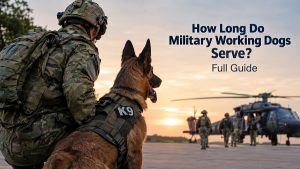
Military working dogs and police K9s usually retire because of age, wear and tear, injury, illness, or because they no longer meet the physical standards needed for operational work. For many dogs, the retirement window comes after years of repetitive stress: jumping in and out of vehicles, tracking for long periods, biting and apprehension work, loud environments, deployments, and exposure to heat or cold. In the RCMP, for example, service dogs typically begin work around 18 to 20 months old and often retire after about five and a half to seven years, depending on their workload and health.
The physical demands become easier to appreciate when you understand how military working dogs are trained, from obstacle courses and patrol work to scent detection and tactical deployments.
A retired working dog is not usually “bad” or “untrained.” In most cases, the dog is simply no longer suited to the intensity of operational life, even if it still has plenty of energy for family life, walks, and a quieter routine. That matters because the public sometimes assumes retirement means failure, when in reality it often means the dog has done its job well enough to earn a gentler chapter.
What Happens Right After Retirement
The retirement process starts with an assessment. Handlers, trainers, kennel staff, and veterinary teams usually decide whether the dog should continue working, be reassigned, or be retired based on fitness, temperament, and health. In the U.S. military system, retired dogs are made available for adoption under federal rules, with preference given to former handlers first, then other qualified adopters, and then law enforcement agencies. Some dogs remain temporarily at a military facility until adoption is finalized, such as the adoption program at Lackland Air Force Base, which has long handled retired military working dog placement.[
This transition period can be emotional for everyone involved. Dogs are often bonded tightly to one handler, so the best retirement outcome is usually the one that preserves familiar relationships and reduces stress during the move. That is why many forces and military systems prioritize the handler’s home first, especially when the dog has already spent years living and working as part of a two-dog team.
Where Retired Dogs Go
Most retired military and police dogs go into one of four paths: they live with their handler, move to another vetted private home, transfer to another working agency, or receive specialized care if adoption is not appropriate. The handler option is often considered the gold standard because it keeps the dog with the person it knows best. In Hong Kong’s Police Dog Adoption Programme, for example, handlers usually apply to take their dogs home, and if they cannot, the force matches the dog with a suitable family.
Many of the dogs entering retirement are top breeds used as military working dogs, such as the Belgian Malinois, German Shepherd, Labrador Retriever, and Dutch Shepherd, each selected for different operational strengths.
Here’s the practical reality:
Handler adoption: Most common and usually easiest for the dog emotionally.
Private family adoption: Happens when the handler cannot take the dog, but the dog is still suitable for home life.
Transfer to another agency: Some dogs continue working in law enforcement, detection, or related roles if they still have the drive and health for it.
Specialized retirement care: Used for dogs with significant medical or behavioral needs that require a controlled environment.
In the U.S., retired military working dogs have been legally adoptable since Robby’s Law passed in 2000, which ended the old policy of euthanizing dogs at the end of service. That legal shift changed the story of retirement from disposal to placement, and it is one of the most important animal-welfare reforms in working-dog history.
Health and Veterinary Care
Retired working dogs often need more medical care than an average pet, especially if they served in physically demanding or combat-related roles. Common issues reported in retired working dogs include orthopedic problems, chronic pain, eye disease, and other age- or service-related conditions; lawmakers and animal-care groups have also highlighted the financial burden that can fall on handlers and adopters. In Florida, the Care for Retired Police Dogs program was created to help cover annual veterinary costs of up to $1,500 per retired police dog, reflecting how real those expenses can be.
Under U.S. law, the Secretary of Defense may establish a veterinary-care system for retired military working dogs, and care standards can be set and updated by the department. That sounds technical, but it matters in the real world because the day a dog retires does not mean the wear-and-tear disappears. A retired explosives dog or patrol dog may need ongoing medications, hip or knee treatment, dental work, or chronic-condition monitoring for the rest of its life.
For adopters, the best mindset is simple: you are not “getting a free dog,” you are taking on a veteran with a medical history. That is a privilege, but it is also a long-term responsibility.
Money, Costs, and Support Programs
The cost side of retirement is where many families get surprised. While some adoption programs do not charge an adoption fee, transport, vet work, medication, and ongoing care can still add up quickly. One Florida lawmaker estimated that some retired dogs with no serious medical issues still cost about $3,000 each year to maintain, which gives you a realistic sense of the budget pressure on handlers.
A few helpful figures show the scale of these systems:
These numbers show two things. First, adoption is common enough to be a formal pipeline, not a rare exception. Second, the ongoing cost of care is one reason modern retirement programs increasingly include nonprofit assistance, grants, or reimbursement structures.
Real-World Examples
The U.S. military’s adoption program at Lackland Air Force Base has been a major retirement hub for years, and published reporting has said the base adopted out roughly 300 to 400 dogs annually at one point. Another widely cited figure is that more than 90% of returning military working dogs go home to their former handlers, which shows how important the handler bond really is. Even when the dog cannot return to the handler, the preferred path is usually a carefully screened civilian or law-enforcement home.
The RCMP offers another strong example of handler-centered retirement. Their service dogs typically retire at around age eight and then move into home life with the handler, or occasionally with a trusted colleague or friend if the handler cannot keep the dog. That model makes sense because a dog that has lived by strict routines often adjusts best to a calm, familiar household rather than a completely new environment.
There is also a historical lesson here. Before Robby’s Law in 2000, retired U.S. military working dogs were euthanized when their service ended, which is a reminder that today’s adoption model did not happen by accident; it came from advocacy, legislation, and public pressure. For anyone who works with these dogs now, that history is why retirement planning should never be treated as an afterthought.
How to Adopt or Care for One
If you ever get the chance to adopt a retired military or police dog, start by understanding the dog’s working background, energy level, and medical needs. These dogs can be extremely obedient, intelligent, and bonded to structure, but they are not always ideal for homes that want a casual, low-effort pet. Some retired K9s also still carry habits from service, such as high alertness, strong toy drive, or a need for predictable routines.
A responsible adopter should be ready to do the following:
Follow the dog’s existing routine as closely as possible in the first few weeks.
Provide secure fencing and controlled introductions to children or other pets.
Budget for advanced veterinary care, not just basic vaccinations.
Respect any mobility limits, post-surgical restrictions, or medication schedules.
Avoid pushing the dog into new “jobs” or high-stress activities unless professionals approve it.
A good example is a retired patrol Malinois that now spends its days on short walks, soft bedding, and low-impact play instead of decoy work. The dog may still look fierce, but its retirement success depends on calm structure, regular medical follow-up, and a home that understands working-dog behavior.
What Happened Before
The older system was far harsher than most people realize. Before 2000 in the United States, military working dogs were typically euthanized after retirement, which makes the modern adoption framework a major welfare improvement. In other words, the current standard of rehoming, handler priority, and veterinary support is not ancient tradition; it is a relatively recent reform. That history still shapes today’s debates about funding, transport, and who should pay for post-service care.[justice4tedds]
This also explains why the phrase “retirement” means something deeper for these dogs than it does for many household pets. It is not just slowing down. It is the end of a very specific working life, and the start of a carefully managed transition into a safer, softer world.
Frequently Asked Questions
1. Do military dogs always stay with their handlers after retirement?
No, but handlers are usually the first adoption choice in many systems, and a large majority of retired military dogs do end up with them.
2. Are retired police dogs free to adopt?
Sometimes the adoption fee is low or waived, but the real cost is in transport, veterinary care, medication, and long-term upkeep.
3. Can a retired K9 still work as a pet?
Yes, but not as an operational dog. Some retired K9s can transition into therapy, family life, or quiet companion roles, depending on health and temperament.
4. What happens if a retired dog is too sick to be adopted?
Dogs with major health or behavior issues may be placed in specialized care or handled under a controlled retirement plan rather than regular family adoption.
5. Is there any government support for retired working-dog vet bills?
Yes, in some places there is. U.S. law authorizes a veterinary-care system for retired military working dogs, and some states have specific support programs for retired police dogs.
Conclusion
Military and police dogs usually retire into adoption, not abandonment, and the best outcomes almost always involve a familiar handler, a vetted family, or another suitable working role. If you remember only one thing, make it this: retirement is not the end of service, it is the start of lifetime care, and the people who take these dogs home should be ready for both the joy and the responsibility.
Understanding what a working dog really is helps explain why retirement should be viewed as the final stage of a professional career rather than simply the end of pet ownership.
If you are writing, adopting, or simply educating others about working dogs, the clearest takeaway is to treat these animals like the professionals they are. They earned their retirement, and the best retirement is one that protects their health, preserves their trust, and gives them a calm place to live out the rest of their years.

Her work centres on obedience, detection, protection and operational readiness. She favours proven methods built on repetition, consistency and real-world conditioning, so that both dogs and handlers are prepared for high-pressure tasks.
Rofiat represented the Nigerian Army Dog Centre at the Nigerian Army Day Celebration (NADCEL) 2026, where she led demonstrations in obedience, explosive detection, agility and tactical movement. Through articles, training content and documentaries, she shares field-based insight into how structured training, clear communication and trust between handler and dog affect performance and reliability.
She is the author of Beyond the Bark: Inside a Pro Handler's Playbook for Raising the Ideal Dog, a practical guide that helps dog owners and handlers apply professional training principles in everyday situations.
- Dog Agility Course Layout: Easy DIY Setup - October 7, 2026
- Local Dog Breeds: Temperament, Health & Training Guide - October 6, 2026
- How Long Do Military Working Dogs Serve? Full Guide - October 5, 2026