Best Nutrition Supplements for Working Dogs (2026)
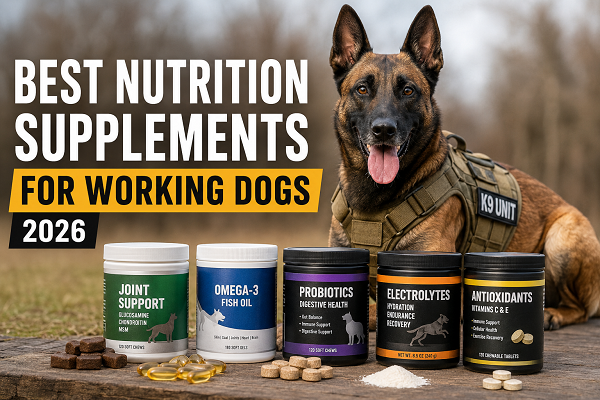
The best nutrition supplements for working dog performance are omega-3 fish oil (EPA/DHA) for joints and inflammation, glucosamine-chondroitin-MSM blends for cartilage support, probiotics for gut stability under stress, electrolyte formulas for hydration during exertion, and antioxidant support (vitamin E and C) to counter exercise-induced oxidative stress. None of these replace a high-quality, performance-grade base diet, they build on top of it.
Table of Contents
- Introduction
- Why Working Dogs Need More Than “Good Dog Food”
- What the Research Actually Shows
- The Core Supplement Categories Every Handler Should Know
- How Much and When to Supplement
- Real-World Case Studies
- Our Top Nutrition Supplement Recommendations
- Common Mistakes Handlers Make With Supplements
- Budgeting for a Working Dog Supplement Stack
- FAQs
- Conclusion
Introduction
If you’ve ever watched a Belgian Malinois clear a six-foot wall after eight hours on shift, or seen a Labrador keep working a scent line in 90°F heat without missing a beat, you already know these dogs aren’t running on kibble alone. Something else is holding their bodies together behind the scenes and more often than not, that “something else” is a smart, targeted supplement routine.
I’ve spent years around K9 units, sled dog kennels, and search-and-rescue teams, and I can tell you the handlers who get the best mileage out of their dogs aren’t the ones buying the flashiest supplement on the shelf. They’re the ones who understand why each supplement exists, when to use it, and just as important, when to leave it in the cabinet. This guide walks you through exactly that.
Working dogs, such as police K9s, military working dogs (MWDs), search and rescue (SAR) dogs, sled dogs, herding dogs, and serious sporting dogs, burn through calories, joint cartilage, and hydration reserves far faster than the average companion dog. Research from Cornell University, Oklahoma State University’s sled dog physiology program, and the Iditarod Trail Committee’s veterinary team consistently points to five supplement categories that make a measurable difference: joint support, omega-3 fatty acids, probiotics, electrolytes, and antioxidants. This article breaks down what the science says, how much to give, when to give it, real-world examples from military and endurance-dog programs, common mistakes to avoid, and specific products worth considering.
Why Working Dogs Need More Than “Good Dog Food”
Here’s the thing most new handlers get wrong: they assume a premium bag of kibble covers everything. It doesn’t, not for a dog that’s actually working.
A sedentary pet dog might need around 30 kcal per pound of body weight per day. A dog in heavy field work, think patrol, detection, herding, or multi-day search operations, can need anywhere from 1.5 to 2.5 times that amount. Sled dogs running the Iditarod are the extreme end of the spectrum, sometimes requiring energy intakes several times higher than their resting needs during peak race days.
That kind of output puts real stress on the body. Joints absorb repeated impact. Muscles break down and rebuild faster than in a couch companion. The gut, which is far more sensitive to stress than people realize, has to process more food, more often, under more pressure. And all of that physical strain generates free radicals, unstable molecules that, over time, damage cells if the dog’s antioxidant defenses can’t keep up.
Standard commercial dog food is formulated for maintenance, not performance. It’s a foundation, not a finish line. If you’re serious about your dog’s long-term durability, whether you’re raising a family protection dog, running SAR call-outs, or handling a K9 on patrol, supplementation is where you close that gap. I go deeper into the full daily feeding framework in our complete working dog nutrition guide, but this article is specifically about the supplement layer on top of that base diet.
What the Research Actually Shows
I want to be upfront here: not every supplement on a pet store shelf is backed by solid evidence, and a good handler learns to tell the difference between marketing and data.
Cornell University’s Riney Canine Health Center, which has studied performance dogs for decades, notes that outside experts have genuinely mixed opinions on blanket supplementation, but they consistently flag two categories as worth prioritizing: post-exercise carbohydrate repletion for multi-day events, and fiber/probiotics for stress-related digestive upset, which remains one of the most common issues handlers report in working dogs.
The most detailed performance-nutrition research on canine athletes comes out of endurance sled dog studies, largely led by Dr. Michael Davis at Oklahoma State University. His team discovered that elite sled dogs undergo a metabolic shift during multi-day exercise, becoming remarkably efficient at burning fat for fuel while sparing muscle glycogen, a trait that has even drawn research funding from human physiology programs interested in insulin sensitivity. That same research group, alongside the Iditarod Trail Committee’s veterinary staff, found something else worth knowing: after examining sled dogs that died during a rough 1997 Iditarod, pathologists found significantly lower vitamin E levels in dogs that showed muscle degeneration compared to those that didn’t. The Iditarod’s own veterinary recommendation since then has been an additional 400 IU of vitamin E per exercising sled dog per day, on top of dietary intake.
A separate French study on search and rescue dogs, published by researchers Grandjean and Cléro, looked at high-fat, high-antioxidant nutritional supplementation given before and during endurance exercise, and found measurable improvements in the dogs’ physiological and biochemical recovery markers compared to unsupplemented controls.
The takeaway isn’t “throw every supplement at your dog.” It’s that specific, targeted supplementation, matched to the actual demands your dog faces, has real, published support behind it. Generic multivitamins dumped on top of a complete diet, on the other hand, have much thinner evidence.
The Core Supplement Categories Every Handler Should Know
Let’s break these down one at a time, because lumping them together is how handlers end up over-supplementing or wasting money on the wrong thing.
1. Joint and Mobility Support
This is the single most requested supplement category among working dog handlers, and for good reason. Repeated jumping, hard stops, decoy work, and years of pavement or uneven-terrain work put real wear on hips, elbows, and stifles.
- Glucosamine and chondroitin are the backbone of most joint formulas. A typical dosing benchmark for a 25-lb dog is roughly 500 mg glucosamine hydrochloride and 400 mg chondroitin sulfate daily, scaled up for larger dogs.
- MSM (methylsulfonylmethane) is usually paired alongside these for its anti-inflammatory support, though an exact optimal dose hasn’t been firmly established in research.
- Green-lipped mussel and UC-II collagen are newer additions in premium formulas, with growing evidence for cartilage support.
Vets I’ve spoken with generally recommend starting joint support proactively around age 3 to 4 in large working breeds, not waiting until you see visible stiffness, because by then cartilage damage is already underway.
2. Omega-3 Fatty Acids (EPA & DHA)
If I had to pick one supplement category with the most universal support across veterinary literature, it’s omega-3s. EPA and DHA, found in fish oil, support joint lubrication, reduce inflammatory response after hard exercise, support cardiovascular and cognitive function, and noticeably improve coat and skin condition in dogs that spend a lot of time outdoors.
For a 50-lb working dog on active joint support, therapeutic dosing typically lands in the range of 2,500–3,750 mg combined EPA + DHA per day, considerably more than the “sprinkle on food” amount many pet owners assume is sufficient. Dosage should always scale to body weight and be introduced gradually to avoid loose stool.
3. Probiotics and Digestive Support
Cornell’s own performance-nutrition specialists single this category out as one of the most practically useful for working dogs and I’d agree from firsthand experience. Deployment, travel, kenneling, food changes, and the physiological stress of hard work are all classic triggers for “stress diarrhea” in working dogs. A quality probiotic, taken consistently (not just reactively once symptoms start), helps stabilize gut flora and reduce the frequency of these episodes.
4. Electrolytes and Hydration Support
Dogs don’t sweat the way people do, they lose heat mainly through panting but they still lose sodium, potassium, and chloride through saliva, respiration, and physical exertion, especially in heat or during multi-hour deployments. A 2016 study involving the Urban Search and Rescue Veterinary Group found that dogs given a rehydration formula during active search work drank more fluid overall and showed measurable performance benefits compared to dogs offered plain water alone.
This matters more than most handlers realize: a dehydrated working dog isn’t just thirsty, it’s operating with reduced blood volume, higher core temperature, and slower cognitive processing, all things that directly hurt detection accuracy and physical output.
5. Antioxidants (Vitamin E and Vitamin C)
Hard, repeated exercise generates oxidative stress in muscle tissue. Vitamin E and vitamin C are believed to help neutralize some of that free-radical damage. As noted above, this isn’t theoretical, it’s tied directly to documented cases where insufficient vitamin E was linked to muscle pathology in racing sled dogs. Vitamin C is not considered an essential nutrient for a sedentary dog (they synthesize their own), but research on racing sled dogs suggests it may become conditionally important under sustained heavy exertion.
6. Protein and Muscle Recovery Support
Working dogs, especially those in bite work, agility, or multi-day endurance events, benefit from additional high-quality protein around exertion, often in the form of hydrolyzed whey or predigested liver/egg protein blends that absorb quickly and support muscle repair between sessions.
If you’re raising a young working prospect, note that puppy nutritional needs are narrower and more precisely calibrated than adult supplementation, particularly around calcium and vitamin D, where excess intake in large-breed puppies can actually disrupt normal bone development. I cover that entire early-life window, week by week, in our puppy nutrition guide from week 1 to month 12.
How Much and When to Supplement
Timing matters almost as much as the supplement itself.
- Joint and daily maintenance supplements (glucosamine, omega-3, multivitamins): given consistently, once or twice daily with food, year-round, not just during heavy work seasons.
- Carbohydrate/glycogen repletion: most useful specifically on multi-day exertion days, given within roughly two hours after strenuous work, not as an everyday addition.
- Electrolytes: most valuable before and during high-heat or high-exertion deployments, not as a daily default for a dog doing light structured exercise.
- Probiotics: most effective given daily and consistently, especially starting a few days before a known stressor like travel, boarding, or a diet change, rather than only once symptoms appear.
- Antioxidants: typically dosed daily in working and competition dogs, with some handlers increasing intake around known high-intensity events.
A general feeding rhythm worth knowing: many working dog nutrition specialists recommend feeding roughly one-third of the daily ration three to four hours before work or exercise, and the remaining two-thirds within two hours after work ends, timed around meals, not stacked all at once. If your schedule doesn’t allow for that split, feeding at the end of a shift is a reasonable fallback. For a broader look at structuring your dog’s activity and recovery windows around this kind of schedule, see our guide on how often you should exercise a working dog.
One more thing worth repeating: always loop your veterinarian in before starting a new supplement stack, particularly if your dog is on any medication. MSM, for example, can have an aspirin-like blood-thinning effect that matters if your dog is already on anticoagulants.
Real-World Case Studies
The Iditarod vitamin E findings. After Iditarod ’97, when three dogs died with muscle degeneration and unusually low vitamin E tissue levels compared to dogs that died from unrelated causes, race veterinarians moved from speculation to a formal recommendation: 400 additional IU of vitamin E per exercising sled dog daily. It’s a clear example of a supplement decision driven by actual necropsy data, not marketing.
Oklahoma State’s fat-metabolism research. Michael Davis’s decade-plus of work with elite sled dogs revealed something genuinely surprising to exercise physiologists: these dogs can switch almost entirely to fat oxidation during multi-day exertion while staying highly insulin-sensitive, the opposite of what chronic high-fat intake typically does in humans. It reshaped how sports-nutrition researchers think about substrate use during extreme endurance work, and it’s part of why high-quality fat sources (not just carbs) matter so much in performance-dog diets.
Modern military working dog conditioning programs. More recent U.S. Army initiatives, including updated Health and Fitness programs for military working dog detachments, explicitly frame MWDs as “tactical athletes”, with specialized diets and recovery protocols built alongside structured conditioning routines, not bolted on as an afterthought. It’s the same philosophy civilian handlers can apply on a smaller scale: performance, recovery, and nutrition are one system, not three separate boxes to check. If you handle or care for a working or military-style dog, our piece on maintaining good health in military working dogs covers how these pieces fit together day to day.
Our Top Nutrition Supplement Recommendations
I get asked constantly which specific products are worth the money. Here are five I’d point a working-dog handler toward, based on ingredient transparency, dosing clarity, and consistent track record:
- Nutramax Cosequin Joint Health Supplement — The most vet-recommended joint supplement brand on the market, combining glucosamine, chondroitin, MSM, and omega-3s in a chewable soft chew most dogs happily take as a treat. A solid starting point for proactive joint maintenance in any working breed over age three.
- Nordic Naturals Omega-3 Pet — A concentrated, third-party-tested liquid fish oil delivering 1,380 mg of omega-3s per teaspoon, which means you hit therapeutic dosing without force-feeding your dog an entire bottle. Ideal for large and giant working breeds.
- Purina Pro Plan FortiFlora Probiotic — The single-packet probiotic most veterinarians reach for first when a working dog’s gut gets unsettled by travel, kenneling, or a food switch. Easy to sprinkle over food daily, even in the field.
- K9Power Go Dog Hydration & Electrolyte Supplement — Purpose-built for active and working dogs, combining electrolytes with beta-alanine, creatine, and BCAAs to support stamina and post-exertion recovery on demanding work days.
- Doc Roy’s Daily Care Multivitamin — A well-rounded daily multivitamin covering 34 essential nutrients, useful as a baseline safety net for dogs eating home-prepared or inconsistent diets while deployed or traveling.
Start with the joint and omega-3 combination if you’re only adding one or two things, that pairing has the broadest evidence base and the most noticeable long-term payoff for a working dog’s career length.
Common Mistakes Handlers Make With Supplements
I’ve seen the same handful of mistakes repeated across departments, kennels, and backyards for years:
- Stacking too many products at once. More isn’t better. Overlapping ingredients (say, three different products all containing MSM) can push a dog past a safe threshold without anyone noticing.
- Treating supplements as a substitute for a quality base diet. No amount of fish oil compensates for a nutritionally inadequate kibble.
- Ignoring dosage-to-weight scaling. A supplement dosed for a 90-lb Malinois isn’t automatically safe or effective at the same amount for a 55-lb herding dog.
- Starting supplementation only after problems appear. Joint and gut support work best as prevention, not damage control.
- Skipping the vet conversation. Especially with anticoagulant-interacting ingredients like MSM, or with dogs on existing medication.
- Assuming raw meat diets solve everything. Homemade and raw diets are common among sled dog and greyhound circles, but they carry real health risks and nutrient-gap concerns without careful formulation, not a shortcut around proper supplementation.
Budgeting for a Working Dog Supplement Stack
A realistic monthly budget for a mid-size working dog on a core supplement stack (joint support, omega-3, and probiotic) typically runs somewhere between $35 and $70, depending on brand and dog size. Adding electrolyte and antioxidant support for a dog in heavy seasonal deployment can push that toward $90–$120 a month. It sounds like a lot until you compare it to the cost of a single joint surgery or an extended vet bill from chronic digestive issues, which is exactly the math most experienced handlers eventually land on.
If you want a broader, food-first foundation to build this supplement layer on top of, our guide on the best vet-backed healthy training treats is a good next stop, since treats are often an overlooked source of hidden calories and nutrients in a working dog’s daily intake.
And if you’re building out a complete handling and conditioning routine, not just the nutrition side, our e-book, Beyond the Bark: Inside a Pro Handler’s Playbook for Raising the Ideal Dog, walks through the full picture of raising a resilient, mission-ready working dog from real field experience.
FAQs
1. Do working dogs really need supplements, or is a good diet enough?
A high-quality, performance-grade diet is the foundation, but most working dogs doing sustained physical work benefit from targeted supplementation on top of it, particularly joint support and omega-3s, because standard commercial diets are formulated for maintenance, not the elevated physical demands of active work.
2. How long does it take to see results from joint supplements?
Most veterinary sources indicate it can take several weeks of consistent daily use before you notice a measurable difference in mobility or comfort. Joint supplements work cumulatively, not as an immediate fix, so consistency matters more than dosage spikes.
3. Can I give my working dog human vitamin E or fish oil supplements?
Human-grade alpha-tocopherol vitamin E capsules are commonly used for sled dogs under veterinary guidance, but dosing and product purity should always be confirmed with your vet first, many human supplements include additives (like xylitol in some gummy formulas) that are toxic to dogs.
4. Are electrolyte supplements necessary for working dogs, or is water enough?
For dogs doing short, low-intensity work in mild conditions, water is usually sufficient. For dogs working in heat, doing multi-hour deployments, or engaged in sustained high-intensity activity, research shows electrolyte-supported hydration improves fluid intake and performance compared to plain water alone.
5. What’s the safest way to introduce a new supplement to a working dog?
Introduce one supplement at a time, start at the lower end of the recommended dose, and monitor stool quality and energy for about a week before adding anything else. This makes it far easier to identify the source if your dog has a negative reaction, and it’s the standard approach most veterinary nutritionists recommend.
Conclusion
Supplementing a working dog isn’t about buying whatever’s trending on a training group’s Facebook page, it’s about matching real, targeted support to the real physical demands your dog is facing. Start with the two categories that have the strongest research behind them: joint support and omega-3 fatty acids. Layer in probiotics if your dog is prone to stress-related digestive upset, add electrolytes for heat or heavy exertion days, and don’t overlook antioxidants if your dog is doing genuinely hard endurance work.
Above all, treat supplementation as part of a complete system, diet, conditioning, recovery, and handler attentiveness, rather than a shortcut around any one of them. The dogs that stay mission-ready into their senior years are almost always the ones whose handlers took this whole-system approach from the start, not the ones who reached for a bottle only after something started hurting.
Disclosure: This article contains affiliate links. We may earn a commission on qualifying purchases at no extra cost to you.

Her work centers on applied training across obedience, detection, protection, and operational readiness, with a strong focus on Military Working Dogs (MWDs) and security K9 programs. Rather than relying on theory alone, Rofiat emphasizes proven training methods built on repetition, consistency, and real-world conditioning principles that prepare both dogs and handlers for high-pressure tasks.
Through articles, training content, and documentaries, she shares experience-based insights from the field, highlighting how structured training, clear communication, and trust between handler and dog directly impact performance and reliability.
Drawing from years of frontline experience, she is also the author of “Beyond the Bark: Inside a Pro Handler’s Playbook for Raising the Ideal Dog,” a practical guide designed to help dog owners and handlers apply professional training principles in everyday situations.
She remains committed to responsible K9 development, continuous skill refinement, and practical education for handlers, trainers, and dog professionals.
- How to Stop Puppy Biting Fast: 5 Proven Steps - September 12, 2026
- Best Dog Trainer in the US: K9 Obedience Guide (2026) - September 11, 2026
- Blue Heeler Dog Training: 5 Secrets to Control High Energy - September 11, 2026