Springer Spaniel Field vs Show Line: Key Differences
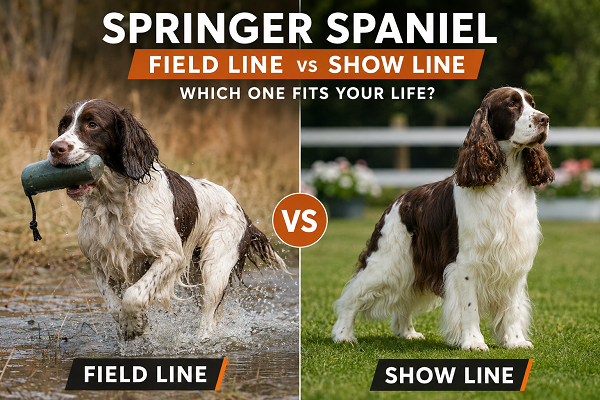
Field-bred (working) Springer Spaniels are leaner, shorter-coated, higher-drive dogs built for all-day flushing and retrieving work, bred and judged on performance in field trials. Show-bred (bench) Springer Spaniels are heavier-boned, longer-coated, calmer dogs bred and judged on conformation to the written breed standard. Both come from the same breed, but their gene pools have been bred separately since roughly the 1940s-1950s, and mixing up which one you’re buying is the single most common regret new Springer owners report.
Table of Contents
- What “Field Line” and “Show Line” Actually Mean
- Physical Differences: How to Tell Them Apart
- Temperament and Energy: The Gap That Surprises Owners
- Health Differences Between the Two Lines
- Training Needs: Field Pups vs Show Pups
- Cost Comparison: What You’ll Actually Pay in 2026
- Which Line Fits Your Lifestyle?
- Real-World Examples and Field Trial History
- Trainer’s Notes: Why This Matters More Than Breeders Admit
- FAQs
- Conclusion
Introduction
This isn’t a small footnote in the breed’s history either. Genetically and behaviorally, the field line and show line of the English Springer Spaniel have been drifting apart for roughly 70 years, to the point where a dog show judge wouldn’t look twice at a field-bred dog, and a field trial judge would send a show-bred dog home in the first series. If you’re about to bring a Springer into your home, whether as a hunting partner, a family dog, or a working K9, knowing which line you’re getting isn’t optional. It’s the difference between the calm, cuddly companion you pictured and a dog that paces the hallway at 6 a.m. demanding a job.
I’ve spent years around working gundogs and K9-line breeds, and I’ll walk you through exactly what separates these two Springer “types”, body, temperament, health, training, and cost, so you can pick the right dog the first time.
Summary of What You’ll Learn
- Where the field vs. show split actually came from, and when
- How to visually tell a field-bred Springer from a show-bred one in under 10 seconds
- The real temperament and energy-level gap (and why it surprises new owners)
- Health conditions each line is more prone to, backed by DNA testing data
- What each type actually costs in 2026, and why
- Which line suits which kind of household, hunter, or handler
- Answers to the 5 questions I get asked most about this topic
What “Field Line” and “Show Line” Actually Mean
The English Springer Spaniel started life as one dog with one job: get out in front of the hunter, find upland game birds hiding in cover, and “spring” them into the air for the gun. That’s literally where the name comes from. The Kennel Club in the UK recognized the English Springer Spaniel as its own distinct breed in 1902, splitting it off from the general “land spaniel” category that also produced the Cocker Spaniel.
For the first few decades, there wasn’t much of a split. Dogs genuinely did double duty, a Springer might spend Saturday morning flushing pheasant in the field and Sunday afternoon standing in the show ring. The English Springer Spaniel Field Trial Association (ESSFTA), founded in 1924 as the breed’s official U.S. parent club, actually notes that “dual type” Springers, dogs capable of winning in both conformation and field trials, were common right up until the early 1940s, when the last true dual champion was crowned.
After that, the two camps went their separate ways. Show breeders started selecting for a specific look: a certain head shape, a longer and more profuse coat, a particular gait judges wanted to see in the ring. Field breeders kept doing what field breeders always do, breeding the dog that found the most birds, marked the best, and worked hardest across a full day of hunting, appearance be damned.
So here’s the thing that trips up a lot of buyers: both types are still registered as the exact same breed. The AKC and the UK Kennel Club don’t split English Springer Spaniels into two official varieties the way some breeds (like Cocker Spaniels in the US vs UK) get split. On paper, a field-bred pup and a show-bred pup are both just “English Springer Spaniel.” In practice, breed experts widely consider this the single widest working-vs-show divergence found in any AKC-recognized breed, wider than Labradors, wider than German Shepherds, wider than almost anything else you’ll find on a kennel club list.
Physical Differences: How to Tell Them Apart
You don’t need a pedigree to spot which line a Springer comes from. Stand two of them next to each other and the differences jump out within seconds.
Body and Build
- Field-bred: Lighter frame, leaner muscle, more “greyhound-ish” tuck to the waist. Typically sits at the lower end of the breed’s 40-50 lb weight range and moves with a quicker, lower-effort gait built for covering ground for hours.
- Show-bred: Heavier bone, deeper chest, a body that’s proportionally a touch longer than it is tall at the shoulder. Built for the higher-stepping, more dramatic movement judges reward in the ring, not for eight hours in a soybean field.
Coat
- Field-bred: Shorter, flatter, wavier, and noticeably lower-maintenance. It sheds burrs and mud instead of collecting them, which matters when your dog is working through brambles all day.
- Show-bred: Longer, silkier, with heavy feathering on the ears, chest, legs, and belly. Gorgeous in photos, but it needs regular brushing, trimming, and bathing or it mats fast. (If low-maintenance coats matter to you, our guide on low-maintenance dog breeds and grooming needs is worth a look before you commit to either coat type.)
Head and Ears
- Field-bred: A cleaner, less exaggerated head, tighter lips, and ears set higher with less “leather” hanging down, all practical adaptations for a dog that needs to hear commands and not trip over its own ears in cover.
- Show-bred: A more pronounced stop (the break between muzzle and skull), longer pendant ears, and often visible dewlap and loose flews, the “classic” Springer look you see on dog food bags and calendars.
Tail and Color
- Field-bred: Tails are often left full-length or docked only a couple of inches, and coat patterns run heavier on ticking (small flecks of color through the white).
- Show-bred: Tails are traditionally docked shorter, and markings tend to be cleaner, bolder blocks of liver-and-white, black-and-white, or tricolor rather than heavy ticking.
Temperament and Energy: The Gap That Surprises Owners
This is the difference that actually changes people’s lives, not just their Instagram photos.
Field-bred Springers are bred, generation after generation, for one measurable outcome: performance in a field trial. And field trials are brutal. The AKC’s National Championship format requires five full land series plus two mandatory water retrieves across four or five demanding days, there’s no “phoning it in” your way to a National Field Champion (NFC) title. Every generation of field-bred dog has been selected from parents that proved they could sustain that level of drive and stamina. You inherit that drive whether you hunt or not.
What that means at home: field-bred Springers are intense. They’re fast, they’re “on” almost constantly, and they need a genuine job, hunting, dock diving, advanced obedience, scent work, something, or they’ll invent their own job, and you probably won’t love their choice (shredded couch cushions, relentless counter-surfing, and 5 a.m. zoomies are common complaints from owners who didn’t know what they were signing up for).
Show-bred Springers are a different animal temperamentally, even though they look like a bigger, fluffier version of the same dog. Breeders select show lines for a calm, biddable, crowd-pleasing temperament that can stand quietly on a table while a judge runs hands over it. Most trainers, myself included, consider show-bred Springers noticeably more laid-back and easier to live with as a straightforward family companion, they still need daily exercise (this is still a sporting breed, not a lapdog), but they’re far more capable of settling on the couch for an evening.
One caveat worth repeating from breed clubs on both sides of the Atlantic: even field-bred dogs need to be able to “switch off” indoors. A well-bred field Springer isn’t wired to run in circles 24/7 but it does need real physical and mental outlets first. If you’re weighing how much daily activity a working-drive dog actually needs, our breakdown on how often you should exercise a working dog is a solid starting point before puppy pickup day.
Health Differences Between the Two Lines
Here’s some good news first: English Springer Spaniels as a whole aren’t considered a breed riddled with health problems. But the two lines do carry different risk profiles, and any responsible breeder, field or show, should be testing for these.
Conditions Both Lines Share
- Hip and elbow dysplasia — screened via OFA (Orthopedic Foundation for Animals) radiographs in the US, or hip/elbow scoring schemes in the UK.
- Progressive Retinal Atrophy (PRA) — the Cord1 mutation is the most common form identified in the breed, and it’s DNA-testable. Untreated, it leads to progressive, irreversible blindness.
- Ear infections — this one deserves its own paragraph, honestly. Those long, hanging, fur-covered ears (especially on show-bred dogs) reduce airflow into the ear canal dramatically. Chronic ear infections are one of the most common vet visits for the breed, full stop. Weekly ear checks and cleaning aren’t optional maintenance, they’re the difference between a dog who gets the occasional infection and one who develops chronic, painful ear disease by age five.
The Fucosidosis Factor, Mostly a Show-Line Issue
This is the one condition where the field-vs-show split really matters for health, and it doesn’t get talked about enough outside dedicated breed clubs. Canine fucosidosis is a fatal, inherited neurological disease caused by a missing enzyme (alpha-L-fucosidase). Affected puppies look completely normal at birth, then start showing symptoms, stumbling, forgetting trained commands, behavioral changes, vision and hearing loss, between one and four years of age. There’s no treatment. Once clinical signs appear, the disease usually kills the dog within months to a couple of years.
According to research published through the AKC Canine Health Foundation, fucosidosis has been identified specifically and predominantly in English Springer Spaniels from UK and Australian conformation (show) lines, with far fewer documented cases in field-trial lines, though it isn’t impossible there either. A DNA test for the mutation has existed since 1997, and it’s now considered a “best practice” health test under the UK Kennel Club’s health standard for the breed. Any breeder, show or field, who can’t show you fucosidosis clearance paperwork on both parents is a breeder to walk away from.
Bottom line on health: don’t assume “field-bred” automatically means “healthier” or vice versa. It means different risk emphasis. Ask every breeder, regardless of line, for proof of hip/elbow scoring, Cord1 PRA clearance, and fucosidosis clearance before you hand over a deposit.
Training Needs: Field Pups vs Show Pups
Both lines are genuinely smart and trainable, Springers as a breed rank consistently high for working/obedience intelligence but they need different approaches out of the gate.
Field-bred puppies need structure early and often. That drive that makes them incredible hunting partners at two years old makes them a handful at four months old if there’s no outlet for it. Start basic obedience the day you bring the puppy home, not at six months. Crate training matters enormously here too, since it gives a high-energy pup a place to actually settle, our step-by-step crate training guide covers the timeline most trainers use for exactly this kind of driven puppy. Once basics are solid, channel that energy: retrieving games, scent work, or formal gundog training classes if you plan to hunt.
Show-bred puppies are typically easier first-time-owner dogs to train because the intensity is lower, but don’t mistake “calmer” for “doesn’t need training.” They still need consistent obedience work, and their people-pleasing nature actually makes them very responsive to positive reinforcement. If you’re building foundational commands with either line, our guide to obedience training commands that actually work is a good place to start, and once basics are locked in, agility training is a fantastic outlet both lines genuinely enjoy, Springers of either type tend to take to agility, obedience, rally, and nose work with real enthusiasm.
Whichever line you end up with, nutrition plays a bigger role in trainability and temperament than most new owners expect, a dog running on the wrong fuel is harder to focus, full stop. Our nutrition and health guide for working dogs covers what active, high-drive breeds actually need in their bowl.
Cost Comparison: What You’ll Actually Pay in 2026
Price varies a lot by country, breeder reputation, and health testing but here’s a realistic 2026 range based on current listings and breeder pricing across the US, UK, and Europe:
| Type | Typical Price Range (USD) | What Drives the Price |
|---|---|---|
| Pet-quality, either line | $600 – $1,300 | No show/trial ambitions, basic health clearances |
| Show-bred, from health-tested champion lines | $1,200 – $2,500+ | Conformation pedigree, full DNA panel, breeder reputation |
| Field-bred, from proven field trial parents | $1,200 – $2,500+ | Working titles (FC, NFC) in the pedigree, hunting drive guarantees |
| Field-bred, from National Champion bloodlines | $2,500 – $4,000+ | Direct lineage to National Field Champion or National Amateur Field Champion dogs |
A few things push price up regardless of line: full genetic panel testing (PRA/Cord1, fucosidosis, hip/elbow evaluation), a breeder actively competing and titling their dogs, and for field lines specifically, parents with documented field trial placements. A puppy “out of champion bloodlines” without any actual competition results behind that claim is a red flag worth asking hard questions about.
Don’t forget first-year costs beyond the purchase price either: vaccinations, spay/neuter, a crate, basic gear, and training classes typically add another $1,000-$2,000 in year one, regardless of which line you choose.
Which Line Fits Your Lifestyle?
Ask yourself these questions before you contact a breeder:
- Do you hunt, or plan to? Field-bred, no contest. A show-bred dog simply doesn’t have the stamina, speed, or drive to compete in field trials or hold up through a full hunting season.
- Do you want a dog for competitive obedience, agility, or dock diving, but not hunting? Either line can do well here, though field-bred dogs often have an edge in raw drive and speed for timed events.
- Do you have a moderately active household, daily walks, weekend hikes, but not hours of structured outdoor work? Show-bred is usually the better fit. That calmer baseline temperament matches a “normal” active family’s routine far more comfortably.
- Are you a first-time dog owner? Show-bred lines are generally more forgiving of training mistakes and less likely to develop destructive habits if a walk gets skipped one day.
- Do you want the classic “magazine cover” Springer look with a full, silky coat? Show-bred, and budget time for regular grooming.
There is genuinely no “better” line here, only a better fit for your specific life. A field-bred Springer in a sedentary apartment household is a recipe for a frustrated dog and a frustrated owner. A show-bred Springer with a serious upland hunter is going to get left in the dust by birds it can’t keep pace with.
Real-World Examples and Field Trial History
To see just how specialized field-bred Springers have become, look at the National Open Championship, the pinnacle event run under ESSFTA and AKC field trial rules. The very first National Championship Field Trial for English Springer Spaniels was held in Herrin, Illinois, in December 1947 and the sport has run every year since, crowning National Field Champions (NFC) and National Amateur Field Champions (NAFC) whose bloodlines are still traded on today. Reputable field breeders will proudly show you a pedigree tracing back to specific NFC or NAFC dogs, the same way show breeders point to multiple Best in Show or Westminster group placements in their lines.
Compare that to the show side: winning English Springer Spaniels compete for Championship points at all-breed and specialty shows sanctioned by the AKC and The Kennel Club, chasing conformation titles rather than field placements. Neither path is “easier”, a National Field Champion has survived one of the most physically demanding competition formats in all of dog sport, while a top show dog has spent years being groomed, conditioned, and handled to a razor-sharp standard. They’re just different Olympics for the same breed.
Trainer’s Notes: Why This Matters More Than Breeders Admit
I’ve worked around enough gundog and K9-adjacent breeds to tell you this straight: the number one reason Springer Spaniels end up surrendered to rescue isn’t aggression, and it isn’t health problems. It’s a mismatch between the dog’s drive level and the owner’s expectations. Someone falls in love with a photo of a gorgeous, calm show-type Springer, then unknowingly buys a field-bred pup from a “family friendly” ad, or the reverse, someone wants a serious hunting partner and ends up with a show-bred dog that has zero interest in birds and can’t keep pace in the field.
Every credible breed authority, the ESSFTA in the US, breed clubs affiliated with The Kennel Club in the UK, says the same thing: ask which line a litter comes from, and ask to meet at least one parent so you can see the temperament and build for yourself. If a breeder can’t or won’t answer that clearly, that’s your answer about whether to buy from them.
If you’re deciding between a working-line dog and a companion-line dog in general, not just for Springers, my e-book, Beyond the Bark, goes deeper into reading working drive, matching a dog’s genetics to your actual daily routine, and avoiding the mismatch mistakes I see most often as a handler. It’s worth a read before you put down a deposit on any working-breed puppy.
FAQs
1. Can a field-bred Springer Spaniel become a good family pet?
Yes, absolutely but go in with realistic expectations. A field-bred Springer needs significantly more daily exercise and mental stimulation than most family dogs, roughly 1-2 hours of purposeful activity, not just a lap around the block. Given that outlet, they’re loyal, affectionate, and genuinely wonderful family companions. Without it, expect behavioral problems.
2. Are show-bred Springer Spaniels less intelligent than field-bred ones?
No, this is a common myth. Both lines score high on working/obedience intelligence as a breed trait. The difference is drive and intensity, not raw smarts. Show-bred dogs are just as trainable; they simply approach tasks with a calmer, less urgent energy.
3. Can you show a field-bred Springer Spaniel in conformation, or hunt with a show-bred one?
Technically the AKC doesn’t forbid it, since both are registered as the same breed. Realistically, no. A field-bred dog’s structure and coat don’t match what conformation judges are looking for, and a show-bred dog lacks the speed, stamina, and drive to be competitive in a field trial or hold up through a full day of hunting.
4. How do I know which line a Springer Spaniel puppy comes from if the breeder doesn’t say?
Ask directly, and ask to see the pedigree. Look for field trial titles (FC, NFC, AFC, NAFC) for field lines, or conformation championship titles (CH, GCH) for show lines in the parents’ names. If the pedigree shows neither, it’s likely a mixed or “pet-line” dog without strong selection either way, which can actually be a fine middle-ground choice for casual owners.
5. Do field-bred and show-bred Springer Spaniels have different life expectancies?
Not significantly, both lines typically live 12-14 years with good care. Health outcomes depend far more on the individual breeder’s health testing practices (hip/elbow scoring, PRA and fucosidosis DNA clearance) than on which line the dog comes from.
Conclusion
The field vs. show line split in the English Springer Spaniel isn’t marketing spin or a minor cosmetic difference, it’s the result of roughly 70 years of two separate breeding goals producing two genuinely different dogs wearing the same breed name. Field-bred Springers are lean, fast, relentless workers built for the gun and the field trial course. Show-bred Springers are heavier, silkier, and calmer, built for the conformation ring and everyday family life.
Before you contact a single breeder, get honest with yourself about your actual daily routine, not the one you wish you had. Ask breeders directly which line their litter descends from, ask for health clearances on both parents (hips, elbows, Cord1 PRA, and fucosidosis at minimum), and meet at least one parent dog in person if you possibly can. Get that part right, and you’ll end up with a Springer Spaniel, field or show, that fits your life instead of fighting against it.
Have you owned both a field-bred and show-bred Springer Spaniel? I’d love to hear how the two compared in your home, drop a comment below or reach out through our contact page.

Her work centres on obedience, detection, protection and operational readiness. She favours proven methods built on repetition, consistency and real-world conditioning, so that both dogs and handlers are prepared for high-pressure tasks.
Rofiat represented the Nigerian Army Dog Centre at the Nigerian Army Day Celebration (NADCEL) 2026, where she led demonstrations in obedience, explosive detection, agility and tactical movement. Through articles, training content and documentaries, she shares field-based insight into how structured training, clear communication and trust between handler and dog affect performance and reliability.
She is the author of Beyond the Bark: Inside a Pro Handler's Playbook for Raising the Ideal Dog, a practical guide that helps dog owners and handlers apply professional training principles in everyday situations.
- Dog Hotel Prep: 7 Must-Haves Before Boarding - October 21, 2026
- How to Enter the COBA National Dog Championship - October 20, 2026
- K9 Advantix Dosage Chart & Safety Guide for Dogs - October 19, 2026