5 Simple SAR Dog Training Games to Start
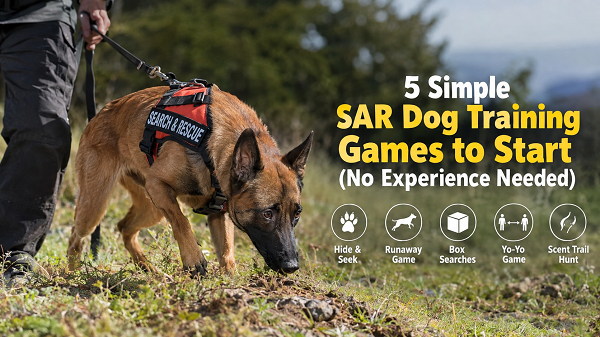
The 5 best beginner SAR (search and rescue) dog training games are: restrained recruit hide-and-seek, the runaway game, box/article scent searches, the yo-yo distance game, and scent trail treasure hunts. Each one builds a specific SAR foundation skill, drive, focus, scent discrimination, or independent searching, using nothing more than treats, a second person, and 10-15 minutes a day. Most dogs can start these games as early as 8 weeks old.
Table of Contents
- Why SAR Training Starts With Games, Not Drills
- Is Your Dog Ready? A Quick Readiness Check
- Game 1: Restrained Recruit (The Classic Hide-and-Seek)
- Game 2: The Runaway Game (Building Drive and Speed)
- Game 3: Box and Article Searches (Scent Discrimination)
- Game 4: The Yo-Yo Game (Stretching Distance and Duration)
- Game 5: Scent Trail Treasure Hunt (Tracking Foundations)
- From Games to Real SAR Work: What Comes Next
- 5 Mistakes New Handlers Make (And How to Avoid Them)
- A Note on Who’s Writing This
- FAQs
- Final Thoughts
Introduction
If you’ve ever watched a search and rescue dog work a debris pile on the news and thought, “I wonder if my dog could do that,” you’re not alone. I get asked this question all the time at training days, and here’s the truth nobody tells beginners upfront: every single SAR dog on active deployment today started with games, not drills.
I’ve spent years around K9 teams, helping evaluate candidate dogs, running scent lines, and watching handlers make the same early mistakes over and over. The biggest one? People think SAR training has to start serious and structured. It doesn’t. It starts as play, and if you skip the play stage or rush it, you end up with a dog that searches like it’s doing a chore instead of chasing the thing it loves most.
So in this guide, I’m going to walk you through 5 simple SAR dog training games you can start this week, no matter your experience level. These are the exact foundation games used by search dog programs around the world, from FEMA-affiliated task forces in the US, to SARDA teams in the UK, to mountain rescue units across Europe. You’ll learn how to run each one, when to level it up, common mistakes to avoid, and how these “games” connect to real SAR certification down the road.
Whether you’re a pet owner just curious about your dog’s potential, or you’re seriously considering the volunteer SAR path, this is the honest starting point.
Why SAR Training Starts With Games, Not Drills
Here’s the thing about search and rescue dogs, the job itself is basically a giant game of hide-and-seek with a life on the line. Find the person, tell the handler, get rewarded. That’s it. That’s the whole job, broken down to its core.
The Mountain Rescue Association puts it simply: SAR is a game for the dog at its core, and keeping it fun isn’t optional, it’s required. A dog that isn’t having fun searching will quit on you exactly when you need it most: hour four of a wilderness search, in the rain, with zero scent cone to follow.
And the numbers back this up. The National Disaster Search Dog Foundation (SDF), founded in 1996 after Wilma Melville searched the Oklahoma City bombing site with her dog Murphy, has trained 94 deployable search teams as of 2024. Before SDF’s game-based foundation method existed, only about 15% of candidate dogs made it through to FEMA certification. Today, that number sits at roughly 85%. Same dogs, same breeds in many cases, the difference is a foundation built on drive and play instead of forced obedience.
That’s the whole point of this article. These 5 games aren’t “cute puppy activities.” They’re the actual entry point real programs use.
Is Your Dog Ready? A Quick Readiness Check
Before jumping in, run through this quick checklist. You don’t need a purpose-bred puppy, plenty of working SAR dogs come from shelters, but a few traits matter:
- Age: Puppies can start these games as early as 8 weeks. Most formal SAR programs won’t start structured tracking or wilderness work until 12-18 months, once joints and focus mature.
- Drive: Does your dog go a little nuts for a toy or food? That obsessive “I NEED that” energy is gold in SAR work.
- Recovery: Can your dog bounce back quickly after a startle (a dropped pan, a loud truck)? SAR dogs work in chaotic, noisy environments.
- Sociability: SAR dogs must be comfortable around strangers, other dogs, and unfamiliar environments, no aggression, ever.
- Physical soundness: No hip, joint, or breathing issues that would make sustained physical work painful.
You don’t need to check every box perfectly today. These games themselves are diagnostic, they’ll tell you a lot about whether your dog has the drive for this work.
Game 1: Restrained Recruit (The Classic Hide-and-Seek)
This is the single most-used foundation game in SAR training worldwide, and for good reason, it teaches the entire “find human, get reward” loop in its simplest form.
What you need: A second person, high-value treats or a tug toy, an open indoor or outdoor space.
How to play:
- Have a helper hold your dog gently (by the collar or harness, not pinned down, this should feel like anticipation, not restraint).
- Get your dog excited by showing a toy or treat, then walk away and hide in an easy spot, behind a door, a couch, a tree.
- Call your dog’s name once. The helper releases the dog immediately.
- The moment your dog finds you, throw a party, treats, tug, praise, whatever gets the tail going hardest.
Progression: Once your dog nails easy hides, increase the hold time before release (5 seconds, then 30, then a full minute), hide further away, and eventually skip calling the dog’s name at all, just let the helper release them to search cold.
This is almost word-for-word how avalanche dog training begins, according to HowStuffWorks’ breakdown of SAR programs: the handler hides, the dog is held back, then released to find the handler and rewarded with a tug session. The same exact mechanic scales all the way up to real avalanche and rubble searches, only the hiding spot changes.
Time commitment: 10 minutes, 3-4 times a week to start.
Game 2: The Runaway Game (Building Drive and Speed)
If Game 1 teaches the search-and-alert loop, the Runaway Game teaches urgency. SAR dogs need to move with purpose, not amble around sniffing at their own pace.
How to play:
- Get your dog fired up with a toy, then literally run away from them (a few steps at first) while looking back excitedly.
- Let them chase and catch you, then reward big with the toy or a tug session.
- Gradually increase the distance you run and start incorporating turns and obstacles (around a tree, behind a car, over a small hill).
This game is deceptively simple but it’s doing real work: it builds the “chase the human” instinct that later transfers directly into “chase the scent trail.” Handlers who skip straight to slow, methodical scent work often end up with dogs that search half-heartedly. Speed and urgency need to be built in early, while it’s still just a game of chase. If you want to understand why instinct-driven games like this outperform pure obedience drills at this stage, our piece on obedience vs. instinct in working dogs breaks down exactly how the two systems work together instead of against each other.
Game 3: Box and Article Searches (Scent Discrimination)
This is where you start building the actual “nose work” that separates casual obedience from true SAR scent detection.
What you need: 4-6 cardboard boxes or plastic tubs, a piece of clothing or an item with a strong human scent on it (a sock works great), high-value treats. As your dog progresses past this stage, you’ll eventually want dedicated scent-training gear, our guide to essential K9 training equipment covers what’s actually worth buying versus what you can DIY.
How to play:
- Line up the boxes a few feet apart.
- With your dog watching, place the scented item under or inside one box.
- Release your dog to “search”, use a consistent cue word like “find it” or “search.”
- The instant your dog shows interest in the correct box (sniffing, pawing, or sitting near it), mark it and reward heavily.
- Repeat, changing which box holds the scent each time so your dog learns to find the scent, not memorize a location.
Progression: Add more boxes, hide the item further out of sight, introduce a second “distractor” scent (a toy with no human scent) so your dog learns to discriminate between target and non-target smells.
According to American Breeder’s SAR training guide, this exact starting-simple-with-cloth-or-toy method is the entry point most professional programs use before moving to open-air and outdoor scent trails. The key research-backed reason it works: dogs’ scent memory and discrimination ability develop through repeated, successful pairing of a specific odor with reward, not through volume of exposure alone.
Game 4: The Yo-Yo Game (Stretching Distance and Duration)
Named for the back-and-forth motion, this game bridges the gap between short indoor hides and real wilderness-style searches where the dog has to work independently for longer stretches.
How to play:
- Two handlers stand about 20 feet apart, each with treats or a toy.
- Handler A calls the dog, rewards on arrival, then Handler B immediately calls the dog from the other direction.
- Gradually increase the distance between handlers each session, 20 feet becomes 50 feet, then 100+ feet, then around corners or through light brush.
- Eventually, add a “search” element: instead of calling the dog’s name, stay silent and let the dog find you using scent and memory alone.
This game is brilliant for building stamina and independent decision-making, two things flat-out required for wilderness SAR work, where dogs often search 40+ acres per hour without direct handler guidance. It also doubles as a fantastic recall exercise for any dog, SAR-bound or not. Stamina work like this needs to be paired with proper conditioning off the field too, see our breakdown of how much exercise a working dog actually needs to avoid overtraining a young SAR candidate.
Game 5: Scent Trail Treasure Hunt (Tracking Foundations)
This is the natural next step after box searches, moving your dog from “find the stationary scent” to “follow a moving scent trail,” which is the backbone of missing-person tracking work.
How to play:
- Have a helper walk a short, straight path (10-15 feet) across grass or dirt, dropping small treats every few steps as they go.
- Let your dog watch the helper leave, then release your dog to follow the trail nose-down, cue with “track” or “trail.”
- At the end of the trail, the helper is waiting with a big reward and praise.
- Over multiple sessions, age the trail (wait a few minutes, then hours, before releasing your dog), add turns, and eventually stop dropping treats along the way, reward only at the end.
Pro tip from the field: Train on varied surfaces early, grass, gravel, pavement, leaf litter. Real missing-person cases don’t happen on a manicured lawn, and dogs that only ever track on grass can struggle when the terrain changes.
From Games to Real SAR Work: What Comes Next
Once your dog is reliably nailing these 5 games, you’re at the actual starting line of formal SAR training, not the finish line. Here’s what the realistic path looks like, based on how established programs run things:
| Stage | Typical Timeline | What Happens |
|---|---|---|
| Foundation games (this article) | Puppy – 12 months | Drive, focus, basic scent discrimination |
| Obedience & agility proofing | 12-18 months | Off-leash control, ignoring distractions, physical fitness |
| Specialized scent training | 12-24 months | Air-scenting, tracking, cadaver, or disaster-specific work |
| Certification testing | 18 months – 2 years | National or regional certification exam |
For context on real-world numbers: FEMA currently maintains around 280 certified live-find disaster dogs and another 80 human remains detection dogs across the US, spread among 28 Urban Search & Rescue task forces. Getting a dog-handler team to that FEMA-certified level typically takes 10-12 months of dedicated training once formal work begins, and organizations like the Search Dog Foundation report full program costs around $75,000 per team when you factor in training, gear, veterinary care, and handler travel, which is exactly why most SAR programs run on donations and volunteer hours.
Certification isn’t a one-and-done deal either. Most national systems (FEMA’s US&R Response System in the US, SARDA in the UK, national K9 associations across Europe) require re-certification every 2-3 years to stay active.
If you’re serious about going further, look into recognized organizations in your region:
- United States: National Association for Search and Rescue (NASAR), National Disaster Search Dog Foundation, FEMA Canine Search Teams
- United Kingdom: Search and Rescue Dog Association (SARDA)
- International: International Rescue Dog Organisation (IRO)
For a closer look at how structured, high-stakes canine work actually gets built day to day, our piece on how military working dogs are trained is a great next read, a lot of the discipline-building principles carry straight over into SAR work.
5 Mistakes New Handlers Make (And How to Avoid Them)
- Rushing past the “easy” stage. If your dog isn’t smashing the easy version of a game, making it harder won’t fix that, it’ll just create frustration and quitting behavior.
- Talking too much during searches. A common tip passed around at Mountain Rescue Association training days is blunt: “Shut up and let your dog work.” Constant chatter and cueing during a search actually distracts a dog from the one thing you want them focused on, the scent.
- Skipping distractor training. A dog that’s only ever practiced in a quiet backyard will struggle the first time it has to ignore wildlife, other people, or food on the ground during a real search.
- Training too long per session. 10-15 minutes of focused, high-energy game time beats an hour of tired, half-hearted repetitions every time.
- Ending on a failure. Always end a session on a win, even if that means making the last rep easier than the rest. Dogs remember how a session ends more than how it started.
A Note on Who’s Writing This
I work hands-on with working and protection dogs day in and day out, evaluating temperament, running scent and obedience drills, and helping first-time handlers figure out if their dog has what it takes for demanding work like this. Everything in this article reflects methods actually used by certified SAR programs internationally, cross-checked against published data from FEMA, the National Disaster Search Dog Foundation, and the Mountain Rescue Association, not recycled blog advice. If these 5 games click with your dog and you want the fuller home-training roadmap, our companion guide on how to start SAR dog training at home picks up right where this article leaves off.
FAQs
1. What age should I start SAR training games with my dog?
You can start simple hide-and-seek and drive-building games as early as 8 weeks old. Formal, structured SAR training (tracking, agility, certification prep) typically doesn’t begin until 12-18 months, once your dog’s body and focus have matured enough for sustained physical work.
2. Do I need a specific breed for SAR dog training?
No. While Border Collies, Labrador Retrievers, German Shepherds, and Belgian Malinois are common in SAR programs because of their drive and stamina, temperament and work ethic matter far more than breed. Many certified SAR dogs, including several trained by the Search Dog Foundation, come from shelters.
3. How long does it take to fully certify a SAR dog?
Most dog-handler teams take 10-12 months of dedicated training to reach FEMA-level disaster search certification once formal training begins, though the total journey from puppy foundation games to full certification often spans 18 months to 2 years.
4. Can I train my dog for SAR work without joining an organization?
You can absolutely start with foundation games like the ones in this article on your own. However, official SAR deployment requires certification through a recognized body (like NASAR or FEMA task forces in the US, or SARDA in the UK), which involves structured evaluation, mentorship, and team-based training you can’t fully replicate solo.
5. What’s the difference between SAR games and regular dog training games?
Regular training games build obedience and manners. SAR foundation games are specifically designed to build drive, scent discrimination, independent decision-making, and stamina for long, unsupervised searches, the exact skills a dog needs to locate a person and alert a handler without step-by-step guidance.
Final Thoughts
Here’s what I want you to take away from all this: you don’t need special equipment, a training facility, or years of experience to start building real SAR foundations with your dog. You need a helper, some treats, 10-15 minutes a few times a week, and the patience to let these games stay games.
Start with restrained recruit hide-and-seek this week. Once your dog is flying to find you every single time, layer in the runaway game for drive, then box searches for scent discrimination. Don’t rush the stages, the dogs who make it to real SAR certification aren’t the ones who trained hardest, they’re the ones whose handlers built a rock-solid, joyful foundation first.
If you want to go deeper into the full path from these starter games to certification-level training, check out Beyond the Bark for the complete roadmap, or head straight to our full guide on starting SAR dog training at home for your next steps.

Her work centers on applied training across obedience, detection, protection, and operational readiness, with a strong focus on Military Working Dogs (MWDs) and security K9 programs. Rather than relying on theory alone, Rofiat emphasizes proven training methods built on repetition, consistency, and real-world conditioning principles that prepare both dogs and handlers for high-pressure tasks.
Through articles, training content, and documentaries, she shares experience-based insights from the field, highlighting how structured training, clear communication, and trust between handler and dog directly impact performance and reliability.
Drawing from years of frontline experience, she is also the author of “Beyond the Bark: Inside a Pro Handler’s Playbook for Raising the Ideal Dog,” a practical guide designed to help dog owners and handlers apply professional training principles in everyday situations.
She remains committed to responsible K9 development, continuous skill refinement, and practical education for handlers, trainers, and dog professionals.
- How Many Teeth Do Dogs Have? Puppy vs Adult Chart - September 22, 2026
- What Colors Do Dogs See? (Dog Vision Spectrum) - September 22, 2026
- Is Cinnamon Bad for Dogs? Safe Dosage by Weight - September 21, 2026