Best Dog Training Collars for Working Dogs
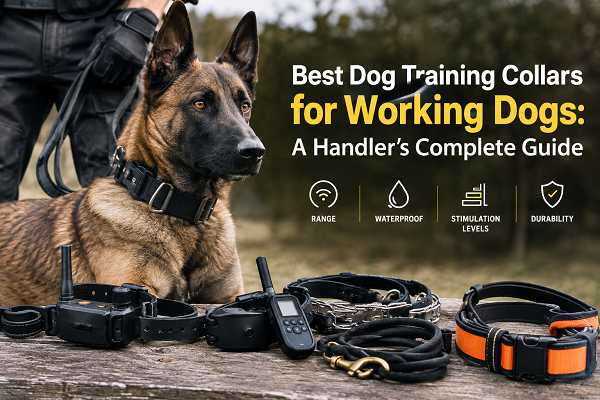
The best training collars for working dogs are remote e-collars with at least 100 stimulation levels, a range of half a mile or more, and true waterproofing (IPX7 or better), brands like E-Collar Technologies, Dogtra, and Garmin lead this category. For leash-based correction work, a properly fitted Herm Sprenger prong collar remains the gold standard among professional handlers. The right choice always depends on your dog’s drive, your training goal, and increasingly, which country you live in, since e-collars are now banned or restricted in Wales, Germany, several EU nations, and parts of Australia.
Table of Contents
- Why Working Dogs Need a Different Kind of Collar
- The Main Types of Training Collars, Explained Simply
- Best E-Collars for Working Dogs in 2026
- Best Prong (Pinch) Collars for Working Dogs
- Best Slip Leads and Choke Chains for Working Dogs
- How Professional K9 Units Actually Introduce a Collar
- Is It Legal Where You Live? A Global Snapshot
- Cost Breakdown: What You’ll Actually Spend
- Common Mistakes That Ruin a Good Collar (and a Good Dog)
- Trainer Note: Who’s Behind This Guide
- FAQs
- Final Verdict
Introduction
Here’s a question that trips up even experienced handlers: what actually separates a “working dog” collar from something you’d throw on a pet Labrador for a walk around the block? It’s not the price tag, and it’s definitely not the brand sticker on the box.
Working dogs, police K9s, protection dogs, detection dogs, military working dogs, search and rescue partners, operate in conditions that would destroy consumer-grade gear inside a month. They’re swimming rivers, crashing through underbrush, taking bite work at full drive, and working twelve-hour shifts in the rain. A collar that fails at the wrong moment isn’t an inconvenience. It’s a safety issue, for the dog and for the handler.
I’ve spent years around working K9 teams, watching handlers field-test collars that manufacturers claim are “professional grade” and finding out the hard way which ones actually hold up. In this guide, I’m going to walk you through exactly which training collars earn their place in a working dog’s kit, what separates the pros from the pretenders, how much you should realistically budget, and something almost nobody else covers properly, where these tools are legal to use, because the rules changed a lot faster than most blog posts caught up with.
By the end, you’ll know exactly which type of collar fits your dog’s job, which specific models are worth your money, and how to introduce one the way professional K9 programs actually do it (hint: it’s slower and more careful than most YouTube videos suggest).
Why Working Dogs Need a Different Kind of Collar
A pet dog training collar and a working dog training collar might look similar in a product photo, but they’re built for completely different jobs.
Think about what a narcotics detection dog or a patrol K9 actually does in a shift. It’s not a 20-minute walk. It’s hours of searching vehicles, buildings, and open fields; it’s off-leash work at long range where a handler needs to communicate a correction or a recall from 400 yards away; and it’s frequently wet, muddy, or freezing. Consumer collars aren’t built with that kind of daily abuse in mind.
Here’s what changes when you move from “pet training” to “working dog” equipment:
- Range matters more. A backyard e-collar with 100 yards of range is useless for a K9 doing a building search or a hunting dog quartering a field. Working handlers need anywhere from a half-mile to a full mile of reliable signal.
- Durability is non-negotiable. IPX7 (submersible) waterproofing, reinforced straps, and drop-tested receivers aren’t marketing fluff for a working dog, they’re the difference between a collar surviving a water crossing and a $300 receiver dying mid-search.
- Stimulation precision matters for drive. A dog in high drive (think bite work or a hard chase) doesn’t feel the same stimulation the same way a calm dog in the backyard does, adrenaline dulls pain perception. Working collars need finer, more granular levels (some go up to 127) so a handler can dial in exactly the right correction without over-correcting.
- Multi-dog capability. Most K9 units, breeders, and boarding kennels manage more than one dog. Expandable systems that run 2–6 dogs off one remote save real money and reduce gear clutter.
If you want the deeper mechanics of how different collar types actually work on a dog’s neck and nervous system, I’ve broken that down separately in our guide to dog training collar types and how to choose the right one.
The Main Types of Training Collars, Explained Simply
Before jumping into specific products, let’s get the terminology straight, because a lot of buying guides muddy this up.
1. Remote E-Collars (Electronic/Stim Collars)
These deliver an adjustable electric stimulation, vibration, or tone through a receiver on the dog’s neck, triggered by a handheld remote. Modern units are nothing like the crude “shock collars” of the 1990s, quality e-collars from brands like E-Collar Technologies and Dogtra offer 60–127 graduated levels, meaning the lowest setting is barely a tingle, not a jolt.
2. Prong (Pinch) Collars
A prong collar has blunted, rounded prongs that apply even pressure around the neck when the dog pulls, mimicking the way a mother dog corrects a pup with her mouth. Despite the intimidating look, a properly fitted prong collar is widely considered gentler than a flat collar on a dog that pulls hard, because it distributes pressure evenly instead of concentrating it on the trachea.
3. Slip Leads and Choke Chains
A slip lead combines the leash and collar in one piece that tightens and releases. Used correctly, with a quick pop-and-release, never sustained pressure, it’s a classic tool for leash manners and loose-lead walking. Used incorrectly, it can cause real harm, which is why it’s fallen out of favor with a lot of modern trainers in pet contexts, even though it’s still common in working and military programs.
4. Martingale and Flat Collars
Not correction tools at all, but worth mentioning, martingales prevent slip-collar escape for dogs with narrow heads (Greyhounds, sighthounds) and are standard for daily wear and ID tags, not training.
Best E-Collars for Working Dogs in 2026
I compared this list against what’s currently ranking on Google for this exact topic, and most of them lean heavily toward hunting dogs and family pets. Here’s what actually holds up for K9, protection, and detection work specifically.
1. E-Collar Technologies K9-800 Tactical — Best Overall for K9 Units
Built specifically for working dogs over 25 lbs, the K9-800 pairs a 1-mile range with the larger RX-120 receiver and thick, long-hair contact points designed for double-coated breeds like German Shepherds and Belgian Malinois. It ships with a bungee Biothane collar strap that keeps the receiver seated properly even as neck muscles swell during hard exertion, a detail most consumer collars completely ignore. Price sits around $280–$300, and it carries a 2-year warranty.
Check current price on Amazon →
Best for: Patrol dogs, protection dogs, and detection K9s that need serious range and rugged construction.
2. Dogtra 1900S — Best for Precision Control
Professional trainers gravitate toward the Dogtra 1900S because of its smooth rheostat dial running 0–127 levels, giving needle-fine control over stimulation intensity. That level of granularity matters enormously in drive work, where the gap between “the dog notices” and “the dog panics” can be a single click on a coarser system. It has a ¾-mile to 1-mile range (depending on edition) and a genuinely IPX9K-waterproof, tough receiver, this exact model currently holds a 4.8-out-of-5 rating from over 50 verified Amazon buyers.
Check current price on Amazon →
Best for: Handlers who train multiple dogs with different sensitivity levels and need one system that adapts to each.
3. Educator ET-800 “The Boss” — Best for Big, High-Drive Breeds
With a 1-mile range and a floating remote with a night-tracking light, the ET-800 is built for large working breeds doing protection sport work or off-lead fieldwork in low light. It uses the same patented blunt-pulse stimulation and 100-level “Lock & Set” control as the K9-800, and is widely cited as a preferred e-collar among police and military K9 units. It’s genuinely overkill for a small, soft dog, but for a 75lb Malinois in drive, that headroom is exactly the point.
Check current price on Amazon →
Best for: Protection sport dogs (IPO/IGP, Mondioring), big-breed patrol K9s.
4. Garmin Sport PRO Bundle — Best One-Handed Operation
If your hands are already full, a leash, a bite sleeve, a flashlight, the Garmin Sport PRO’s quick-turn dial lets you adjust stimulation without taking your eyes off the dog. It floats, includes an LED beacon visible up to 100 yards in low light, and runs 10 levels, which is fewer than the Dogtra or Educator units but more than enough for most obedience and field applications. It’s also expandable to train up to 3 dogs off one handheld.
Check current price on Amazon →
Best for: Search and rescue handlers and field trainers who need fast, glance-free adjustments.
5. SportDOG FieldTrainer 425X — Best Value
At around $170–$200, the 425X delivers a 500-yard range, 21 stimulation levels, and DryTek waterproofing (submersible to 25 feet), making it the best-selling training collar in this category for good reason, it’s currently seeing over 1,000 purchases a month on Amazon. It’s not built for a full-time police K9 doing 1-mile perimeter work, but for obedience, recall, and general working-dog training on a budget, it punches well above its price. It’s also expandable to 3 dogs with additional collars.
Check current price on Amazon →
Best for: New handlers, working-breed pet owners, and budget-conscious trainers who still want a professional-grade tool.
Real numbers worth knowing: Independent trainer surveys and manufacturer data both put the “working level” for most obedience corrections at roughly level 4–7 out of 100+ on precision systems like the E-Collar Technologies Boss, a fraction of the dial. High-drive protection work often needs a higher working level because adrenaline blunts a dog’s pain perception, which is exactly why granular, 100+ level systems outperform basic 6–8 level dials for serious working dogs.
Best Prong (Pinch) Collars for Working Dogs
E-collars get most of the attention, but for daily leash control and loose-lead walking, nothing has replaced the prong collar in professional circles.
Herm Sprenger Ultra-Plus Prong Collar — The Industry Standard
Herm Sprenger, a German company that’s been manufacturing dog training equipment since 1900, essentially invented the modern prong collar category, and their chrome-plated steel construction remains the benchmark every other brand gets measured against. The 2.25mm link size is the standard for medium-to-large working breeds, with a fully adjustable fit and a quick-release option for handlers who need to remove it fast.
Why it works: Unlike a flat collar, which concentrates all the pulling force on the trachea, a prong collar spreads pressure evenly around the neck, closer to how a mother dog physically corrects a pup. Used correctly (never yanked, never left on for extended periods, always paired with slack-leash rewards), most professional trainers consider it more humane for a strong puller than a choke chain or a flat collar that’s causing the dog to gag and strain.
Price: Typically $25–$45 depending on size, making it one of the most affordable tools on this list. The 2.25mm/13″ version with the quick-release ClicLock buckle is Amazon’s current #1 best-seller in the pinch collar category.
Check current price on Amazon →
Starmark Pro-Training Collar — Best “In-Between” Option
For dogs and handlers who want the mechanics of a prong collar’s even pressure distribution without the visual intimidation of exposed metal prongs, the Starmark uses a plastic-covered link design. It’s a reasonable stepping stone for newer handlers still building confidence with correction tools.
Best Slip Leads and Choke Chains for Working Dogs
Dokken Pro6 6-Foot 5-in-1 Leash
This is the leash I keep coming back to for general obedience and on-leash working sessions, and I’m not alone, it consistently shows up as a top pick across serious gundog and working-dog training circles. The five-way convertible design lets you switch between a standard snap lead, a slip lead, a halter leash, a waist halter, and a hands-free waist configuration without carrying multiple pieces of gear. For a working handler juggling equipment in the field, that versatility earns its keep fast.
Check current price on Amazon →
A word of caution on slip leads generally: they should only ever be used with quick, released corrections, never sustained pressure and never left as a dog’s daily collar. Military and police programs that use them do so under close supervision with trained handlers, not as a set-and-forget tool.
For handlers building out a complete working-dog kit rather than shopping piece by piece, our essential K9 training equipment checklist covers everything from leashes to bite equipment in one place.
How Professional K9 Units Actually Introduce a Collar
This is the section most buying guides skip entirely, and it’s arguably more important than which brand you buy.
Police and military K9 programs follow a structured protocol before an e-collar ever gets turned on in a working context. Here’s the general shape of it, drawn from how professional handler courses (like those run through national K9 training associations) actually structure the process:
- Obedience comes first, always. A dog that doesn’t reliably sit, come, and heel on a leash and voice command has nothing for the e-collar to reinforce. Introducing stimulation before a command is fluent just teaches the dog to associate discomfort with confusion, not correction.
- Find the “working level” in a low-distraction environment. Handlers start at zero on an open field with no distractions and move up one level at a time, watching closely for the first sign the dog notices, a slight ear flick or head turn, not a yelp or flinch.
- Separate working levels for different contexts. A dog’s working level for calm obedience is almost always lower than its working level for high-drive tasks like controlled aggression or bite work, because adrenaline raises the pain threshold. A dog that responds at level 4 in the yard might need level 7–10 mid-search.
- Watch for conflict, not just compliance. Professional trainers treat rising stress or escalating levels as a red flag that the dog doesn’t understand the command, not a sign to simply increase intensity. That escalating cycle is one of the most common mistakes new handlers make.
- Generalize slowly across environments. A command that’s rock-solid in a quiet training yard often falls apart the first time it’s tested with real distractions, traffic, other dogs, gunfire simulation. Professional programs build this in stages, never assuming a behavior transfers automatically.
This is also where military and police programs differ sharply from a weekend hobbyist’s approach: a dog isn’t handed off to a handler with an e-collar and a hope. Programs like those run by national narcotics and K9 detector associations dedicate multi-day courses, often 4 to 5 days, purely to e-collar theory and application before handlers are cleared to use one independently in the field.
If you want a broader look at how military programs structure this from day one, we’ve covered it in depth in how military working dogs are trained.
Is It Legal Where You Live? A Global Snapshot
Almost no other article on this topic covers this properly, and it genuinely matters if you’re training a working dog outside the US. The legal landscape around e-collars and prong collars shifted significantly over the past few years, and it varies a lot by country, sometimes by region within the same country.
Banned or restricted:
- Wales (UK): E-collars have been illegal since 2010 under the Animal Welfare (Electronic Collars) (Wales) Regulations, the first UK nation to act, and the ban survived a judicial review challenge.
- Germany, Austria, Switzerland: All prohibit e-collars (and in some cases prong collars) under animal welfare law. Austria’s ban dates back to 2005, Switzerland’s to 2008.
- Scandinavia: Denmark, Norway, Sweden, and Finland all ban e-collars; Sweden and Finland also ban prong collars.
- France, Netherlands, Slovenia: All have enacted bans, though the Netherlands carves out exceptions for police and armed forces dogs under ongoing review.
- Spain: Banned under a 2023 animal welfare law, but with an explicit carve-out for working categories, police, rescue, herding, and hunting dogs are excluded from the restriction.
- Australia: New South Wales, South Australia, and the Australian Capital Territory have banned or heavily restricted both e-collars and prong collars.
- Canada: Quebec bans e-collars provincially; the rest of Canada does not have a federal ban.
Currently legal (but under active debate):
- England, Scotland, Northern Ireland: As of mid-2026, e-collars remain legal in all three nations. England’s planned 2024 ban was never approved by Parliament, and Scotland’s proposed ban was defeated 84–28 in January 2025. Both governments have signaled the topic isn’t closed, so if you’re in the UK outside Wales, treat this as a live issue and check current guidance before you buy.
- United States: No federal ban exists. A small number of state-level bills have been introduced (Massachusetts, Rhode Island) but none had passed into law as of 2026.
The bottom line: if you’re a working-dog handler anywhere outside the US, don’t assume the legal status of your training tools, verify it locally before you invest in a system, especially if you’re a hobbyist rather than an exempted working-dog category like police or search and rescue.
Cost Breakdown: What You’ll Actually Spend
Here’s a realistic budget breakdown most buying guides gloss over:
| Collar Type | Entry-Level | Mid-Range (Recommended for Working Dogs) | Professional/K9 Grade |
|---|---|---|---|
| E-collar | $150–$200 (SportDOG 425X) | $250–$300 (E-Collar K9-800, Dogtra 1900S) | $300–$400+ (multi-dog systems, GPS combo units) |
| Prong collar | $15–$25 (basic steel) | $25–$45 (Herm Sprenger Ultra-Plus) | $45–$60 (custom-sized, quick-release hardware) |
| Slip lead / training leash | $20–$35 | $50–$80 (Dokken Pro6 5-in-1) | $80–$120 (tactical-grade, biothane) |
A realistic full working-dog kit, one solid e-collar, one properly fitted prong collar, and a quality leash, lands most handlers somewhere between $350 and $550, which is a fraction of what a single vet bill for a training-related neck injury or a failed obedience evaluation can cost you down the line.
If you’re outfitting a working dog beyond just the collar, harnesses, boots, cooling gear, our tactical K9 gear guide breaks down the full kit and what’s actually worth the money.
Common Mistakes That Ruin a Good Collar (and a Good Dog)
I’ve watched handlers make every one of these mistakes, usually with good intentions:
- Skipping obedience foundations. Slapping an e-collar on a dog that doesn’t know “sit” reliably off-leash sets both dog and handler up to fail.
- Leaving a prong or e-collar receiver on 24/7. Both are training tools, not everyday wear. Extended wear causes pressure sores, chafing, and in rare cases, embedded prong injuries.
- Using the same working level for every context. A level that works for calm backyard obedience often does nothing during high-drive bite work and cranking it up mid-session without finding the actual working level first just creates confusion.
- Buying based on price alone. A $40 no-name e-collar with vague “waterproof” claims will fail exactly when you need it most, mid-search, in the rain, half a mile from your dog.
- Ignoring fit. A prong collar sitting too low on the neck (versus high, right behind the ears) loses most of its effectiveness and can cause tracheal strain instead of preventing it.
- Never phasing the tool out. The best working-dog trainers treat e-collars and prong collars as training aids toward a reliably obedient dog, not permanent equipment. If your dog still needs full-power correction after a year, something in the training plan needs revisiting, not just the equipment.
For handlers dealing specifically with a dog that shuts down or fights every correction tool, we go deeper into the underlying behavior in our piece on dog dominance vs. discipline, it’s often not the collar that’s the problem.
Trainer Note: Who’s Behind This Guide
This guide was built by cross-referencing hands-on field experience with working K9 teams against manufacturer specifications, professional K9 handler course curricula, and current animal welfare legislation across the US, UK, EU, and Australia. Recommendations prioritize collars actually used in police, military, and protection-sport contexts, not just consumer bestseller lists. Legal information was verified against primary government sources and current as of September 2026; because legislation in this space is genuinely still moving (particularly in England and Scotland), always double-check current local law before purchasing.
If you’re building out a complete working-dog training system rather than just buying a collar, our team put together a full field manual covering drive, obedience, and control, check out Beyond the Bark on Amazon for the deeper framework behind everything summarized in this guide.
FAQs
1. What’s the best training collar for a German Shepherd or Belgian Malinois working dog?
For these high-drive breeds, a granular e-collar like the Dogtra 1900S or E-Collar Technologies K9-800 is generally the top choice, since their fine-grained stimulation levels (up to 127) let handlers find a precise working level even when the dog’s adrenaline is up. Pair it with a properly fitted Herm Sprenger prong collar for daily leash control.
2. Are e-collars cruel or inhumane for working dogs?
Modern e-collars, used correctly at a dog’s actual working level, are not comparable to older “shock collar” designs. Most professional K9 programs use them specifically because they allow off-leash communication at range that a leash simply can’t provide. That said, misuse, starting too high, correcting without a clear command, or using it as punishment rather than reinforcement, can absolutely cause stress and fallout, which is why proper introduction protocol matters more than the device itself.
3. How many stimulation levels do I actually need?
For a working dog, aim for at least 60–100 levels. Basic 6–21 level systems are fine for general pet obedience, but working dogs, especially those doing protection or detection work, benefit from finer increments so you’re not jumping from “barely noticeable” to “too intense” in one click.
4. Is a prong collar better than a choke chain for a strong-pulling working dog?
Most professional trainers prefer a prong collar over a choke chain because it distributes pressure evenly around the neck instead of concentrating force on the trachea with each correction. A properly sized and fitted prong collar, used with quick corrections rather than sustained pulling, is generally considered the gentler option for dogs that pull hard.
5. Can I use an e-collar on my working dog in the UK or EU?
It depends entirely on where you’re located. E-collars are currently legal in England, Scotland, and Northern Ireland but banned in Wales. Across the EU, Germany, Austria, Switzerland, France, and the Nordic countries all prohibit them, while Spain’s ban explicitly excludes working dog categories like police and rescue K9s. Always verify current local law before buying, several of these countries have active legislative reviews underway in 2026.
Final Verdict
If you’re outfitting a serious working dog, patrol, protection, detection, or search and rescue, here’s the shortlist that earns its price tag:
- Best overall e-collar: E-Collar Technologies K9-800 Tactical
- Best for precision control: Dogtra 1900S
- Best for big, high-drive breeds: Educator ET-800 “The Boss”
- Best budget e-collar: SportDOG FieldTrainer 425X
- Best prong collar: Herm Sprenger Ultra-Plus
- Best all-purpose leash: Dokken Pro6 6-Foot 5-in-1
The right collar is never a substitute for solid foundational obedience, it’s a tool that amplifies training you’ve already put in. Start with fundamentals, introduce any correction tool gradually and at the dog’s actual working level, verify your local legal position if you’re outside the US, and budget for genuine durability over flashy features. Do that, and whichever collar you land on will earn its keep for years, not months.

Her work centers on applied training across obedience, detection, protection, and operational readiness, with a strong focus on Military Working Dogs (MWDs) and security K9 programs. Rather than relying on theory alone, Rofiat emphasizes proven training methods built on repetition, consistency, and real-world conditioning principles that prepare both dogs and handlers for high-pressure tasks.
Through articles, training content, and documentaries, she shares experience-based insights from the field, highlighting how structured training, clear communication, and trust between handler and dog directly impact performance and reliability.
Drawing from years of frontline experience, she is also the author of “Beyond the Bark: Inside a Pro Handler’s Playbook for Raising the Ideal Dog,” a practical guide designed to help dog owners and handlers apply professional training principles in everyday situations.
She remains committed to responsible K9 development, continuous skill refinement, and practical education for handlers, trainers, and dog professionals.
- How Many Teeth Do Dogs Have? Puppy vs Adult Chart - September 22, 2026
- What Colors Do Dogs See? (Dog Vision Spectrum) - September 22, 2026
- Is Cinnamon Bad for Dogs? Safe Dosage by Weight - September 21, 2026