How Search and Rescue Dogs Work: A Handler’s Guide
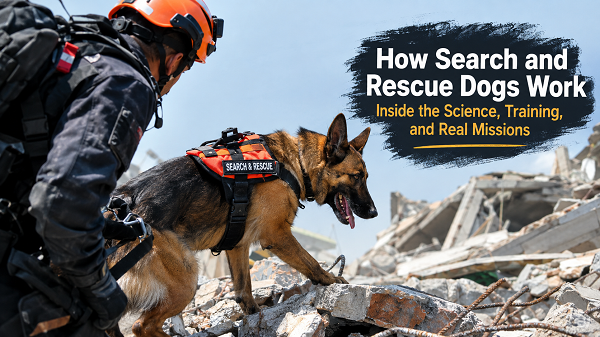
Search and rescue dogs work by using their extraordinarily sensitive noses, up to 100,000 times more sensitive than a human’s, to detect human scent carried on air currents or left behind on the ground, then alerting their handler with a trained signal (usually a bark or a “refind”) once they locate the source. Depending on their specialty, a dog might follow an individual trail (trailing), sweep an open area for any human scent (air-scenting), search collapsed buildings after a disaster, or locate remains underwater or beneath snow. Training a single SAR dog to full certification typically takes 600 to 1,000+ hours over one to two years.
If you’ve ever watched footage of a dog scrambling over rubble after an earthquake and wondered how it actually knows where to go, you’re about to get the full picture, not the Hollywood version.
Table of Contents
- What Is a Search and Rescue Dog, Exactly?
- The Science Behind the Sniff
- The Main Types of Search and Rescue Dogs
- How SAR Dogs Are Actually Trained (Timeline, Hours, Cost)
- Certification: What “Mission Ready” Really Means
- A Day in the Life: Real Deployments That Changed the Field
- Best Dog Breeds for Search and Rescue Work
- The Human Half of the Team: What Makes a Good Handler
- The Hard Parts Nobody Talks About
- How to Get Involved in SAR Work
- FAQs
- Conclusion
Introduction
Somewhere right now, in a forest, a collapsed building, or along a riverbank, a dog is doing something no piece of technology can fully replicate: reading the air for a single human scent among thousands of competing smells, and doing it with more precision than a lab full of sensors.
Search and rescue (SAR) work is one of the oldest and most misunderstood jobs a dog can do. Most people know the broad strokes, dog sniffs, dog finds person but they don’t know how the scent actually travels, why some dogs work on leash and others don’t, why it can take two years and thousands of dollars to certify a single team, or why so many search dogs today started life in a shelter rather than a breeder’s kennel.
This guide breaks all of that down. You’ll learn exactly how a dog’s nose processes scent differently from a human’s, the real difference between an air-scent dog and a trailing dog, what certification actually demands, what it costs, which breeds dominate the field and why, and what happens on an actual deployment, from the Mexico City earthquake to the 2023 Turkey-Syria disaster. If you’re a dog owner curious about the field, a volunteer thinking about starting SAR training, or just someone who wants to understand these remarkable animals properly, you’re in the right place.
What Is a Search and Rescue Dog, Exactly?
A search and rescue dog is a canine trained to locate missing or trapped people using scent detection, then communicate that discovery to a human handler through a specific, repeatable “alert” behavior, typically a focused bark, a sit-and-stare, or returning to the handler to lead them back to the find (called a “refind”).
SAR dogs aren’t a single breed or a single skill set. The umbrella covers wilderness search dogs looking for lost hikers, urban disaster dogs working collapsed buildings after earthquakes, water search dogs detecting drowning victims from a boat, avalanche dogs in ski resorts, and Human Remains Detection (HRD) dogs, sometimes called cadaver dogs, trained specifically to locate deceased individuals rather than the living.
What ties them all together is drive. Every credible SAR program looks for the same core traits: an obsessive desire to hunt for a reward, physical stamina, confidence around unfamiliar terrain and loud environments, and the ability to work independently while still taking direction. It’s a strange combination, a dog has to think for itself in the field, but also come back and check in with the handler constantly.
The Science Behind the Sniff
Here’s the thing that surprises most people: dogs don’t just have a “better” nose than ours. It’s a fundamentally different organ, built and wired for an entirely different job.
The numbers are staggering. A human nose carries around 5 to 6 million scent receptors. A dog’s nose carries between 220 million and 300 million, depending on the source and the breed. Scent-focused breeds sit at the high end of that range, while flat-faced breeds sit lower. On top of that, a dog’s olfactory bulb, the part of the brain that processes smell, is proportionally around 40 times larger relative to brain size than a human’s, even though the dog’s whole brain is smaller than ours.
That anatomy translates into real-world detection thresholds that are hard to wrap your head around. Research on trained detection dogs has measured their ability to detect certain compounds at concentrations as low as one part per trillion. To put that in perspective, that’s roughly the equivalent of detecting a single drop of a substance dissolved in 20 Olympic-sized swimming pools.
How the nose actually separates “breathing air” from “smelling air.” When a dog inhales, incoming air splits inside the nasal cavity. Most of it goes straight to the lungs. A smaller portion gets diverted upward into a maze of bony structures called turbinates, which slow the airflow down and trap odor molecules against the olfactory epithelium, the tissue lined with those hundreds of millions of receptors. When a dog exhales, it pushes air out through the side slits of its nostrils instead of back out the front, which means it doesn’t blow away the fresh scent it’s trying to sample. That’s the mechanical trick behind why a dog can sniff almost continuously without “resetting” its sense of smell the way we would.
Scent doesn’t sit still, it moves like smoke. This is the part most articles skip. Human scent is a cocktail of skin rafts (dead skin cells, shed constantly), bacteria, sweat, and breath. Once released, it behaves like smoke from a fire: it rises, drifts on wind currents, pools in low areas, and gets trapped by obstacles like walls, rocks, or dense brush. A trained SAR dog isn’t just smelling “a person”, it’s reading a moving, three-dimensional scent plume and working out where the source has to be based on where the scent is strongest and which direction it’s drifting from. This is why wind direction, temperature, humidity, and even time of day change how a search team plans its approach.
Understanding scent behavior separates a handler who can read a search area from one who’s just following the dog around. It’s also exactly why the different dog specialties described below approach a search so differently.
The Main Types of Search and Rescue Dogs
Not every SAR dog does the same job, and mixing up the disciplines is one of the biggest misconceptions the public has about this field.
1. Air-scent dogs
Air-scent dogs work off-leash, sweeping a designated search sector while moving perpendicular to the wind to intercept airborne human scent. They’re not scent-discriminating, meaning they’ll find any human in their area, not a specific person, which makes them ideal for wide, unknown search zones where there’s no scent article to work from. A well-trained air-scent team can effectively clear 40 to 80 acres in a few hours, depending on terrain and vegetation density.
2. Trailing and tracking dogs
Trailing dogs (bloodhounds are the classic example, though many breeds now do this work) are given a scent article belonging to the missing person and follow the specific trail that individual left, often on a harness and long leash. Because they discriminate for one scent among many contaminating ones, trailing dogs can work in areas with lots of human traffic, a mall, a neighborhood, a campground, where an air-scent dog would be overwhelmed by unrelated scent. Tracking dogs work similarly but rely more heavily on ground disturbance (crushed vegetation, disturbed soil) alongside scent.
3. Human Remains Detection (HRD) dogs
Often called cadaver dogs, HRD dogs are trained on the specific chemical compounds released by decomposition rather than living human scent. They’re used in criminal investigations, disaster recovery, and historical/cold-case searches. Some HRD dogs are cross-trained to work from boats, detecting scent rising through water from remains on a lakebed or riverbed below.
4. Disaster and urban search (USAR) dogs
These are the dogs deployed after earthquakes, building collapses, and explosions, the ones most people picture when they hear “search and rescue dog.” USAR dogs are trained to navigate unstable rubble, climb at steep angles, balance on narrow beams, and ignore the chaos of sirens, generators, and rescue crews around them, all while hunting for live scent rising through gaps in the debris. This is arguably the most physically demanding specialty in the field.
5. Water search dogs
Water search teams work from boats or shorelines, detecting scent that rises to the surface from a body submerged below. The dog alerts on the strongest point of scent concentration, which helps divers narrow a search area that could otherwise span acres of open water.
6. Avalanche dogs
Common at ski resorts across the Alps, the Rockies, and other mountain regions, avalanche dogs are trained to detect human scent through several feet of packed snow, often the fastest method available in the critical first 15 minutes after a burial, when survival odds are highest.
How SAR Dogs Are Actually Trained (Timeline, Hours, Cost)
This is where a lot of SAR content online gets vague. Here’s what the actual numbers look like.
Selecting the dog. Reputable programs don’t pick dogs at random. The National Disaster Search Dog Foundation (SDF), a nonprofit based near Santa Paula, California, specifically recruits from shelters and breed rescues, targeting Labrador Retrievers, Golden Retrievers, Border Collies, Belgian Malinois, and mixes of those breeds. The traits that get a dog labeled “too much” for a family home, obsessive toy drive, restless energy, relentless focus, are precisely what make a great search dog. SDF has noted that before it streamlined its selection and training process, only about 15% of dogs it evaluated made it to FEMA certification; today that figure sits closer to 85%, thanks to more rigorous screening at the front end.
Training hours. Industry estimates place the total training investment for a field-ready SAR dog at roughly 600 to 1,000+ hours, spread across obedience foundations, scent discrimination games, agility on unstable surfaces, distraction-proofing, and live-find/alert conditioning. Handlers themselves aren’t exempt from this, a FEMA-credentialed handler typically logs around 1,000 hours of their own training in navigation, radio communication, incident command systems, and wilderness first aid before they’re considered field ready.
Timeline. Depending on the dog’s age when training starts and the program’s methodology, certification takes anywhere from six months to two years. SDF’s structured program, which pairs a rescued dog with a trained mentor dog before matching it to a firefighter-handler, typically produces a certified team in 10 to 12 months.
Cost. This is the number that surprises most people. SDF has stated that training a single search dog and handler team through to certification costs approximately $75,000, covering professional trainers, equipment, veterinary care, and the extended time investment. Volunteer-run SAR groups spend less in raw dollars but shift much of that cost onto the handler personally: fuel, gear, food, veterinary bills, and travel to training weekends are almost always paid out of pocket, not reimbursed. It’s genuinely a labor of love before it’s anything else.
If you’re weighing whether to start this journey with your own dog, our detailed walkthrough on how to start SAR dog training at home covers exactly which foundational skills you can build yourself before joining a formal unit and which parts genuinely require a certified mentor.
Certification: What “Mission Ready” Really Means
There’s no single global licensing body for SAR dogs the way there is for, say, a commercial pilot. In the United States, the closest thing to a national standard comes through FEMA’s Urban Search and Rescue (US&R) canine certification, required for any team that wants to deploy as part of a federal disaster task force. As of a 2020 count, there were 284 live-find canine search teams and 90 human-remains detection teams holding that credential nationwide, a strikingly small number when you consider the size of the country and the frequency of major disasters.
A FEMA canine/handler certification typically must be renewed every three years and tests both halves of the team. The dog is evaluated on command response, agility over rubble, a clear and consistent alert (usually a focused bark) on live finds, and the ability to keep working despite heat, noise, food distractions, and other animals nearby. The handler is tested separately on search strategy, mapping, victim marking protocols, and briefing/debriefing procedures. Dogs must be at least 18 months old to attempt certification, though most don’t test until closer to age two, once they’re physically and mentally mature enough for the work.
Outside the federal system, local and regional SAR organizations, groups like the National Association for Search and Rescue (NASAR), the American Rescue Dog Association, and Search and Rescue Dogs of the United States, set their own “mission ready” standards, which vary by region but generally mirror the same core skills.
A Day in the Life: Real Deployments That Changed the Field
Numbers and training charts only tell half the story. Here’s where the work actually gets proven.
Oklahoma City, 1995. A retired schoolteacher named Wilma Melville deployed to the Oklahoma City bombing with her FEMA-certified search dog, Murphy. What she found on the ground shook her: there were only about 15 certified canine search teams in the entire United States at the time, nowhere near enough for a disaster of that scale. That gap led her to found the National Disaster Search Dog Foundation the following year, with a goal of training 168 teams, one for every life lost in the bombing. SDF hit that number in 2020 and, as of 2024, had over 90 active search teams deployable regionally and nationally.
Mexico City earthquake, 1985. Long-time handler and California Rescue Dog Association founding member Bev Peabody has described this disaster as the turning point that got canine disaster work taken seriously in the US. Over five days on-site, dogs on her team found eight people alive in the rubble, including a grandfather and grandson pulled alive from a collapsed parking structure. The demand for trained disaster dogs in the US grew sharply in the years that followed.
Turkey-Syria earthquake, 2023. After the 7.8-magnitude earthquake struck near Gaziantep in February 2023, killing tens of thousands, international USAR teams deployed with dozens of certified search dogs as part of the broader relief effort, including a US Urban Search and Rescue task force that brought a dozen dogs alongside structural engineers and technical search specialists. It’s one of the clearest recent examples of how canine search capability gets folded directly into a country’s formal disaster response machinery.
These aren’t just feel-good stories, they’re the reason modern SAR training standards exist at all. Every certification requirement in place today traces back to a disaster where the gaps in canine readiness cost precious search time.
Best Dog Breeds for Search and Rescue Work
There’s no single “correct” SAR breed, but certain breeds consistently dominate the field because of a specific combination of drive, build, and trainability.
- Belgian Malinois — high energy, intense focus, and the athleticism to handle rubble and rough wilderness terrain; increasingly the top choice for disaster/USAR work.
- German Shepherd — versatile, biddable, and strong in both air-scent and trailing roles; a long-standing staple of European and North American SAR units.
- Labrador Retriever — food and toy-driven, generally easygoing around strangers and other dogs, which matters when a search area is crowded with rescue personnel.
- Golden Retriever — similar profile to the Labrador, often favored for wilderness and water search work.
- Border Collie — exceptional focus and problem-solving ability, strong in air-scent and wilderness search roles.
- Bloodhound — the traditional benchmark for trailing work, prized for scent discrimination even on trails more than 24 hours old.
- Dutch Shepherd — gaining ground in disaster search circles for the same high-drive traits that make Malinois so effective.
Mixed breeds pulled from shelters make up a significant share of working SAR dogs today, especially through nonprofit programs, proof that pedigree matters far less than drive, nerve stability, and physical soundness.
If you’re comparing working-dog training pathways more broadly, it’s worth reading how these principles carry over into other disciplines in our guide on how military working dogs are trained, the foundational obedience and drive-channeling techniques overlap significantly with SAR work, even though the end goals differ.
The Human Half of the Team: What Makes a Good Handler
A brilliant dog with a mediocre handler is a wasted resource. The handler carries the search strategy, the timeline, witness accounts, terrain analysis, and theories about where a missing person might have gone. The dog carries none of that. It simply follows scent. That division of labor is exactly why the partnership works: the human brings context, the dog brings a sense we simply don’t have.
Good handlers understand something a lot of pet owners never fully grasp, the difference between a dog working on obedience (doing what it’s told) and a dog working on instinct and drive (doing what its nose and prey drive are pulling it toward). SAR work depends on a handler who can read which mode their dog is in at any given moment and know when to give the dog freedom versus when to rein it back in. We go deeper into that distinction, and why it matters for every type of working dog, in our piece on obedience versus instinct in working dog training.
Trainer E-E-A-T note: Effective SAR training isn’t built on generic obedience drills, it’s built on channeling a dog’s natural drive into a repeatable, reward-driven task, then proofing that behavior against every distraction a real disaster site can throw at it (noise, unstable footing, unfamiliar people, competing smells). This is the same core methodology used across working-dog disciplines, from protection work to detection to SAR, and it’s the foundation we apply with every dog and handler team we train. Handlers also need to be equipped properly for the terrain, a harness that holds up on rubble and steep ground matters as much as the training itself, which is why we put together a tactical K9 harness guide covering what professional handlers actually check before trusting a piece of gear in the field.
The Hard Parts Nobody Talks About
SAR work looks heroic in news footage, and it is, but it comes with costs that rarely make the highlight reel.
Physical strain. Both air-scent and disaster dogs are often required to work 4 to 8 hours straight in extreme conditions, heat, cold, rubble, deep snow, without breaks that would be normal for a companion dog. Handlers have to manage hydration, paw injuries, and heat stress constantly, which is why proper gear matters so much on deployment. If your dog trains or works in hot climates, our guide to dog cooling vests that actually work is worth a look before your next hot-weather session.
Emotional toll. This one surprises people. SAR dogs can pick up on the emotional weight of a search, especially disaster deployments where “finds” are often victims rather than survivors. Handlers involved in the Oklahoma City response reported that some dogs showed signs of depression after long stretches without a live find, enough that handlers began staging a “success” scenario at the end of a shift, having a colleague hide so the dog could experience the reward of a find and stay motivated. Human SAR volunteers report similar emotional strain, which is part of why many SAR organizations now build peer support and critical-incident stress management directly into their programs.
Working lifespan. Most SAR dogs have an effective working career of roughly five to seven years, depending on the age they were certified, their genetics, and overall health. Handlers typically need to begin training a successor dog once their current partner reaches six to eight years old, to avoid a readiness gap when retirement comes.
Financial burden. As mentioned earlier, most of the ongoing costs, travel, food, veterinary care, equipment, fuel, land on the handler’s shoulders, not a government agency. Volunteer SAR remains, for the vast majority of people in the field, an expensive passion project rather than a paid career.
How to Get Involved in SAR Work
If this article has you thinking seriously about SAR work with your own dog, here’s the honest roadmap:
- Assess your dog’s drive and temperament first. Not every dog, even a “smart” one, has the obsessive hunt drive SAR work demands. Confidence around loud noises, unstable footing, and strangers is non-negotiable.
- Build rock-solid foundational obedience before anything else. A dog that won’t recall reliably off-leash isn’t ready for scent work in an open search area.
- Find a certified mentor or established SAR unit. Nearly every credible program strongly discourages solo training past the foundational stage, scent discrimination and alert-proofing are hard to self-teach correctly.
- Expect a multi-year commitment, both in training hours and personal cost, before your team is deployment-ready.
- Budget realistically. Even outside a $75,000 professional program, expect meaningful recurring costs for gear, fuel, and travel to training weekends.
For handlers who want a deeper, field-tested breakdown of the mindset and discipline that separates a hobbyist from a genuinely reliable working-dog team, our founder’s e-book, Beyond the Bark, digs into the real-world lessons learned from years of hands-on K9 training, well worth adding to your reading list before you commit to this path.
Frequently Asked Questions
1. How long does it take to train a search and rescue dog?
Most SAR dogs need 600 to 1,000+ hours of training spread across six months to two years, depending on the dog’s age at the start, the specialty (wilderness, disaster, water, etc.), and the training program’s structure.
2. What breeds make the best search and rescue dogs?
Belgian Malinois, German Shepherds, Labrador Retrievers, Golden Retrievers, Border Collies, and Bloodhounds are the most common breeds in SAR work, though shelter mixed-breed dogs with strong drive and nerve stability are increasingly used, especially through nonprofit training programs.
3. How much does it cost to train a certified SAR dog?
Professional programs like the National Disaster Search Dog Foundation cite roughly $75,000 to fully train and certify a dog-and-handler team. Volunteer SAR units cost less in program fees but shift most ongoing expenses, gear, travel, veterinary care, fuel, onto the handler personally.
4. What’s the difference between an air-scent dog and a trailing dog?
Air-scent dogs work off-leash and detect any human scent in a search area, making them ideal for wide, unknown zones. Trailing dogs work on a leash, follow the specific scent of one individual using a scent article, and can work through areas contaminated with other people’s scent.
5. How do search and rescue dogs signal that they’ve found someone?
Most SAR dogs are trained to give a clear, repeatable alert, commonly a focused, sustained bark at the find location, or a “refind,” where the dog returns to the handler and leads them back to the person. The specific alert style is chosen and reinforced during training so it’s unmistakable in the field.
Conclusion
Search and rescue dogs work because their biology gives them a sense we simply don’t have access to, and because handlers spend years shaping that raw ability into something precise, repeatable, and trustworthy under pressure. It’s not magic, it’s hundreds of millions of scent receptors, a brain wired to prioritize smell, and a training process built on turning a dog’s obsession with a reward into a lifesaving skill.
If you take one thing away from this guide, let it be this: the partnership matters as much as the nose. A world-class dog paired with an inexperienced handler will underperform, and a great handler can’t manufacture drive a dog doesn’t have. Getting both halves right, through proper selection, realistic training timelines, and genuine investment in the dog’s wellbeing, is what turns a family pet’s energy into the kind of skill that finds a grandfather and grandson alive under a collapsed parking garage, or a lost hiker before nightfall.
Whether you’re considering starting this journey with your own dog or simply wanted to understand what’s really happening when you see a SAR team on the news, hopefully you now see it for what it is: one of the most demanding, and most quietly heroic, partnerships between humans and dogs anywhere in the working-dog world.

Her work centers on applied training across obedience, detection, protection, and operational readiness, with a strong focus on Military Working Dogs (MWDs) and security K9 programs. Rather than relying on theory alone, Rofiat emphasizes proven training methods built on repetition, consistency, and real-world conditioning principles that prepare both dogs and handlers for high-pressure tasks.
Through articles, training content, and documentaries, she shares experience-based insights from the field, highlighting how structured training, clear communication, and trust between handler and dog directly impact performance and reliability.
Drawing from years of frontline experience, she is also the author of “Beyond the Bark: Inside a Pro Handler’s Playbook for Raising the Ideal Dog,” a practical guide designed to help dog owners and handlers apply professional training principles in everyday situations.
She remains committed to responsible K9 development, continuous skill refinement, and practical education for handlers, trainers, and dog professionals.
- How Many Teeth Do Dogs Have? Puppy vs Adult Chart - September 22, 2026
- What Colors Do Dogs See? (Dog Vision Spectrum) - September 22, 2026
- Is Cinnamon Bad for Dogs? Safe Dosage by Weight - September 21, 2026