How to Choose a Therapist for Your Dog
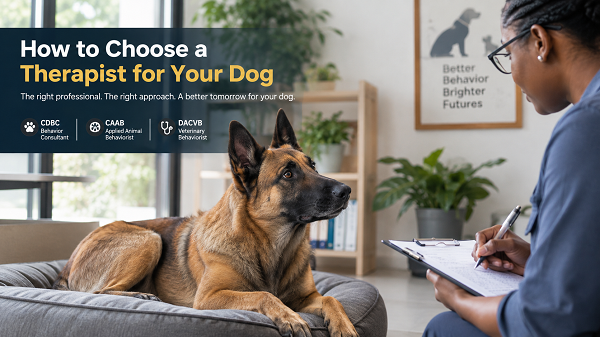
To choose the right therapist for your dog, look for a certified dog behavior consultant (IAABC-CDBC), Certified Applied Animal Behaviorist (CAAB), or board-certified veterinary behaviorist (DACVB), not just anyone calling themselves a “dog psychologist.” Rule out medical causes with your vet first, ask about their methods (avoid anyone pushing dominance theory or e-collars as a first resort), and get a written behavior plan before you pay for a package of sessions.
Table of Contents
- What People Actually Mean by “Dog Therapist”
- Signs Your Dog Might Actually Need One
- Trainer vs. Behavior Consultant vs. Veterinary Behaviorist
- 7 Steps to Choosing the Right Professional
- Red Flags That Should Make You Walk Away
- What the First Session Actually Costs (US & UK Numbers)
- Working, Protection & Ex-K9 Dogs: A Different Conversation
- In-Person vs. Online Behavior Consults
- How Long It Takes to See Results
- FAQs
- Final Thoughts
Introduction
Your dog growls at every visitor now. Or she’s chewed through two doors this month trying to get out when you leave for work. Maybe he’s fine at home but turns into a different animal on walks, lunging, barking, dragging you toward every dog he sees. You’ve tried the YouTube tutorials. You’ve tried the treats-in-your-pocket approach. Nothing’s sticking, and honestly, you’re starting to feel a bit hopeless about it.
So you type “how to choose a therapist for your dog” into Google, and here’s the thing nobody tells you upfront: there’s no such job as a “dog psychologist” with a couch and a license plate on the wall. What you’re actually looking for is a dog behavior professional and figuring out which kind, with which credentials, at what cost, is where most owners get stuck.
I’ve spent years around working and protection dogs, and I’ve watched owners waste hundreds of dollars on “behaviorists” who had no formal training at all, and I’ve also watched a single well-run consult turn a dog that was headed for rehoming into a completely manageable, even joyful, family pet. The difference almost always comes down to who you picked and how you picked them.
By the end of this guide, you’ll know exactly what “dog therapist” really means, which credentials actually matter, what red flags to run from, what it should cost, and because this is something most generic articles skip entirely, how the process changes if your dog is a working, protection, or retired K9 dog rather than an average family pet.
What People Actually Mean by “Dog Therapist”
Let’s clear this up first, because it trips up almost everyone.
A “dog therapist” isn’t a real professional title. What you’re searching for usually falls into one of these categories:
- A behavior consultant or dog behaviorist — someone trained to assess and modify problem behaviors like aggression, fear, and anxiety
- A veterinary behaviorist — a licensed vet with additional specialty training who can diagnose behavioral conditions and prescribe medication
- A dog trainer with behavior experience — someone who teaches skills and may also help with mild behavior issues, though this varies wildly
Research cited by Canine Journal found that as many as 85% of dogs display at least one problematic behavior at some point in their lives, so if you’re dealing with this, you’re nowhere near alone. Aggression is the single most common reason owners seek professional help, followed closely by separation anxiety and fear-based reactivity.
The term “behaviorist” is actually protected in a professional sense, reputable practitioners agree it should only be used by people certified through bodies like the Animal Behavior Society or the American College of Veterinary Behaviorists. Anyone can slap “behaviorist” on a business card. Not everyone has earned it.
Signs Your Dog Might Actually Need One
Not every quirky habit needs a professional. But you should book a consult if you’re seeing:
- Aggression — growling, snapping, or biting directed at people, other dogs, or even you during handling
- Separation anxiety — destructive chewing, house-soiling, or panic-level distress when left alone
- Resource guarding — stiffening, growling, or snapping over food, toys, or spaces
- Compulsive behaviors — excessive licking (especially to the point of raw skin), tail-chasing, or shadow-chasing
- Fear or phobias — extreme reactions to noise, strangers, or specific environments that don’t fade with normal exposure
- A bite history — this one isn’t optional. If your dog has broken skin, get professional help immediately, both for safety and liability reasons
A good rule of thumb from certified applied animal behaviorist Dr. Stephen Zawistowski, science advisor to the ASPCA: if the behavior could put your dog, another animal, or a person in danger, that’s your signal to stop troubleshooting alone and call in a professional.
If leash lunging and barking at other dogs is your main issue rather than full-blown aggression, it’s worth reading our dedicated guide on how to calm leash reactivity first, some reactivity cases can be worked through with structured training before you need a behaviorist at all.
Always start with your vet. Pain, thyroid issues, and neurological conditions frequently show up disguised as “behavior problems.” A good vet visit before any behaviorist appointment can save you months of training a symptom instead of a cause.
Trainer vs. Behavior Consultant vs. Veterinary Behaviorist
This is the comparison most articles either skip or get wrong. Here’s how the three actually stack up:
| Dog Trainer | Certified Behavior Consultant | Veterinary Behaviorist | |
|---|---|---|---|
| Focus | Obedience skills (sit, stay, loose-leash walking) | Complex behavior problems (aggression, anxiety, phobias) | Diagnosing and treating behavioral conditions medically |
| Typical credentials | CPDT-KA, CPDT-KSA | CDBC (IAABC), CBCC-KA (CCPDT), CAAB (ABS) | DACVB (must be a licensed vet + residency) |
| Can prescribe medication | No | No | Yes |
| Education level | Varies, some certified, many are not | Certification exam + hundreds of logged hours | DVM + 3-year residency + published research |
| Best for | Puppy classes, basic manners, mild reactivity | Aggression, severe anxiety, resource guarding | Cases needing medication alongside behavior work |
| Typical session cost (US) | $50–$150 | $150–$400 for initial consult | $300–$600+ for initial consult |
A helpful way to think about it: a trainer teaches your dog new skills. A behavior consultant changes how your dog feels about a trigger. A veterinary behaviorist does both, plus medication when the dog’s brain chemistry needs support to make any training possible at all.
If your dog’s issue turns out to be more “needs better manners” than “needs behavior modification,” our full breakdown on how to choose a dog trainer walks through the same credential-checking process for that side of things.
Dog training itself is still an unregulated industry in most countries, there’s no license required to call yourself a trainer or even a behaviorist. That’s exactly why credentials matter so much here; they’re the only real quality filter you have.
7 Steps to Choosing the Right Professional
Step 1: Rule Out Medical Causes First
Book a vet visit before anything else. Pain, hormonal imbalances, and sensory decline (especially in older dogs) can all mimic “behavior problems.”
Step 2: Match the Credential to the Problem
- Mild reactivity or manners issues → certified trainer (CPDT-KA)
- Aggression, severe anxiety, resource guarding → CDBC, CBCC-KA, or CAAB
- Suspected medical/neurological component, or medication being considered → DACVB veterinary behaviorist
Step 3: Verify the Credential, Don’t Just Take Their Word
Search the practitioner’s name directly on these public directories:
- International Association of Animal Behavior Consultants (IAABC) member directory
- Animal Behavior Society’s CAAB directory
- American College of Veterinary Behaviorists (ACVB) directory
- Certification Council for Professional Dog Trainers (CCPDT) directory
If someone claims a certification you can’t verify, that’s a dealbreaker, not a technicality.
Step 4: Ask About Their Methods Before You Book
A quick phone call should tell you a lot. Ask directly: “What training philosophy do you use?” You want to hear terms like positive reinforcement, force-free, or LIMA (Least Intrusive, Minimally Aversive). Be cautious of anyone who leads with dominance, “pack leader,” or “balanced training” language without explaining exactly what tools that involves.
Step 5: Check Real Reviews and Ask for References
Google reviews, testimonials, and best of all, a direct reference from a past client with a similar issue to yours. A confident, ethical behaviorist won’t hesitate to connect you with one.
Step 6: Ask What a Session Actually Looks Like
A proper initial consult should include a detailed history intake (sometimes a written questionnaire sent beforehand), direct observation of your dog, and a written behavior modification plan you take home, not just verbal advice you’re expected to remember.
Step 7: Confirm Follow-Up Support Is Included
Behavior change isn’t a one-and-done fix. Ask how many follow-up sessions are typical for a case like yours, and whether email or video check-ins are included between visits.
Red Flags That Should Make You Walk Away
- Guarantees of a “fixed” dog, nobody can ethically promise that, especially for aggression cases
- Refusal to explain their methods in plain language before you book
- Heavy reliance on shock collars, prong collars, or physical corrections as the primary tool, especially for fear-based behavior (this frequently makes anxiety and aggression worse, not better)
- No written plan, if everything is verbal with nothing to reference later, that’s a problem
- Dismissing your vet’s input or refusing to coordinate with your veterinarian on medical cases
- Pressure to buy a large package of sessions before you’ve even had a first consult
- Vague or unverifiable credentials, “20 years of experience” isn’t a substitute for accountability to a professional body
If a “behaviorist” tells you your dog is trying to “dominate” the household within the first five minutes, that’s an outdated framework most modern behavior science has moved away from. It’s worth ending the call there. We’ve written more on why this distinction matters in Dog Dominance vs. Discipline: What K9 Trainers Know That Pet Owners Don’t.
What the First Session Actually Costs (US & UK Numbers)
Real numbers, pulled from actual practicing consultants and clinics rather than vague estimates:
United States:
- Group class or basic trainer session: $50–$150
- Certified behavior consultant, initial consult (60–120 minutes): $150–$390
- Veterinary behaviorist, initial consult: $300–$600+, often not covered by standard pet insurance
- Follow-up sessions: typically $65–$150 per session
United Kingdom:
- Certified behaviourist initial consultation (usually 90 minutes to 2.5 hours): £150–£250
- Follow-up sessions or phone check-ins: £50–£100
Most complex cases (real aggression, severe separation anxiety) need 4 to 8 follow-up sessions spread across 8–16 weeks, not a single visit. If someone quotes you a flat “one session fixes it” price for a genuine aggression case, be skeptical, behavior change takes repetition and time, the same way it would for a person.
Budget tip: Local animal shelters and humane societies (like Marin Humane or Berkeley Humane in the US) often run in-house behavior consult programs at $85–$150, staffed by certified trainers, and these are a genuinely solid, affordable starting point before you commit to a private specialist.
Working, Protection & Ex-K9 Dogs: A Different Conversation
This is the part most general pet-advice articles miss entirely, and it matters if you’re dealing with a Malinois, GSD, or any dog bred and trained for drive, bite work, or detection.
Working and protection dogs are often high-drive animals selected specifically for traits, intensity, prey drive, environmental confidence, that can look like “problem behavior” out of context but actually need to be managed and channeled, not suppressed. A generalist behavior consultant unfamiliar with working-line temperaments can misread genuine drive as pathological aggression, and vice versa.
A few things to look for if your dog falls into this category:
- Find a consultant with documented working-dog or protection-sport experience, ask directly whether they’ve handled Malinois, working-line GSDs, or dogs from IPO/IGP, Schutzhund, or PPD backgrounds. It’s a different skill set from suburban pet-dog training. Our piece on obedience vs. instinct and balancing drive with control goes deeper into why this distinction gets misdiagnosed so often.
- Retired K9s carry real trauma risk. Military and police service dogs can and do show signs consistent with hypervigilance, noise sensitivity, and stress-related behavior after retirement, not unlike PTSD symptoms in humans. Programs like Mission K9 Rescue in the US specialize specifically in transitioning retired working dogs into civilian homes, and they’re a genuinely useful referral point if you’ve adopted or retired a service dog.
- Bite work and protection training should never be handled by a generalist “positive-only” trainer with no protection sport background, and conversely, aggression in a family pet should never be handled by a bite-work specialist using drive-building techniques meant for sport dogs. Match the specialist to the actual job.
- Decoy work, defense drive assessments, and civil agitation are specialized skills, ask specifically whether the professional has training or certification through a recognized working-dog body (such as USPCA, NASDU, or an established Schutzhund/IGP club), not just general obedience certification.
Curious how professional programs handle this at scale? Our breakdown of how military working dogs are trained shows how structured, high-level programs build and manage drive in dogs that do genuinely dangerous work, the same principles just get scaled down for a family protection dog.
If you’re building or maintaining a protection or working dog and want a deeper foundation in this specific world, drive development, handler psychology, and real operational scenarios rather than pet-dog manners, it’s worth going beyond a single blog post. Our team put together a full guide for handlers covering exactly this ground: Beyond the Bark, on Amazon.
In-Person vs. Online Behavior Consults
Since 2020, video-call behavior consults have become genuinely mainstream, and for a lot of cases, they work just as well as in-person visits, sometimes better.
Online consults work well for:
- Separation anxiety (the behaviorist needs to see your dog alone, which is honestly easier to film at home than replicate in a clinic)
- Owners in rural areas with no local specialist
- Follow-up sessions after an initial in-person assessment
In-person is usually better for:
- Active aggression cases where hands-on safety management and environment-reading matter
- Multi-dog household dynamics
- Working and protection dog assessments involving drive testing
Most reputable behavior consultants now offer both, and plenty of top-tier CAABs and CDBCs run entirely virtual practices. Don’t rule out a highly qualified specialist just because they’re not local to you, a great video consult from an expert usually beats a mediocre in-person session from whoever happened to be nearby.
How Long It Takes to See Results
Set realistic expectations here, because this is where a lot of owners give up too early or get talked into unnecessary extra sessions.
- Mild issues (leash reactivity, jumping on guests): noticeable improvement in 2–4 weeks of consistent practice
- Moderate issues (separation anxiety, resource guarding): 6–12 weeks for meaningful change
- Severe aggression or trauma-based fear: 3–6 months or longer, sometimes with lifelong management rather than a full “cure”
Behavior modification isn’t linear, expect good weeks and setback weeks. A behaviorist worth their fee will tell you this upfront instead of promising a fast fix. Studies on canine aggression case outcomes generally show the biggest predictor of success isn’t the severity of the original problem, it’s owner consistency in following the plan between sessions.
Trainer Note: Why This Matters Coming From a K9-Focused Team
We work daily with protection and security dogs, where a single misread behavior, mistaking genuine aggression for drive, or drive for aggression, has real consequences for handler safety and dog welfare. That perspective is exactly why we push back so hard on the “one-size-fits-all obedience trainer” approach when it comes to genuine behavior problems. The right professional for a nervous rescue Labrador is very often the wrong professional for a working-line Malinois with a bite history, and treating them the same is how good dogs get mislabeled and rehomed unnecessarily.
FAQs
1. Is a “dog therapist” the same as a dog behaviorist?
Not officially, “dog therapist” isn’t a regulated title. What you actually want is a certified dog behavior consultant, applied animal behaviorist, or veterinary behaviorist, depending on the severity of the issue.
2. How do I know if my dog needs a behaviorist instead of just a trainer?
If the issue involves aggression, a bite history, severe anxiety, or fear that isn’t improving with basic training, go straight to a certified behavior consultant rather than a general obedience trainer.
3. How much does a dog behaviorist cost on average?
In the US, expect $150–$400 for an initial consult with a certified behavior consultant, and $300–$600+ for a veterinary behaviorist. In the UK, initial consults typically run £150–£250.
4. Can a regular vet help with dog behavior problems?
Yes, as a first step, your vet can rule out medical causes and refer you to a veterinary behaviorist if medication or a formal diagnosis is needed. But most vets aren’t trained to run full behavior modification programs themselves.
5. Do online dog behavior consults actually work?
Yes, for many issues, especially separation anxiety and follow-up work, video consults with a qualified specialist can be just as effective as in-person visits, and they open up access to specialists outside your local area.
Final Thoughts
Picking the right professional for your dog’s behavior issue comes down to three things: matching the credential to the actual problem, verifying that credential instead of trusting a business card, and being honest with yourself about your dog’s specific background, especially if you’re working with a protection, working, or ex-service dog rather than a typical family pet.
Start with your vet to rule out medical causes. Then look for CDBC, CAAB, or DACVB credentials depending on severity. Ask about methods before you book, watch for the red flags above, and expect real change to take weeks or months, not a single session.
Your dog’s behavior problem almost certainly has a path forward, you just need the right person walking it with you. If you’re navigating this with a working or protection dog specifically, browse more of our Training & Handling guides.

Her work centers on applied training across obedience, detection, protection, and operational readiness, with a strong focus on Military Working Dogs (MWDs) and security K9 programs. Rather than relying on theory alone, Rofiat emphasizes proven training methods built on repetition, consistency, and real-world conditioning principles that prepare both dogs and handlers for high-pressure tasks.
Through articles, training content, and documentaries, she shares experience-based insights from the field, highlighting how structured training, clear communication, and trust between handler and dog directly impact performance and reliability.
Drawing from years of frontline experience, she is also the author of “Beyond the Bark: Inside a Pro Handler’s Playbook for Raising the Ideal Dog,” a practical guide designed to help dog owners and handlers apply professional training principles in everyday situations.
She remains committed to responsible K9 development, continuous skill refinement, and practical education for handlers, trainers, and dog professionals.
- How Many Teeth Do Dogs Have? Puppy vs Adult Chart - September 22, 2026
- What Colors Do Dogs See? (Dog Vision Spectrum) - September 22, 2026
- Is Cinnamon Bad for Dogs? Safe Dosage by Weight - September 21, 2026