7 Best Dog Training Books for Beginners
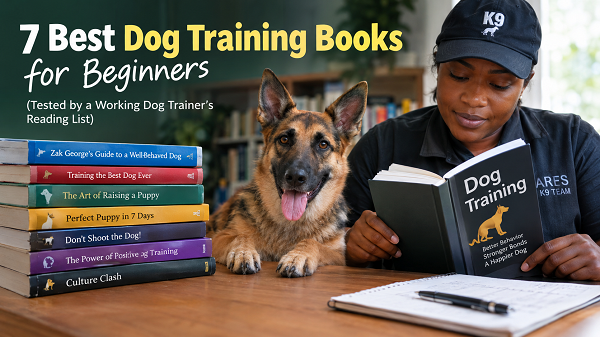
The best dog training book for most beginners is Zak George’s Guide to a Well-Behaved Dog because it’s organized by problem (jumping, chewing, barking) instead of by chapter order, so you can flip straight to whatever’s going wrong today. If you want a structured, day-by-day plan instead, Training the Best Dog Ever runs a proven 5-week program that’s easier to follow start to finish.
Table of Contents
- What Makes a Dog Training Book Actually Work
- The 7 Best Dog Training Books for Beginners
- Quick Comparison Table
- How to Actually Use a Training Book (Most Owners Skip This)
- Training Books to Be Careful With
- When a Book Isn’t Enough
- FAQs
- Final Thoughts
Introduction
If you’ve ever typed “best dog training books” into Google, you’ve probably noticed something. Every list looks the same. Same five or six titles, shuffled into a different order, with a “Check Price” button under each one. Nobody tells you why one book beats another for a specific kind of owner, and almost nobody mentions that a training book, by itself, changes almost nothing.
I’ve spent 14+ years working dogs professionally, most of it training dogs for security and detection work where there’s no room for guesswork. But long before any of that, I was a first-time dog owner leaning on library books because I couldn’t afford a trainer. Some of those books helped enormously. A couple were actively bad advice dressed up in a nice cover. This list is built from that experience, not from an affiliate spreadsheet.
By the end of this guide, you’ll know exactly which of these 7 books fits your situation, how to actually get value out of a training book instead of letting it collect dust, and which older “classics” you should skip because the advice inside hasn’t aged well.
Trainer’s Note (Why Trust This List)
I’m Rofiat Muritala, a certified trainer and military K9 handler with 14+ years in working-dog obedience, protection, and detection programs. I didn’t rank these books by bestseller status. I ranked them by whether the training method inside actually holds up against what modern behavior science says works and whether a total beginner, with zero prior experience, could follow the instructions without a trainer standing next to them.
What Makes a Dog Training Book Actually Work for a Beginner
Most “best books” lists skip this part entirely, which is exactly why so many people buy the wrong book and give up. Before you spend money, run any dog training book against these four checks:
- Reward-based, not correction-based. Look for “positive reinforcement,” “reward-based,” or “force-free” on the cover or in the first chapter. A 2024 meta-analysis of dog training studies found reward-based methods consistently outperform punishment-based methods on both obedience and welfare measures, dogs trained with corrections show more stress signals and no better long-term compliance.
- Organized the way you’ll actually use it. Some books are meant to be read cover-to-cover as a program (great for total beginners who want structure). Others are reference guides you flip through when a specific problem shows up. Neither is “better”, pick the format that matches how you learn.
- Written by someone with hands-on training hours, not just a media platform. Being a good on-camera personality and being a good teacher of written instruction are different skills. Several of the books that dominate “best of” lists are written by celebrity trainers whose books are ghost-written summaries of their show content.
- Matches your dog’s actual stage. A young puppy needs socialization-window content (0–16 weeks is the critical period). An adult rescue with existing habits needs behavior-modification content. A book written for one doesn’t transfer cleanly to the other.
One more thing worth saying plainly: a training book is a curriculum, not a substitute for repetition. I’ll come back to that in the section on how to actually use one, because it’s the single biggest reason beginners feel like “the book didn’t work.”
The 7 Best Dog Training Books for Beginners
1. Zak George’s Guide to a Well-Behaved Dog — Best Overall for Beginners
By Zak George and Dina Roth Port | 224 pages | ~$15–18 | View on Amazon
This is the one I hand to almost every new dog owner who asks me for a single book. Zak George built his reputation on YouTube teaching reward-based training to millions of owners, and this book is organized around real, specific problems, jumping on guests, play biting, thunderstorm fear, separation anxiety, rather than forcing you to read three chapters of theory before you get anything usable.
Why it works for beginners: you don’t need to read it front to back. If your dog is chewing the couch tonight, you go straight to the chewing chapter and you have a plan in ten minutes.
Where it falls short: it’s light on the “why” behind the science. If you want to understand how dogs learn, not just what to do, pair it with book #5 on this list.
2. Training the Best Dog Ever — Best Structured 5-Week Program
By Dawn Sylvia-Stasiewicz and Larry Kay | 304 pages | ~$15–18 | View on Amazon
Dawn Sylvia-Stasiewicz trained the Obama family’s dog, Bo, along with several of the late Senator Ted Kennedy’s dogs, real professional credentials, not a TV persona. This book lays out a literal week-by-week curriculum: 10 to 20 minutes a day for five weeks, covering hand-feeding, crate and potty training, core cues (sit, stay, come), and troubleshooting for jumping, barking, and leash-pulling.
Why it works for beginners: if you’re the kind of person who does better with a checklist than an open-ended reference guide, this removes all the guesswork about what to train and when.
Where it falls short: the 5-week pacing assumes daily consistency. If your schedule is unpredictable, you’ll need to stretch the program rather than abandon it when week 3 gets skipped.
3. The Art of Raising a Puppy (Revised Edition) — Best for New Puppy Owners
By the Monks of New Skete | ~350 pages | ~$14–20 | View on Amazon
The Monks of New Skete have bred and trained German Shepherds in their Cambridge, New York monastery community for decades, and this book is less a training manual than a full guide to the first year of a puppy’s life, choosing a breeder or rescue, preparing your home, the critical socialization window, and early obedience.
Why it works for beginners: it treats puppy-raising as relationship-building, not just command-drilling, which sets realistic expectations for owners who’ve never raised a dog from 8 weeks old.
Where it falls short: the original editions leaned on dominance-based language (“assert leadership”) that hasn’t aged well against current behavior science. Buy the revised edition specifically, it updates the outdated sections, but a few dominance-era phrasings still slip through, so treat any “be the pack leader” advice as outdated and skip straight to the practical socialization and house-training chapters.
4. Perfect Puppy in 7 Days — Best Vet-Authored, Science-Based Puppy Guide
By Dr. Sophia Yin, DVM | 176 pages | ~$20–28 | View on Amazon
Dr. Sophia Yin was a veterinarian and applied animal behaviorist, and it shows, this book is built around the puppy socialization window (roughly 3 to 14 weeks), which research consistently shows is the single biggest predictor of adult temperament. It’s photo-heavy, with step-by-step visuals for handling, potty training, and preventing nipping and jumping before they become habits.
Why it works for beginners: it’s the most scientifically grounded puppy-specific book on this list, written by someone with veterinary and behavioral credentials rather than a media background.
Where it falls short: it’s puppy-only. If you’ve adopted an adult dog, this book won’t cover your situation, go with #1 or #2 instead.
5. Don’t Shoot the Dog! — Best for Understanding How Learning Actually Works
By Karen Pryor | 240 pages | ~$10–17 | View on Amazon
This is the book almost every professional trainer’s reading list includes, and almost no “best of” listicle mentions, probably because it’s not really a dog-specific how-to, it’s an explanation of operant conditioning (how any animal, including humans, learns through consequences). Karen Pryor was a marine mammal trainer before she became one of the founders of modern clicker training, and this book has sold over 300,000 copies and been translated into 15 languages since it was first published.
Why it works for beginners: once you understand why reinforcement timing matters, every other training book on this list makes more sense, and you stop making the common beginner mistake of rewarding half a second too late.
Where it falls short: it’s not step-by-step dog training instructions. Read it alongside a practical book like #1, not instead of one.
6. The Power of Positive Dog Training — Best for Building a Full Obedience Foundation
By Pat Miller | 288 pages | ~$18–24 | View on Amazon
Pat Miller is the founder of Peaceable Paws Dog & Puppy Training Center and has trained dogs professionally for over 30 years. Her book runs a six-week basic training program with a built-in progress diary, clicker-to-verbal-cue transition instructions, and a full glossary of training terms, genuinely useful if trainer jargon (like “marker,” “capturing,” or “shaping”) has been confusing you in other books.
Why it works for beginners: the progress diary format holds you accountable in a way that pure reference books don’t, and the glossary means you’re never stuck googling a term mid-chapter.
Where it falls short: at nearly 300 pages, it’s the most text-dense book on this list. If you want quick answers rather than a full course, start with #1 instead.
7. Culture Clash — Best for Leveling Up Once the Basics Click
By Jean Donaldson | ~240 pages | ~$14–25 | View on Amazon
Jean Donaldson founded the San Francisco SPCA Academy for Dog Trainers and has won the Dog Writers’ Association of America’s Maxwell Award four times. Culture Clash isn’t written as a beginner’s how-to, it’s a behavior-science explainer that dismantles outdated dominance theory and explains why dogs do what they do from the dog’s actual point of view, not a human’s assumptions about them.
Why it belongs on a beginner’s list anyway: every trainer I know who’s serious about the craft read this book early, and it permanently changes how you interpret your dog’s behavior, which makes every other training book you read afterward click faster.
Where it falls short: some readers find Donaldson’s writing style dense or occasionally blunt about outdated methods. It’s not the book to start with if you need step-by-step instructions tonight, start with #1, then read this once your dog is past the basics.
Quick Comparison Table
| Book | Best For | Format | Price Range |
|---|---|---|---|
| Zak George’s Guide to a Well-Behaved Dog | Overall beginners, problem-solving | Reference (look up as needed) | $15–18 |
| Training the Best Dog Ever | Owners who want a set schedule | 5-week structured program | $15–18 |
| The Art of Raising a Puppy | New puppy owners (8 weeks+) | Full first-year guide | $14–20 |
| Perfect Puppy in 7 Days | Puppies specifically, vet-backed | Photo-based, day-by-day | $20–28 |
| Don’t Shoot the Dog! | Understanding why training works | Theory/explainer | $10–17 |
| The Power of Positive Dog Training | Full obedience course + tracking | 6-week program with diary | $18–24 |
| Culture Clash | Leveling up past the basics | Behavior-science explainer | $14–25 |
How to Actually Use a Training Book (The Part Every Other List Skips)
Here’s the thing nobody selling you a book wants to say out loud: reading a training book doesn’t train your dog. Your dog doesn’t learn from the pages, they learn from the repetitions you run after you close the book.
I see the same pattern constantly with new clients who’ve already bought two or three of these titles and still feel stuck:
- They read the whole book before starting anything. Don’t. Read the chapter for the one behavior you’re working on this week, practice it for several days, then move to the next chapter.
- They train once a day for twenty minutes instead of five times a day for three minutes. Dogs, especially puppies, learn faster from short, frequent repetitions than from one long session. Three to five minutes, five or six times a day, beats a single 20-minute session almost every time.
- They stop the moment the dog “gets it” in the living room. A behavior isn’t reliable until it holds up with distractions, another dog nearby, a stranger at the door, the backyard instead of the kitchen. Every book on this list undersells how much repetition “generalizing” a command actually takes; budget 2 to 4 weeks per command across different locations, not two or three sessions.
- They mix methods from three different books at once. Pick one book’s core system first. Once your dog is reliably responding to it, layer in ideas from a second book. Switching mid-week between two different “sit” cues just confuses a dog that hasn’t built a solid association yet.
Training Books to Be Careful With
Not every well-known dog book has aged well, and a beginner has no way to know that from a bookstore shelf. A few things worth watching for in any dog training book, including older editions of titles on this list:
- Heavy “dominance” or “alpha” language. The pop-science idea that dogs are constantly trying to “dominate” their owners has been walked back by the same wolf researcher whose original study popularized it. If a book’s main framework is about “asserting alpha status,” treat the obedience techniques with more skepticism.
- Physical correction as a first response, like “alpha rolls,” scruff shakes, or leash “pops” recommended for basic obedience mistakes (not safety emergencies). Reputable veterinary behavior organizations have moved away from recommending these for standard training.
- No mention of your dog’s emotional state. A book that only talks about compliance and never mentions fear, stress signals, or body language is missing half of what actually makes training stick.
When a Book Isn’t Enough
Books are excellent for normal puppy manners, house training, and everyday obedience. They’re not built to handle everything, and knowing the line matters:
- Group obedience classes typically run $150–$300 for a 6-week course and add something no book can: a real dog, in a real distracting environment, with a trainer watching your timing live.
- Private in-home sessions for a specific problem like resource guarding, leash reactivity, or fear-based aggression usually run $75–$200 per session. If a behavior involves growling, snapping, or genuine fear rather than simple excitement, that’s a private-trainer or veterinary-behaviorist situation, not a book-and-YouTube situation.
- Board-and-train programs for drive, obedience, or working-dog foundations run considerably more, often $2,500–$6,000 for 3–4 weeks and are more relevant to working and protection dogs than family pets. If you’re building toward that level of structured obedience, our guide on dog training for Belgian Malinois walks through the timeline for a high-drive breed from puppyhood forward, and our piece on how K9 units train working dogs shows how professional programs structure that progression.
If you’re dealing with real bite pressure, drive that feels unmanageable, or a dog that’s genuinely aggressive rather than mouthy or excitable, our guide on stopping unwanted biting and channeling high drive covers the step-by-step redirection techniques professional handlers actually use, and our military K9 basic training techniques guide breaks down how professional programs sequence obedience before anything more advanced. If you’d rather have the fundamentals of handler-dog communication laid out in one place written specifically from a working-handler’s perspective, my own book, Beyond the Bark, walks through the same reward-based principles these authors use, applied the way a working K9 handler actually applies them day to day.
FAQs
What is the best dog training book for a complete beginner?
Zak George’s Guide to a Well-Behaved Dog is the easiest starting point because it’s organized by specific behavior problems rather than requiring you to read the whole book before you can use it.
Should I buy a puppy-specific book or a general dog training book?
If your dog is under 16 weeks old, a puppy-specific book like Perfect Puppy in 7 Days or The Art of Raising a Puppy covers the critical socialization window that general books gloss over. For an adult dog or rescue, a general behavior-problem book like Zak George’s guide is more useful.
Are older dog training books like The Art of Raising a Puppy still worth reading?
The updated editions are, but read them critically. Skip any “alpha” or “pack leader” framing and focus on the practical socialization and house-training sections, which hold up well.
Can I train my dog using only a book, with no classes?
For basic manners, house training, and everyday obedience, yes, plenty of owners do it successfully. For fear-based behavior, aggression, or resource guarding, a book isn’t a safe substitute for a private trainer or veterinary behaviorist.
How long does it actually take to train a dog using one of these books?
Basic cues like sit, down, and come typically take 1 to 2 weeks of short daily sessions to learn in a low-distraction environment, and another 2 to 4 weeks to become reliable around real-world distractions. Behavior problems like jumping or leash pulling usually take longer, generally 4 to 8 weeks of consistent practice, because you’re replacing an existing habit rather than teaching a new one from scratch.
Final Thoughts
If you only buy one book from this list, make it Zak George’s Guide to a Well-Behaved Dog for the flexibility, or Training the Best Dog Ever if you want a set schedule to follow. Add Don’t Shoot the Dog! once you want to understand the mechanics behind why the techniques work, and Culture Clash once the basics have clicked and you’re ready to go deeper.
But the book is only step one. Pick one system, run short daily sessions instead of one long weekly one, and practice each command in a new location before you consider it “learned.” That single habit will get you further than owning all seven of these books and reading none of them twice.

Her work centres on obedience, detection, protection and operational readiness. She favours proven methods built on repetition, consistency and real-world conditioning, so that both dogs and handlers are prepared for high-pressure tasks.
Rofiat represented the Nigerian Army Dog Centre at the Nigerian Army Day Celebration (NADCEL) 2026, where she led demonstrations in obedience, explosive detection, agility and tactical movement. Through articles, training content and documentaries, she shares field-based insight into how structured training, clear communication and trust between handler and dog affect performance and reliability.
She is the author of Beyond the Bark: Inside a Pro Handler's Playbook for Raising the Ideal Dog, a practical guide that helps dog owners and handlers apply professional training principles in everyday situations.
- Australian Cattle Dog vs Blue Heeler: Any Difference? - October 1, 2026
- Bousnic Dog Training Collar Review: Is It Safe? - September 30, 2026
- Gravy Train Dog Food Review: Ingredients & Recalls - September 30, 2026