How to Enter the COBA National Dog Championship
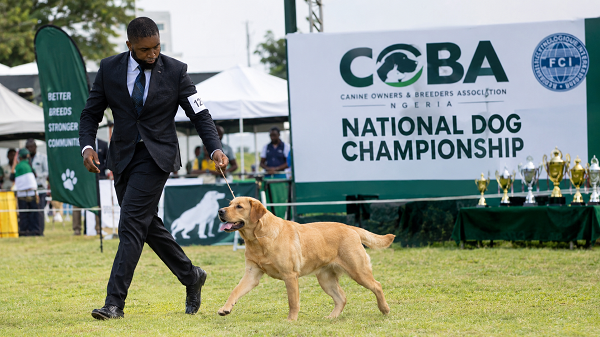
To enter the COBA National Dog Championship, you first register as a member with the Canine Owners & Breeders Association (COBA), Nigeria’s FCI-affiliated national kennel club, then register your dog in the COBA Studbook with a valid pedigree, health certificate, and microchip. Once your dog’s registration is verified, you submit the show entry form and fee before the published deadline, historically around N20,000 per dog, closing roughly three to four weeks before show day.
If you’ve ever watched a conformation show and thought, “I want that trophy on my mantle,” this guide walks you through exactly how to get there, from your very first COBA membership form to standing in the ring on championship day.
Table of Contents
- What Is the COBA National Dog Championship?
- Why This Show Matters More Than It Used To
- Who Can Enter: Eligibility Requirements
- Step 1: Become a COBA Member
- Step 2: Register Your Dog in the COBA Studbook
- Step 3: Complete Health, DNA, and Microchip Requirements
- Step 4: Submit Your Show Entry and Pay the Fee
- Entry Fees, Deadlines, and Timing
- What Happens on Show Day
- Preparing Your Dog to Actually Compete Well
- Can International and Diaspora Owners Enter?
- Common Mistakes First-Time Exhibitors Make
- Trainer’s Take
- FAQs
- Conclusion
What Is the COBA National Dog Championship?
The Canine Owners & Breeders Association (COBA) is Nigeria’s national kennel club, founded in 2019 and recognized internationally as the country’s official registry for purebred and non-purebred dogs. It’s a Contract Partner Member of the Fédération Cynologique Internationale (FCI), the same global umbrella body that recognizes over 80 national kennel clubs and 350+ breed standards worldwide, including partner organizations across Africa such as Egypt, South Africa, Morocco, Tunisia, Madagascar, and Ghana.
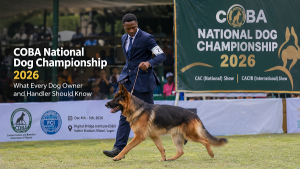
The COBA National Dog Championship (CNDC) is the association’s flagship annual event, a full conformation show where registered dogs are judged against their breed standard, not against each other directly. Think of it as Nigeria’s answer to the AKC National Championship in the US or Crufts in the UK, just younger and growing fast. The most recent edition drew breeders and handlers from Nigeria, Ghana, and Togo, and it was the first CNDC held after COBA secured its FCI accreditation, a milestone that means titles won at the show now carry international recognition, not just local bragging rights.
That last point matters more than most first-time exhibitors realize. Before FCI recognition, a “Nigerian Champion” title stayed within Nigeria. Now, championship points and titles earned at COBA-licensed shows can, in principle, be referenced against FCI’s international framework, which is exactly why the entry list has been growing year over year.
Why This Show Matters More Than It Used To
I’ve sat ringside at enough shows to know most people underestimate what a national championship actually does for a breeding program. It’s not just a ribbon. A dog that finishes well at CNDC:
- Adds documented, judge-verified proof of conformation quality to its pedigree record
- Becomes more marketable as a stud or dam, since serious breeders check show results before approaching a kennel
- Builds the exhibitor’s reputation within COBA’s breeder network, which matters when you’re trying to import or export breeding stock
- Gives working-dog and security-dog kennels a credibility marker that pure obedience titles don’t provide on their own
For handlers coming from a working-dog or K9 background rather than the conformation-show world, this is the one place where structure, temperament, and breed type get evaluated by an outside, licensed judge, not just by how well your dog performs on command.
Who Can Enter: Eligibility Requirements
COBA splits its registry into sections, and which section your dog sits in determines whether it can enter the Main Show ring or only the Assessment class. Based on COBA’s published studbook rules and recent show entry terms, here’s what you need to know before you fill out any form:
- Pedigree status: Only dogs holding a COBA pedigree or a recognized Export Pedigree Certificate from another FCI-affiliated club (AKC, The Kennel Club UK, CKC, etc.) are eligible for the Main Show ring. Non-pedigree dogs can attend Assessment only.
- PET Register and Disqualified Register dogs: Dogs recorded in COBA’s PET Register or Disqualified Register are barred from the show ring entirely, regardless of how they look on the day.
- Health documentation: Every dog must present a current clean bill of health from a licensed veterinarian, be free of external parasites, and be up to date on vaccinations.
- Microchipping: Dogs without a microchip are typically chipped on-site at no extra cost, but arriving already chipped speeds up check-in considerably.
- Females in season: A female dog in heat can usually still attend the Assessment class but is excluded from the Main Show that day, plan your entry timing around her cycle if you’re cutting it close.
- Age and physical faults: As with most FCI-style shows, dogs must meet a minimum age (commonly six months and up) and should not carry disqualifying faults as defined by their breed’s official standard.
If any of this sounds unfamiliar, it’s worth reading it twice, the single biggest reason first-timers get turned away at check-in isn’t a bad dog, it’s incomplete paperwork.
Step 1: Become a COBA Member
You can’t enter a dog under a club you haven’t joined. Head to COBA’s official registration portal and create an account with your personal details, name, contact address, and email. Membership is what gives you access to the Studbook system (COBA calls it the VCMS Portal), where all of your dog’s records, titles, and health tests live for the rest of its life.
If your dog was bred by someone else, confirm with the breeder that both the sire’s and dam’s owners are COBA-registered members with DNA profiles on file, puppies can only be birth-registered when that’s true.
Step 2: Register Your Dog in the COBA Studbook
Once you’re a member, your dog needs its own Studbook entry. Where it lands depends on its background:
- Studbook Proper Register (SP): For a Nigerian-bred dog from two verifiable imported parents, an imported dog with a verifiable pedigree or Export Pedigree Certificate, or an offspring of qualifying appendix crosses.
- Premium Stud Register (SR): The elite tier, reserved for dogs meeting stricter health and fertility screening, this isn’t required to simply enter a show, but it’s worth knowing about if you’re planning a serious breeding program alongside showing.
- FCI Studbook Proper Register (FCI-SP): For dogs that meet SP requirements and descend from parents holding export pedigrees from FCI-recognized clubs or clubs with FCI bilateral agreements.
Litters must be recorded within 60 days of birth to avoid a steep late-registration fee, so if you’re planning to show a puppy from your own litter next season, get the birth notification filed early rather than scrambling later.
Step 3: Complete Health, DNA, and Microchip Requirements
This is the step people most often underestimate. Depending on which studbook section your dog falls into, you may need:
- A veterinary health certificate dated close to the show
- Confirmation of vaccination status
- DNA profiling for parentage verification (compulsory for dogs entering some sections of the National Registry, and advised for others)
- Microchip registration linked to your dog’s Studbook record
Budget time and a little extra cost, for this stage. DNA testing and vet certification aren’t always same-week turnarounds, especially outside Lagos and Abuja, so start this at least a month before the show’s entry deadline.
Step 4: Submit Your Show Entry and Pay the Fee
Once your dog’s paperwork is in order, watch COBA’s official events page for the current year’s CNDC entry form. You’ll typically need to:
- Fill out the show entry form with your dog’s registered name, breed, and Studbook number
- Pay the entry fee per dog before the published closing date
- Confirm your dog’s vaccination and health status one more time at submission
- Save your entry confirmation, you’ll need it, along with your dog’s original documents, at on-site check-in
Entry Fees, Deadlines, and Timing
Pricing shifts a little year to year, but recent COBA all-breed shows have charged around N20,000 per dog, with entries closing roughly three to four weeks before the event, for example, a December show with entries closing December 1st. That fee typically does not include DNA profiling costs, so factor that in separately if your dog’s Studbook section requires it.
CNDC has historically been held toward the end of the year (the association’s fifth edition, and its first as an FCI-recognized show, took place in December). Because exact dates move, the safest approach is to check COBA’s events calendar directly a few months out rather than assuming last year’s schedule repeats exactly and to register the moment the form goes live, since spots and judging slots by breed group can fill.
What Happens on Show Day
Show day runs in two tracks: Assessment and Main Show.
- Assessment is open to a broader range of dogs, including non-pedigree entries and females in season. Judges evaluate structure and temperament, but results here don’t carry championship weight the way Main Show placements do.
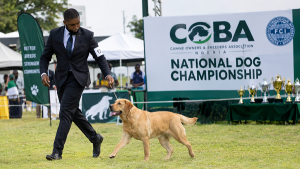
- Main Show is where pedigree-verified dogs are judged breed by breed against the official FCI breed standard, not against each other’s breed. A judge is looking for how closely each dog matches the ideal specimen of its own breed: proportion, movement, coat, temperament, and structural soundness.
From there, breed winners typically progress into group judging, and group winners compete for Best in Show, the title that made headlines when the 2025 event’s top prize went to a dog from a Lagos-based kennel, with international delegates from Ghana and Togo in attendance. Expect a full day: morning check-in and veterinary inspection, breed judging through midday, groups in the afternoon, and awards, often with a dinner and presentation ceremony, closing things out.
Preparing Your Dog to Actually Compete Well
Paperwork gets you in the ring. Preparation is what gets you placed. A few things I tell first-time exhibitors, working-dog handlers especially, since your dog’s day-to-day training doesn’t automatically transfer to a conformation ring:
- Practice the stand-and-stack. A judge needs to see your dog stand still in a natural, breed-correct pose while being physically examined, hands on the bite, the coat, the structure. If your dog has never been handled by a stranger this way, start weeks in advance.
- Work on ring gaiting, not just loose-leash walking. Judges assess movement at a trot, in a straight line and a triangle pattern, so practice a controlled trot on lead well before show day.
- Grooming is part of the score, not separate from it. Coat condition, cleanliness, and presentation all factor into a judge’s overall impression. If you’re not confident on breed-specific grooming standards, our grooming guide for healthy, show-ready coats covers the basics that carry over directly into ring presentation.
- Bring the right kit. A properly fitted show lead and collar (not a training or tactical harness) is expected in the conformation ring, if your dog’s usual gear is built for security or patrol work, our K9 training equipment guide has background on the difference between working gear and what’s appropriate for show handling.
- Desensitize to crowds and noise early. Conformation shows are loud, crowded, and full of unfamiliar dogs. If your dog is used to disciplined public demonstrations, the kind we cover in our recap of handling a military working dog at a public event, that composure under pressure translates well, but it still needs to be built specifically around a show ring environment.
If your background is working-dog obedience rather than the show ring, and you want a structured way to bridge handler discipline with the calm, controlled presentation a judge expects, our e-book, Beyond the Bark, walks through the handling fundamentals that carry over from operational work into competitive settings.
Can International and Diaspora Owners Enter?
Yes, and this is where COBA’s FCI accreditation matters most. Because COBA now holds Contract Partner Member status with the FCI, dogs imported into Nigeria with a verifiable Export Pedigree Certificate from another FCI-recognized club, the American Kennel Club, The Kennel Club (UK), the Canadian Kennel Club, or clubs with FCI bilateral agreements, can qualify for the FCI Studbook Proper Register and compete in the Main Show, provided all other health and documentation requirements are met.
In practice, this means a diaspora Nigerian breeder relocating a dog from the US or UK, or an international breeder partnering with a Nigerian kennel, isn’t shut out. You’ll still need to complete COBA membership, Studbook registration, and the same health and microchip steps as a locally bred dog, the import paperwork is an additional layer, not a replacement for the standard process.
Common Mistakes First-Time Exhibitors Make
- Registering the dog but not the owner. COBA membership and Studbook registration are two separate steps, some new exhibitors register a puppy’s litter without ever completing their own membership account, then can’t submit a show entry.
- Missing the 60-day birth registration window. The late fee jumps substantially after 60 days, and a late-registered puppy can also miss the current year’s show entry deadline entirely.
- Assuming any pedigree counts. Only export pedigrees from FCI-recognized clubs, or clubs with bilateral FCI agreements, qualify a dog for the international registry tiers, a pedigree from an unrecognized registry won’t clear Main Show eligibility.
- Skipping the DNA test until the last minute. Turnaround times vary, and a rushed DNA profile can cost you your entry deadline.
- Bringing a female close to her season without a plan. If she comes into heat right before the show, she’s limited to Assessment only, know her cycle and time your entry accordingly.
- Under-preparing for ring handling. A structurally excellent dog that won’t stand for examination or gait cleanly on lead will lose to a merely good dog that’s been properly trained for the ring.
Trainer’s Take
I’m Rofiat Muritala, a veteran military K9 handler and certified trainer with over 14 years of hands-on experience across obedience, protection, and working-dog programs, including public demonstration work at events like the Nigerian Army Day Celebration. Conformation showing operates by different rules than operational K9 work, but the underlying principle is identical: a dog that’s been prepared with patience, consistency, and the right foundational handling skills performs better under any kind of scrutiny, whether that’s a judge’s hands-on exam or a live security demonstration. This guide reflects both COBA’s published entry requirements and what I’ve seen work, and trip people up, in getting dogs ring-ready.
FAQs
1. What is the COBA National Dog Championship?
It’s the flagship annual conformation show run by the Canine Owners & Breeders Association, Nigeria’s FCI-affiliated national kennel club, where registered dogs are judged against their official breed standard.
2. Who can enter the COBA National Dog Championship?
COBA members with a dog holding a valid COBA pedigree or an accepted Export Pedigree Certificate from an FCI-recognized club can enter the Main Show. Non-pedigree dogs may only attend Assessment.
3. How much does it cost to enter?
Recent COBA all-breed shows have charged around N20,000 per dog, not including any required DNA profiling costs. Fees can change year to year, so confirm the current figure on COBA’s official entry form.
4. Can dogs from outside Nigeria compete?
Yes. Dogs imported with a verifiable Export Pedigree Certificate from an FCI-recognized club can qualify for COBA’s International Registry, provided the owner completes standard COBA membership and Studbook registration.
5. Is COBA registration required before entering a show?
Yes. You must register as a COBA member and register your dog in the Studbook before you can submit a show entry, there’s no way to enter a show with an unregistered dog.
Conclusion
Entering the COBA National Dog Championship isn’t complicated once you see the sequence clearly: join COBA, register your dog in the right Studbook section, complete health and DNA requirements, then submit your entry and fee before the deadline. The paperwork is the part most people rush or skip, and it’s the part that actually decides whether you get past check-in.
If you’re serious about competing, start the Studbook registration and health documentation process at least six to eight weeks before you expect the entry form to open, not after. Practice ring handling separately from your dog’s regular training, because a show ring rewards a different kind of composure than obedience work does. And if you want to go deeper on the handling side, subscribe to our weekly newsletter for more K9 training breakdowns like this one.

Her work centres on obedience, detection, protection and operational readiness. She favours proven methods built on repetition, consistency and real-world conditioning, so that both dogs and handlers are prepared for high-pressure tasks.
Rofiat represented the Nigerian Army Dog Centre at the Nigerian Army Day Celebration (NADCEL) 2026, where she led demonstrations in obedience, explosive detection, agility and tactical movement. Through articles, training content and documentaries, she shares field-based insight into how structured training, clear communication and trust between handler and dog affect performance and reliability.
She is the author of Beyond the Bark: Inside a Pro Handler's Playbook for Raising the Ideal Dog, a practical guide that helps dog owners and handlers apply professional training principles in everyday situations.
- How to Enter the COBA National Dog Championship - October 20, 2026
- K9 Advantix Dosage Chart & Safety Guide for Dogs - October 19, 2026
- How to Set Up & Use Bousnic Dog Training Collar - October 18, 2026