Therapy Dog Training: Full Requirements (2026 Guide)
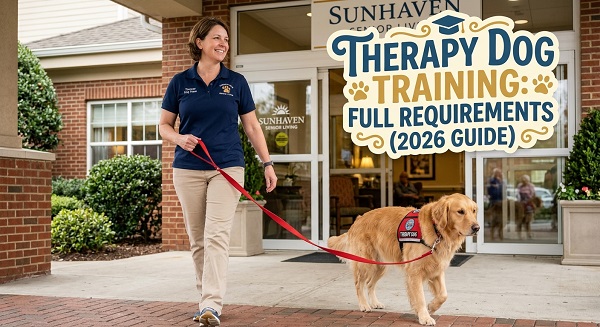
To become a therapy dog, your dog must usually be at least one year old, healthy, fully vaccinated, and calm and friendly with strangers. You also need solid obedience skills, a handler course (for some groups), and a passed evaluation with a registry such as Pet Partners, Alliance of Therapy Dogs, Therapy Dogs International or Pets As Therapy in the UK. Most teams need about 3 to 6 months of preparation, and many registries add supervised visits before you get final approval.
Table of Contents
- Introduction
- What Is a Therapy Dog (and What Isn’t)?
- The Core Requirements Every Therapy Dog Must Meet
- The Therapy Dog Skills Checklist
- Therapy Dog Organizations Compared
- How to Get Certified: Step by Step
- Training Timeline and Real Costs
- Why Dogs Fail the Evaluation (and How to Fix It)
- Protecting Your Therapy Dog’s Welfare
- Handler’s Notes: What I Tell Every New Team
- FAQs
- Final Thoughts and Your Next Steps
Introduction
You’ve got a friendly dog. Strangers love him. So he’s ready for therapy work, right?
Not so fast. I’ve seen sweet, social dogs freeze up the first time a wheelchair rolled past or a metal tray crashed on a hospital floor. Being friendly is the starting line. It isn’t the finish.
The tricky part is that therapy dog training requirements change depending on who certifies you, where you live and where you want to volunteer. One website says six weeks. Another says six months. A third says no certification is needed at all. They can all be partly right, and that confuses people.
In this guide, you’ll get the full picture in one place. You’ll learn the age, health and temperament rules, the exact skills evaluators test, how the big registries compare, what it costs, how long it takes, and why dogs fail. You’ll also learn something most guides skip: how to protect your dog’s mental health once visits begin.
Whether you’re a casual dog owner or a working handler adding a new skill, you can follow along.
What Is a Therapy Dog (and What Isn’t)?
A therapy dog is a pet that volunteers with its handler to give comfort and affection to other people. Think hospitals, nursing homes, schools, libraries, airports and disaster sites. The dog works for many people, not just one owner.
That’s a very different job from a service dog. So let’s clear up the three terms people mix up most.
Therapy Dog vs. Service Dog vs. Emotional Support Animal
| Therapy Dog | Service Dog | Emotional Support Animal | |
|---|---|---|---|
| Main job | Comfort many people during visits | Perform specific tasks for one disabled person | Comfort one owner through presence |
| Training needed | Obedience plus therapy-specific manners; evaluation by a registry | Years of task training | No formal training required |
| Public access rights | None. Only where invited | Broad legal access in many countries | Limited, varies by law |
| Who owns the relationship | Volunteer handler and facility | The disabled handler | The owner |
The big takeaway: a therapy dog badge doesn’t open shop doors, restaurants or hotels. One hospital program in Los Angeles states plainly that service animal laws and protections don’t apply to therapy dogs. Alliance of Therapy Dogs says the same about hotels and campgrounds, which treat therapy dogs as pets.
If you want the legal access that comes with assistance work, you’re looking at a different path entirely. This guide covers therapy work only.
Is Certification Always Required?
It depends on where you live. In the UK, there’s no official government register or legal certification for therapy dogs. But in practice, most care homes and hospitals only accept dogs registered with a charity like Pets As Therapy, because those groups handle assessment and insurance.
In the US, there’s no federal law requiring a therapy dog certificate either. Your family dog can cuddle your grandmother without paperwork. But if you want to visit a hospital or school program, nearly every facility will ask for registration with a recognized group, plus liability insurance. So for facility visits, treat certification as required.
The Core Requirements Every Therapy Dog Must Meet
Registries differ in the details, but the same five building blocks show up almost everywhere.
Minimum Age and Time Together
Most groups want the dog to be at least 12 months old. You can start training a puppy earlier, but you can’t test until the dog is an adult. Here’s the pattern across the big names:
- Alliance of Therapy Dogs (ATD): dog at least 1 year old, and the handler has known the dog for at least 6 months.
- Pet Partners: dog at least 1 year old, and in your home at least 6 months.
- Pets As Therapy (UK): dog at least 12 months old, and owned for at least 9 months.
Why the waiting period? Evaluators want to see a settled bond. A dog you adopted last week is still adjusting to you, so his behavior isn’t reliable yet.
Temperament: The Part You Can’t Fake
This is the biggest requirement, and it’s the one training can only improve, not create. A good therapy dog is calm, patient, confident and genuinely enjoys human contact. Pet Partners puts it simply: temperament matters more than breed, size or age. Dogs can be energetic and full of personality, as long as they stay well-mannered and under the handler’s control.
Here’s my quick home check. Your dog should:
- Stay relaxed when a stranger pets him, even clumsily
- Tolerate hugging, hand-patting and awkward touches without stiffening
- Recover quickly after a sudden noise
- Show no history of aggression toward people or dogs
- Take food gently and ignore dropped food on command
If your dog tolerates people but doesn’t truly enjoy them, think twice. Therapy visits can last close to an hour. Enjoyment is what keeps a dog stable that long.
Health and Vaccination Rules
Facilities protect vulnerable patients, so health rules are strict. Expect to provide:
- A vet health check, signed by your veterinarian
- Up-to-date vaccinations, including rabies where the law requires it
- Proof the dog is free of internal and external parasites (some groups ask for a negative fecal test)
- A clean, groomed coat and trimmed nails on visit days
Two rules surprise people. First, Pet Partners and Pets As Therapy do not allow dogs fed a raw protein diet, because of infection risk around frail patients. Second, vaccine titers may not replace vaccinations with some groups. Read your registry’s current rules before you change your dog’s food or vaccine plan.
Handler Requirements
Most guides focus on the dog and forget the human half of the team. Evaluators watch you closely too. Pet Partners is the strongest example: it requires a handler course (online or in person) before the evaluation, and it’s known for training the human end of the leash, not just testing the dog.
Typical handler rules include:
- Being at least 18 (UK PAT requires this; some US groups allow younger handlers with an adult)
- A background check (ATD requires one)
- Learning to read your dog’s stress signals
- Knowing the facility’s rules and infection-control steps
- Keeping your attention on your dog during every visit. Handlers must not hand their dog’s leash to patients or staff.
Insurance and Registration
Registration with a recognized group usually includes liability insurance for volunteer visits. That’s often the real reason facilities insist on it. Without registration, most places won’t let you in the door.
The Therapy Dog Skills Checklist
Here’s where training comes in. I split skills into three groups so you know what’s tested and what simply makes visits easier.
Foundation Obedience (Tested by Almost Everyone)
The Canine Good Citizen (CGC) test from the American Kennel Club is the unofficial base layer for therapy work. Many trainers recommend passing it before starting therapy-specific training, and Therapy Dogs International builds its own test directly on the CGC’s 15-step format. Core skills include:
- Accepting a friendly stranger
- Sitting politely for petting
- Walking on a loose leash
- Walking through a crowd
- Sit, down and stay on command
- Coming when called
- Polite behavior around other dogs
- Staying calm through distractions
- Calm separation from the handler for a short time
If your obedience needs work, start there. Our guide on how to balance drive and control in your dog explains why a dog that listens under pressure behaves so differently from a dog that only listens in the living room.
And if you want a full step-by-step foundation program, my e-book Beyond the Bark covers the obedience building blocks I use with working dogs: get your copy here.
Therapy-Specific Skills (Where Most Dogs Slip)
These skills aren’t in a basic obedience class, but evaluators test them:
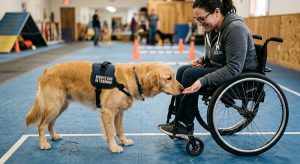
- Reaction to medical equipment. The dog stays calm around wheelchairs, walkers, canes, crutches and rolling carts. TDI’s test lists this as its own step.
- Leave it. The dog ignores dropped pills, food and trash on the floor. This one is a safety skill, not a trick.
- Acclimation to infirmities. The dog stays confident around people who move unevenly, shout, shake or look different.
- Say hello. The dog greets people politely, with four paws on the floor.
- Reaction to children. The dog stays gentle when kids approach quickly or loudly.
- Supervised separation. The dog accepts a stranger holding the leash while you step out of sight for a few minutes.
- Handling skills. The dog accepts ears, face, paws and tail being touched. Pets As Therapy evaluators test this directly.
Nice-to-Have Skills (Not Required, but Helpful)
These make visits smoother and keep your dog safe:
- Place or mat. A dog who settles on a mat beside a bed is easier to manage in tight rooms.
- Gentle take. Treats get taken softly from patients, if the facility allows treats at all.
- Chin rest or paws up (only if the facility says it’s okay).
- Simple tricks. A shake or a bow gives patients something to smile about. If you’d like ideas, try the beginner-friendly routines in our guide to 10 K9-approved tricks to teach your dog.
Therapy Dog Organizations Compared
Choosing the right registry saves you months. Here’s how the main players stack up on the points that matter. (Fees and rules change, so confirm them on each group’s website before you apply.)
| Pet Partners | Alliance of Therapy Dogs (ATD) | Therapy Dogs International (TDI) | Pets As Therapy (UK) | |
|---|---|---|---|---|
| Min. dog age | 1 year | 1 year | 1 year | 12 months |
| Time with owner | 6 months | 6 months | Varies by chapter | 9 months |
| Handler training | Required course | Not a formal course; background check required | Varies | Application, two references |
| Evaluation | Team skills and aptitude test in a simulated visit | Handling-skills test by a local tester | CGC-based test with extra therapy items | Temperament assessment, roughly 45 minutes |
| Observed visits | Not required to register | 3 supervised visits | Check your chapter | Confirmed by assessor and local coordinator |
| Renewal | Re-evaluate every 2 years | Yearly renewal | Check your chapter | Ongoing with annual review |
| Other species | Yes, several | Dogs only | Dogs mainly | Dogs and cats |
Which One Should You Choose?
Here’s how I’d decide:
- Pick Pet Partners if you want to volunteer at a big hospital system. Many hospitals require it, and its team-based testing is strict. Children’s Hospital Los Angeles, for example, requires all its therapy teams to be registered with Pet Partners.
- Pick ATD if you want a lower-cost, flexible route with local testers, and you don’t mind the three observed visits.
- Pick TDI if you like the CGC-style structure and want a widely recognized name in schools and care homes.
- Pick Pets As Therapy if you live in the UK.
Always ask your target facility first. They’ll tell you which registry they accept. I’ve watched handlers pay for certification with one group, then learn their local hospital only works with another. A single phone call prevents that.
What About AKC Therapy Dog Titles?
The AKC doesn’t certify therapy dogs. It recognizes the work after you’re certified by another group. To earn a title, you need to be registered with an AKC-recognized therapy organization and log visits. The ladder runs from Therapy Dog Novice (10 visits) and Therapy Dog (50 visits) up through Advanced (100), Excellent (200), Distinguished (400) and Supreme (600). Mixed breeds qualify too, through the AKC’s Canine Partners enrollment.
Titles are a fun way to track your progress, but they’re optional.
If Your Country Has No Formal Registry
This is a gap most competitor articles ignore. If you live somewhere without a national therapy dog charity, you still have options:
- Ask local hospitals, schools and care homes if they run their own visiting-dog screening.
- Work with a professional trainer who can run a CGC-style evaluation and give you a written report.
- Create a visit log, vet records and a handler reference letter. Facilities often accept a documented, vet-cleared, trainer-assessed team.
- Consider joining an international registry if it accepts overseas members.
Even without a formal body, follow the strictest standard in this guide. It protects your dog and the people you visit.
How to Get Certified: Step by Step
Here’s the path most teams follow.
- Check your dog’s fit. Run the home temperament check above. Be honest.
- Confirm the registry. Ask your target facility which group it accepts.
- Book a vet exam. Get vaccines, parasite checks and the health form signed.
- Train foundation obedience. Work toward CGC-level skills.
- Add therapy-specific skills. Medical equipment, leave it, handling, separation.
- Complete the handler course. Required for Pet Partners; useful for everyone.
- Pass the evaluation. Practice in the style of the test, not just the skills.
- Do observed or probationary visits. ATD needs three supervised visits before your paperwork goes in.
- Register, pay and get insured. Keep your ID, vest and records current.
- Start visiting, and renew on time. Pet Partners re-tests every two years, and ATD renews yearly.
Training Timeline and Real Costs
This is where I give you numbers you won’t find in most guides.
How Long Does Therapy Dog Training Take?
For a dog that already has good manners, expect about 3 to 6 months from start to registration. A typical therapy prep class runs about 6 weeks, while some programs run 5 to 11 weeks across two class levels. Add time for your vet exam, paperwork and any observed visits.
Here’s a realistic 12-week plan for an adult dog with basic obedience already in place:
| Weeks | Focus | Goal |
|---|---|---|
| 1-2 | Calm greetings, sit for petting, loose leash | Dog stays four paws down with strangers |
| 3-4 | Leave it, drop it, settle on a mat | Ignores dropped food and settles for 5+ minutes |
| 5-6 | Medical equipment exposure | Walks past wheelchairs, walkers and carts without reacting |
| 7-8 | Handling and clumsy petting | Accepts ears, paws and tail touches calmly |
| 9-10 | Crowds, children, new places | Stays relaxed in a busy cafe or park |
| 11-12 | Mock evaluation | Runs the full test with a friend acting as evaluator |
The puppy path is longer. You can socialize early, but registration must wait until your dog reaches the minimum age.
What Does It Cost?
Costs vary by country and group, so treat these as ballpark figures:
- Registry fees: ATD has listed a first-year cost of roughly $45 to $65 with yearly renewal around $30 to $35. Pet Partners has historically charged a registration fee covering two years, plus a separate handler course fee.
- Training classes: local therapy prep classes often run into the low hundreds of dollars.
- Vet exam and tests: varies widely by clinic.
- Gear: vest or bandana, ID, a flat collar and a 6-foot leash.
My rough all-in budget for the first year is a few hundred dollars for most teams. That’s my estimate, not a registry price, so check before you plan around it. The good news is that the work is volunteer-based, and your visits are free.
Don’t forget the bigger cost: time. Children’s Hospital Los Angeles, for instance, asks teams to commit to about two visits a month, or roughly 24 a year.
Why Dogs Fail the Evaluation (and How to Fix It)
Dogs rarely fail because they’re bad dogs. They fail because the training didn’t match the test. Here are the issues I see most, and what to do.
| Problem | What it looks like | Fix |
|---|---|---|
| Jumping up | Paws on a stranger during greeting | Reward four paws on the floor; have helpers ignore jumping |
| Pulling | Drags handler toward people | Practice walks in low-distraction spots, then build up |
| Noise sensitivity | Startles or hides at a dropped tray | Pair soft noises with treats; slowly increase volume |
| Grabbing food | Snatches dropped treats | Daily leave-it practice with higher-value items |
| Overexcitement | Whining, spinning, frantic tail | Teach a calm mat; do not greet until calm |
| Handler nerves | Tight leash, rushed commands | Practice mock tests; breathe and slow down |
Here’s something I tell every handler: your nerves travel down the leash. A calm handler makes a calm dog. If you’re anxious, rehearse the test with a friend until it feels boring.
One more point. Running your dog’s energy at the right level matters. A tired dog isn’t always a calm dog, and an over-exercised dog can be wired and cranky. Our guide on how often to exercise a working dog helps you find that sweet spot before visit days.
Protecting Your Therapy Dog’s Welfare
Most guides stop at certification. But the real test starts after you pass. A therapy dog works in places full of strange smells, sounds and emotions. Your job is to make sure the work is good for the dog, not just for the patients.
What the Research Says About Stress
The news is mostly reassuring, with a catch.
- A pilot study from Mayo Clinic’s Caring Canine Program followed nine therapy dog teams during their first three hospital visits. Visits averaged about 47 minutes and about nine people. Researchers found no significant difference in stress hormone (cortisol) before and after visits. But handlers who judged their dogs as highly stressed were usually right, because those dogs had higher cortisol afterward.
- A separate study by American Humane, funded by the Human Animal Bond Research Institute, found dogs did not show increased stress during sessions with pediatric cancer patients. Researchers analyzed nearly 600 saliva samples.
The lesson? Dogs can do this work well, but handler awareness is the safety net. The studies show your reading of your dog’s body language matters.
Stress Signals to Watch
Stop the visit if you see:
- Repeated lip licking or yawning
- Turning the head away or avoiding eye contact
- Panting without heat or exercise
- Whale eye (the white of the eye showing)
- A stiff body, tucked tail or lowered posture
- Shaking off when nobody is wet
- Refusing treats the dog normally loves
Pets As Therapy tells volunteers to stop a visit if there are concerns about the dog’s or a person’s behavior or wellbeing. Follow that rule even if you don’t register with them.
Visit Length, Frequency and Retirement
Follow these simple welfare rules:
- Keep early visits short. Aim for 30 to 45 minutes while your dog adjusts.
- Build up slowly. Don’t jump from one easy visit to a long, busy ward.
- Give recovery time. Plan quiet days after big visits.
- Watch for changes with age. As dogs get older, their energy and tolerance shift, and some therapy groups note this directly.
- Retire your dog the moment he stops enjoying it. A dog who dreads the vest is telling you something.
This is the part I care about most. A therapy dog should love the job. If he doesn’t, it’s not fair to him, no matter how many people he helps.
Handler’s Notes: What I Tell Every New Team
In my years working with dogs under pressure, one pattern holds: the dogs that last are the ones whose handlers pay attention. Here’s my short list for new therapy teams.
- Practice in boring places first. Garden centers, pet-friendly shops and quiet park benches build calm habits before the real thing.
- Train your leash handling. Many hospital hallways are narrow. A short, loose leash keeps your dog out of trouble. Choose a flat collar or a well-fitted harness that gives control without discomfort.
- Be the dog’s advocate. If a patient grabs too hard or a room is too loud, step out. You can always come back.
- Keep records. Vet papers, visit logs and renewal dates should live in one folder.
- Never push a reluctant dog. If your dog resists, take it as information, not defiance.
I’d also suggest finding a mentor team near you. Handlers who’ve done this for years can spot problems you’d miss.
FAQs
1. Can any dog be a therapy dog?
Almost any breed or mix can qualify. ATD accepts all breeds and mixes that pass its test, and Pet Partners focuses on temperament, not breed or size. But not every dog suits the job. The dog must be an adult, healthy, social and calm around strangers.
2. How long does it take to train a therapy dog?
Most dogs with good basic manners need about 3 to 6 months. Therapy prep classes often run about 6 weeks, and some programs run 5 to 11 weeks. Puppies must wait until they reach the minimum age, usually 12 months, before testing.
3. How much does therapy dog certification cost?
It depends on the group. ATD has listed first-year costs of roughly $45 to $65, with yearly renewal around $30 to $35. Pet Partners adds a handler course fee and a registration fee covering two years. Add vet visits, classes and gear. Always check current prices on each group’s site.
4. Do therapy dogs need to pass the Canine Good Citizen test?
Not always. But many trainers use CGC as the starting point, and Therapy Dogs International builds its test on the CGC format. Some registries accept other proof of good manners. Passing CGC first makes the therapy test much easier.
5. Can a therapy dog go anywhere with me?
No. Therapy dogs have no special public access rights. They can enter places that allow dogs or places that invite therapy teams, like hospitals, schools and libraries with visiting programs. Stores, hotels and restaurants can follow their normal pet rules.
Final Thoughts and Your Next Steps
Becoming a therapy dog team takes more than a friendly dog. You need an adult dog with a steady temperament, a clean bill of health, solid obedience, therapy-specific skills and a handler who can read stress early. Pick your registry based on where you want to volunteer, and ask the facility first.
Here’s your quick action plan:
- Test your dog’s temperament honestly this week.
- Call your target facility and ask which registry it accepts.
- Book the vet exam and confirm vaccine and diet rules.
- Follow the 12-week plan above, and mock-test before the real evaluation.
- Start with short visits and watch for stress signals.
Done well, this work changes lives, including your own.
Want more training guides like this? Subscribe to our weekly articles roundup newsletter and get new K9 tips in your inbox: https://arfsk9team.com.ng/newsletter/
Building your dog’s obedience foundation? Grab Beyond the Bark.

Her work centres on obedience, detection, protection and operational readiness. She favours proven methods built on repetition, consistency and real-world conditioning, so that both dogs and handlers are prepared for high-pressure tasks.
Rofiat represented the Nigerian Army Dog Centre at the Nigerian Army Day Celebration (NADCEL) 2026, where she led demonstrations in obedience, explosive detection, agility and tactical movement. Through articles, training content and documentaries, she shares field-based insight into how structured training, clear communication and trust between handler and dog affect performance and reliability.
She is the author of Beyond the Bark: Inside a Pro Handler's Playbook for Raising the Ideal Dog, a practical guide that helps dog owners and handlers apply professional training principles in everyday situations.
- Food Aggression Dog Training: Pro K9 Guide - November 21, 2026
- DIY Dog Scent Training: Easy 4-Week Home Guide - November 20, 2026
- Buckeye Puppies Review: 5 Red Flags to Check - November 19, 2026