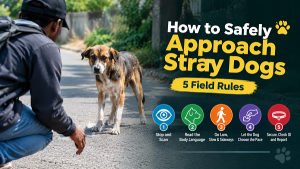
How to Safely Approach Stray Dogs: 5 Field Rules
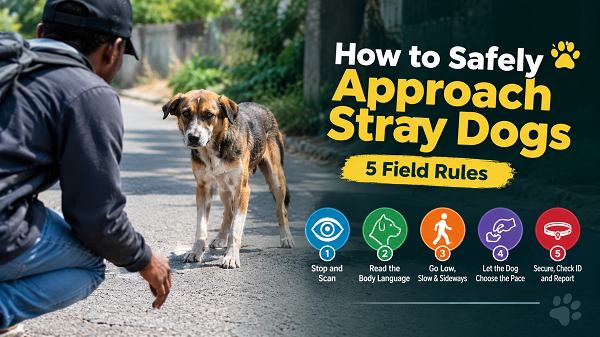
To safely approach a stray dog, scan the area and read the dog’s body language first. If it looks calm, move slowly and sideways, stay low, avoid direct eye contact and let the dog come to you. Never chase, corner or grab a stray. Walk away if you see stiff posture, bared teeth, growling, guarding behavior or more than one dog. Once the dog is relaxed, secure it with a slip lead, check for ID and call animal control or a vet. Treat any bite as a possible rabies exposure.
Table of Contents
- Why Approaching a Stray Dog Is Riskier Than It Looks
- Rule 1: Stop and Scan Before You Move
- Rule 2: Read the Dog’s Body Language (Go or No-Go)
- Rule 3: Go Low, Slow and Sideways
- Rule 4: Let the Dog Choose the Pace
- Rule 5: Secure, Check ID and Report
- When to Walk Away: Packs, Guarding and Chases
- What to Do If a Stray Dog Bites You
- Handler’s Field Notes (Experience and Expertise)
- 5 FAQs About Approaching Stray Dogs
- The Bottom Line
Introduction
You’re walking home and see a skinny dog by the roadside. He’s looking at you. Your heart says help him. Your gut says be careful. Both are right.
Most people get this moment wrong in one of two ways. Some rush in with a hand out and get bitten. Others freeze, panic or run, and a calm dog turns into a chasing dog. I’ve seen both.
This guide gives you five simple field rules to follow before you ever touch a stray. You’ll learn how to read stray dog body language, how to move so you don’t scare the dog, what to do with food, how to secure a dog safely and how to handle the scary scenarios, like packs and bites. Casual dog owners and professional handlers can use every step.
Why Approaching a Stray Dog Is Riskier Than It Looks
A stray has no history you can check. You don’t know if he’s vaccinated, hurt, scared, guarding something or just lost. That’s why handlers treat every unknown dog as unpredictable until the dog proves otherwise.
Here are the numbers that matter:
- Bites are common. The CDC estimates about 4.5 million dog bites happen in the US each year, and roughly one in five bites needs medical attention. Most of those bites come from familiar dogs at home. With a stray, though, you can’t predict anything, so the odds shift against you.
- Rabies is the big hidden risk. The WHO estimates rabies causes around 59,000 human deaths a year in over 150 countries, with 95% of cases in Africa and Asia. Dogs cause up to 99% of human rabies transmissions, and once symptoms start, rabies is almost always fatal.
- Children pay the highest price. The WHO reports that about half of rabies cases are in children under 15.
- Friendly doesn’t mean safe. Rabies doesn’t always look like a snarling dog. The quieter “paralytic” form makes up about 30% of human cases. A dog that looks sleepy or oddly calm can still be sick.
So is it ever okay to approach a stray? Yes, if you follow a method. That’s what the five rules give you.

Rule 1: Stop and Scan Before You Move
Take ten seconds before you take one step. A handler never walks into a scene without looking at it first, and you shouldn’t either.
Run through this quick checklist in your head:
- How many dogs are there? One dog is manageable. Two or more is a different situation (more on that below).
- Where’s your exit? Know which way you’ll step back, whether that’s a car door, a gate or a wall.
- What’s around the dog? Look for food, puppies, a bowl, a bone or a fence line. Dogs guard what they value.
- Is the dog hurt? Limping, bleeding or a hunched posture mean pain. Pain makes even gentle dogs snap.
- Is there traffic? A panicked stray can bolt into a road in a second. Think about the dog’s safety, and yours.
- Do you have a reason and a plan? Ask yourself: do I have time, a lead and somewhere to take this dog? If the answer is no, calling animal control or a local rescue is the better first move.
Your own dog changes the math. If you’ve got a dog on a leash, a stray approaching can spark a fight in seconds. A solid “Leave It” and “Watch Me” on your own dog helps a lot here, and our guide to the 10 essential protection dog commands shows you how to build both.
Handler’s rule of thumb: Your first job is to avoid becoming a second victim. If the scene feels wrong, it is wrong. Step back and call for help.
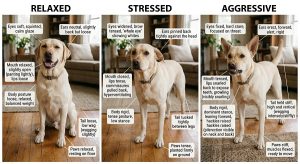
Rule 2: Read the Dog’s Body Language (Go or No-Go)
Dogs tell you what they’ll do before they do it. You just need to know the signals. Stay at least 3 to 4 meters (about 10 to 13 feet) back while you read the dog. That’s my rule of thumb, not an official standard, but it gives you room to react.
Here’s a simple traffic-light system:
| Signal | Green (Go slowly) | Yellow (Pause, give space) | Red (No-go, back away) |
|---|---|---|---|
| Body | Loose, wiggly, curved | Frozen, crouched, pacing | Stiff, leaning forward, hackles up |
| Eyes | Soft, blinking | Looking away, “whale eye” (whites showing) | Hard, unblinking stare |
| Mouth | Relaxed, open | Lip licking, yawning, tight lips | Bared teeth, snarling, growling |
| Tail | Mid-height, wide sweeping wag | Tucked low | Held high and stiff, or twitching |
| Movement | Approaches in a curve, sniffs ground | Backs away, circles | Stalks straight toward you, lunges |
A few things trip people up:
- A wagging tail isn’t always a friendly tail. A fast, stiff, high wag can mean the dog is tense and ready to bite.
- Fear drives most aggression. One dog-behavior group puts it as over 90 percent of aggressive displays being fear-based. A scared stray who feels trapped will bite to make you go away.
- Quiet isn’t safe either. A dog that doesn’t react to you at all, drools, staggers or acts strangely could be sick. Keep your distance and call the authorities.
Understanding why a stray reacts this way helps too. Fear, territory and survival instinct run the show, not training. Our article on dog obedience vs instinct explains how instinct overrides everything when a dog feels threatened.
Your decision: Green means you can continue to Rule 3. Yellow means wait and watch for a few minutes. Red means stop, step away and call animal control or a rescue group.
Rule 3: Go Low, Slow and Sideways
If the dog shows green or mild yellow signals, now you can move. How you move matters more than what you say.
Dogs read our bodies all day. A person walking straight at them, standing tall, staring and reaching out looks like a threat. So flip all four.
The Body-Language Approach, Step by Step
- Turn sideways. Angle your body about 45 degrees instead of facing the dog head-on. Head-on feels confrontational.
- Lower yourself. Crouch or squat a little. Don’t lean over the dog.
- Soften your eyes. Look at the ground or the dog’s chest, and use your peripheral vision. A hard stare reads as a challenge.
- Keep your hands low and quiet. No quick reaching, no waving.
- Use a calm, low voice. Talk gently. Loud, high-pitched noises can startle a nervous dog.
- Move in a slow curve, not a straight line. Take a few steps, then stop. Watch the dog’s response each time.
Common Mistakes That Cause Bites
- Chasing the dog. Your dog at home probably treats chasing like a game. A scared stray treats it like a hunt, and he’ll run.
- Grabbing or hugging. Never grab a dog you don’t know. Never reach over his head.
- Towering and staring. Both feel threatening.
- Running away. The CDC’s advice is to stand still like a tree, don’t run and don’t scream. Running can trigger a chase.
- Cornering the dog. An animal with no exit fights. Always leave him a way out.
Tip from the field: FOUR PAWS, a major animal welfare group, points out that the dog should come to you voluntarily, so you shouldn’t actively approach it. They also note that pretending to pick up something can scare a dog away, because many strays have been hurt by people. So don’t mimic throwing a stone, even as a joke.
Rule 4: Let the Dog Choose the Pace
This is the rule most people skip, and it’s the one that keeps you safe. You don’t approach the dog. You invite the dog to approach you.
How to Invite a Stray Dog Closer
- Stop at a safe distance and wait. Sit or crouch sideways. Give it 5 to 15 minutes if the dog isn’t in danger. Patience beats speed.
- Toss, don’t hand-feed. If you have food, toss a few pieces of plain food (like boiled chicken or dog treats) a short way toward the dog, then another bit a little closer to you. Don’t hold food out in your hand at first. A hungry, scared dog may snatch.
- Offer a hand only after the dog comes to you. Hold a loose, low hand, palm down, and let him sniff it. Don’t reach to pet the head. Scratch the chest or shoulder first.
- Watch for the “consent” signals. If he leans in, relaxes and sniffs, he’s saying yes. If he stiffens, turns his head or backs off, he’s saying no. Respect it.
Food Can Help, But Use It Wisely
Food is a powerful tool, but it comes with risks:
- Never feed several strays at once. Food starts fights, and you’ll be standing in the middle.
- Watch for food guarding. Stiffening, freezing or growling over a treat means step back.
- Don’t force it. If he won’t eat and won’t come, that tells you something. Stay calm and consider calling in help.
If the dog approaches you first: Stay still, keep your hands to yourself and let him sniff. Don’t squeal, don’t pet right away, and don’t move suddenly. Wait until his body is loose and wiggly.

Rule 5: Secure, Check ID and Report
You made it through the approach. Now what? Don’t let your guard drop. The next steps protect the dog, protect your own pets and give the dog the best shot at getting home.
Step 1: Secure the Dog Safely
A slip lead is the best tool for this, because it works without a collar and can’t be backed out of easily. If you don’t have one, a strong leash, a belt or a length of rope can do in an emergency. Slide the loop over the dog’s head slowly from the side, not over the face. Don’t grab the scruff or the collar first.
If you want to keep proper gear in your car, our guide to K9 training equipment for handlers covers the basics, including leads that give you real control.
Step 2: Check for ID
Look for a collar, tag, bandana or a tattoo. Lost pets often wear a tag, and many “strays” live close to home.
Step 3: Get the Dog Scanned for a Microchip
Take the dog to any vet or shelter. They’ll scan for free in many places, and a chip can reunite a dog with its family fast. In one study of more than 7,000 stray animals at 53 shelters, microchipped dogs went home 52.2% of the time, compared with 21.9% for dogs without chips. A Spanish national study found chipping made it three times more likely a dog got back to its owner.
Step 4: Report It
Call local animal control, a shelter or a rescue group. Give them the location where you found the dog, a description and any photos. In the US, about 710,000 stray dogs entering shelters are returned to their owners each year. In the UK, councils handled an estimated 110,000 stray dogs in 2014. Reporting puts your found dog in the system where his owner will look.
Also post a photo in local lost-and-found groups and check the area’s “lost dog” posts. Keep one detail back (such as a mark or a feature) so you can confirm the real owner.
Step 5: Protect Your Home Pets and Yourself
Keep the stray away from your own dogs until a vet checks him for parasites and disease. Strays often carry fleas, ticks and other issues. Wash your hands after handling him.
If the dog turns out to be a puppy that needs a new home, our e-book Beyond the Bark: Inside a Pro Handler’s Playbook for Raising the Ideal Dog covers puppy basics like potty training so those first weeks go smoothly.
When to Walk Away: Packs, Guarding and Chases
Some situations call for distance, not a rescue attempt. These are where many guides fall short.
More Than One Dog
Dogs in a group act differently. They back each other up, and one dog’s fear can spread through all of them. Don’t approach a group. Keep your distance, move away calmly and call animal control or a rescue organization.
A Dog Guarding Something
Walk away if the dog is guarding food, a carcass, puppies, a doorway or a corner. WHO guidance also advises not to disturb dogs that are eating or tied up. Mothers with puppies can be fierce.
A Dog That’s Chasing or Charging You
- Stop. Stand still like a tree. Fold your arms in, keep your hands close and look down.
- Don’t run, scream or kick. Running triggers the chase.
- Put something between you and the dog. Use a bag, jacket, bike, car door or wall.
- Back away slowly once the dog loses interest.
- If you’re knocked down, curl into a ball. Cover your head and neck with your arms and stay still. This is the CDC’s “be still like a log” advice.
Never hit an approaching dog out of fear. It escalates fast.
What to Do If a Stray Dog Bites You
Treat every stray bite as a possible rabies exposure, even if the wound looks tiny. A scratch counts too.
- Wash the wound right away. The WHO advises washing with soap and water for at least 15 minutes, then applying an antiseptic.
- Go to a clinic or hospital immediately. Don’t wait for symptoms. Prompt wound cleaning and vaccination within hours of contact can prevent rabies and death.
- Tell the doctor everything. Say it was a stray, whether it looked sick and whether you know its vaccine status.
- Report the bite. Contact animal control or your local health department.
- Note the details. Write down the dog’s size, color and the direction he went.
- Check your tetanus status. Dog bites can carry bacteria, and tetanus is a known risk.
This isn’t medical advice, only a safety summary. Always follow your doctor’s guidance and local health rules.
Handler’s Field Notes (Experience and Expertise)
I’m a professional dog trainer, and I’ve worked with military working dogs, including public demonstrations at the Nigerian Army Day Celebration (NADCEL) 2026. Working dogs taught me something that applies to every stray: calm handlers get calm dogs.
Here’s what experience keeps proving:
- Your energy is the first thing a dog reads. Rushing, panicking or hovering makes dogs nervous.
- The best rescues look boring. Quiet body, low voice, no drama.
- Patience wins. Most “difficult” strays settle once nobody pushes them.
- Gear matters. A proper slip lead in your bag turns a risky rescue into a controlled one.
- Knowing when not to engage is a skill. Experienced handlers call for help more often than beginners do.
5 FAQs About Approaching Stray Dogs
Is it safe to approach a stray dog?
It can be, but only if the dog shows relaxed body language, you’re alone with one dog and you follow a slow, sideways approach. Never approach a dog that’s growling, stiff, guarding something or part of a group. When in doubt, call animal control.
How can you tell if a stray dog is friendly or dangerous?
Look at the whole body. Loose, wiggly movement and soft eyes point to friendly. A hard stare, stiff legs, raised hackles, bared teeth or growling point to danger. Fear signs like tucked tails and lip licking mean the dog needs space. A wagging tail alone doesn’t tell you much.
Should you feed a stray dog?
You can toss a little plain food from a distance to help a calm dog trust you, but never hand-feed a nervous dog and never feed several strays at once. Food can trigger guarding and fights. Feeding also doesn’t replace contacting animal control or a vet.
What should you do if a stray dog chases or attacks you?
Stand still, stay quiet and avoid eye contact. Don’t run or scream. Put a barrier between you and the dog, then back away slowly. If you’re knocked down, curl up, cover your head and neck and stay still until the dog leaves.
Do I need a rabies shot after a stray dog bite?
Treat it as yes until a doctor says otherwise. Wash the wound for at least 15 minutes and get medical care immediately. Rabies treatment works best when it starts quickly, and the disease is almost always fatal once symptoms appear.
The Bottom Line
Helping a stray is one of the kindest things you can do, but kindness without a method gets people bitten. Keep the five rules in your pocket:
- Stop and scan the scene, the dog count and your exit.
- Read the body language and use the green-yellow-red system.
- Go low, slow and sideways, with no staring, chasing or grabbing.
- Let the dog choose the pace and use food carefully.
- Secure, check ID and report, then get the dog scanned and checked.
Keep a slip lead in your car or bag, save your local animal control number in your phone and make sure everyone in your household, especially kids, knows to walk away from unknown dogs. If you’re ever bitten, wash the wound and get treated right away.
Want more handler-tested tips like this one? Subscribe to our weekly articles roundup newsletter and get new K9 training and safety guides in your inbox every week.

Her work centres on obedience, detection, protection and operational readiness. She favours proven methods built on repetition, consistency and real-world conditioning, so that both dogs and handlers are prepared for high-pressure tasks.
Rofiat represented the Nigerian Army Dog Centre at the Nigerian Army Day Celebration (NADCEL) 2026, where she led demonstrations in obedience, explosive detection, agility and tactical movement. Through articles, training content and documentaries, she shares field-based insight into how structured training, clear communication and trust between handler and dog affect performance and reliability.
She is the author of Beyond the Bark: Inside a Pro Handler's Playbook for Raising the Ideal Dog, a practical guide that helps dog owners and handlers apply professional training principles in everyday situations.
- How to Safely Approach Stray Dogs: 5 Field Rules - November 22, 2026
- Food Aggression Dog Training: Pro K9 Guide - November 21, 2026
- DIY Dog Scent Training: Easy 4-Week Home Guide - November 20, 2026