Dog Body Language: Warning Signs Before an Attack

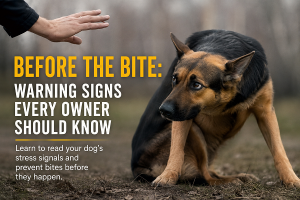
Dogs almost always warn before they attack. The clearest dog body language warning signs are a sudden freeze, a hard stare, a closed mouth, a stiff body leaning forward, raised hackles, and a low growl. Softer stress signals, like lip licking, yawning, and turning away, often show up even earlier. If you see these signs, stay calm, create space, and never punish the growl.
Table of Contents
- Why “Out of Nowhere” Attacks Almost Never Come Out of Nowhere
- Two Kinds of Warning: “I’m Uncomfortable” vs. “Something’s Wrong”
- The Ladder of Aggression in Plain English
- The 12 Warning Signs at a Glance
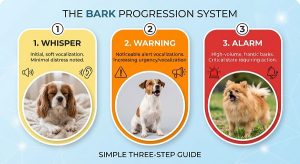
- Stage 1: The Whisper (Worried Signals)
- Stage 2: The Warning (Rising Tension)
- Stage 3: The Alarm (Threat Behavior)
- Read Clusters, Not Single Signs
- The Tail Wag Myth and Other Misreads
- When a Dog Gives No Warning at All
- What To Do When Your Own Dog Shows Warning Signs
- What To Do When a Strange Dog Shows Them
- Children and Familiar Dogs: The Hidden Risk
- Do Some Breeds Warn Differently?
- How To Train a Dog That Keeps Giving Warnings
- Trainer’s Note
- Frequently Asked Questions
- Conclusion
Why “Out of Nowhere” Attacks Almost Never Come Out of Nowhere
Ever heard someone say, “He just snapped. There was no warning”? I hear it a lot. And almost every time, the warning was there. The person just missed it.
Dog body language warning signs before an attack are not rare or hidden. They are a normal, predictable sequence. The problem is that the early parts are quiet. A lip lick. A turned head. A dog that goes still for one second. Most of us are watching for the loud stuff, the bark and the lunge, and by then the quiet stuff is long over.
Here’s why this matters. The CDC and the American Veterinary Medical Association still cite about 4.5 million dog bites a year in the United States, with roughly 800,000 needing medical care. Those numbers come from older surveys that people keep repeating, so treat them as a rough picture rather than an exact count. Even so, the pattern behind them is consistent:
- Nearly 1 in 5 people who get bitten need medical attention.
- Children aged 5 to 9 are bitten at the highest rate.
- Most bites to young children happen during everyday moments with a dog the child already knows.
- In one CDC-based breakdown, 80% of bites to people under 18 came from a family dog (30%) or a neighbor’s dog (50%).
- The government of Victoria, Australia, reports that about 80% of hospitalized dog attack victims were bitten at home by their own dog or a friend’s or neighbor’s dog.
So this is not just a “stranger danger” topic. It’s a “the dog on your sofa” topic. And it’s not only a USA problem. Those Australian numbers look a lot like the American ones.
There’s one more number worth knowing. Dr. Ian Dunbar, a veterinarian and behaviorist, created the most widely used bite scale. It runs from Level 1 (the dog acts aggressive but its teeth never touch skin) to Level 6 (a fatal attack). Dunbar says Levels 1 and 2 make up well over 99% of dog incidents. In other words, in nearly every case the dog is still talking, not tearing. That’s your window.
How long is the window? It depends. UK veterinary behaviorist Kendal Shepherd points out that a dog can go from first signal to bite in seconds if a threat appears suddenly and up close. And dogs that have had their early signals ignored or punished can learn to skip steps altogether. That’s why you can’t wait for the growl. You need to catch the whisper.
Two Kinds of Warning: “I’m Uncomfortable” vs. “Something’s Wrong”
Most articles on this topic mash all the signs into one list. That causes mistakes, because dogs show warnings for two different reasons, and the same sign can mean different things.
Kind 1: The stress warning (“I’m uncomfortable. Please stop.”) This happens when a person or dog is too close, a hug is too tight, someone reaches for a food bowl, or a vet is handling a sore spot. The dog is trying to avoid a fight. You’ll see lip licking, yawning, turning away, whale eye, and then stiffening, staring, and growling if nobody listens.
Kind 2: The alert warning (“Something’s out there.”) This happens when a dog senses a stranger at the gate, a noise outside, or an unfamiliar person near its territory or family. You’ll see ears locking forward, head up, a freeze, a hard stare, a stiff forward lean, hackles, and barking. Guardian breeds and working K9s show this mode most clearly.
Why split them? Because a freeze and a hard stare show up in both, but at different moments. In the stress warning, they sit near the top of the ladder, right before a growl or snap. In the alert warning, they’re often the very first thing you notice. Context tells you which one you’re looking at. Ask yourself: Is something pressuring my dog, or is my dog watching something out there?
Get that wrong and you’ll respond wrong. A dog that’s stressed by a hug needs you to back off. A dog that’s alerting to a noise needs you to calmly assess and give a cue.
The Ladder of Aggression in Plain English
Kendal Shepherd developed the Canine Ladder of Aggression, and it’s been taught widely in veterinary and behavior circles across the UK, US, and Europe since the early 2000s. It’s a simple idea: dogs climb a ladder of signals when they feel stressed or threatened, and biting sits at the very top.
From the bottom up, the rungs look roughly like this:
- Lying down, rolling over, or showing the belly
- Crouching with the tail tucked
- Creeping with ears back
- Turning the head away
- Stiffening up and staring
- Growling
- Snapping
- Biting
Shepherd also lists yawning, blinking, nose licking, walking away, and turning the body away on the lower rungs. The lower rungs are the dog’s way of saying, “I’m worried.” The upper rungs say, “Stop. Go away.”
Two points matter most. First, aggression is a last resort, not a first move. Dogs use calming and avoiding signals constantly in daily life because fighting is costly. Second, the ladder is not about “dominance.” It’s a response to stress and threat, and it has nothing to do with a dog trying to be the boss.
Here’s the catch. Some dogs skip rungs. A dog that was scolded for growling, or one that has often been pushed past its limit, can learn that the early rungs don’t work. Next time it may go from stiff to snap with almost no steps in between. That dog didn’t “bite without warning.” It was trained out of giving one.
The 12 Warning Signs at a Glance
| # | Sign | What you’ll see | Stage |
|---|---|---|---|
| 1 | Lip or nose licking | Quick tongue flick with no food around | Whisper |
| 2 | Out-of-context yawn | Yawn when the dog isn’t sleepy | Whisper |
| 3 | Turning away | Head or body turns, or the dog walks off | Whisper |
| 4 | Whale eye | Whites of the eyes show as the dog glances sideways | Whisper |
| 5 | Crouch with tucked tail, ears back | Body low, tail under, ears flat | Whisper (fear) |
| 6 | Sudden freeze | Body goes still mid-action | Warning |
| 7 | Hard stare, closed mouth | Unblinking eyes, tight face, panting stops | Warning |
| 8 | Stiff, forward-leaning body | Weight on front legs, tail high and rigid | Warning |
| 9 | Raised hackles | Hair up along neck, shoulders, or spine | Warning |
| 10 | Low growl | Rumble in chest or throat | Warning |
| 11 | Lifted lip or bared teeth | Wrinkled muzzle, teeth showing | Alarm |
| 12 | Air snap or lunge | Quick bite into the air, or a fast forward charge | Alarm |
Now let’s go through them stage by stage.
Stage 1: The Whisper (Worried Signals)
These are the easiest signs to miss. Nothing looks dramatic. Your dog is saying, “I’m not sure about this,” and hoping you’ll fix it.
- Lip or nose licking. A quick flick of the tongue when there’s no food. It’s a classic stress signal.
- Yawning out of context. We yawn when we’re bored or tired. A dog that yawns in the middle of a vet visit or while a stranger leans over it is usually stressed, not sleepy.
- Turning the head or body away. This is a polite way of saying, “I don’t want this interaction.” If a dog turns away or leaves, let it. Don’t follow it or pull it back.
- Whale eye. The dog keeps its head still but turns its eyes toward the thing it’s worried about, so the whites show in a half-moon shape. It often means anxiety.
- Crouching, tail tucked, ears back. This is fear made visible. A frightened dog that feels cornered can bite to make the scary thing go away.
What to do in Stage 1: Stop what you’re doing. Give the dog space. Let it leave if it wants to. This is the cheapest moment to fix anything. You don’t need a command or a fight. You just need to notice.
Stage 2: The Warning (Rising Tension)
If the whisper gets ignored, or if the dog has detected something it thinks is a real threat, the body gets tense.
- The sudden freeze. Mid-step, mid-chew, mid-play, the dog stops. Everything goes still. Be careful here: a frozen dog is not a calm dog. Sometimes it’s “I’m assessing.” Sometimes it’s “I’m so uncomfortable I have no good option.” Either way, treat a freeze as serious.
- The hard stare with a closed mouth. The dog was panting, and now the mouth shuts and the face tightens. Eyes lock on one spot and barely blink. This is one of the most important signs on the list.
- Stiff, forward-leaning body. Weight shifts to the front legs. The tail rises and goes rigid. The dog looks like a coiled spring.
- Raised hackles. The hair lifts along the neck and back. This is an involuntary adrenaline reflex. It can mean fear, excitement, or aggression, so read the rest of the body before deciding.
- The low growl. A rumble from the chest. This is the dog saying, in the clearest way it can without using teeth, “Back off.” A growl is useful information. Treat it like a smoke alarm. You’d never rip the battery out of a smoke alarm because it was too loud.
What to do in Stage 2: Calm yourself first. Take a slow breath. Then create distance, either by calmly moving away or by calmly moving your dog away. More on this below.
Stage 3: The Alarm (Threat Behavior)
At this point the dog has decided it must act.
- Lifted lip, bared teeth, wrinkled muzzle. The dog is showing its weapons.
- Loud, deep, repeated barking while moving forward.
- Lunging or charging.
- Air snap. A quick bite into empty space. This is a warning shot, not a miss. A dog that wanted to bite you would have.
- A high, stiff tail wagging in short, tight motions. More on that next.
What to do in Stage 3: Safety first. If it’s your dog, get distance with a barrier or a leash and a calm retreat. If it’s a strange dog, go to the steps in the “strange dog” section below. And afterward, ask what you missed in Stages 1 and 2, because that’s where the fix lives.
Read Clusters, Not Single Signs
Here’s a mistake I see new owners make all the time: they find one sign online and decide what it means. “My dog yawned, so he’s stressed!” Maybe. Maybe he’s sleepy.
Instead, use the Rule of Three:
- Look for three signals together. A stare alone is a stare. A stare, plus a closed mouth, plus a stiff forward lean is a warning.
- Check the context. Who is nearby? What just happened? Is there food, a toy, a child, a gate, a strange noise?
- Know your dog’s baseline. Some dogs have naturally stiff tails or serious faces. Others are loose and wiggly. A change from normal is more meaningful than any single sign.
That third one is something we stress with working dogs. A handler who knows what “normal” looks like for their dog can spot a change in a second. That skill is what turns a pet owner into a good observer.
The Tail Wag Myth and Other Misreads
Let’s clear up some myths that cause real bites.
“A wagging tail means a friendly dog.” Not always. A wag shows arousal and energy, not happiness. A loose, sweeping wag with a soft, wiggly body usually means friendly. A tail held high and stiff, wagging in a quick, tight motion, on a rigid body, is a warning. Always read the whole body.
“Raised hackles mean the dog is aggressive.” Hackles show strong emotion. It could be fear, excitement, or aggression. Look at the face, tail, and posture.
“The dog looks guilty.” That “guilty look” is usually fear of your reaction, not an understanding of what it did.
“A yawn means he’s tired.” Out of context, it’s usually stress.
“A dog that’s lying still is relaxed.” A truly relaxed dog has loose muscles, soft eyes, and a slightly open mouth. A frozen dog is tense. This is one of the most misread signals, especially around children.
When a Dog Gives No Warning at All
Sometimes it really does look like there was no warning. These are the most common reasons.
The growl was punished away. This is the biggest one. When a dog is scolded or hurt for growling, it doesn’t stop feeling uncomfortable. It stops warning you. The discomfort stays and the dog goes straight to a snap or bite next time. Behavior organizations, including shelters and veterinary groups, have said this for years.
The dog was never allowed to say no. Dogs pushed past their limits again and again can learn to shut down and suffer in silence, until one day they can’t.
The dog is in pain. This is one that people forget. Veterinarians say pain and neurological problems are leading causes of sudden behavior change. Arthritis, a bad tooth, an ear infection, or an injury can make a gentle dog snap when touched in the wrong spot. Merck Veterinary Manual notes that pain is common in dogs referred for behavior problems, which is why a vet exam should come first. If a calm dog suddenly snaps at something it used to tolerate, book a vet visit before you book a trainer.
The dog is trained to stay quiet. Working and sport dogs are often taught to stay silent and focused. They still talk with their bodies: the weight shifts forward, the eyes go hard, the mouth closes, and the dog goes very still. The signal is quieter, but it’s still there.
If your dog has “no warning” bites in its history, don’t guess. Talk to your vet, then work with a veterinary behaviorist or a certified professional trainer.
What To Do When Your Own Dog Shows Warning Signs
Here’s a simple plan that scales with the stage.
Stage 1 (Whisper): Notice and ease off. Stop the thing that’s bothering your dog. Don’t loom over it. Let it move away. Calmly say its name or give a gentle cue.
Stage 2 (Warning): Cue, then create distance. Give one calm, clear cue your dog already knows well, like “place,” “with me,” or “sit.” Say it once, in a steady voice. Repeating it fast sounds like panic. Then increase the distance. Turn your body slightly sideways, keep your breathing slow, and move away or guide your dog away. Keep the leash steady. Don’t yank it or tighten it hard, because tension travels down the leash and tells your dog the situation is dangerous.
Stage 3 (Alarm): Barrier and retreat. Put something between your dog and the trigger. A car, a gate, a door, or simply more space. Don’t grab at the dog’s collar with a bare hand if you can avoid it. Don’t shout. Don’t punish.
After it’s over: Reward the calm-down. Once your dog settles, quietly praise it or give a treat. You’re teaching, “When I stand down, good things happen.” You still want your dog to alert you. You just want it to stand down when you ask.
Then do the detective work. Write down what happened, where, who was there, and what your dog did first. After two or three notes, patterns appear. Maybe it’s always the same visitor, the same doorway, or the same time of day.
Want a structured way to build those control cues? Our guide to basic protection commands for the family pet walks through the foundation step by step.
What To Do When a Strange Dog Shows Them
You can’t train a dog you don’t own, so here you’re managing yourself. These steps are in line with guidance from the AVMA and animal-control agencies.
- Stop and stand still. Running triggers chase instinct. Keep your arms close to your body.
- Turn slightly sideways. Facing a dog head-on feels like a challenge.
- Avoid hard eye contact. Look at the dog in your peripheral vision, or glance at the ground.
- Stay quiet, or speak low and firm. Don’t scream. A calm “No” or “Go home” is fine.
- Back away slowly. Never turn your back and never run.
- Put something between you. A bag, a jacket, a bike, a car, a gate.
- If you’re knocked down, curl up. Cover your head and neck with your arms and stay still until the dog loses interest.
One more tip: many attacks in public places happen near the edge of the dog’s home territory, such as a footpath beside its yard. Even friendly dogs can guard their property. If a dog is barking and stiff behind a fence, that’s not a dog to reach toward. Cross the street.
Children and Familiar Dogs: The Hidden Risk
Remember the numbers earlier? Kids get bitten most often by dogs they know. And kids tend to be bitten on the head, face, and neck, because of their height. So this section matters.
Children miss dog warnings for a simple reason: they love dogs. They hug, grab, climb, and stare, which are the exact things that stress a dog. Here’s what works:
- Never leave a young child alone with any dog, no matter how gentle the dog is.
- Teach the “ask first” rule. Always ask the owner, then let the dog sniff first.
- No hugging, no leaning over, no cornering. Dogs don’t enjoy hugs the way we do.
- Respect the exit. If a dog walks away or hides under a table, the interaction is over. Don’t let a child follow or reach for it.
- Teach kids the three “stop” signs: turning away, going stiff, and growling.
- Keep food bowls, bones, and toys off-limits when kids are near.
If you take one rule from this article for your household, make it that last one. Guarding food and toys is one of the most common triggers for bites at home.
Do Some Breeds Warn Differently?
A little, though the individual dog and its training matter more than its breed. Guardian and herding breeds such as the German Shepherd, Belgian Malinois, Rottweiler, and Dutch Shepherd often show a clear, deliberate alert-mode sequence. They were bred to assess a situation before acting. Many companion breeds go to barking faster, because quiet watching wasn’t part of their job.
Also remember that any dog of any size or breed can bite if it’s pushed far enough. A small dog’s warning signs are exactly the same, they’re just easier to ignore. If you’re choosing a breed for family protection, our breakdown of the top guard and protection dogs for family safety explains which traits actually support reliable, controllable alert behavior.
How To Train a Dog That Keeps Giving Warnings
Your goal isn’t a silent dog. It’s a dog that keeps telling you what it notices, and that stands down when you say so. A realistic rough plan looks like this:
- Weeks 1 to 4: Foundation. Sit, stay, place, and recall in low-distraction spaces. Build impulse control.
- Weeks 5 to 10: Controlled exposure. Introduce new sounds, smells, and visitors at a distance your dog can handle. Pair a calm response with a cue and a reward.
- Weeks 10 to 16: Distance and duration. Practice calm-downs after a trigger. Reward the return to relaxed, not just the first reaction.
- Ongoing: Proofing. A dog that behaves perfectly in your yard may act very differently on a walk or at a friend’s house. Practice in new places.
Every dog moves at a different speed, so treat those weeks as a guide, not a deadline. A dog with a bite history, or one with fear-based aggression, needs a professional’s plan from the start. Don’t try to “fix” that alone.
And here’s the principle underneath it all: a dog that trusts you to respond to its early signals will keep giving them. A dog that gets ignored or punished will stop.
Want to look at your whole property through your dog’s eyes? Our room-by-room K9 home security audit is a good next read.
Trainer’s Note
In military working dog training, the first skill we teach a handler isn’t giving commands. It’s reading the dog. A handler who can’t tell the difference between “my dog is interested” and “my dog is tense” will give the wrong command at the wrong time, no matter how good the dog is.
The same goes for you. Spend a week just watching your dog. Watch how it moves when it’s relaxed. Watch its face when the doorbell rings. Watch what it does with its mouth, tail, and weight when someone new walks in. That baseline is the most valuable tool you’ll ever build, and it costs nothing.
If you’d like a structured, step-by-step breakdown of how professional handlers build obedience, awareness, and calm decision-making into a dog, my e-book, Beyond the Bark: Inside a Pro Handler’s Playbook for Raising the Ideal Dog, covers the principles in plain English, without encouraging unnecessary aggression.
Cpl. Rofiat Muritala is a Nigerian Army military working dog instructor and handler with more than 14 years of experience at the Nigerian Army Dog Centre.
Frequently Asked Questions
1. What are the first warning signs a dog is about to attack?
The earliest signs are usually subtle: lip licking, yawning, turning the head away, or showing the whites of the eyes. Closer to a bite you’ll see a sudden freeze, a hard stare with a closed mouth, a stiff body leaning forward, raised hackles, and a low growl. Not every dog shows every sign, so watch for several together.
2. How long do you have between the warning signs and a bite?
It varies. With a slow build-up, the signs can stretch across several seconds or longer. If a threat appears suddenly and up close, a dog can move from first signal to bite within seconds. Dogs that have been punished for warning often skip steps. That’s why it pays to notice the very first signs.
3. Do all dogs growl before they bite?
No. Many do, but some don’t. Dogs that were punished for growling, dogs that are in pain, and dogs trained to stay quiet may go straight from stiff to snap. If a dog suddenly goes still and stares, treat that as a warning even if you hear nothing.
4. Does a wagging tail mean a dog is friendly?
Not always. A wag shows energy and arousal. A loose, sweeping wag with a wiggly body is usually friendly. A high, stiff tail wagging in short, tight motions on a rigid body can be a warning. Always read the whole dog, not just the tail.
5. What should I do if a dog shows aggression toward me or my child?
Stop and stand still, keep your arms close, turn slightly sideways, avoid hard eye contact, and stay quiet or speak low and calm. Then back away slowly and put a barrier between you and the dog. Don’t run, scream, or turn your back. For a child, calmly pick them up or move them behind you once the dog is not within reach, and keep the child’s face and neck protected.
Conclusion
A dog’s warning system doesn’t start with a bark. Barking is what happens after the quiet signals get missed. The lip lick, the turned head, the freeze, the hard stare, the stiff lean, the growl: those are all your dog talking, often several seconds before anything else happens.
Here’s your short action list:
- Learn the three stages: Whisper, Warning, Alarm.
- Read clusters, not single signs, and learn your dog’s baseline.
- Never punish a growl. It’s a warning, and you want to keep it.
- Create space first, then give one calm cue.
- See your vet if a calm dog suddenly gets snappy, to rule out pain.
- Protect kids with supervision, “ask first” rules, and respect for the dog’s exit.
- Train the stand-down, so your dog can alert and relax on cue.
Do that, and you’ll end up with something better than a dog that reacts to danger. You’ll have a dog that helps you see it coming.
Want more practical K9 tips like this each week? Subscribe to our weekly articles roundup newsletter at https://arfsk9team.com.ng/newsletter/.
Sources Checked
- AVMA, “Preventing dog bites”: https://www.avma.org/resources-tools/pet-owners/dog-bite-prevention
- CDC dog bite guidance (via AVMA and CDC-citing summaries); CDC MMWR 2003;52:605-610 (nonfatal dog bite injuries treated in US emergency departments, 2001)
- Kendal Shepherd, The Canine Ladder of Aggression (BSAVA Manual of Canine and Feline Behaviour)
- Dr. Ian Dunbar, Dog Bite Scale (APDT authorized version): https://apdt.com/wp-content/uploads/2017/01/ian-dunbar-dog-bite-scale.pdf
- Agriculture Victoria (Australia), “Preventing dog attacks in the community”: https://agriculture.vic.gov.au/livestock-and-animals/animal-welfare-victoria/dogs/dog-attacks-dangerous-and-menacing-dogs/preventing-dog-attacks-in-the-community

Her work centres on obedience, detection, protection and operational readiness. She favours proven methods built on repetition, consistency and real-world conditioning, so that both dogs and handlers are prepared for high-pressure tasks.
Rofiat represented the Nigerian Army Dog Centre at the Nigerian Army Day Celebration (NADCEL) 2026, where she led demonstrations in obedience, explosive detection, agility and tactical movement. Through articles, training content and documentaries, she shares field-based insight into how structured training, clear communication and trust between handler and dog affect performance and reliability.
She is the author of Beyond the Bark: Inside a Pro Handler's Playbook for Raising the Ideal Dog, a practical guide that helps dog owners and handlers apply professional training principles in everyday situations.
- K9 Advantix Dosage Chart & Safety Guide for Dogs - October 19, 2026
- How to Set Up & Use Bousnic Dog Training Collar - October 18, 2026
- Westminster Dog Show 2026: Winners & Full Results - October 17, 2026