Malinois vs German Shepherd Intelligence: Security Work

Which is smarter, the Belgian Malinois or the German Shepherd? Neither wins across the board. The Malinois scores higher in recent lab testing, especially at reading human gestures and solving spatial puzzles. The German Shepherd ranks higher in the older obedience-based rankings and tends to think more independently. For security work, the Malinois fits fast, high-intensity jobs. The German Shepherd fits long, steady, public-facing jobs. Your handler’s skill level matters as much as the breed.
Table of Contents
- What “Intelligence” Really Means in Security Work
- What the Science Says (Coren vs. the Helsinki Study)
- Malinois vs German Shepherd Intelligence: Side-by-Side
- Where the Malinois’s Brain Wins
- Where the German Shepherd’s Brain Wins
- The Shared Weakness: Impulse Control
- What Militaries Actually Do
- Which Breed for Which Security Job?
- The Handler Factor
- How to Train Either Breed’s Intelligence
- Handler’s Notes
- FAQs
- Final Verdict
Introduction
Ask ten handlers which breed is smarter and you’ll get ten loud answers. Most of them are based on one dog they once worked with.
That’s the problem. If you’re choosing a dog for guard duty, patrol, or personal protection, “smarter” isn’t a useful question. A dog that learns a command in three repetitions can still be a bad pick for a quiet, eight-hour gate shift. A calm, thoughtful dog can still be too slow for a rapid response team.
So here’s what you’ll get in this guide:
- What the research says about Malinois and German Shepherd intelligence
- Where each breed’s mind has a real edge
- A role-by-role guide for security work
- Why your own experience level can matter more than the breed
I’ll also point out where popular claims, including some you’ll read on other blogs, go further than the evidence does.
What “Intelligence” Really Means in Security Work
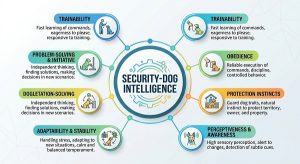
Dog intelligence isn’t one thing. Researcher Stanley Coren split it into three types: instinctive, adaptive, and working/obedience intelligence. Security dogs need all three, but in different amounts.
For protection and security work, I break it down like this:
- Learning speed: how many repetitions before the dog gets it
- Reading people: can the dog pick up on your gestures, tone, and posture?
- Problem-solving: what does the dog do when the plan falls apart?
- Impulse control: can the dog wait, or does it explode into action?
- Stress stability: does the dog stay clear-headed in noise, crowds, and chaos?
- Stamina of focus: can the dog stay sharp for hours, not just minutes?
Most blogs only talk about the first one. Security work lives and dies on the last three.
What the Science Says (Coren vs. the Helsinki Study)
The Old Benchmark: Stanley Coren’s Rankings
Coren’s 1994 book The Intelligence of Dogs ranked 131 breeds. It put the Border Collie first, and it focused on working and obedience intelligence: how well a dog understands and follows commands. Coren’s list put the German Shepherd third. His ranking drew on surveys of more than 200 obedience judges in the US and Canada.
That’s useful, but it’s opinion-based and obedience-focused. It doesn’t test how a dog thinks. And the Malinois isn’t ranked separately in the way most people assume, because Coren grouped Belgian Shepherd varieties differently. That’s one reason the “GSD is smarter” claim has stuck around.
The Newer Evidence: University of Helsinki (2022)
The better data comes from a Finnish team led by Saara Junttila and Katriina Tiira. They tested 1,002 dogs from 13 breeds in a standardized battery and found real breed differences in understanding human gestures, spatial problem-solving, inhibitory control, and persistence on an unsolvable task.
Here’s what matters for us:
- The Malinois took first place overall. News coverage reported it scored 35 out of 39 points, ahead of the Border Collie.
- The Malinois was the best at understanding human gestures. The Labrador retriever was close behind.
- The German Shepherd landed near the bottom of the points ranking. It sat below mixed-breed dogs in the published list.
- Both breeds scored poorly on impulse control. The researchers noted that the Malinois and German Shepherd received low scores in the inhibitory control test.
- The German Shepherd was more likely to ignore a misleading human gesture. The Malinois was among the breeds most likely to trust the human’s gesture over its own memory, while the Hovawart and German Shepherd were most likely to ignore it. c
How I’d Read These Results
Here’s my take as a handler. A lower GSD “score” doesn’t mean a dumber dog. In that test setup, a dog that follows its own judgment over a human’s pointing gesture loses points. In real security work, that same independence can be an asset. A dog that second-guesses a bad cue, or works through a problem without waiting for you, is useful.
Also, the lead researcher herself warned against over-reading these results. Junttila said the findings describe performance in those specific problem situations, and that each dog is still an individual. Treat the study as a signal, not a verdict.
Malinois vs German Shepherd Intelligence: Side-by-Side
| Intelligence trait | Belgian Malinois | German Shepherd | Edge for security work |
|---|---|---|---|
| Learning speed | Very fast, often few reps | Fast, steady retention | Malinois (speed), GSD (consistency) |
| Reading human gestures | Top performer in the Helsinki study | Good, more independent | Malinois |
| Spatial problem-solving | Among the fastest in the Helsinki study | Solid | Malinois |
| Independent judgment | Leans on handler cues | More likely to trust its own read | GSD |
| Impulse control | Low on lab test | Low on lab test | Tie, both need training |
| Long-shift focus | Frustrates if bored | Steady, patient | GSD |
| Recovery from handler mistakes | Low tolerance, learns errors fast | More forgiving | GSD |
| Public/crowd settings | Needs careful conditioning | Generally calmer | GSD |
Notice the pattern. The Malinois is the faster, sharper dog. The German Shepherd is the more forgiving, steadier dog. Neither is simply “smarter.”
Where the Malinois’s Brain Wins
1. It Reads You Fast
The gesture result matters more than it sounds. A security dog that picks up on your hand signal, body angle, or a subtle shift in your stance needs fewer words. In a noisy environment where voice commands get lost, that’s a real advantage.
2. It Learns Quickly (For Better or Worse)
Malinois often lock in a new behavior in very few repetitions. That’s great for building detection and apprehension skills quickly.
But here’s the catch I warn every new handler about: a Malinois learns your mistakes just as fast. Reward a half-sit once, and you’ve taught a half-sit. Let the dog win a tug game at the wrong moment, and you’ve built a habit. Sloppy handling gets punished quickly with this breed.
3. It Handles Chaos
In rapid-response work, the Malinois’s speed of thought and movement together is hard to beat. Anthony Richling of Liberty K9 Dog Camps compares the German Shepherd to a station wagon and the Malinois to a Corvette. It’s a fun image, and it fits: the Malinois is built to go from zero to full speed immediately.
Where the German Shepherd’s Brain Wins
1. Independent, Steady Judgment
The German Shepherd tends to assess before it acts. In security work, that translates to restraint. Think of a dog at an event entrance, an airport, or a hospital perimeter. You want a dog that stays composed when 500 people walk past.
2. Forgiving of Handler Mistakes
Every handler makes errors. A GSD usually gives you more room to fix them. That’s why I generally point first-time handlers toward the German Shepherd, not because it’s less capable, but because it’s less punishing.
3. Long-Haul Focus
For a long perimeter patrol or overnight site security, a dog with a steady engine beats a dog with a turbo. A Malinois on a slow, boring shift often creates its own work: pacing, fixating, or inventing problems. If your job is mostly watching and waiting, the GSD’s pacing is a gift. (For a deeper breed profile, read our guide on German Shepherd intelligence and how they compare to humans.)
4. A Wider Job Range
German Shepherds have the longest track record in patrol, tracking, search, and general-purpose security. Plenty of agencies still start here because the breed is proven and widely available.
The Shared Weakness: Impulse Control
Here’s the part almost no competing article covers. Both breeds scored low on impulse control in the Helsinki testing.
What does that mean in plain English? These dogs are wired to act. They’re bred for it. Put a smart, fast, high-drive dog next to a moving target, a flung toy, or a running person, and its first instinct is to go.
For a security dog, that’s both the gift and the danger. You want drive. You also need an “off switch.” The good news is that impulse control is highly trainable.
Here’s what I teach handlers:
- Start with “wait” at doors and food bowls. Daily, from the first week.
- Build the out and the down-stay under distraction. Add motion, noise, and other people slowly.
- Reward calm behavior, not just action. Pay your dog for staying still next to something exciting.
- Proof it in new places. A stay at home isn’t a stay in a parking lot.
Skip this work and you don’t have a smart security dog. You have a fast, strong, unpredictable one.
What Militaries Actually Do
When real agencies buy dogs, they don’t pick based on a blog debate. They test.
The majority of dogs bought for the US Department of Defense are German Shepherds or Belgian Malinois, usually between one and three years old. That alone tells you both breeds earn their place.
A few more numbers worth knowing:
- Selection is tough. One 341st Training Squadron commander said that on a recent buying trip his team evaluated more than 300 dogs and brought about 130 back. That’s well under half.
- Training takes months. Initial training typically runs around 120 training days, roughly six months, before the dog is ready for the field.
- Volume is significant. The 341st trains roughly 350 dogs per year for all four branches.
- The in-house breeding program picked a side. The Lackland breeding program, launched in 2005, breeds only the Belgian Malinois. About 10 percent of DoD working dogs are bred in San Antonio, and the rest come from nearly 30 vendors.
You can see an example of how far the Malinois has gone. Cairo, a Belgian Malinois, worked alongside SEAL Team operator Will Chesney. For a bigger picture of the breeds in uniform, see our guide to which breeds are used as military working dogs.
My takeaway: serious programs use both breeds, and they screen individual dogs hard. Breed is the starting point. The individual dog’s nerves, drive, and health decide the outcome.
Which Breed for Which Security Job?
Here’s the guide I wish more clients had before they bought a dog.
| Security role | Better fit | Why |
|---|---|---|
| Rapid response / tactical support | Malinois | Speed, fast learning, strong drive |
| Apprehension work | Malinois (experienced handler) | Intensity and quick reads |
| Explosives / narcotics detection | Either (individual dog matters most) | Drive for the search matters more than breed |
| Overnight site or perimeter patrol | German Shepherd | Steady focus, less boredom-driven stress |
| Event, airport, or crowd presence | German Shepherd | Calmer around people, good judgment |
| Residential / family protection | German Shepherd | More forgiving, usually easier to live with |
| Corporate security with an experienced handler | Either | Match to the schedule and environment |
| First-time handler, any role | German Shepherd | Easier to learn with |
The Handler Factor
Here’s what I tell everyone: the best dog for you is the one you can handle well.
A Malinois with a weak handler is a high-speed liability. A German Shepherd with an expert handler can match a Malinois on many tasks. Ask yourself these five questions before you choose:
- Can I give 1 to 2 hours of real exercise daily? Both breeds are commonly said to need that much, with the Malinois often needing a bit more. Our guide on how often to exercise a working dog breaks it down by job type.
- Am I consistent? A Malinois punishes inconsistency fast.
- Will this dog work a long, quiet shift? If yes, lean GSD.
- Do I have access to a good trainer? Not optional with a Malinois.
- Is this dog a worker or also a house companion? Malinois can be harder in a home. If you want a dog that lives with the family, think carefully.
On health, figures vary across sources. Many give both breeds a lifespan of roughly 10 to 14 years, with the Malinois often a bit longer. Hip and elbow dysplasia are the big concerns for both, and more so in the GSD. Whichever breed you choose, ask for health clearances on the parents.
How to Train Either Breed’s Intelligence
Smart dogs get bored and invent their own jobs, which you won’t like. Use these steps:
- Start socialization early. Expose the dog to different surfaces, noises, people, and places in puppyhood.
- Teach through short sessions. Five to ten minutes, a few times a day, beats one long grind.
- Mix tasks. Rotate obedience, searching, and tugging so the dog stays engaged.
- Train “calm” on purpose. Settle mats, crate time, and place commands.
- Raise difficulty slowly. Change one thing at a time: location, distance, or distraction.
- Plan for six months minimum. Even government programs need about 120 training days for already-selected adult dogs, so don’t expect a ready security dog in six weeks.
- Review often. Film your sessions. You’ll spot handler errors you can’t feel in the moment.
Handler’s Notes
This guide draws on published research (Helsinki, Coren), public military procurement data, and the practical experience of the ARFS K9 Team. Our lead author, Cpl. Rofiat Muritala, is a Nigerian Army military working dog instructor and handler with more than 14 years at the Nigerian Army Dog Centre. Her background covers dog selection, foundational training, behavior shaping, and performance evaluation in real operational environments.
One lesson I come back to constantly: handlers often judge dogs on how quickly they learn, yet the dogs that last in real work are the ones that stay steady under stress. Speed impresses on day one. Stability pays off in year three.
Note: this is general guidance, not a replacement for an in-person evaluation by a qualified trainer.
Frequently Asked Questions
1. Is a Malinois smarter than a German Shepherd?
In recent lab testing, yes in several areas. The Malinois outperformed most breeds, including the German Shepherd, overall in the Helsinki study. But older obedience rankings rate the German Shepherd highly, and each breed’s strengths suit different jobs. “Smarter” depends on the task.
2. Which breed is better for security work?
It depends on the role. The Malinois suits fast, high-intensity work with experienced handlers. The German Shepherd suits long shifts, public settings, and less experienced handlers.
3. Which breed is easier to train for beginners?
The German Shepherd, usually. It forgives mistakes better. A Malinois learns quickly, which means it also learns your errors quickly.
4. Why do militaries use both breeds?
Different jobs and a limited supply of good dogs. Programs test individual dogs hard, and each breed brings strengths. The US program, for example, buys both breeds but breeds only Malinois in-house.
5. Do both breeds have trouble with impulse control?
Yes. The Helsinki researchers found both scored low on the inhibitory control test. It’s trainable, but you need to teach it on purpose, from the start.
Final Verdict
So, which is smarter? The honest answer: the Malinois is quicker and sharper, and the German Shepherd is steadier and more forgiving. For security work, “smart” means fitting the task, and that’s why both breeds still dominate K9 units worldwide.
Your action steps:
- Match the breed to the job: fast and intense (Malinois), or long and steady (GSD).
- Be honest about your handling skills before you buy.
- Train impulse control from day one.
- Test the individual dog. Parents’ health and temperament matter more than breed labels.
- Budget at least six months of structured training.
Want to go deeper into raising a reliable working dog? My e-book, Beyond the Bark: Inside a Pro Handler’s Playbook for Raising the Ideal Dog, shares the professional training principles I use every day.
And if you’d like a weekly roundup of new K9 training and handling articles, subscribe to our newsletter here.

Her work centres on obedience, detection, protection and operational readiness. She favours proven methods built on repetition, consistency and real-world conditioning, so that both dogs and handlers are prepared for high-pressure tasks.
Rofiat represented the Nigerian Army Dog Centre at the Nigerian Army Day Celebration (NADCEL) 2026, where she led demonstrations in obedience, explosive detection, agility and tactical movement. Through articles, training content and documentaries, she shares field-based insight into how structured training, clear communication and trust between handler and dog affect performance and reliability.
She is the author of Beyond the Bark: Inside a Pro Handler's Playbook for Raising the Ideal Dog, a practical guide that helps dog owners and handlers apply professional training principles in everyday situations.
- Dog Agility Course Layout: Easy DIY Setup - October 7, 2026
- Local Dog Breeds: Temperament, Health & Training Guide - October 6, 2026
- How Long Do Military Working Dogs Serve? Full Guide - October 5, 2026