Dogs Sleep Patterns: Hours, Cycles & Red Flags

Most adult dogs sleep about 10 to 14 hours in every 24, puppies sleep 15 to 20 hours, and seniors often sleep 14 to 18 hours. Dogs don’t sleep in one block like we do. They sleep in short cycles, wake up often, and stay alert even while resting. Twitching, whimpering and paw-running are normal REM (dreaming) sleep. A sudden change in how much or how your dog sleeps is the real warning sign. Call your vet if you see one.
Table of Contents
- How Much Sleep Do Dogs Need?
- Why Dog Sleep Patterns Look So Different From Ours
- The Dog Sleep Cycle: Stages and REM Sleep
- Why Dogs Twitch, Whimper and “Run” in Their Sleep
- Dog Sleeping Positions and What They Tell You
- What Changes Your Dog’s Sleep
- Puppy, Adult and Senior Dog Sleep
- Sleep in Working and K9 Dogs
- Dog Sleep Disorders and Red Flags
- How to Help Your Dog Sleep Better
- FAQs
- The Bottom Line
Introduction
Ever watched your dog nap for the fifth time before lunch and wondered, “Is this normal?”
You’re not alone. It’s one of the most common questions I hear from new owners, and from new handlers too. We spend a lot of time on feeding, walks and training, but sleep gets ignored. That’s a mistake. Sleep is when your dog’s brain stores what it learned, their body repairs, and their stress levels settle.
In this guide, you’ll learn how many hours of sleep dogs really need, what happens inside the dog sleep cycle, and why twitching and whining at night are usually fine. You’ll also learn when dog sleep patterns signal a health problem, and how to build a better sleep routine. I’ll also share what we see with working dogs, because their rest rules are different.
How Much Sleep Do Dogs Need?
Short answer: Adult dogs need about 10 to 14 hours of sleep a day. Puppies need 15 to 20 hours. Senior dogs often need 14 to 18 hours.
| Life stage | Typical sleep per day | Notes |
|---|---|---|
| Puppy (up to 12 months) | 15–20 hours | Sleeps in short bursts between play |
| Adult dog | 10–14 hours | Varies with breed, work and activity |
| Senior dog | 14–18 hours | Lighter, more broken sleep |
| Working dog (off duty) | 12–14 hours | Needs protected, quiet rest |
Why do sources disagree? Check a few articles and you’ll see 8–14 hours in one, 12–14 in another, 18–20 in a third. That isn’t a mistake. Dogs nap, doze and rest with their eyes open, so “sleep” depends on what the researcher counts. One study summarized by the Sleep Foundation found adult dogs needed between 8 and 13.5 hours, with an average of just under 11. Most vets and insurers quote 12 to 14 because they count all the napping.
Here’s how I’d explain a typical dog’s day. About half of it is real, restorative sleep, and roughly 30% is light dozing with the ears still on alert. The last 20% or so is active time.
Size matters too. Large breeds like Great Danes, German Shepherds and Bernese Mountain Dogs tend to need more sleep than dachshunds or Chihuahuas. Giant breeds, like Mastiffs and Saint Bernards, can sleep 16 to 18 hours.
Why Dog Sleep Patterns Look So Different From Ours
We sleep once, for 7 to 8 hours. Dogs sleep many times a day. Scientists call this polyphasic sleep.
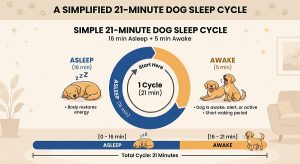
The classic study here is from Murdoch University in Australia. Researchers watched 24 pet dogs overnight. The dogs averaged 23 sleep-and-wake episodes in eight hours, with cycles of about 16 minutes asleep and 5 minutes awake. That’s about three wake-ups an hour, and it’s completely normal.
Why? Think of the wolf ancestors. Wolves rest when there’s nothing to hunt, but they have to wake fast if danger shows up. Your sofa-loving Labrador kept that wiring. The same study found that dogs slept as close to their owners as they were allowed to. They’re checking on their pack, even in their sleep.
So here’s the thing: a dog that wakes up when you walk past isn’t a “bad sleeper.” That’s a dog doing exactly what evolution built it to do.
The Dog Sleep Cycle: Stages and REM Sleep
A dog’s sleep has four states: awake, drowsy, non-REM (quiet, deep sleep) and REM (active, dreaming sleep).
1. Drowsy. Eyes half-closed, head heavy. A noise can pull your dog out of this in a second.
2. Non-REM sleep. Breathing and heart rate slow, and muscles relax. This is the body-repair stage.
3. REM sleep. The brain gets very active. Eyes move under the lids, paws twitch, and you may hear soft barks.
Most dogs enter REM roughly 10 minutes after falling asleep. And here’s something many owners don’t know: dogs spend only about 10% of their sleep in REM, compared with up to 25% in humans. Because dogs wake so often, they sometimes cut cycles short. That’s one reason they need to sleep more times a day to get enough REM.
Sleep is how dogs learn
This part matters for training. Researchers at Eötvös Loránd University in Budapest found that the pattern of brain waves called sleep spindles linked to how well a dog remembered new commands learned before a nap. In follow-up work, scientists confirmed that the density of sleep spindles in non-REM sleep predicts learning success.
What does that mean for you? Short training session, then rest. A dog who sleeps after learning remembers more. Stacking five sessions with no downtime wastes your effort.
Sleep also changes with what your dog did before bed. In one study of 16 family dogs, dogs slept more after an active day and spent more time in deep and REM sleep. The same study found that when dogs weren’t at home, they were less likely to reach REM sleep. This matches what I see: dogs rest worse in new places.
Why Dogs Twitch, Whimper and “Run” in Their Sleep
If your dog is paddling their legs, whining or letting out a muffled “woof,” they’re almost certainly in REM sleep.
- Twitching and leg kicks: The brain is replaying movement. Muscles are normally switched off during REM, but small signals slip through.
- Whimpering or soft barking: Same cause. Usually it lasts seconds.
- Eye movement under closed lids: Classic REM.
- Irregular, quick breathing: Normal in REM.
Do dogs dream? Almost certainly yes. Their brain activity looks a lot like ours, and puppies and seniors seem to move more in their sleep.
Should you wake a dreaming dog? Usually no. A dog jolted out of REM can wake confused and may snap by reflex, even a gentle one. If you must wake them, call their name softly from a distance and let them come around.
When it’s not a dream: If the episode lasts more than a couple of minutes, your dog is stiff, drooling, can’t be woken, or loses bladder control, it may be a seizure. Film it and call your vet.
Dog Sleeping Positions and What They Tell You
Positions give clues, but they’re hints and not hard science. Behaviorists link them to comfort and temperature, so read them alongside your own dog’s habits.
| Position | What it usually means |
|---|---|
| Curled in a ball | Conserving warmth, protecting the belly. Common in cold rooms or in light sleepers |
| Side sleeping | Relaxed and feels safe |
| On the back, legs up | Very comfortable, and often cooling off. Seen in secure dogs |
| “Superman” (belly down, legs out) | Ready to jump up. Common in puppies and high-energy dogs |
| Back-to-back with you | Trust and bonding |
| Head propped on something | Often helps breathing. Flat-faced breeds do this a lot |
Notice a new position, especially a dog who suddenly won’t lie down flat? That can point to pain or breathing trouble, so track it.
What Changes Your Dog’s Sleep
Several things shape dog sleep patterns:
- Age. Puppies and seniors sleep more (more on this below).
- Breed and size. Big dogs sleep longer. Flat-faced breeds like Bulldogs and Pugs often sleep lightly and snore because of their airways.
- Activity. Active dogs sleep deeper, as the study above showed.
- Health. Pain, itching, thyroid problems and heart disease all change sleep.
- Environment. Noise, heat and a busy room break up rest.
- Food and timing. A big meal right before bed can cause restlessness.
- Stress. Separation anxiety, thunderstorms and house moves all disturb sleep.
The “first night” effect
The Murdoch researchers saw something worth knowing. REM-type sleep was suppressed for a night when a dog was placed in a new habitat, then returned over the following two nights. So if you bring a new puppy or adopted dog home, expect a rough first night or two. It’s not a bad dog, just a normal adjustment.
The same paper found that nine of the 14 owners unknowingly disturbed their dogs’ sleep. Late-night TV, checking on them, and moving them around all add up.
Puppy, Adult and Senior Dog Sleep
Puppies
Puppies grow fast, and most of that growth happens while they sleep. Expect 15 to 20 hours a day, in short bursts. A rule of thumb from my handling experience: a young puppy can usually stay awake for only about an hour or so before needing a nap. Overtired puppies get bitey, hyper and whiny, much like overtired toddlers.
Want fewer crying nights? Use a crate as a quiet den. We’ve written a full step-by-step guide to crate training a puppy that covers nighttime setup.
Adult dogs
Adults settle into a routine, and it follows yours. Regular meals, walks and bedtime lock in a steady sleep schedule. Most healthy adults sleep through the night, with the usual short wake-ups. They also nap through the day, especially when they’re bored. Boredom sleeping is real, so more daytime stimulation often means better sleep at night.
Senior dogs
Older dogs sleep more (14 to 18 hours) but sleep lighter and wake more. Joint pain is a common reason, so a thick orthopedic bed helps a lot.
There’s a bigger issue to know about: canine cognitive dysfunction (dementia). According to Texas A&M, onset is usually between 12 and 15 years, and sleep-wake cycle changes can be an early sign. A study from North Carolina State University found that the higher a dog’s dementia score, the less time it spent in non-REM and REM sleep. Watch for:
- Sleeping more by day, and pacing or being restless at night
- Staring at walls, getting stuck in corners
- Forgetting house training
If your senior dog turns day into night, don’t just accept it as “old age.” Ask your vet.
Sleep in Working and K9 Dogs
This is the section most articles skip, and it’s where my experience matters most.
Do working dogs sleep less than pets? A common claim is yes, because they’re trained to stay alert. The reality is more interesting. The Murdoch University researchers studied six drug-detector dogs and found that changing handler-dog work shifts didn’t alter their sleep-wake patterns. Working dogs adapt well, but only if they get real downtime.
Where handlers go wrong:
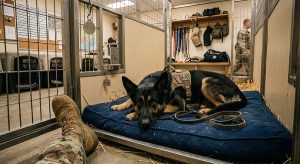
- Treating the kennel as rest. A Brazilian study of Military Police sniffer dogs in São Paulo measured stress hormones on duty and off duty. Dogs worked 12-hour shifts, then rested 36 hours. The result was surprising: cortisol levels showed rest time was more stressful than work, because the dogs sat in kennels with little to do. A bored, confined dog doesn’t rest well. Rest needs to be calm and enriched, not just empty.
- Noise. The US Army Public Health Center ran a noise study on military working dogs and used dosimeters fixed to the dogs’ collars to link kennel noise to behavior. Loud kennels mean broken sleep.
- Back-to-back sessions. A tired dog learns less. Space out the hard drills and give a nap after teaching something new.
- Ignoring recovery after heavy work. Detection and patrol dogs need more recovery than a pet on the same day.
My practical rules for handlers:
- Give each dog a quiet, shaded, away-from-traffic sleep spot.
- Keep rest times fixed, so the dog learns “off duty” means off.
- After a hard training day, expect extra sleep. That’s recovery, not laziness.
- Keep a simple sleep log (see the checklist below), because changes show up there before they show up in performance.
For more on keeping working dogs fit and settled, read our guide on how often to exercise a working dog and how military working dogs are trained to stay calm under pressure.
Dog Sleep Disorders and Red Flags
Dogs get sleep disorders just like people do.
- Insomnia/restlessness: Usually caused by pain, anxiety, itching or boredom.
- Sleep apnea: Loud snoring and pauses in breathing, common in flat-faced breeds and overweight dogs.
- Narcolepsy: Sudden collapse into sleep or limp muscles, often triggered by excitement or food. It’s seen in breeds like Dobermans, Labradors and Dachshunds, and often starts in young dogs.
- REM sleep behavior disorder: The dog acts out dreams, with violent thrashing, running or snapping while asleep.
- Canine cognitive dysfunction: Day-night reversal in older dogs, covered above.
Too little sleep can cause restlessness, whining, trouble concentrating, neediness and sluggishness, so a “naughty” dog may simply be a tired one.
Normal or vet visit?
| Normal | Call your vet |
|---|---|
| Twitching, soft whimpers in REM | Violent thrashing, or can’t be woken |
| Waking a few times a night to shift | Night pacing, panting, or crying for hours |
| Snoring that’s mild and steady | Loud snoring with breathing pauses |
| More sleep after a hard day | Sudden big jump or drop in sleep hours |
| Brief grogginess after waking | Collapsing mid-play or mid-meal |
| Slow stiff start in an old dog | Day-night reversal or confusion |
My tip: Film the episode on your phone. A 30-second clip tells your vet more than any description.
How to Help Your Dog Sleep Better
Try this checklist for two weeks:
- Keep a sleep log. Note bedtime, wake-ups, daytime naps and odd events. Patterns appear fast.
- Fix the schedule. Feed, walk and go to bed at similar times every day.
- Exercise on purpose. Add mental work, like sniff walks and puzzle feeders, not just laps.
- Pick the right bed. Match size and age. Seniors need thick, supportive foam.
- Control the room. Cool, dark, quiet. Use white noise if your street is loud.
- Time the dinner. Finish the main meal 2 to 3 hours before bed.
- Add a wind-down. A short walk, a calm chew, then lights down.
- Choose a sleep spot. Whether it’s your bedroom or their own space, stay consistent. Research on this is mixed, and the Sleep Foundation notes that sharing your bed can disrupt both your sleep and your dog’s.
- Handle anxiety at the source. Calm, consistent handling beats punishment every time. See our post on why structure works better than dominance.
Sample day for an adult dog:
| Time | Activity |
|---|---|
| 6:30 am | Potty, walk, breakfast |
| 8:00–11:30 am | Nap |
| 12:00 pm | Short training or sniff walk |
| 1:00–4:30 pm | Rest and nap |
| 5:00 pm | Longer walk or play |
| 6:00 pm | Dinner |
| 8:30 pm | Calm time, last potty |
| 9:30 pm | Bedtime |
Adjust it to your dog. The point is predictability.
FAQs
1. How many hours should a dog sleep a day?
Adult dogs need about 10 to 14 hours. Puppies need 15 to 20 and seniors 14 to 18. Check your own dog’s normal by tracking a week, because a sudden change matters more than any average.
2. Is it normal for my dog to sleep all day?
Often yes, especially if the day is quiet. Dogs fill empty hours with sleep. But if your dog also seems low on energy, loses interest in food or play, or is drinking much more, see your vet.
3. Do dogs dream, and can they have nightmares?
Dogs go through REM sleep and show signs of dreaming. They may also have unpleasant dreams, though we can’t be sure what they see. Don’t wake a dreaming dog, and if bad dreams happen a lot, look at their stress levels and daytime routine.
4. Why does my dog twitch and whimper in his sleep?
It’s usually REM sleep. The brain is active and small movements leak through. It becomes a concern if the episode is long, violent, or your dog can’t be woken. Film it and call your vet.
5. Why is my senior dog awake all night?
Pain, anxiety, needing to urinate more, or canine cognitive dysfunction can all cause it. Night restlessness can be an early sign of dementia, so book a vet check rather than waiting.
The Bottom Line
Dog sleep patterns are different from ours: short cycles, frequent waking, and plenty of naps. That’s normal. What you should watch is change. A big jump or drop in hours, new night pacing, breathing pauses, or confusion are your cues to call the vet.
Here’s what to do this week:
- Start a simple sleep log.
- Set a steady routine for meals, walks and bedtime.
- Give your dog a quiet, comfortable bed away from noise.
- Rest your dog after training, because sleep is where the learning sticks.
- Film anything odd and show your vet.
Want weekly tips like this from a working K9 handler? Subscribe to our weekly articles roundup newsletter.
Want a full system for raising a calm, balanced dog that settles and sleeps well? Get my book, Beyond the Bark: Inside a Pro Handler’s Playbook for Raising the Ideal Dog.

Her work centres on obedience, detection, protection and operational readiness. She favours proven methods built on repetition, consistency and real-world conditioning, so that both dogs and handlers are prepared for high-pressure tasks.
Rofiat represented the Nigerian Army Dog Centre at the Nigerian Army Day Celebration (NADCEL) 2026, where she led demonstrations in obedience, explosive detection, agility and tactical movement. Through articles, training content and documentaries, she shares field-based insight into how structured training, clear communication and trust between handler and dog affect performance and reliability.
She is the author of Beyond the Bark: Inside a Pro Handler's Playbook for Raising the Ideal Dog, a practical guide that helps dog owners and handlers apply professional training principles in everyday situations.
- Westminster Dog Show 2026: Winners & Full Results - October 17, 2026
- 10 K9-Approved Tricks to Teach Your Dog (Step-by-Step) - October 16, 2026
- COBA National Dog Championship 2026: Full Guide - October 15, 2026