Are Wolf Dogs Legal to Own? 2026 Laws by Country and State
It depends on where you live, and often on how many generations the dog is from a wolf, not on its wolf percentage. The US has no federal ban on wolf dogs as pets, but states, counties and cities set their own rules, and some ban them outright. In the UK, a close wolf hybrid needs a Dangerous Wild Animals licence from your council. Australia blocks the import of the main wolf dog breeds. Even where owning one is legal, no rabies vaccine is licensed for wolf hybrids, and that single fact causes more legal and safety trouble than almost anything else.
Table of Contents
- What Counts as a “Wolf Dog”? (Hybrids, Breeds and Look-Alikes)
- Why Laws Use Generations, Not Percentages
- Can a DNA Test Prove Wolf Content?
- Wolf Dog Laws in the United States
- UK, Europe, Australia and Beyond
- The Rabies Problem Nobody Talks About
- Are Wolf Dogs Dangerous? What the Data Shows
- A Handler’s View: Why Instinct Wins
- Legal Due Diligence: 8 Steps Before You Buy
- Already Own One? What to Do Now
- Wolf-Look Alternatives That Won’t Land You in Court
- FAQs
- Conclusion
Introduction: The Wolf Dog Dream Meets the Legal Reality
You see a photo of a wolf dog with pale eyes and a wolf’s long stride, and you think, “I want one.” Plenty of people do. Then they search are wolf dogs legal to own and find a mess of conflicting answers.
Here’s the problem. One site says “legal in 30 states.” Another says “banned almost everywhere.” A breeder tells you the puppy is “only 40% wolf, so it’s basically a dog.” And the law may not care about that percentage at all.
In this guide, you’ll learn:
- What a wolf dog really is, and how it differs from a wolfdog breed and a wolf-look-alike
- Why many laws count generations, and why DNA tests can’t settle the question
- Real examples of US state, UK and Australian rules
- The rabies gap that makes even “legal” ownership risky
- An 8-step checklist, plus safer dogs that give you the wolf look
I work with military working dogs. My job is to judge which dogs stay steady under pressure and which ones don’t. That lens shapes this whole article.
This is general education, not legal advice. Laws change, so confirm with your local council, wildlife agency or a lawyer before you buy.
What Counts as a “Wolf Dog”?
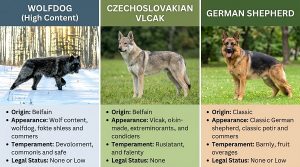
People use “wolf dog” for three very different animals. Mixing them up is the number one reason people get the legal question wrong.
| Type | What it is | Examples | Legal treatment |
|---|---|---|---|
| Wolf hybrid (wolf dog) | A recent cross between a wolf and a dog, or two hybrids | F1 litter, “high-content” backyard-bred pups | Most regulated; often licensed or banned |
| Wolf dog breed | A closed breed started from wolf dog crosses decades ago | Czechoslovakian Wolf dog, Saarloos Wolf dog | Recognised as breeds, but some places still restrict or ban them |
| Wolf-look-alike | A domestic dog bred to look like a wolf, with no recent wolf ancestry | Siberian Husky, Alaskan Malamute, Tamaskan, Northern Inuit | Treated as normal dogs |
The real wolf dog breeds are older than most people think. The Czechoslovakian Wolf dog began in 1955, when Karel Hartl started a military experiment crossing a German Shepherd with a Carpathian wolf. The first litter came in 1958, and breeders added more wolf crosses in 1960, 1968, 1974 and 1983. The Saarloos Wolf dog goes back to 1932, when Dutch breeder Leendert Saarloos crossed a German Shepherd male with a female European wolf. The FCI, the main international kennel body, recognises both.
Now, a correction you’ll want to know: these breeds are not 75–90% wolf. A 2019 genomic study put wolf ancestry at about 20–30% for the Czechoslovakian Wolf dog and about 18–33% for the Saarloos. A lot of old blog posts get this wrong.
The Tamaskan is different again. It was developed from Husky, Malamute and German Shepherd lines to look like a wolf. It isn’t a wolf cross.
Why Laws Use Generations, Not Percentages
Here’s the thing most articles skip. Lawmakers rarely write “no more than 40% wolf.” They write about generations and ancestry, because that’s something you can prove with paperwork.
A quick guide to the labels:
- F1: one parent is a pure wolf, so roughly half the genes come from the wolf.
- F2: one parent is an F1 hybrid, so a wolf is a grandparent.
- F3 and beyond: the wolf sits further back in the family tree.
A few real examples show how this works:
- New Hampshire defines a wolf hybrid as any canine with a wolf ancestor in the previous four generations, and it counts a dog its owner says has wolf ancestry.
- The UK licenses hybrids based on closeness to the wolf, not DNA share. A wildlife expert has pointed out that the rules turn on how many generations away from a wolf the animal is.
- Alaska covers a wolf hybrid as the offspring of a wolf or hybrid with a dog or another hybrid, and it also covers any animal represented as part wolf.
That last point catches people out. If you or the breeder call a dog “part wolf,” some laws treat it as a wolf hybrid, even if a DNA test says otherwise.
Percentages also mislead because they shuffle. Each time hybrids breed back to dogs, genes mix at random, so one puppy can carry more wolf than its sibling. Two “25% wolf” pups can behave nothing alike.
Can a DNA Test Prove Wolf Content?
Short answer: not reliably. And that matters, because owners, breeders and officials all lean on these tests.
Scientists have told reporters that proving an exact wolf percentage is basically impossible. Labs can often tell whether a dog has a wolf in its family tree within about the last three generations. They report results as “dog,” “wolf” or “hybrid.” Past that point, the signal fades, because dogs descend from wolves and share most of their DNA.
Two more problems:
- Consumer tests make mistakes. In a University of Colorado study of mail-in dog DNA tests, one company labelled a bulldog as a wolf hybrid.
- Eyeballing doesn’t work either. Studies show experienced dog professionals disagree with each other, and with DNA results, when they guess breed by sight. Some “experts” have been proven wrong in court.
What this means for you: a fur-and-face guess from a neighbour, an animal control officer or a breeder is a weak basis for a legal decision. If you must prove what your dog is, keep pedigree papers, breeder records and a vet’s note. Those hold up far better than a swab.
Wolf Dog Laws in the United States
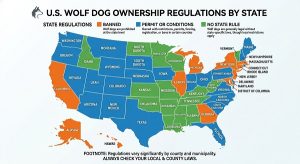
Start with the big picture. There’s no single US federal ban on keeping a wolf dog as a pet. The rules sit at three levels, and the strictest one wins:
- State law: can ban, license or ignore wolf hybrids.
- County or city law: can be stricter than the state.
- Landlord, HOA and insurer rules: private, but they can end your plan fast.
Here are real examples, drawn from state statute summaries kept by the Animal Legal & Historical Center at Michigan State University and from state codes:
| State | What the law does |
|---|---|
| Michigan | The Wolf Dog Cross Act (2000) bans acquiring or possessing wolf dog crosses. It grandfathered animals already owned, under a strict permit system. |
| Alaska | You need a state permit to possess, transport, sell or buy a live wolf or wolf hybrid. A narrow defence covers certain pets owned before 2002 with proper records. |
| New Hampshire | Selling or reselling a wolf hybrid is banned. Owners must keep the animal under physical control or in an escape-proof enclosure. Breaking the law is a Class A misdemeanor. |
| Arkansas | Ownership is allowed, but with rabies and fence rules. If a hybrid bites or injures an animal while out of its enclosure, the person responsible faces a Class A misdemeanor. |
| Virginia | Local governments may create permit systems. Officers must kill a hybrid canine caught killing livestock or poultry. |
| Vermont | Wolf-hybrids are licensed and controlled alongside dogs under the state’s consolidated dog laws. |
| Hawaii, Illinois, Wyoming | Commonly reported as prohibiting wolf dog ownership. Check current rules before you rely on this. |
| Colorado | Commonly reported to require no state licence for hybrids. Local rules still apply. |
Three traps to watch for:
- “Legal” can mean “legal with conditions.” Fencing, microchips, spay/neuter proof and rabies paperwork are common.
- A permit may not travel. If you move states, assume you start from zero.
- Pure wolves are a separate, tougher category. Don’t mix up wolf rules with wolf dog rules when you read a website.
UK, Europe, Australia and Beyond
United Kingdom
The key law is the Dangerous Wild Animals Act 1976. Its schedule lists wolves and other wild canids, plus certain hybrids. Government guidance says a cross between a wolf and a domestic dog requires a licence. The wording also covers a hybrid with a dangerous wild animal as a parent and an animal with a hybrid parent. In plain English, first- and second-generation wolf dog crosses need a licence. Councils and media often point to roughly the first three generations, so ask your council about an F3 before you commit.
What the licence involves, using one English council as an example:
- The applicant must be over 18.
- The licence costs about £601 and lasts two years.
- The council inspects the premises first.
- Keep one without a licence and you risk a fine of up to £2,000, and the council can seize the animal.
The Czechoslovakian Wolf dog and Saarloos are established breeds and are generally handled as dogs in the UK, though the Czechoslovakian Wolf dog Club of Great Britain exists and breeders there are open about the breed’s demands.
Germany and the wider EU
There’s no single EU pet-wolf dog rule. National and regional dog laws apply, and many countries treat early-generation hybrids as wildlife. In Germany’s wolf management guidance, the first four hybrid generations are handled at the same protection level as wolves. Check your state or canton, because dog laws there vary a lot.
Australia
Australia is tough on imports. Pet-transport companies report that the Czechoslovakian Wolf dog, Saarloos Wolf dog, Lupo Italiano and Kunming Wolf dog, plus crosses of those breeds, can’t be imported under customs and environmental law. Confirm the current list with the Australian Department of Agriculture before any move.
Canada and everywhere else
In Canada, provinces and cities set their own rules. In most countries, local or regional law decides, so the safest first call is to your municipal animal control office, not a breeder.
The Rabies Problem Nobody Talks About
This is the biggest gap in most guides, and it’s one I want you to take seriously.
The US rabies compendium, published by the National Association of State Public Health Veterinarians and carried by the CDC, says that the efficacy of rabies vaccination in wildlife and hybrids hasn’t been established, and no vaccine is licensed for these animals. It adds that wild animals or hybrids should not be kept as pets.
Why does that matter in real life?
- If your wolf dog bites someone, officials may not accept its vaccine record as proof of protection.
- That can mean long quarantine, or testing that requires euthanasia.
- Insurers and landlords know this, which is one reason policies and leases often exclude hybrids.
A vaccine certificate on your fridge doesn’t solve this. Talk to your vet and your local health authority before you buy, and get their answer in writing.
Are Wolf Dogs Dangerous? What the Data Shows
Let’s keep this fair. Most wolf dogs never hurt anyone, and some are gentle with their families. But the pattern in the data is hard to ignore.
What the US data shows:
- A CDC-published review of dog-bite deaths from 1979 to 1998 found 14 deaths linked to wolf dog hybrids, out of 238 total fatal attacks. Pit bull-type dogs and Rottweilers made up more than half the total.
- The CDC’s earlier report on 1995–96 describes a 2-year-old boy in South Dakota killed by two chained wolf-German Shepherd hybrids after he wandered into a neighbour’s yard.
Two honest caveats. First, those researchers warned that breed identification in attack reports is shaky, since it often comes from news accounts. Second, there are far fewer wolf hybrids than most breeds, so raw counts don’t give a fair rate. Still, a small population producing 14 deaths is a red flag, not a footnote.
Why do the risks look the way they do? From a handler’s view, it comes down to a few things:
- Prey drive: small pets, and sometimes small children, can trigger a chase and a kill.
- Fear reactions: a shy, fearful animal that feels cornered can bite fast.
- Escape skills: many hybrids climb, dig and jump well. Escapes are where most legal trouble starts.
- Weak “off switches”: a dog bred to obey for generations will usually stop when told. A hybrid may not.
And please don’t count on a wolf dog as a guard dog. Guarding needs a dog that tells friend from threat on command. Shy, unpredictable animals don’t do that well. If you want a protection dog, read about how a German Shepherd compares with a Belgian Malinois for working and security roles.
A Handler’s View: Why Instinct Wins
In working-dog selection, we don’t pick the dog that looks the toughest. We pick the one that stays predictable when noise, stress and distraction all pile on. Handlers call it reliability under pressure.
That’s where wolf dogs struggle. Training builds habits through repetition and consistency, but instinct can overrule habit when the stakes rise. It’s the same idea I explain in Obedience vs Instinct: The Two Types of Dog Intelligence Every Handler Must Understand. A dog that obeys in your living room isn’t automatically a dog that obeys when it’s scared.
So here’s my practical test for any dog, wolf-blooded or not: “Would I trust this dog around a child it has never met, with a stranger at the gate, and a squirrel running past?” If you hesitate, the answer’s no.
Legal Due Diligence: 8 Steps Before You Buy
Before you pay a deposit, work through these eight steps:
- Call your local animal control and wildlife agency. Ask in plain words: “Is a wolf dog hybrid allowed at my address?” Write down the name and date.
- Ask how the law defines a hybrid. Is it by generation, by percentage, or by what the owner calls it?
- Check county, city and HOA rules. They can be stricter than the state.
- Call your insurer. Ask in writing whether homeowner’s or renter’s cover and liability cover apply to a wolf hybrid.
- Ask your vet about rabies. Find out how they’ll handle the vaccine gap and a bite incident.
- Demand paperwork from the seller. You want pedigree, generation, parents’ details, health records and a written sale contract.
- Plan the enclosure. Ask what fencing the law requires. Plan for height, buried barriers and a double gate.
- Plan for the future. Who takes the dog if you move, get sick or can’t cope? Sanctuaries are often full.
If you can’t tick all eight, you have your answer.
Already Own One? What to Do Now
If you already have a wolf dog, don’t panic. Do these things:
- Find out your status. Some places allow existing pets under grandfather rules, such as Michigan’s permit system and Alaska’s pre-2002 defence, but only with records and compliance.
- Keep records current: microchip, vet visits, spay/neuter proof and a clear ownership history.
- Never sell or give away the dog without checking the law first. In New Hampshire, for instance, selling or reselling a wolf hybrid is banned.
- Upgrade the fence before something goes wrong. Escapes are where liability and prosecutions begin.
- Don’t breed. Breeding wolf hybrids adds to the problem, and it’s illegal in many places.
- Get professional help early. Choose a trainer with real experience in primitive or high-instinct dogs, not someone using dominance gimmicks.
Wolf-Look Alternatives That Won’t Land You in Court
You can love the wolf look without the legal baggage. These domestic dogs are treated as normal dogs in most places:
| Dog | Why people pick it | Reality check |
|---|---|---|
| Siberian Husky | Classic wolf face and eyes | Escape artist; needs huge exercise |
| Alaskan Malamute | Big, powerful, wolf-coloured coat | Strong and stubborn; heavy shedder |
| Tamaskan | Built to look like a wolf, from sled-dog and shepherd lines | Needs active owners and early socialisation |
| Northern Inuit / Utonagan | Wolf look with a family-dog goal | Can be anxious without company |
| German Shepherd | Wolf-like build, proven working record | High-energy; needs training |
| Kangal | A livestock guardian historically linked to wolf defence | Not a city dog; see below |
If your real draw is the idea of a dog tough enough to stand up to a wolf, meet the Kangal Dog, the breed that can take down a wolf. It’s a domestic dog bred for the job, with a very different legal and behavioural profile.
And if you’d like to learn how to raise any strong breed the professional way, my e-book, Beyond the Bark: Inside a Pro Handler’s Playbook for Raising the Ideal Dog, walks you through the habits that make a dependable dog.
FAQs
1. Is it legal to own a wolf dog?
It depends on your location. The US has no federal pet ban, but states and cities vary from permit systems to full bans. The UK requires a Dangerous Wild Animals licence for close hybrids. Always confirm with local authorities before buying.
2. What percentage of wolf is legal in a dog?
There’s no universal percentage. Many laws use generations or ancestry, and some count any animal described as part wolf. Because DNA tests can’t give a reliable percentage, paperwork and local definitions matter more than a number.
3. Are Czechoslovakian Wolf dogs and Saarloos Wolf dogs legal?
In most places they’re treated as dog breeds, since their wolf ancestry is about 20–33% and dates back decades. But some countries restrict them, and Australia bans their import. Local law still decides, so check first.
4. Do wolf dogs have a legal rabies vaccine?
No. US public health guidance states that no rabies vaccine is licensed for wildlife or hybrids. That can affect what happens after a bite, even if your dog has had a standard shot.
5. Do wolf dogs make good pets or guard dogs?
For most people, no. Wolf dogs can be shy, escape-prone and hard to predict, which makes them poor guard dogs and risky family pets. Reliable working breeds are safer and far easier to train.
Conclusion
So, are wolf dogs legal to own? Sometimes. But “legal” is only the first hurdle, and the rules change fast depending on your street, your county and your country.
Here’s what to remember:
- Know the type. A hybrid, a wolf dog breed and a look-alike aren’t the same thing, legally or practically.
- Expect generation rules. Laws often count how far the dog is from a wolf, and some count what you call it.
- Don’t trust DNA or looks alone. Keep pedigree papers and vet records.
- Plan for rabies. No licensed vaccine exists for hybrids, and that affects bites, insurance and housing.
- Do the 8-step check before you pay a deposit.
- Consider a look-alike. You can have the wolf look with a dog that fits normal law and normal life.
My advice? Unless you have the legal clearance, secure facilities and real experience with high-instinct animals, choose a wolf-look domestic breed or a proven working dog. You’ll sleep better, and so will your neighbours.
Want more honest K9 advice every week? Subscribe to our weekly articles roundup newsletter and get new guides straight to your inbox.
Sources and Further Reading
- UK Dangerous Wild Animals Act 1976, Schedule: https://www.legislation.gov.uk/ukpga/1976/38/schedule/data.htm
- Scottish Government DWA species guidance (wolf-dog pups need a licence): https://www.gov.scot/publications/dangerous-wild-animals-species-guidance/pages/explanatory-notes/
- St Albans council DWA licence (fee, term, penalties): https://www.stalbans.gov.uk/dangerous-wild-animals
- Animal Legal & Historical Center, Wolves statutes: https://www.animallaw.info/statutes/species/wolves
- Michigan Wolf-Dog Cross Act summary: https://www.animallaw.info/node/38444
- New Hampshire wolf hybrid law summary: https://www.animallaw.info/node/38660
- Alaska 5 AAC 92.030: https://www.law.cornell.edu/regulations/alaska/5-AAC-92.030
- Compendium of Animal Rabies Prevention and Control (CDC/NASPHV): https://cdc.gov/mmwr/preview/mmwrhtml/rr5205a1.htm
- Sacks et al., Breeds of dogs involved in fatal human attacks, 1979–1998 (JAVMA)
- CDC MMWR, Dog-Bite-Related Fatalities, United States, 1995–1996: https://www.cdc.gov/mmWR/preview/mmwrhtml/00047723.htm
- Genomic make-up of the Czechoslovakian Wolfdog: https://pmc.ncbi.nlm.nih.gov/articles/PMC6043967
- Genomic effects of hybridization in Czechoslovakian and Saarloos Wolfdogs: https://pmc.ncbi.nlm.nih.gov/articles/PMC11764532
- Connecticut Public, “What Can DNA Tests Tell Us?” (wolfdog DNA limits): https://ctpublic.org/environment/2014-04-04/so-you-think-its-a-wolfdog-what-can-dna-tests-tell-us
- National Canine Research Council, visual vs DNA breed identification: https://www.nationalcanineresearchcouncil.com/research_library/summary-analysis-comparison-of-visual-and-dna-breed-identification-of-dogs-and-inter-observer-reliability/

Her work centres on obedience, detection, protection and operational readiness. She favours proven methods built on repetition, consistency and real-world conditioning, so that both dogs and handlers are prepared for high-pressure tasks.
Rofiat represented the Nigerian Army Dog Centre at the Nigerian Army Day Celebration (NADCEL) 2026, where she led demonstrations in obedience, explosive detection, agility and tactical movement. Through articles, training content and documentaries, she shares field-based insight into how structured training, clear communication and trust between handler and dog affect performance and reliability.
She is the author of Beyond the Bark: Inside a Pro Handler's Playbook for Raising the Ideal Dog, a practical guide that helps dog owners and handlers apply professional training principles in everyday situations.
- Westminster Dog Show 2026: Winners & Full Results - October 17, 2026
- 10 K9-Approved Tricks to Teach Your Dog (Step-by-Step) - October 16, 2026
- COBA National Dog Championship 2026: Full Guide - October 15, 2026