Is the Bullmastiff a Good Guard Dog? K9 Review
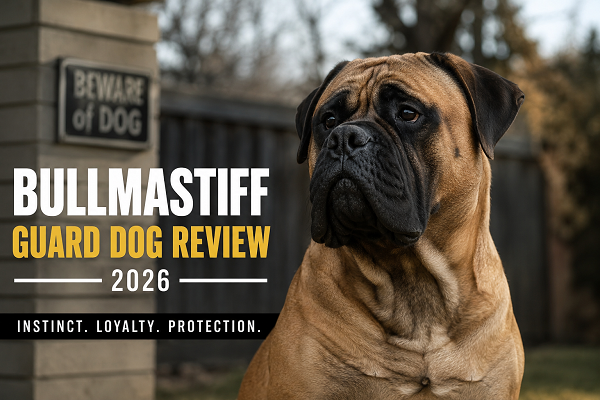
Yes. The Bullmastiff is an excellent guard dog for home and family protection. It was bred in 19th-century England to silently track poachers, knock them down and hold them without mauling. It guards by size, silence and pressure, not by constant barking. It does best with a calm, experienced owner who trains and socializes it for life. It is not the right choice if you want a dog that barks at every noise, runs with you for miles, or follows fast, precise commands the way a police K9 does.
Table of Contents
- Introduction
- Quick Answer: Where the Bullmastiff Fits (Watchdog, Guard Dog or Protection Dog?)
- Where the Bullmastiff’s Guard Instinct Comes From
- What a Bullmastiff Actually Does When a Stranger Shows Up
- Bullmastiff Temperament: Calm at Home, Serious at the Gate
- Strengths and Weaknesses at a Glance
- Bullmastiff Guard Dog Training Timeline
- Should You Do Bite Work With a Bullmastiff?
- 7 Mistakes That Ruin a Bullmastiff Guard Dog
- Male vs Female Bullmastiff as a Guard Dog
- Bullmastiff vs Rottweiler, Cane Corso, German Shepherd and Others
- Heat, Drool and Daily Care: The Parts Breed Profiles Skip
- Health and Lifespan: How Long Can It Work?
- What a Bullmastiff Really Costs
- Setting Up Your Home and Property
- Who Should (and Shouldn’t) Get a Bullmastiff
- How This Review Was Built
- FAQs
- Final Verdict and Next Steps
Introduction
Picture a 120-pound dog standing at your gate. It isn’t barking. It isn’t lunging. It’s just watching a stranger with a heavy, wrinkled brow, and the stranger suddenly decides he’d like to be somewhere else.
That quiet pressure is why so many people ask: is the Bullmastiff a good guard dog, or is the reputation just good marketing?
Here’s the problem. Most breed pages say “yes, excellent guard dog” and stop there. They don’t tell you how the dog actually behaves, how long training takes, what happens in hot weather, or what it costs when the dog’s hips give out at six. That’s how people end up with a giant, untrained dog and a lot of regret.
In this guide, I’ll walk you through the real picture. You’ll learn how the Bullmastiff guards, what training looks like month by month, the mistakes I see owners make, how it compares with other protection breeds, the health numbers that limit its working life, and the full cost. If you’re a first-time owner or an experienced handler, you’ll know by the end whether this breed fits your home.
Quick Answer: Where the Bullmastiff Fits (Watchdog, Guard Dog or Protection Dog?)
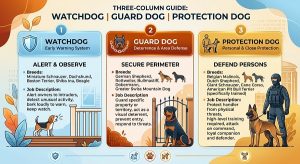
People use three terms as if they mean the same thing. They don’t, and mixing them up is the first reason people pick the wrong breed.
- Watchdog: Alerts you. Barks. Doesn’t have to do anything else. (Many small and medium dogs.)
- Guard dog: Deters and, if needed, physically stops a threat on your property. This is the Bullmastiff’s lane.
- Protection dog: Trained to take direction from a handler and engage on command, often with advanced obedience and bite work. (Malinois, German Shepherds, Dutch Shepherds, Rottweilers.)
Featured answer: A Bullmastiff is a natural guard dog, not a trained protection dog. It deters with presence, blocks and pins rather than bites hard, and works best when you control it with solid obedience.
Where the Bullmastiff’s Guard Instinct Comes From
The Bullmastiff isn’t a mastiff with a bulldog attitude added later. It was built on purpose, roughly 60% Old English Mastiff and 40% Old English Bulldog, by English gamekeepers in the mid-1800s. The Mastiff brought size and calm. The Old English Bulldog (a taller, more athletic dog than today’s Bulldog) brought speed and grit.
Why go to the trouble? Poaching on big estates was a serious problem, and the stakes were high. Poachers faced harsh penalties, and some chose to fight the gamekeeper rather than be caught. The gamekeeper needed a dog that could:
- Work quietly at night without giving away its position.
- Run down a man and knock him off his feet.
- Hold him there without killing him, because a dead poacher meant trouble for the keeper.
That job earned the breed its nickname, “the Gamekeeper’s Night Dog.” The UK Kennel Club recognized the Bullmastiff in 1924, and the American Kennel Club followed in 1933. Over the years the breed also worked as army and police dogs, and it was reportedly used to guard diamond fields in southern Africa in the early 20th century.
Here’s the key takeaway for you: the Bullmastiff was bred to make a judgment call alone, in the dark, with no handler nearby. That’s different from a Malinois, which was bred to take instructions from a handler. It explains both the Bullmastiff’s greatest strength (independent, calm confidence) and its biggest challenge (it won’t always wait for your command).
What a Bullmastiff Actually Does When a Stranger Shows Up
Breed profiles say “protective.” Let me show you what that looks like on the ground. A well-bred, well-socialized adult usually moves through stages like these:
- Notice. The head comes up. Ears and eyes lock on. The dog goes still. Often no sound at all.
- Position. It moves between you and the stranger. Many owners miss this because it looks like the dog is just “standing around.”
- Warn. A deep, low bark or a rumble, usually only once or twice. A Bullmastiff that barks a lot is often anxious or bored, not guarding.
- Block and pressure. It closes distance, uses its chest and body weight, and stares. For most people, the show ends here.
- Pin and hold. If the person keeps pushing, the dog’s old job kicks in: knock down and hold.
So do Bullmastiffs attack intruders? Not like a terrier or a trained bite dog. Their instinct is to dominate and restrain. But please don’t confuse “bred to hold, not maul” with “safe.” A 120-pound dog that pins someone can still cause serious injury, and in most countries you are legally responsible for what your dog does. That’s why control matters more than courage with this breed.
Bullmastiff Temperament: Calm at Home, Serious at the Gate
The breed standard describes the Bullmastiff as fearless and confident yet docile. In real life that looks like this:
- With family: Affectionate, sometimes goofy, and famous for leaning its full weight on you. It bonds deeply and hates being left out.
- With strangers: Reserved and watchful. Not automatically friendly, not automatically hostile. A properly socialized dog watches you for cues before deciding how to react.
- With children it knows: Patient and gentle. The risk is size, not temper. A happy 110-pound dog can flatten a toddler by accident.
- With other dogs: This is where owners get surprised. Many Bullmastiffs, especially males, can be pushy or aggressive with unfamiliar dogs, particularly of the same sex.
- With cats and small pets: Often a poor mix. Retailers like Orvis and several breed clubs warn that some Bullmastiffs have a strong chase drive.
- With barking: Quiet. Good for neighbors, not good if you want a loud early-warning system.
One more thing nobody tells you: they’re stubborn. Not dumb, stubborn. A Bullmastiff will often think about your command before deciding to do it. If you give in to that habit when the dog is 30 pounds, you’ll pay for it at 120.
Strengths and Weaknesses at a Glance
| Strengths as a guard dog | Weaknesses as a guard dog |
|---|---|
| Imposing size and presence deters most people | Shorter working life (about 7 to 10 years) |
| Silent, calm, instinctive guarding | Slow to respond to rapid, precise commands |
| Strong family bond | Can be aggressive toward other dogs |
| Low exercise needs compared to herding breeds | Heat-sensitive, with heavy drooling |
| Bred to restrain rather than maul | Large joint and cancer risks |
| Doesn’t bark constantly | Needs strong, calm leadership for life |
Bullmastiff Guard Dog Training Timeline
The single biggest mistake is thinking a “natural guardian” needs no training. It’s the reverse. The instinct is already there, so your job isn’t to build a guard dog. Your job is to build control around one. Here’s the timeline I’d follow.
8 to 16 weeks: Foundation and socialization
This is the most important window in your dog’s life. Introduce your puppy safely to many people, surfaces, sounds, vehicles and calm, vaccinated dogs. Teach name, sit, down, crate and handling. Poor socialization here is the most common reason I see fearful or reactive adult Bullmastiffs, which is far more dangerous than a confident one.
4 to 6 months: Impulse control
Teach “leave it,” “off,” loose-leash walking and calm greetings. Bullmastiff puppies grow very quickly, so protect their joints: no jumping off furniture, no long runs and no forced stair marathons.
6 to 12 months: The testing phase
Expect pushback. The dog is bigger, stronger and wants to see what it can get away with. Stay calm, clear and consistent. Reward-based training with firm boundaries works far better than harsh corrections, which can damage trust and sometimes increase reactivity.
12 to 24 months: Guard instinct matures
A friendly adolescent can turn watchful and selective around 12 to 18 months. This is normal, but it’s the moment your control commands must already be solid: recall, “leave it,” “out” or “release,” “place” and “settle.” Bullmastiffs can keep filling out until around two to two and a half years old.
Lifelong: Maintenance
Five minutes a day of obedience beats one long session a month. Rehearse visitors arriving, doorbells, gate openings and strangers approaching the car.
The 6 commands I’d put first for a guard Bullmastiff
- Recall. Comes back, even when excited.
- Leave it. Ignores what you tell it to ignore.
- Out / Release. Lets go and stops on cue.
- Place. Goes to a spot and stays there when visitors arrive.
- Settle. Switches off arousal and lies down.
- Wait. Doesn’t rush doors, gates or car exits.
If you want a structured, field-tested way to build all of this from day one, my e-book, Beyond the Bark: Inside a Pro Handler’s Playbook for Raising the Ideal Dog, walks through the methods professional handlers use to build dependable, well-mannered dogs.
Should You Do Bite Work With a Bullmastiff?
Short answer: for most homes, no. Here’s why.
A Bullmastiff already has the guarding instinct. What it usually lacks is control. Adding bite work to a dog without bulletproof obedience can turn a calm deterrent into a liability. Courts and insurers don’t care that your dog is “naturally gentle.”
If you still want protection training, follow these rules:
- Only work with a qualified trainer who has experience with giant, independent breeds.
- Do obedience and impulse control first. The dog must reliably out, recall and settle before anything else.
- Don’t start before the dog is physically mature. Giant-breed joints need time.
- Check your local laws and your insurance. Some areas treat trained protection dogs differently from pets.
- Evaluate the dog’s nerve. A fearful or unstable dog should never be pushed into this work.
For most families, the better plan is simple: a well-socialized dog that guards by presence, plus a solid “place” and “settle.”
7 Mistakes That Ruin a Bullmastiff Guard Dog
- Skipping socialization. Fear-based dogs bite. Confident dogs usually don’t need to.
- Letting a puppy do what you won’t allow an adult to do. Jumping, leaning, mouthing and pulling all become safety problems.
- Using harsh, dominance-style methods. This breed is sensitive under its tough exterior. It can shut down or push back.
- Chaining or isolating the dog. A guard dog kept alone outside becomes frustrated and unpredictable. Bullmastiffs are people dogs.
- Over-exercising puppies. Hard, repeated impact during growth hurts joints.
- Using a weak fence. A determined dog can lean on, dig under or push through a poorly built barrier.
- Quitting training after puppy class. The dog’s real guarding drive shows up at 12 to 24 months. That’s when you need training the most.
Male vs Female Bullmastiff as a Guard Dog
| Male | Female | |
|---|---|---|
| Typical size | 25 to 27 in, about 110 to 130 lb | 24 to 26 in, about 100 to 120 lb |
| Presence | Bigger, more imposing | Slightly smaller, often just as capable |
| Dog-to-dog behavior | More likely to be pushy with other males | Can still be dominant, often a bit easier |
| Maturity | Slower | Often a little quicker |
| Best for | Experienced owners who want maximum deterrence | Families who want a calm, capable guardian |
The honest truth: individual temperament and training matter far more than sex. A well-bred, well-raised female is a better guard dog than a poorly raised male every time.
Bullmastiff vs Rottweiler, Cane Corso, German Shepherd and Others
| Breed | Guarding style | Trainability | Lifespan (typical) | Best for |
|---|---|---|---|---|
| Bullmastiff | Silent, instinctive, pin-and-hold | Smart but stubborn | 7 to 10 years | Calm homes wanting a quiet deterrent |
| Rottweiler | Confident, assertive, powerful | High, needs firm handling | 9 to 10 years | Experienced owners wanting a versatile guardian |
| Cane Corso | Highly territorial, athletic | High drive, needs early socialization | 9 to 12 years | Owners with big-breed experience |
| German Shepherd | Alert, vocal, handler-directed | Very high | 9 to 13 years | Active owners who want a working partner |
| Belgian Malinois | High-drive, fast, handler-focused | Very high | 12 to 14 years | Experienced handlers with a job for the dog |
| Akita | Dignified, territorial, dog-aggressive | Independent | 10 to 13 years | Experienced owners, single-dog homes |
How I’d explain the difference to a friend: Malinois and German Shepherds are tools you operate. Bullmastiffs are partners that decide. If you want fast, precise obedience in a changing situation, choose a shepherd. If you want a calm presence that watches your home while you sleep, the Bullmastiff makes sense.
If you like the idea of a calm giant guardian, you might also compare it with the Black Russian Terrier in our review, Is a Black Russian Terrier a Good Guard Dog?, or read about a very different kind of loyal protector in our Akita guide.
Heat, Drool and Daily Care: The Parts Breed Profiles Skip
This is the section most competitors skip, and it matters if you live somewhere warm, like much of Africa, the southern US, the Middle East or Southeast Asia.
- Heat is a real risk. Bullmastiffs have a shortened muzzle, which makes it harder to cool down by panting. Don’t run with your dog, exercise early morning or late evening, and always provide shade, cool water and airflow.
- Know the signs of overheating: heavy, noisy panting, thick drool, bright red gums, wobbling or collapse. Overheating is an emergency. Cool the dog with water (not ice-cold) and get to a vet immediately.
- Drool is part of the package. Keep a towel by the door. If you can’t live with drool on your clothes and walls, choose another breed.
- Exercise is moderate. Think 30 to 60 minutes a day of walking and calm play, split up. This is not a jogging partner.
- Feeding: Most adults eat about three to four cups of quality food a day, split into two meals. Don’t let the dog gulp food or exercise hard right after eating (see bloat below).
- Grooming is easy: Short coat, weekly brushing, regular wrinkle and ear cleaning.
For a deeper look at what working dogs need beyond physical exercise, see our guide: What Does It Mean If a Dog Is a Working Dog?
Health and Lifespan: How Long Can It Work?
I’ll be blunt. A guard dog is only as good as its body, and giant breeds pay a price.
- Lifespan: About 7 to 10 years, shorter than most mid-sized guard breeds.
- Hip dysplasia: Roughly one in four Bullmastiffs evaluated by the Orthopedic Foundation for Animals (OFA) show some degree of hip dysplasia, one of the higher rates among large breeds. Check OFA’s current figures when you research breeders.
- Elbow dysplasia: Around one in seven is commonly cited.
- Bloat (gastric dilatation-volvulus): A life-threatening emergency in deep-chested breeds. Feed smaller meals, avoid hard exercise around mealtimes and ask your vet about preventive surgery (gastropexy), sometimes done at spay or neuter.
- Cancer: The breed has a relatively high incidence of lymphoma and mast cell tumors.
- Heart disease: Screen for conditions such as subaortic stenosis and dilated cardiomyopathy.
- Eye problems: Entropion and progressive retinal atrophy (PRA) can appear.
- Heat sensitivity: Covered above.
How to protect yourself when buying a puppy:
- Ask for OFA (or equivalent national scheme) hip and elbow results on both parents.
- Ask for a recent cardiac exam on the parents.
- Ask for DNA test results where available (for example PRA).
- Meet the mother and, if possible, other adult dogs from the line.
- Avoid breeders who sell without health proof or push you to “decide fast.”
Health screening won’t make a Bullmastiff immortal, but it’s the biggest lever you have.
What a Bullmastiff Really Costs
Prices vary by country and breeder, so use these as ballpark ranges.
| Cost | Typical range |
|---|---|
| Puppy from a health-testing breeder | About $1,500 to $3,000 (more for show lines) |
| Food | About $80 to $150+ per month |
| Routine vet care and vaccines | About $300 to $600 per year |
| Pet insurance | About $50 to $90+ per month, depending on country and cover |
| Training | Group classes about $150 to $300 per course; private trainers about $75 to $150 per session |
| Orthopedic surgery, if needed | Often several thousand dollars |
Over 7 to 10 years, expect the total to reach five figures. It’s worth it for many owners, but it’s better to know before you buy than after.
Don’t forget the “hidden” costs: a strong fence and gate, heavy-duty leash and harness, a big crate or bed, cooling gear for hot climates, and possibly higher home insurance. Some insurers restrict or charge more for certain breeds, so check before you bring a puppy home.
Setting Up Your Home and Property
A guard dog needs a safe setup, not just a scary bark.
- Fence: Solid, tall and well anchored. Check gates and latches. A Bullmastiff can lean, push and wear down weak points.
- Visitor plan: Teach your dog to go to its “place” when people come to the door. Never rely on the dog’s judgment about who’s welcome.
- Signage: “Beware of dog” signs help with liability and deterrence.
- Indoor time: Let the dog live with your family. A Bullmastiff that sleeps in the house is calmer and better bonded.
- Children: Supervise all play. Teach kids not to tug, climb or run screaming at the dog.
Who Should (and Shouldn’t) Get a Bullmastiff
Great fit if you:
- Want a calm, quiet guardian that’s gentle with family.
- Can handle a very strong dog and stay firm without being harsh.
- Have time for daily training and a secure property.
- Can afford giant-breed food, vet bills and insurance.
Think twice if you:
- Want a dog that barks to alert you.
- Live in extreme heat without air conditioning or cool areas.
- Own cats or small pets and can’t manage them carefully.
- Want a jogging, hiking or sport partner.
- Are a first-time owner unwilling to work with a professional trainer. (Royal Canin and other breed guides say this breed needs an owner with some experience.)
How This Review Was Built
- Author experience: Written by Cpl. Rofiat Muritala, a Nigerian Army military working dog instructor and handler with over 14 years of experience at the Nigerian Army Dog Centre. Her work covers dog selection, foundation training, behavior shaping and performance evaluation.
- Sources checked: American Kennel Club and UK Kennel Club breed information, FCI standard, Orthopedic Foundation for Animals (OFA) screening data, Orvis, Royal Canin, PetSure and other breed guides.
- Review approach: Compared the top-ranking articles, kept what’s accurate, and added what they leave out: real guard behavior, heat management, training for control, bite-work warnings, costs and home setup.
- Medical note: Health information is general. Talk to your veterinarian about your dog’s specific needs.
FAQs
1. Is the Bullmastiff a good guard dog for beginners?
It can be, but only for a committed beginner who works with a professional trainer. The breed is calm, but it’s strong, stubborn and dog-reactive. Poor socialization or inconsistent handling can create a dangerous 100-plus-pound problem.
2. Do Bullmastiffs bark a lot as guard dogs?
No. Bullmastiffs are known for being quiet. They typically watch first and bark rarely. If your dog barks constantly, it may be anxious or bored and needs more training, exercise or mental work.
3. Will a Bullmastiff protect my family without training?
It will likely show protective behavior, but untrained protection is unpredictable. Without obedience and socialization, a Bullmastiff might be too wary of guests or too slow to release. Basic training turns instinct into reliable guarding.
4. Which is the better guard dog: Bullmastiff or Rottweiler?
The Rottweiler is more assertive and generally easier to direct, while the Bullmastiff is quieter and more restraint-focused. Choose a Rottweiler if you want a more active, versatile guardian, and a Bullmastiff if you want a calm, imposing deterrent.
5. How long do Bullmastiffs live, and how does that affect guarding?
Most live about 7 to 10 years. Joint problems often show up in the later years, so many Bullmastiffs slow down by 6 to 8. Health-tested parents, a lean body weight and early vet care can help extend a working life.
Final Verdict and Next Steps
So, is the Bullmastiff a good guard dog? Yes, for the right owner. It’s one of the best breeds for quiet, instinctive home protection: big, calm, loyal and bred to hold a threat rather than maul it.
But it isn’t plug-and-play. It needs early socialization, steady training, a strong fence, careful heat management and a budget that covers a giant breed’s health needs. It has a shorter lifespan than many guard breeds, and it won’t give you the fast, precise obedience of a police K9.
Your action plan:
- Decide honestly whether you want a deterrent (Bullmastiff) or a handler-directed protection dog (Malinois, German Shepherd, Rottweiler).
- Visit an adult Bullmastiff and its owner before you commit.
- Choose a breeder who shows OFA hip and elbow scores, heart tests and parent temperaments.
- Build your training plan before the puppy comes home. Start with socialization, recall, leave it, place and settle.
- Prepare your property and your budget, including heat control and insurance.
- Keep training for life, not just for puppy class.
If you want more field-tested training advice like this, subscribe to our weekly articles roundup newsletter and get new K9 guides straight to your inbox. And if you’d like a step-by-step framework for raising a well-mannered, dependable dog from the start, grab a copy of Beyond the Bark: Inside a Pro Handler’s Playbook for Raising the Ideal Dog.
Disclaimer: This article is for education and isn’t a substitute for advice from a qualified veterinarian, behaviorist or trainer. Laws about guard and protection dogs differ by country and region.

Her work centres on obedience, detection, protection and operational readiness. She favours proven methods built on repetition, consistency and real-world conditioning, so that both dogs and handlers are prepared for high-pressure tasks.
Rofiat represented the Nigerian Army Dog Centre at the Nigerian Army Day Celebration (NADCEL) 2026, where she led demonstrations in obedience, explosive detection, agility and tactical movement. Through articles, training content and documentaries, she shares field-based insight into how structured training, clear communication and trust between handler and dog affect performance and reliability.
She is the author of Beyond the Bark: Inside a Pro Handler's Playbook for Raising the Ideal Dog, a practical guide that helps dog owners and handlers apply professional training principles in everyday situations.
- How to Enter the COBA National Dog Championship - October 20, 2026
- K9 Advantix Dosage Chart & Safety Guide for Dogs - October 19, 2026
- How to Set Up & Use Bousnic Dog Training Collar - October 18, 2026