Is a Black Russian Terrier a Good Guard Dog? Full Guide

Yes. A Black Russian Terrier (BRT) is a very good guard dog for the right owner. The Soviet military built the breed for guard duty, and it pairs an imposing size with a calm, watchful nature. The catch is that a BRT needs early socialization, daily structure and an experienced handler. Without those, its protective instinct can turn into fear and over-reaction.
Table of Contents
- The Quick Answer: Watchdog, Guard Dog or Protection Dog?
- Where the Black Russian Terrier Really Came From
- How a BRT Actually Guards: Three Layers of Protection
- Where the BRT Falls Short as a Guard Dog
- Training Timeline: When Is a BRT Reliable?
- Black Russian Terrier vs Other Guard Breeds
- Health, Costs and What They Mean for a Guard Dog
- Four Myths That Waste Owners’ Money
- Is a BRT Right for You? Honest Checklist
- How to Choose a Puppy and Breeder
- How I Judge a Guard Dog Candidate
- Safety and Legal Basics for Any Guard Dog Owner
- FAQs
- Conclusion and Next Steps
Introduction
Picture a stranger walking up to your gate at dusk. Some dogs explode into a wall of noise. Others wag and invite him in. A well-raised Black Russian Terrier does neither. It stands up, stares, plants itself between you and the gate, and waits to see what you do. That quiet confidence is why so many handlers talk about this breed with real respect.
But here’s the problem. Plenty of websites call the BRT “the ultimate guard dog” and stop there. They skip the hard parts: the slow maturity, the joint problems, the heat issues, and the fact that a poorly socialized BRT can become a liability. So is a Black Russian Terrier a good guard dog, or is it just a big, hairy, intimidating pet?
In this guide, you’ll learn how the breed was built, how it really behaves under pressure, what training looks like year by year, what it costs, and who should (and shouldn’t) bring one home. I’ve written it the way I’d explain it to a new handler on the training field.
The Quick Answer: Watchdog, Guard Dog or Protection Dog?
Is a Black Russian Terrier a good guard dog? Yes. The BRT is an excellent watchdog, a strong natural guard dog, and a capable protection-sport candidate when a professional trains it. It was bred to guard, and its calm temperament makes it more controllable than many high-drive guard breeds. It is not a good choice for first-time owners.
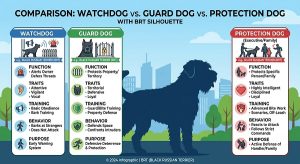
People mix up three different jobs, so let’s separate them:
| Job | What the dog does | Does the BRT fit? |
|---|---|---|
| Watchdog | Notices and alerts you | Yes, naturally |
| Guard dog | Deters intruders and defends its territory and family | Yes, with socialization and structure |
| Protection dog | Bites on command and stops on command | Possible, but only with a qualified professional trainer |
Why does this matter? Because buying a guard dog and expecting a trained protection dog is how families end up in trouble. Instinct gives you the first two. Only careful training gives you the third.
Where the Black Russian Terrier Really Came From
The BRT didn’t drift into guarding over centuries. The Soviet Union designed it.
The work took place at the Red Star Kennel, a state military kennel in Moscow. Purebred stock across Russia had been wrecked by the Revolution and two world wars, so breeders rebuilt from what they could get. After World War II, quality Giant Schnauzers and Rottweilers came in from Germany, and the program took off. The kennel mixed about 17 breeds in total. The four main ones were the Giant Schnauzer, Rottweiler, Airedale Terrier and Newfoundland. A Giant Schnauzer named Roy is often credited as the foundation sire.
The design brief matters more than the history lesson. The FCI breed standard says the goal was a large, brave, strong and manageable working dog with a strong guarding instinct, able to handle many climates. Notice that word, manageable. Soviet handlers didn’t want a dog that just bit. They wanted one they could control around soldiers, prisoners and border crossings.
Breed historians even note a useful detail. The Rottweiler side of the mix is more aggressive, while the Giant Schnauzer side leans toward companion work. The final BRT tilted toward the Schnauzer, which made it more socially acceptable and easier to live with.
Key dates at a glance:
- 1930s–1950s: Red Star Kennel develops the “Black Terrier” group.
- 1955: The group wins a Gold Medal at a Soviet agricultural exhibition.
- 1958: The first official standard appears in a military dog training manual.
- 1981: The USSR Ministry of Agriculture recognizes the breed.
- 1984: The FCI (Fédération Cynologique Internationale) recognizes it.
- 1980s: The first BRTs reach the United States.
- 2001: The AKC accepts the breed into its Miscellaneous Class.
- 2004: The AKC moves it into the Working Group.
BRTs have worked as military police guard dogs at border crossings, prisons and installations. Breed sources also report that they served in military operations in Afghanistan and Bosnia.
And a quick fact check, since many articles get this wrong: despite the name, the BRT isn’t in the Terrier Group. The “terrier” label comes from the Airedale in its ancestry.
How a BRT Actually Guards: Three Layers of Protection
Every good guard dog works in layers. I teach new handlers to think of them like security rings around a house.
Layer 1: Presence (Deterrence)
The AKC describes the BRT as bred to intimidate through its size, demeanor and behavior. Adults commonly weigh somewhere around 80 to 130 pounds (about 36 to 59 kg), and the dense black coat makes them look even bigger. Most burglars want easy, quiet targets. A large, dark, bearded dog watching the gate makes them pick someone else. That’s deterrence, and it stops far more incidents than any bite ever does.
Layer 2: Alertness (Detection)
The FCI standard calls the breed distrustful of strangers and inclined toward strong defense. In real life, that means a BRT notices new people, new sounds and changes in routine. The good news is that a stable BRT does this calmly. Orvis, drawing on AKC breed information, describes the temperament as brave and confident with a calm alertness. You get a dog that alerts, not one that barks at every falling leaf.
Layer 3: Action (Response)
If a real threat crosses the line, a well-bred, well-trained BRT will confront it. This is where handler control matters. A dog that confronts the wrong person, like a delivery driver or a neighbor’s child, is a danger. The breed’s steady nerves are a big plus here, but they don’t replace training.
Here’s how this looks in real life:
- The delivery driver: A good BRT watches him come to the gate, maybe gives two or three deep barks, then settles when you greet him. A poorly socialized one keeps barking, lunges, or hides and snarls.
- The 2 a.m. noise: A stable BRT wakes you, stands between you and the door, and waits for your cue. An anxious one paces, barks nonstop and escalates.
- Visitors you invited: A good BRT checks them out, then relaxes once you show you’re comfortable. A fearful one stays tense all evening.
See the pattern? Calm recovery is the sign of a good guard dog. Loud and constant is just a nervous dog with a big body.
Where the BRT Falls Short as a Guard Dog
No breed is perfect. If you want a Black Russian Terrier guard dog, you need to know these weak spots first.
1. Wary can turn into fearful
The BRT’s natural suspicion of strangers is a feature. But without heavy early socialization, suspicion slides into fear, and a frightened 100-pound dog is unpredictable. Fear-based reactions look different from confident guarding: ears pinned, tail tucked, backing away while barking, a sudden snap. Learn to read these early. My guide on dog bite warning signs every owner should know walks through the stress signals that come before a bite.
2. They hate being left alone
The AKC says BRTs don’t take kindly to alone time. Many owners park a guard dog in a backyard kennel and forget it. With this breed, that backfires. A lonely BRT gets bored, destructive and barky, and some start “guarding” their pen instead of your home.
3. Heat is a real problem
This one almost no competitor covers well. The BRT’s coat was built for Russian winters. The FCI standard describes a natural, untrimmed coat of roughly 5 to 15 cm, and the AKC advises against running these dogs in hot, humid weather. If you live somewhere warm, tropical or desert-dry, plan for:
- A shorter clip (ask a groomer who knows the breed, and never shave to the skin)
- Exercise at dawn or after dark only
- Air conditioning or a fan-cooled, shaded indoor space
- Cool water at all times and regular heat-stress checks
Signs of heat stress include heavy drooling, bright red gums, wobbling and vomiting. Treat it as an emergency.
4. Slow maturity
A BRT puppy looks like a guard dog long before it thinks like one. Expect real reliability at around two to three years, not at one.
5. Other dogs and small pets
In my experience with large guardian breeds, many do best as the only dog or with pets they grew up with. A BRT with strong guarding instincts may treat unfamiliar dogs and small animals differently from family members. Introduce new pets carefully and always supervise.
6. It’s not a beginner’s dog
The AKC says BRTs suit only highly experienced owners. I agree. The mix of size, intelligence and independence needs a handler who stays calm, consistent and clear.
Training Timeline: When Is a BRT Reliable?
Let’s be honest about time. A reliable BRT guard dog isn’t a six-month project. Here’s the roadmap I’d give you:
- 8 to 16 weeks: Socialization first. Introduce lots of people, surfaces, sounds, cars and calm dogs. Keep every experience positive. This window shapes whether adult wariness becomes controlled watchfulness or fear.
- 4 to 12 months: Foundation obedience. Teach sit, down, stay, come, heel and place. Add impulse control: wait at doors, leave it, release on cue. Keep socializing. Puppy classes help even experienced handlers.
- 12 to 24 months: Structure and confidence. The guarding instinct usually shows more clearly now. Build outing manners, calm greetings and a rock-solid “quiet” and “out.” Any formal bite work should start only with a qualified professional, and only once the dog has proven nerves and obedience.
- 2 to 3 years: Maturity. This is when you meet the adult dog. A mature BRT can tell the mail carrier from a real problem, but only if you’ve done the earlier work.
Protect those joints. BRTs are large and grow fast. General large-breed guidance applies: avoid repetitive jumping and long runs on hard ground while the bones are still developing, and feed a large-breed puppy diet until around 18 months.
Want the full step-by-step method? I break down how to build obedience first and protection second in how to train your dog for family protection.
And if you want the foundation pro handlers use to raise stable dogs, my book Beyond the Bark: Inside a Pro Handler’s Playbook for Raising the Ideal Dog covers socialization, leadership, impulse control and exposure training. The principles work for a Black Russian Terrier, Cane Corso, Boerboel, German Shepherd or Malinois. Get your copy of Beyond the Bark here.
Black Russian Terrier vs Other Guard Breeds
So how does the BRT compare with other popular guard dogs? This table gives a handler’s-eye view.
| Breed | Guarding style | Energy and drive | Grooming | Best for |
|---|---|---|---|---|
| Black Russian Terrier | Calm, watchful, territorial | Steady, moderate drive | High (clipping and brushing) | Experienced owners in cool or managed climates |
| German Shepherd | Alert, versatile, handler-focused | High | Moderate (heavy shedding) | Active owners who want a do-it-all dog |
| Rottweiler | Confident, imposing, guarding-focused | Moderate | Low | Experienced owners who want a classic guardian |
| Giant Schnauzer | Alert, athletic, strong-willed | High | High | Owners with time for training and exercise |
| Cane Corso | Assertive, physically dominant | Moderate | Low | Confident handlers with firm, fair control |
The BRT’s edge is its calm, steady nerve and cold-weather build. Its weaknesses are grooming, heat sensitivity and rarity. If you want help choosing between several breeds, read my list of the top 7 guard protection dogs for family safety.
One more point on rarity. In the AKC’s 2025 rankings, which counted 202 breeds, the BRT fell 27 places and now sits among the rarest quarter of breeds. That means fewer breeders, longer waiting lists and a smaller gene pool to choose from.
Health, Costs and What They Mean for a Guard Dog
A guard dog with bad hips isn’t guarding anything. So let’s look at the numbers owners rarely see.
Joint problems
The BRT is generally robust, but hip and elbow dysplasia are the main concerns. A health article published through the Black Russian Terrier Club of America (the AKC parent club) reported that more than 41% of BRTs with hip X-rays sent to the Orthopedic Foundation for Animals (OFA) failed the hip screening, and more than 26% failed the elbow screening. Many dogs are X-rayed but not submitted, so the real picture may differ, but the message is clear: test the parents.
Other conditions to know
- Bloat (GDV): A deep-chested breed risk. Feed two or three meals a day, avoid hard exercise around meals, and know the emergency signs: swollen belly, unproductive retching, pale gums, collapse.
- JLPP: Juvenile laryngeal paralysis and polyneuropathy, a serious inherited puppy disorder with a DNA test. Watch for voice change or noisy breathing.
- Hyperuricosuria: A condition linked to urate bladder stones.
- Eye and heart issues: Eye exams and cardiac checks are on the parent club’s recommended list.
Recommended breeder tests
The parent club recommends hip and elbow X-rays (after 24 months of age), a cardiac exam, an eye exam, and DNA testing for JLPP, plus color genetics tests. Here’s a tip many buyers miss: a CHIC number means the breeder completed the tests. It doesn’t mean the dog passed them. Ask to see the actual results.
Realistic costs
Prices vary by country and breeder, so treat these as ballparks and check your local market:
- Puppy: Often quoted around $1,500 to $3,000 or more in the US from health-testing breeders. Very cheap puppies are a red flag.
- Monthly care: Food, grooming, insurance and routine vet visits commonly land around $250 to $300 for a dog this size.
- Emergency estimates (US insurer figures): Hip dysplasia treatment can run roughly $1,500 to $6,000, elbow dysplasia $1,500 to $4,000, and bloat surgery $1,500 to $7,500.
- Lifespan: About 10 to 12 years.
So what does that mean for you? If you can’t afford a $5,000 emergency, get pet insurance or build a savings buffer before you buy.
Four Myths That Waste Owners’ Money
Myth 1: “BRTs are hypoallergenic.” Not true. The AKC says they aren’t hypoallergenic despite the wiry coat and Airedale ancestry. Some sites repeat this claim, so double-check anything you read.
Myth 2: “Big and black means it will protect you automatically.” Size creates deterrence, not skill. An untrained BRT is a large, worried dog.
Myth 3: “Just chain it outside and it will guard.” The breed is people-oriented. Isolation breeds stress, not loyalty.
Myth 4: “It’s a terrier, so it’s small-dog tough.” The name misleads. It’s a Working Group giant.
Is a BRT Right for You? Honest Checklist
A BRT is probably a great fit if you:
- Have raised large or strong-willed working breeds before
- Can spend serious time on socialization during the first year
- Want a calm, discerning guardian, not a siren
- Live in a cool or well-cooled home with room to move
- Can handle grooming costs and a 10-plus year commitment
A BRT is probably not for you if you:
- Are a first-time dog owner
- Leave the dog alone for long hours
- Live in a hot climate with no cooling
- Want a dog that loves every stranger instantly
- Can’t afford emergency vet care
How to Choose a Puppy and Breeder
A good guard dog starts with good parents. Before you pay a deposit:
- Ask for health results for hips, elbows, eyes, heart and the JLPP DNA test, and verify them on the OFA database or your country’s equivalent.
- Meet the parents. Look for calm, confident dogs that recover quickly from surprises. Skip breeders whose adults are frantic or hiding.
- Ask how the puppies are socialized before they leave, including exposure to noise, surfaces and different people.
- Be careful with “attack-trained puppy” promises. A young puppy can’t be protection trained, and anyone who says so is selling a story.
- Ask about the breeder’s support. Good breeders take dogs back, answer questions for years and screen buyers.
How I Judge a Guard Dog Candidate (E-E-A-T Section)
As a Nigerian Army military working dog instructor and handler with more than 14 years of experience, I’ve seen how often owners pick a guard dog by looks. We do it differently. When I evaluate a candidate of any breed, I look at five things:
- Nerve stability. Does the dog stay steady around sudden noise and movement?
- Recovery time. After a startle, how fast does it return to normal? Seconds is good. Minutes isn’t.
- Social clarity. Can it tell friend from threat without help from its handler?
- Drive balance. Does it have enough drive to work without being driven by it?
- Handler focus. Does it check in with you when things get tense?
The BRT’s breed profile scores well on these, which is why I rate it highly. But individual dogs vary a lot, so evaluate the dog in front of you, not just the breed on paper.
Safety and Legal Basics for Any Guard Dog Owner
This part isn’t glamorous, but it protects you.
- You’re responsible. In most countries, owners are legally liable for injuries their dogs cause. A guard dog doesn’t change that, and a bite to the wrong person can mean heavy penalties.
- Secure your property. Use solid fencing, a locking gate and clear warning signs.
- Check local rules and insurance. Some areas regulate “dangerous” or guard dogs, and some insurers ask about breeds. Call before you buy.
- Never encourage aggression at home. Teasing, rough games with strangers and “testing” the dog create unpredictable behavior.
- Use a professional for bite work. Always.
FAQs
1. Are Black Russian Terriers aggressive?
Not by nature. A well-bred, well-socialized BRT is calm and confident, with natural wariness of strangers. Aggression usually shows up when owners skip socialization, isolate the dog or confuse fear with guarding.
2. Is a Black Russian Terrier good for first-time owners?
Usually no. The AKC says the breed suits highly experienced owners, because it combines large size, high intelligence and independence. A first-timer should start with a more forgiving breed and work up.
3. Are Black Russian Terriers good with kids?
Often yes, with their own family. Breed sources describe them as gentle and playful with children they know. Because of their size, supervise all play, and teach children how to treat the dog.
4. Do Black Russian Terriers bark a lot?
Typically they alert with a few deep barks and then settle. Excess barking usually signals boredom, loneliness or anxiety. Exercise, training and company fix most of it.
5. Can a Black Russian Terrier live in a hot climate?
It can, but it takes effort. Provide cooling, shade, a trimmed coat and early-morning or late-evening exercise. If you can’t cool the home reliably, choose a breed built for warm weather.
Conclusion and Next Steps
So, is a Black Russian Terrier a good guard dog? Yes, and a very good one when it fits your life. The Soviets built it to guard with a clear head, and the breed still shows that steady, controllable nerve. But it needs experienced hands, a cool home, early socialization, joint-health screening and a long training runway.
Your action plan:
- Decide honestly if you have the time, experience and budget.
- Find a breeder who shows hip, elbow, eye, heart and JLPP results.
- Start socialization the first week you bring the puppy home.
- Teach obedience before any protection work.
- Plan for heat, bloat and emergency vet costs.
- Hire a qualified professional for any bite work.
Want more handler-tested advice every week? Subscribe to the ARFS K9 Team weekly articles roundup newsletter: https://arfsk9team.com.ng/newsletter/
Sources and References
- Orvis / AKC breed information: https://www.orvis.com/black-russian-terrier.html
- AKC, Black Russian Terrier History: https://www.akc.org/expert-advice/dog-breeds/black-russian-terrier-history-soviet-superdog/
- AKC, 5 Facts About the Black Russian Terrier: https://www.akc.org/expert-advice/lifestyle/5-facts-black-russian-terrier/
- AKC, Rarest Dog Breeds of 2025: https://www.akc.org/expert-advice/dog-breeds/rarest-dog-breeds-2025/
- FCI Standard No. 327, Russian Black Terrier: https://dev.fci.be/Nomenclature/Standards/327g02-en.pdf
- Showsight, The Black Russian Terrier: A Picture of Health: https://showsightmagazine.com/?p=49001
- Showsight, The Origins and Development of the Black Russian Terrier: https://showsightmagazine.com/the-origins-and-development-of-the-black-russian-terrier/
- Healthy Paws, Black Russian Terrier guide: https://healthypawspetinsurance.com/blog/dog-breeds/black-russian-terrier
- Embrace Pet Insurance, Black Russian Terriers: https://www.embracepetinsurance.com/dog-breeds/black-russian-terrier
- Petfinder, Black Russian Terrier: https://www.PetFinder.com/dog-breeds/black-russian-terrier/

Her work centres on obedience, detection, protection and operational readiness. She favours proven methods built on repetition, consistency and real-world conditioning, so that both dogs and handlers are prepared for high-pressure tasks.
Rofiat represented the Nigerian Army Dog Centre at the Nigerian Army Day Celebration (NADCEL) 2026, where she led demonstrations in obedience, explosive detection, agility and tactical movement. Through articles, training content and documentaries, she shares field-based insight into how structured training, clear communication and trust between handler and dog affect performance and reliability.
She is the author of Beyond the Bark: Inside a Pro Handler's Playbook for Raising the Ideal Dog, a practical guide that helps dog owners and handlers apply professional training principles in everyday situations.
- How to Enter the COBA National Dog Championship - October 20, 2026
- K9 Advantix Dosage Chart & Safety Guide for Dogs - October 19, 2026
- How to Set Up & Use Bousnic Dog Training Collar - October 18, 2026