Is Bull Terrier Dog Breed Good for Protection Work?
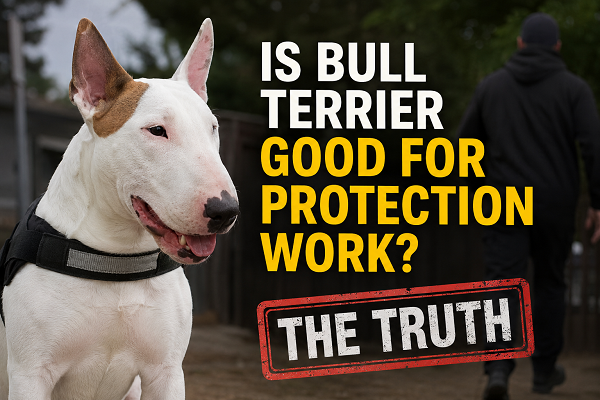
No, a Bull Terrier isn’t a good choice for real protection work. It makes a decent watchdog. Its muscular build and loud bark can put off opportunists. But the breed is too friendly with strangers, too stubborn, and too inconsistent in guarding instinct to be a reliable protection dog. Most also come with a high risk of dog aggression, and white dogs carry a real deafness risk. If you need a dog that can tell a threat from a guest and respond on command, pick a purpose-bred Shepherd, Malinois, Doberman or Rottweiler instead.
Table of Contents
- Introduction
- Watchdog, Guard Dog or Protection Dog? Know the Difference
- Meet the Bull Terrier (and the Target Dog Myth)
- What Bull Terriers Do Well
- Where Bull Terriers Fall Short
- Why Online Sources Disagree
- Are Bull Terriers Used in K9 Units?
- Bull Terrier vs Traditional Protection Breeds
- Health and Legal Risks
- Can You Train a Bull Terrier for Protection?
- What It Really Costs
- So Which Dog Should You Get?
- Why Trust This Guide
- FAQs
- Conclusion
Introduction
Ever stood in a Target store, looked at Bullseye, and thought, “That dog looks like it could handle a burglar”? You’re not alone. Every month, people ask me whether a Bull Terrier is good for protection work.
I get why. That egg-shaped head, the small triangular eyes and the stocky body look tough. But looking tough and working tough are two different things in the K9 world. Mix them up and you end up with a dog that can’t do the job you bought it for.
In this guide, you’ll learn what protection work actually means, how the Bull Terrier measures up, where the Target dog reputation comes from, what the health and legal risks look like, and what to buy instead if safety is your goal.
Watchdog, Guard Dog or Protection Dog? Know the Difference
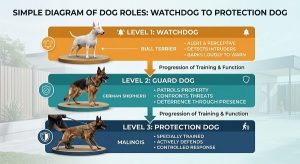
Most articles on this topic blur three very different jobs. Here’s how I separate them.
| Job | What the dog does | Bull Terrier verdict |
|---|---|---|
| Watchdog | Notices something odd and barks to alert you | Yes, if it can hear and it’s awake |
| Guard dog | Deters strangers and defends its territory | Maybe, but inconsistent between individuals |
| Protection dog | Bites on command, releases on command, ignores harmless people, stays calm under pressure | Not reliably |
Think of it like a smoke alarm, a locked door and a firefighter. They all help in a fire, but you wouldn’t swap one for another.
A true protection dog needs an “on/off switch.” It’s relaxed at a barbecue and sharp when a real threat appears. That switch comes from generations of selection for nerve strength (staying stable under stress), drive (the dog’s inner energy for biting, tracking and working), and handler focus. Bull Terriers weren’t built around those traits.
Meet the Bull Terrier (and the Target Dog Myth)
Let’s get the basics straight. The Bull Terrier is often mixed up with the Staffordshire Bull Terrier and the American Pit Bull Terrier. They share ancestry, but they’re different dogs.
Quick breed snapshot:
- Origin: 19th-century England, developed from the Bulldog, the now-extinct White English Terrier, and possibly the Dalmatian (Britannica).
- Original job: Pit fighting, then refined into a fashionable companion
- Size: about 20–24 inches tall and 50–70 pounds for most standard dogs, though some run heavier
- Miniature version: The AKC recognized the Miniature Bull Terrier as its own breed in 1991.
- Breed group: Terrier (not Working, not Herding)
Notice that last line. The breed was never in a guarding or herding group.
The Bullseye Effect
For millions of people, the Bull Terrier is Bullseye. The mascot debuted in Target’s 1999 “Sign of the Times” ad campaign. The first dog was an AKC champion called Kingsmere Moondoggie, nicknamed “Smudgie”. Bullseye is played by female dogs, and Target has six dogs who can step into the role, with two more in training (as of its 2019 post).
Here’s the thing. Bullseye’s calm behavior at store openings comes from professional training and careful handling. It doesn’t prove a guarding instinct. A show dog walking past cameras tells you nothing about how a random Bull Terrier reacts when a stranger rattles your gate at 2 a.m.
Patton’s Willie: A Famous “Military” Bull Terrier
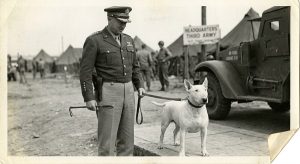
Here’s a story most breed articles skip. General George Patton’s Bull Terrier, “William the Conqueror” (Willie), went everywhere with him in World War II. Yet the AKC describes the dog as gun-shy. The best-known military Bull Terrier in history loved his person, but he wasn’t a combat dog.
That sums up the breed. It’s devoted and full of character. It isn’t a nerve-tested guardian.
What Bull Terriers Do Well
I don’t want to be unfair. The breed has real strengths, and some are useful for home security.
- Courage and tenacity. Bull Terriers don’t back down easily.
- Physical power. Britannica notes that, for its weight, the breed is considered one of the strongest of all dogs.
- Loyalty. They bond deeply with their families.
- Visual deterrent. A muscular, white or brindle dog with an odd head makes many opportunists think twice.
- Protectiveness of “their” things. Orvis notes the breed is protective of its people, food, toys and territory.
That last point cuts both ways. Resource guarding (defending food and toys) isn’t the same as guarding your family. A dog that growls over a bone doesn’t automatically stand between you and a stranger.
And one note on bite force. You’ll see big PSI numbers thrown around online for this breed. Breed-wide bite force numbers aren’t measured reliably, and raw bite pressure isn’t what makes a protection dog. Control, grip, release and judgment matter far more.
Where Bull Terriers Fall Short
These are the problems that stop a Bull Terrier from earning a protection role.
1. They’re too friendly with strangers
Many Bull Terriers greet visitors like long-lost friends. That’s lovely in a pet. In a protection dog, it’s a deal-breaker, because the dog must discriminate between a threat and a guest. Wisdom Panel notes the breed is sociable and quickly accepts others when introduced properly.
2. Dog aggression is a real risk
Because of their fighting ancestry, Bull Terriers often don’t get along with other dogs, especially of the same sex. Britannica warns the breed can be aggressive with unfamiliar animals, which is why it’s a poor dog park candidate.
This matters more than people realize. Protection programs generally want dogs that stay neutral around other dogs. A dog that locks onto every passing dog is hard to control in public. Reactivity to other dogs is one of the most common reasons trainers reject a candidate.
3. They’re stubborn
Bull Terriers are clever, but they like doing things their way. Protection work needs instant, reliable obedience, including the ability to out (release the bite) on the first command. A stubborn dog that gets excited is a risk.
4. Strong prey drive
Cats, small dogs and fast-moving children can all trigger a chase. That’s not protection. It’s a liability.
5. White Bull Terriers can be deaf
This is the point most articles forget. A watchdog has to hear. LSU’s deafness research tested 683 Bull Terriers. In white dogs, about 20% were deaf in at least one ear, versus 1.3% of coloured dogs. About 2% of white dogs were deaf in both ears. A dog that can’t hear the intruder can’t alert you to the intruder. Careful breeders test every puppy.
Why Online Sources Disagree
You may have noticed different websites give different answers. Here’s why.
- Some sites mix up protective of its family with trained to protect.
- Some use “guard dog” loosely to mean “barks at the door.”
- Some copy each other’s profiles without any working-dog experience.
- Vetstreet notes the breed can be protective if the family is in danger, so socialization matters. That’s accurate, but it describes a tendency, not a reliable skill.
- Wisdom Panel notes Bull Terriers often prefer fun, frivolous activities over working-dog jobs. That fits what I’d expect.
When I read all these sources side by side, the honest middle is clear: good watchdog, unreliable guard, poor protection dog.
Are Bull Terriers Used in K9 Units?
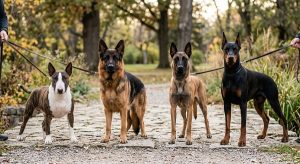
I don’t know of any police or military program that uses Bull Terriers as a standard patrol or protection breed. Handlers worldwide lean on the Belgian Malinois, German Shepherd and Dutch Shepherd, with Dobermans and Rottweilers in some patrol and personal-protection roles.
Those breeds share traits Bull Terriers lack in standardized form:
- Controllable, high working drive
- Clean bite and release
- Generations of selection through working trials (KNPV, IGP/Schutzhund, Ring, Mondioring)
- A dog that switches between “off duty” and “on duty” cleanly
Bull Terrier breeding has centered on the show ring and companionship for well over a century. That’s a different selection pressure. Individual owners have earned protection-sport titles with a Bull Terrier, and I respect that effort. But one exceptional dog is a hobby success story, not proof the breed fits the job.
Bull Terrier vs Traditional Protection Breeds
| Trait | Bull Terrier | German Shepherd | Belgian Malinois | Doberman |
|---|---|---|---|---|
| Bred for guarding/protection | No (pit, then show ring) | Yes | Yes | Yes |
| Working bloodlines | Essentially none | Extensive | Extensive | Established |
| Bite and release reliability | Inconsistent | Strong | Strong | Strong |
| Obedience focus | Stubborn | High | Very high (needs experienced handler) | High |
| Stranger-discrimination | Weak | Strong | Strong | Strong |
| Other-dog neutrality | Often poor | Good with training | Good with training | Good with training |
| Common in real K9 work | No | Very common | Very common | Occasional |
My Handler Scorecard for the Bull Terrier
This is my professional rating out of 5, for protection suitability only. It’s not a rating of the breed as a pet.
| Trait | Score | Why |
|---|---|---|
| Courage | 4/5 | Confident and not easily scared |
| Deterrent look | 4/5 | Unusual and muscular |
| Stranger discrimination | 1/5 | Often too friendly |
| Obedience reliability | 2/5 | Independent and stubborn |
| Neutrality with other dogs | 1–2/5 | Fighting ancestry |
| Predictable temperament | 2/5 | No working lines to rely on |
| Hearing/health consistency | 2–3/5 | Deafness risk in white dogs |
| Overall protection suitability | 2/5 | Great pet, weak protection candidate |
Health and Legal Risks
Most protection-dog articles skip this section. Don’t.
Breed-specific legislation (BSL)
Some countries limit or monitor Bull Terriers. In Ireland, the English Bull Terrier is on the restricted list. Restricted dogs must be securely muzzled in public and led on a strong leash no longer than 2 metres by a person over 16. The list also includes German Shepherds, Dobermans and Rottweilers, so you won’t dodge restrictions just by choosing a different breed.
In the UK, the Dangerous Dogs Act of 1991 named the pit bull terrier, Japanese Tosa, Fila Brasileiro and Dogo Argentino. The Bull Terrier wasn’t named. However, Orvis warns that because Bull Terriers are lumped in with pit-type breeds, some local ordinances include them in bans, restrictions and muzzle rules.
What to do: Check your national law, your city or council rules, your landlord and your home insurance before you buy. Insurers sometimes treat bully-type breeds as higher risk. If you train a dog to bite on command and it injures someone, your legal exposure rises. I’m not a lawyer, so ask a local professional.
Health issues to budget for
The UK Kennel Club lists BAER hearing tests, plus heart and kidney screening schemes for the breed. Wisdom Panel also lists genetic conditions including laryngeal paralysis and lethal acrodermatitis.
Here’s what to ask any breeder:
- BAER hearing results for the puppy, not just the parents
- Heart and kidney screening on both parents
- DNA tests for known inherited conditions
- How old the parents and grandparents lived to
None of this makes the Bull Terrier a bad pet. It does mean you shouldn’t bet your family’s safety on a dog that might be deaf or have heart problems.
Can You Train a Bull Terrier for Protection?
Here’s the honest, nuanced answer. A particular Bull Terrier, from stable parents, with an experienced trainer and a lot of patience, can become a reliable alert dog and maybe a decent deterrent. A few owners have done more. But it’s the exception, not the rule.
If you still want to try, here’s a realistic path.
Step 1: Choose temperament over papers. Meet both parents. Look for calm, confident, bounce-back dogs, not nervous or hyper ones. Ask for the BAER result.
Step 2: Socialize early and widely. The key window runs from about 3 to 16 weeks. Introduce your puppy safely to people, surfaces, noises and well-behaved dogs. This isn’t to make a guard dog. It’s to build a stable one.
Step 3: Build rock-solid obedience (months 3–12). Sit, down, stay, recall and “leave it” must hold up with distractions. Expect it to take longer than with a Shepherd. My article on how to train your dog for security and protection covers this foundation, and the essential protection dog commands show you what every protection-minded dog should know.
Step 4: Teach “speak” and “quiet” on cue. For most owners, this is the smartest goal. A dog that barks on command and stops on command gives you a controlled alert without the risks of bite work.
Step 5: Evaluate honestly at 12–18 months. A professional decoy or protection trainer should test nerve strength, recovery from stress, and neutrality around other dogs. Many programs reject more candidates than they accept, even among Shepherds and Malinois. Be ready to hear “this dog isn’t suited.”
Step 6: Never skip professional help. Controlled bite work done wrong creates a dangerous dog. This is not a YouTube project.
A Safe 3-Minute Home Temperament Check
This doesn’t qualify a dog for protection. It just tells you what you’re working with.
- Doorbell test. Does your dog alert, then settle when you say “enough”? Or does it ignore the bell, or go frantic?
- Stranger test. Have a calm friend walk in. Does the dog stay curious and relaxed, wag and jump, or hide?
- Startle test. Drop a lid or clap from a distance (never close, never to scare). Does the dog recover in a few seconds, or stay shaken?
If your dog is friendly, relaxed and recovers fast, you have a lovely pet. That’s a good outcome. It just isn’t a protection dog.
What It Really Costs
“Just train it myself” sounds cheaper than it is. These are typical ranges. They vary by country and trainer.
- Puppy from a health-testing breeder: roughly $1,500–$3,500 USD
- Basic obedience classes: about $150–$500 for a group course; private lessons cost more
- Professional protection training: often $6,000–$20,000+ for a titled personal-protection dog, with no guarantee your dog has the nerve to finish
- Vet costs: plan higher than average if you buy a white dog with deafness risk
- Already-trained protection dog: commonly $15,000–$60,000+, but built for the job from day one
If the Bull Terrier washes out halfway through training, you’ve paid for a very expensive pet. For some owners, that’s fine. For others, it’s a painful lesson.
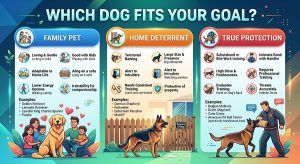
So Which Dog Should You Get?
Answer these honestly.
You want a funny, loyal family dog that barks at strangers.
A Bull Terrier fits beautifully. A visible, vocal dog already deters many opportunists. Pair it with good locks, lighting and an alarm.
You want a dog that can tell a threat from a guest and act under pressure.
Look at working-line German Shepherds, Belgian Malinois, Dutch Shepherds, Dobermans or Rottweilers. First-time owners often do better with a sound Shepherd, Doberman or Rottweiler than with a Malinois, which needs an experienced handler.
You want a tough-looking, bully-type dog.
Remember Bullseye. It’s a trained performer, not a guardian. If you love the bully look, read my breakdown of Pitbull vs American Bully to see how much “tough look, not bred to guard” confusion exists in that whole family.
You already own a Bull Terrier.
Don’t panic. Focus on socialization, obedience and a controlled “speak” and “quiet.” Keep gates secure, supervise around other dogs, and let the dog be a great companion.
Why Trust This Guide
I’m writing this the way I’d talk to a handler at the kennel, not the way a pet-profile site would.
Cpl. Rofiat Muritala is a Nigerian Army military working dog instructor and handler with more than 14 years of experience at the Nigerian Army Dog Centre. Her training includes advanced obedience, K9 patrol and advanced explosive detection courses. She led obedience, explosive detection, agility and tactical movement demonstrations at the Nigerian Army Day Celebration (NADCEL) 2026. She’s also the author of Beyond the Bark.
Sources behind the facts: Britannica (breed overview), LSU Veterinary School (deafness prevalence), The Kennel Club UK (health schemes), Wisdom Panel (genetic conditions), Waterford City and County Council (Ireland’s restricted breeds rules), Target Corporation (Bullseye facts) and the AKC (Patton’s Willie).
FAQs
Is a Bull Terrier a good guard dog?
It’s a decent watchdog and can be a visible deterrent. As a true guard or protection dog, it’s unreliable. Many Bull Terriers greet strangers warmly, and guarding instinct varies widely between individuals.
Can a Bull Terrier be trained as a protection dog?
A few exceptional dogs have earned protection-sport titles, but it takes a stable dog, a skilled trainer and a lot of time. For most owners, a better goal is a controlled “speak” and “quiet” alert. If you need real protection, choose a working breed.
Is Target’s Bullseye a trained protection dog?
No. Bullseye is a show-quality Bull Terrier trained for calm public appearances and ads. The mascot’s polished behavior says nothing about guarding ability.
Are Bull Terriers used by police or the military?
I’m not aware of any police or military program that uses them as a standard patrol or protection breed. Most rely on Malinois, German Shepherds and Dutch Shepherds. Patton’s famous Bull Terrier, Willie, was a beloved companion who, according to the AKC, was gun-shy.
Is a Bull Terrier or a Staffordshire Bull Terrier better for protection?
Neither is a proven protection breed. The Staffordshire is smaller and often more people-focused, while the Bull Terrier is bigger and more stubborn. Both appear on Ireland’s restricted list, and both are better as companions than as trained protectors.
Conclusion
The Bull Terrier is a funny, loyal, one-of-a-kind dog with a famous face. It can bark at strangers, look tough, and love your family with all its heart. But a Bull Terrier isn’t a good choice for real protection work. It’s too stranger-friendly, too stubborn, and often too reactive with other dogs. White dogs also carry a hearing risk that can undermine the watchdog job.
Your action plan:
- Decide whether you need a watchdog, a guard dog or a protection dog.
- If you want a pet that alerts, a Bull Terrier can work. Ask for BAER, heart and kidney test results.
- If you need real protection, choose a purpose-bred working breed from titled lines.
- Check your local laws and your home insurance before you buy.
- Layer your security with locks, lights and alarms. A dog is one tool, not the whole system.
Want the obedience-first foundation behind every real protection program? My book Beyond the Bark: Inside a Pro Handler’s Playbook for Raising the Ideal Dog walks you through it step by step.
Get more weekly K9 tips: Subscribe to our weekly articles roundup at arfsk9team.com.ng/newsletter and get new training, breed and security guides in your inbox.

Her work centres on obedience, detection, protection and operational readiness. She favours proven methods built on repetition, consistency and real-world conditioning, so that both dogs and handlers are prepared for high-pressure tasks.
Rofiat represented the Nigerian Army Dog Centre at the Nigerian Army Day Celebration (NADCEL) 2026, where she led demonstrations in obedience, explosive detection, agility and tactical movement. Through articles, training content and documentaries, she shares field-based insight into how structured training, clear communication and trust between handler and dog affect performance and reliability.
She is the author of Beyond the Bark: Inside a Pro Handler's Playbook for Raising the Ideal Dog, a practical guide that helps dog owners and handlers apply professional training principles in everyday situations.
- How to Enter the COBA National Dog Championship - October 20, 2026
- K9 Advantix Dosage Chart & Safety Guide for Dogs - October 19, 2026
- How to Set Up & Use Bousnic Dog Training Collar - October 18, 2026