3 Critical Commands Every Police Dog Must Master
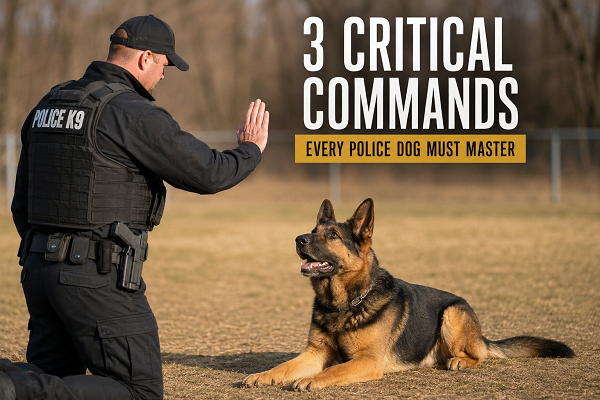
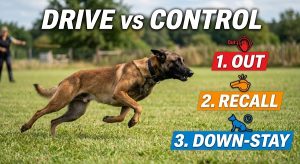
The three police dog commands that matter most are out (release the bite), recall (come back, including breaking off a pursuit mid-run) and down-stay (hold position under noise, pressure or distraction). Out matters most. Courts keep asking one question in K9 bite cases: how long did the dog keep biting after the suspect stopped resisting? A dog that can’t let go on the first command is a danger to the public, the handler and the whole unit.
Table of Contents
- Why These Three Commands Come Before Everything Else
- The Three Commands at a Glance
- Command 1: Out (Aus), the Release
- Command 2: Recall (Hier) and the Call-Off
- Command 3: Down-Stay (Platz, Bleib)
- The Step Before the Commands: The Warning
- How Long Does It Take, and What Do Certifiers Test?
- Keeping the Commands Sharp After Graduation
- Self-Test: Is Your Dog’s Control Really Reliable?
- What Protection Dog Owners Should Take From This
- Why You Can Trust This Guide
- FAQs
- The Bottom Line
Introduction
Picture a live bite-work demo. The dog is locked on, muscles tight, every instinct saying finish this. Then the handler says one word and the dog lets go as if someone flipped a switch.
That moment isn’t luck. It’s hundreds of hours of boring, repetitive work. And it’s the line between a defensible police K9 deployment and a lawsuit.
Here’s the problem. Most articles on police dog commands give you a generic list: sit, stay, come, heel. Those matter, but they aren’t what end careers. The commands that do are the ones you need when the dog is at full speed, full drive and full adrenaline.
In this guide you’ll learn:
- Why out, recall and down-stay carry more weight than any other police K9 skill
- What real court cases show when the out fails
- How to train each command, with a step-by-step progression and the mistakes that wreck it
- What certification standards in the US and UK actually test
- A 10-point self-test you can run on any working or protection dog
Whether you’re a serving handler, a trainee or a protection dog owner, you’ll walk away with something you can use this week.
Why These Three Commands Come Before Everything Else
Ever wonder why some police dog commands matter far more than others? Or why a K9 team can be superb at finding narcotics and still fail certification? It comes down to one idea: drive gets a dog into the program, control keeps the team in it.
A police dog is bred for drive. The Belgian Malinois, German Shepherd and Dutch Shepherd dominate police work because they chase, grip and don’t quit. But that same drive becomes a liability the second the situation changes. A suspect surrenders. A bystander steps into the path. Officers realize they’ve got the wrong person. The only thing standing between the dog and a bad outcome is a command.
Look at what the rule books say:
- South Carolina’s minimum standards for patrol canines require the team to pass an aggression test that includes a recall and a verbal out within a reasonable amount of time.
- The International Police Work Dog Association (IPCA) patrol standards build the apprehension phase around bite, out, recall and a call-off while the dog is still running toward the suspect. Their certifications last one year, and a re-bite after a release can count against the team.
- A Baton Rouge Police Department policy requires a recall from apprehension in its certification, with a minimum score of 490 out of 700 points.
- A county policy I reviewed tells handlers to call the dog off at the first safe moment and to track bite ratios monthly, for the team and the whole unit.
Notice the pattern. Every serious standard measures control, not aggression.
Even directed searches, where you send a dog off leash to clear an area, rest on these skills. Leerburg’s training material says the dog must understand down-stay and have a reliable recall before you start directed search work. That makes sense: if you can’t stop the dog or call it back, you can’t send it anywhere.
The Three Commands at a Glance
| Command | Common cue (German / English) | Used when | Biggest risk if it fails |
|---|---|---|---|
| Out | Aus / “Out” | Dog is on a bite and must release | Injury to a surrendering suspect, lawsuits |
| Recall / Call-off | Hier / “Come” | Dog is running or searching and must return or abort | Dog bites the wrong person or a bystander |
| Down-Stay | Platz, Bleib / “Down, stay” | Gunfire, loud scenes, search pauses, crowds | Dog bolts, enters danger or is hurt |
Command 1: Out (Aus), the Release
If you only remember one command from this article, make it this one.
What is the out command? The out (often aus, said “ows”) tells a dog to release its grip right now and disengage. One word, and a 30 to 40 kg (65 to 90 lb) dog has to let go of something it was bred and trained to hold.
Why Out Carries So Much Legal Weight
Bite-and-hold is a standard method for many patrol K9 programs. Courts don’t usually argue about whether the dog was sent. They ask how long the bite lasted after the suspect stopped resisting.
Here are real cases that show why:
| Case | What happened | Outcome |
|---|---|---|
| Rosenbaum v. City of San Jose (9th Cir., 2024) | Police dog Kurt held a bite for more than 20 seconds after Zachary Rosenbaum surrendered, lying prone with his arms out. About 43 seconds passed from deployment upstairs to release. | The appeals court refused the officers qualified immunity. It said the law is clear that letting a dog keep biting a fully surrendered suspect violates the Fourth Amendment. |
| Sligh v. City of Conroe (5th Cir., 2023) | K9 Thor bit Olivia Sligh for about 62 to 64 seconds in 2018. The handler gave release commands starting about eight seconds in, and the dog didn’t comply. The handler grabbed the collar about 36 seconds after the bite command. | The appeals court found excessive force but shielded the officer with qualified immunity. A lower court had dismissed the suit earlier. |
| Bates v. Brentwood (California, 2020 incident) | A German Shepherd bit a woman’s head for roughly a minute. A federal judge said a jury could find that the handler should have called the dog off about 30 seconds in, and that another 40 seconds after a verbal surrender was serious. | The city paid $967,000 in 2024. The police chief later said the department had no working K-9 officers. |
| St. Paul, Minnesota (bystander case) | A K9 tracking a burglary suspect clamped onto a woman taking out her trash. It did not let go after multiple commands. | The city reached a tentative $520,000 settlement. The handler and dog went back to training for another month. |
| Edwards v. Shanley (11th Cir., 2012) | The court examined a five-to-seven-minute dog attack on a man lying face down and pleading for officers to call the dog off. | The court held that clearly established law forbids that level of force. |
Two things stand out. First, nobody in these cases argued about whether the dog could bite. The fights were about the gap between “suspect stops resisting” and “dog actually lets go.” Second, in Conroe and Brentwood the handler ended up physically pulling or removing the dog. That works once. It isn’t a command.
A quick note: this is educational information, not legal advice. Court outcomes depend on specific facts.
How the Out Is Trained: A Five-Step Progression
Here’s the progression I teach. The idea behind it is simple: the dog must learn that letting go is the doorway to something better, not the end of the fun.
- Teach the release away from the bite. Start with a tug or ball at low excitement. Say your marker word, wait for the grip to open, then give the toy right back. The dog learns that letting go makes the game continue.
- Raise the excitement. Do the same exercise when the dog is wound up. Keep rewarding the release with an instant restart.
- Move to bite equipment with a still helper. On a sleeve or suit, give the out and have the helper freeze the moment the dog lets go. A dog that sees “out equals the fight stops” learns exactly what a real surrender looks like.
- Add movement, stress and distance. Now the helper struggles, yells and pulls. The dog must still out on the first command, mid-bite and mid-shake, and must not re-grip.
- Proof it everywhere. New locations, night work, crowds, gunfire at a distance, a tired dog and a fresh dog. If the out only works on your home field, you don’t have an out.
Some programs add a remote collar to back up the verbal command. That’s a decision for qualified trainers, and it never replaces a dog that understands the exercise. Gear matters too. A sleeve that’s too hard or too soft changes how the dog grips and how it outs, so read my guide to choosing the right bite sleeve strength before you start.
Out Mistakes I See Most Often
- Repeating the command. “Out, out, OUT” teaches the dog that the first word is optional. Say it once, clearly. If it fails, that’s a training gap, not a reason to shout.
- Relying on a collar grab. If you need your hands on the dog to end a bite, the verbal out isn’t trained.
- Training out only with one helper in one place. Dogs read context. Vary everything.
- Skipping the “no re-bite” rule. A dog that outs and instantly re-grips hasn’t learned the exercise. IPCA’s own standards treat re-bites as a problem.
- Punishing the release. If letting go brings a harsh correction, the dog holds on tighter next time.
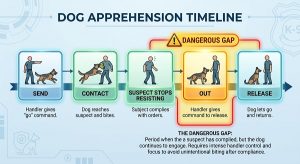
If you want to understand why this is the hardest thing to teach, read my breakdown of obedience vs. instinct and how to balance drive and control. The out fights the dog’s own prey and defense drive, which is why we test it every year, not once at graduation.
Command 2: Recall (Hier) and the Call-Off
The second command stops a dog before teeth touch skin.
What’s the difference between a recall and a call-off? A recall brings the dog back to the handler from a distance. A call-off aborts a pursuit that’s already underway. The IPCA standards test both, including a call-off while the dog is still en route to the decoy. Many guides lump them together. They shouldn’t. A call-off is the same skill at the hardest possible moment.
Why It Matters as Much as the Out
Think about the seconds between “send” and “contact.” A suspect drops to the ground. A civilian wanders into the path. The description turns out to be wrong. In each case, the only tool a handler has is a dog that will break off a full-speed run on one word.
A recall on a calm walk is a different animal from a recall at full prey drive. That’s exactly why so many high-drive dogs wash out in selection.
Training Stages That Work
- Foundation recall. No distractions. Make coming to you the best thing in the dog’s day.
- Add distance and a long line. Practice at 5, 10, then 20 meters. Mix up the rewards: food, a toy, a short game.
- Add distractions. Other dogs, moving people, interesting smells. Start easy and build.
- Drive recall. Recall from a chase on a toy, then from a helper running, with the helper going passive as a visual cue at first.
- Call-off en route. Send the dog toward the helper, then call it off before contact. Gradually remove the visual cue until the verbal command alone works at distance.
Here’s a rule I use: make a good share of your apprehension drills end in a recall, not a bite. If every run ends in contact, the dog learns that running always equals biting, and your call-off gets weaker every week.
Recall Mistakes
- Poisoning the recall. If “come” only ever means “fun is over,” the dog stops coming. Sometimes recall the dog and then send it right back to work.
- Calling when you can’t enforce it. Use a long line until the behavior is solid.
- Changing the word. Pick a cue and keep it. “Hier,” “here,” “come” and “get back” are four different words to a dog.
- Rewarding slow responses. A recall that arrives in ten seconds isn’t a recall. Reward speed.
For a broader command set, including how recall fits with the rest of a working dog’s vocabulary, see my guide to the 10 essential protection dog commands.
Command 3: Down-Stay (Platz, Bleib)
Platz (down) sounds like the dull one. Ask any handler who has worked a barricaded-suspect call or a building search and you’ll hear a different story.
Where Down-Stay Earns Its Keep
- Gunfire and loud noise. Certification scenarios check how a dog handles gunfire. A dog that holds a down while officers assess the scene is a dog that stays alive and stays useful.
- Search pauses. When you need to listen, use the radio or talk to a partner, the dog must hold position instead of drifting into unclear space.
- Directed searches. As noted earlier, directed search training assumes a solid down-stay and recall.
- Crowds and bystanders. Planting the dog in place beats having it mill around a chaotic scene.
- Officer safety. If you need both hands free for a radio, a weapon or a first-aid job, the dog must hold without you.
IPCA’s obedience routine also tests the down in motion, where the dog drops on command while moving. That’s a different skill from a static down, and it’s worth training on its own.
How to Build It: Duration, Distance, Distraction
Trainers talk about “the three Ds.” Build them one at a time:
- Duration. Start at a few seconds and add small steps. Return to the dog and reward calmly before you release. Don’t make big jumps.
- Distance. Step one pace away, then two, then ten, then out of sight. Return to the dog to reward it, so the dog learns that staying is where the reward lives.
- Distraction. Add people walking past, other dogs working nearby, then sudden noises. Introduce gunfire gradually, from far away at first, only after the dog is calm with every other distraction.
Always teach a clear release word (“free” or “okay”) so the dog knows exactly when the stay ends. Without it, dogs invent their own endings.
Down-Stay Mistakes
- Rushing to gunfire. Skip the build-up and you can create a noise-sensitive dog for life.
- Ignoring the ground and the weather. Hot tarmac or a slick floor will break a stay for the wrong reason. Check surfaces and heat.
- Always releasing from the same spot. Vary where you release from, or the dog anticipates.
The Step Before the Commands: The Warning
There’s one more item that sits right before these three commands: the verbal warning before a deployment. Court decisions in the US have repeatedly treated a missing warning as a serious problem. One Eighth Circuit case allowed a claim to proceed because officers allegedly gave no warning before releasing a bite-and-hold dog, and a Fourth Circuit line of cases treats failing to warn as objectively unreasonable. The warning also gives the suspect a last chance to comply, which can prevent the whole sequence.
How Long Does It Take, and What Do Certifiers Test?
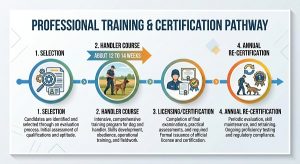
How long does it take to train a police dog on these commands? There’s no single number. Programs differ by country, dog and job, but here’s what the published material shows:
| Program / standard | What the sources say |
|---|---|
| UK general-purpose police dog courses | Surrey and Sussex Police list a 12-week general-purpose course accredited under the NPCC (National Police Chiefs’ Council). Devon and Cornwall’s dog section has reported 12-week and 13-week courses with a licensing assessment by an instructor from another force. |
| UK overseas example | The Royal Gibraltar Police reported an 8-week UK course element, then a national licensing assessment covering obedience and control, tracking, searching and detaining offenders. |
| US example (older report) | A Fairfax County, Virginia handler described a 14-week basic course, with obedience as the most important lesson. |
| Certification validity | IPCA patrol certifications are valid for one year. |
| Minimum control standard | South Carolina requires a recall and verbal out within a reasonable amount of time. |
Notice the word “reasonable.” The rules don’t give you a stopwatch number, which is exactly why you should set your own tight standard. Mine: a clean release on the first command, with no re-bite.
Keeping the Commands Sharp After Graduation
Graduating isn’t owning the skill. A command that looked flawless on a calm training field can fall apart the first time adrenaline hits. Here’s what reliable teams do:
- Train often and log it. Many agencies set a monthly training-hour minimum, with 16 hours a month a commonly cited figure. Check your own agency’s policy.
- Review video. Film out and recall reps and time them. Your eyes will lie to you in the moment. The footage won’t.
- Track bite ratios. Some policies require supervisors to calculate bite ratios monthly for each team and for the unit.
- Re-certify every year, with real scenarios and not just paperwork.
- Retrain after any incident. After the St. Paul incident, the handler and dog went back for another month of training. That’s the right instinct.
- Confirm the target before release. Look at what the dog is focused on and who is actually in front of it.
If you’re building toward this level, my e-book Beyond the Bark walks through the progression I use with working dogs, from foundation obedience through proofing under pressure.
Self-Test: Is Your Dog’s Control Really Reliable?
Run this on any working or protection dog. Be honest. Film it.
- Does the dog out on the first command, every time, mid-bite?
- Does it stay off after the out (no re-bite)?
- Does it out with a different helper, location and time of day?
- Does it out when tired, and when fresh and wound up?
- Does it recall from 20 meters or more with a distraction in play?
- Can you call it off mid-run toward the decoy?
- Does it hold a down-stay for 3 minutes or more with people walking past?
- Does the stay survive a sudden noise?
- Does it down on command while moving?
- Can your handler do all of this without touching the dog?
Fewer than 10 “yes” answers? That’s your training plan. Fix the weakest item first.
What Protection Dog Owners Should Take From This
You may not be a police handler. But if you own a protection or guard dog, you carry legal responsibility too. If your dog can’t out on command, it shouldn’t be doing bite work, full stop.
Start with obedience, then build the out, recall and down-stay in that order of priority. Don’t let anyone talk you into “bite work first, control later.” That’s backward, and it’s how dogs end up in the news.
Why You Can Trust This Guide
About the author: Cpl. Rofiat Muritala is a Nigerian Army military working dog instructor and handler with more than 14 years of experience at the Nigerian Army Dog Centre. She has completed advanced obedience, K9 patrol and advanced explosive detection courses, and she led obedience, explosive detection, agility and tactical movement demonstrations at the Nigerian Army Day Celebration (NADCEL) 2026. She is the author of Beyond the Bark.
How this guide was researched: Legal cases come from published court opinions and news reports. Certification details come from published agency standards and policies. Everything is paraphrased and linked in the references below. Training steps reflect handler practice and are meant to be adapted by qualified trainers for the individual dog.
FAQs
1. What is the most important command for a police dog?
The out (release) command is usually the most critical. A delayed release is the common thread in many K9 excessive-force cases. A dog can be excellent at everything else and still be unfit for duty if the out isn’t reliable.
2. How do police dogs know when to let go of a bite?
They learn it through repetition. The dog is taught that a specific word means “release,” and that releasing leads to something rewarding or a continued game. Trainers then proof the command under stress, with movement and distractions, until it works on the first cue even mid-bite.
3. Why do police dogs often respond to German commands?
Many police dogs come from European working lines, where commands like aus, platz, hier and fuss became standard. Dogs trained in Europe usually learn commands in that country’s language, and it’s easier for an officer to learn new words than to retrain the dog. A distinct cue also helps because a suspect can’t easily confuse the dog by shouting everyday English words like “no” or “stop.”
4. How long does it take to train a police dog on these commands?
Foundation work starts before a handler gets the dog, and initial handler courses often run around 12 to 14 weeks in the examples above. But true reliability takes longer. It’s built and re-tested for the dog’s entire working life through maintenance training and annual certification.
5. What happens if a police dog won’t release on command?
The handler may have to physically remove the dog, the suspect can suffer serious injury, and the department can face lawsuits. As the Conroe, Brentwood and St. Paul cases show, the fallout includes court rulings, settlements and, in some cases, a unit with no working K9s.
The Bottom Line
Police dog commands get less attention than bite work, and that’s a mistake. Police K9 work looks like drive and power from the outside. But the real measure of a good police dog isn’t how hard it bites. It’s whether it lets go the instant it’s told, breaks off a full-speed run on a single word, and holds position under pressure.
Here’s your action list:
- Out: Train it as a game first, make release lead to more fun, and proof it everywhere. Never rely on grabbing the collar.
- Recall and call-off: Keep the recall rewarding, practice call-offs often and don’t repeat commands.
- Down-stay: Build duration, distance and distraction one at a time, and add gunfire slowly.
- Maintenance: Log it, film it, test it and re-certify every year.
Get these three right and you’ve got a dog that’s effective, safe and defensible. Skip them and you’re one incident away from a courtroom.
Want more handler-level training insight every week? Subscribe to our weekly articles roundup newsletter: https://arfsk9team.com.ng/newsletter/
References and Sources
- Ninth Circuit opinion, Rosenbaum v. City of San Jose (2024): https://cdn.ca9.uscourts.gov/datastore/opinions/2024/07/11/22-16863.pdf
- NBC News coverage of the Conroe, Texas case (Sligh): https://www.nbcnews.com/news/us-news/patrol-dog-bit-unarmed-woman-62-seconds-was-excessive-force-judges-rul-rcna126292
- Legal analysis of the Fifth Circuit’s Sligh decision (LLRMI): https://www.llrmi.com/?p=8683
- Courthouse News on the Brentwood, California K-9 case: https://courthousenews.com/bay-area-cop-cant-dodge-excessive-force-claims-over-k-9-bite-injuries/
- NBC News on the $967,000 Brentwood settlement: https://www.nbcnews.com/news/rcna180719
- Law Officer on the St. Paul $520,000 settlement: https://www.lawofficer.com/woman-to-receive-520000-after-attack-by-k-9-dog/
- Eleventh Circuit decision on a five-to-seven-minute K9 attack (Leagle): https://www.leagle.com/decision/infco20120112072
- IPCA Patrol Certification Standards: https://cnca.com/wp-content/uploads/2024/01/Standards-Patrol-Certification-IPCA.pdf
- South Carolina Criminal Justice Academy, Patrol Canine Certification Guidelines (2026): https://sccja.sc.gov/wp-content/uploads/Guidelines-for-Initial-Patrol-Canine-Team-Certification-2026.pdf
- Baton Rouge Police Department canine certification procedure: https://www.brla.gov/DocumentCenter/View/16706/Intra-Division-Procedure-502-95-15-K-9-Team-Certification-Requirements
- Surrey and Sussex Police Dog School courses: https://www.surrey.police.uk/police-forces/surrey-police/areas/au/about-us/dog-school/dog-training-courses/
- Devon and Cornwall Police Dog Section training blog: https://dogsection.devon-cornwall.police.uk/2019/12
- Royal Gibraltar Police training report: https://www.yourgibraltartv.com/crime/13411-dec-15-pc-olivero-and-police-dog-ness-receive-certificate-of-excellence
- Leerburg, Training Off-Leash Control and Directed Search: https://leerburg.com/flix/player.php?flixid=564
- Berlitz, German dog training commands: https://www.berlitz.com/en-ca/blog/german-dog-training-commands
- Connection Newspapers, Fairfax County K-9 unit profile (2007): https://m.connectionnewspapers.com/news/2007/jul/24/dogs-that-criminals-fear

Her work centres on obedience, detection, protection and operational readiness. She favours proven methods built on repetition, consistency and real-world conditioning, so that both dogs and handlers are prepared for high-pressure tasks.
Rofiat represented the Nigerian Army Dog Centre at the Nigerian Army Day Celebration (NADCEL) 2026, where she led demonstrations in obedience, explosive detection, agility and tactical movement. Through articles, training content and documentaries, she shares field-based insight into how structured training, clear communication and trust between handler and dog affect performance and reliability.
She is the author of Beyond the Bark: Inside a Pro Handler's Playbook for Raising the Ideal Dog, a practical guide that helps dog owners and handlers apply professional training principles in everyday situations.
- Westminster Dog Show 2026: Winners & Full Results - October 17, 2026
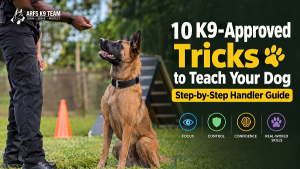
- 10 K9-Approved Tricks to Teach Your Dog (Step-by-Step) - October 16, 2026
- COBA National Dog Championship 2026: Full Guide - October 15, 2026