Ringworm in Puppies: How to Spot and Treat It Fast

Ringworm in puppies is a contagious fungal skin infection, not a worm. It usually shows up as round, scaly, hairless patches on the face, ears, paws or tail. To treat it, your vet confirms the diagnosis with a fungal culture, then prescribes oral antifungal medicine (usually itraconazole or terbinafine) plus medicated lime sulfur dips or shampoos. Treatment normally runs six weeks or more, and your puppy counts as cured only after two negative fungal cultures. Because the fungus spreads to people and other pets, you also need to isolate the puppy and clean the home every day.
Table of Contents
- What Is Ringworm in Puppies?
- Why Puppies Catch Ringworm So Easily
- How to Spot Ringworm in Puppies: Symptoms to Watch For
- Ringworm vs Mange vs Allergies: How to Tell Them Apart
- How Vets Diagnose Puppy Ringworm
- How to Treat Ringworm in Puppies Effectively
- Week-by-Week Treatment Timeline
- Home Remedies: What Works and What Is Dangerous
- How to Clean Your Home After Puppy Ringworm
- Protecting Your Family and Other Pets
- Isolation Without Ruining Socialization
- How Much Does Ringworm Treatment Cost?
- Prevention Checklist for Owners, Breeders and K9 Handlers
- A Handler’s Field Notes
- FAQs
- Conclusion
Introduction
You’re cuddling your new puppy and notice a small bald spot on the ear. It’s dry, a bit crusty, and your puppy barely seems to notice it. Most owners shrug it off. Then a week later, the spot has doubled, and your child has a red ring on their arm.
That’s how ringworm in puppies usually goes. It looks minor, it spreads quietly, and by the time people take it seriously, the whole household is dealing with it.
I’ve seen this happen with pet puppies, kennel litters and young working-dog prospects. The good news? Ringworm is very treatable. The bad news? It takes patience, and a lot of owners quit too early or clean too little.
In this guide, you’ll learn:
- How to recognize puppy ringworm symptoms early (and not confuse them with mange)
- How vets confirm the diagnosis
- The treatments that actually work, with a realistic timeline
- How to clean your home so the infection doesn’t come back
- How to protect your kids, your other pets and yourself
- How to keep your puppy socialized while they’re in isolation
- What treatment costs and how to prevent a repeat
Let’s start with the basics.
What Is Ringworm in Puppies?
Ringworm is a fungal infection of the skin, hair and sometimes the nails. The medical name is dermatophytosis. It has nothing to do with worms. The old name came from the round, ring-like rash it can leave on skin.
The fungi involved are called dermatophytes. They feed on keratin, the protein in hair, skin and nails. According to the Merck Veterinary Manual, about 70% of canine cases are caused by Microsporum canis, roughly 20% by Microsporum gypseum and about 10% by Trichophyton mentagrophytes.
Why does that matter? Because each one spreads differently:
- M. canis passes mainly from animal to animal (and from animals to people). Cats are a common source, even when they look perfectly healthy.
- M. gypseum lives in soil. Puppies that dig a lot pick it up from the ground.
- T. mentagrophytes often links back to rodents and other small animals.
Is ringworm dangerous? For a healthy puppy, usually not. It’s more annoying than deadly. But in very young, sick or underfed puppies, it can spread across the body and become hard to clear. It also spreads to people, which is the part that worries most families.
Why Puppies Catch Ringworm So Easily
Adult dogs with healthy skin and strong immune systems often resist ringworm. Puppies don’t have that defense yet.
Here’s why they’re the perfect target:
- Immature immune system. Puppies are still building their defenses, especially under 6 months old.
- Stress. A new home, travel, rehoming and vaccinations all stress a puppy, and stress weakens immunity.
- Crowded places. Shelters, pet shops, breeding kennels and puppy classes all put many young animals in close contact.
- Poor nutrition or worms. A puppy with parasites or a poor diet has weaker skin and coat protection.
- Skin damage. Scratches, flea bites and rough play let the fungus in.
- Digging and rolling. Puppies explore the world with their paws and nose, so they touch contaminated soil and surfaces constantly.
Some breeds seem to struggle more. The Merck manual notes that Yorkshire Terriers can develop persistent, widespread infections. Long-coated and toy breeds also hide lesions well, so you often find the problem late.
How the fungus spreads
Ringworm spreads three main ways:
- Direct contact with an infected dog, cat or person
- Contaminated objects like bedding, brushes, collars, crates, bowls and carpets
- Soil that holds fungal spores
Here’s the part many owners miss. The spores can stay alive in the environment for up to 18 months, according to VCA Animal Hospitals. Some sources say up to two years. That’s why cleaning matters just as much as medicine.
Also, some puppies carry the fungus without any visible lesions. They look healthy but still spread it. Veterinary behaviorists and shelter vets call these dogs “asymptomatic carriers.”
How to Spot Ringworm in Puppies
Ringworm doesn’t always look like a neat ring. In fact, many puppies never develop one. Think of it as a “patchy, scaly, broken-hair problem” and you’ll catch more cases.
The main puppy ringworm symptoms
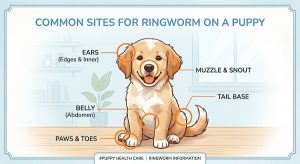
- Circular or uneven bald patches, often on the face, ears, paws and tail
- Scaly, flaky or dandruff-like skin inside the patch
- Crusty or red skin at the edge of the lesion
- Broken, stubby hairs around the border (a classic clue)
- Darkened or thickened skin in older lesions
- Mild itching or no itching at all
- Brittle, rough or misshapen claws
- Rarely, nodules or oozing sores (deeper infection, usually in severe cases)
Early signs vs advanced signs
| Stage | What you’ll see |
|---|---|
| Early (days 1 to 7) | One small, dry, crusty bald spot, often on the face, ear or paw. Skin may look slightly gray or flaky. |
| Developing (weeks 2 to 3) | Patch grows, hair breaks off, edges turn red or scaly. New spots appear. |
| Advanced (weeks 4+) | Multiple patches, thick crusts, darker skin, nail changes. Possibly spreads to family members. |
Where to check on your puppy
Run your hands over these areas every day for the first few months:
- Around the eyes and muzzle
- Inside and behind the ears
- Between the toes and on the paw pads
- Base of the tail
- Belly and inner thighs
- Under the collar
Handler tip: Check with your fingers, not only your eyes. In thick or dark coats, you’ll often feel a rough, crusty spot before you see it. I teach every new handler to do a “hands-on body check” while grooming. It takes two minutes and catches skin problems early. If you want more on this habit, read our guide on essential dog grooming tips for a healthy puppy.
Ringworm vs Mange vs Allergies
This is where most owners (and some first-time breeders) get stuck. Several skin problems look alike. Here’s a side-by-side comparison to help you tell them apart. It can’t replace a vet exam, but it shows you what to expect.
| Feature | Ringworm | Mange (demodectic or sarcoptic) | Allergies | Bacterial skin infection (pyoderma) |
|---|---|---|---|---|
| Cause | Fungus | Mites | Food, pollen, fleas, etc. | Bacteria |
| Itch level | Mild or none | Mild (demodex) to severe (sarcoptic) | Moderate to severe | Moderate |
| Hair loss | Round or uneven patches, broken hairs | Patchy loss, often around eyes and muzzle (demodex), or ears and elbows (sarcoptic) | Often all over, with chewing and licking | Patchy, with pimples and crusts |
| Skin look | Scaly, crusty | Red, flaky, sometimes greasy | Red, inflamed | Pimples, pus bumps, collarettes |
| Spreads to humans? | Yes | Sarcoptic mites can cause a temporary rash | No | No |
| How to confirm | Fungal culture, PCR, Wood’s lamp | Skin scraping | Elimination diet, allergy tests | Skin cytology |
Quick rule of thumb: Mild itch, scaly patch, broken hairs, and a family member with a rash? Think ringworm. Intense scratching and chewing? Think mange or allergies first. But don’t guess. Puppies can have two problems at once, such as ringworm plus bacterial infection.
How Vets Diagnose Puppy Ringworm
You can’t diagnose ringworm by looking at it, and your vet can’t either. Many skin conditions look the same. So vets use a mix of tests.
| Test | How it works | Speed | Pros | Cons |
|---|---|---|---|---|
| Wood’s lamp | UV light in a dark room. Some M. canis strains glow apple-green. | Instant | Quick, painless screening | Not every strain glows. A negative result does not rule ringworm out. Some medicines and debris can cause false glows. |
| Microscope exam | Vet plucks hairs and checks for fungal spores | Minutes | Fast, cheap | Needs experience. Can miss infections. |
| Fungal culture | Hairs are grown on special medium | A few days to 3 weeks | The gold standard. Also used to track cure. | Slow |
| PCR test | Detects fungal DNA | 1 to 3 days | Fast and sensitive | Can detect dead spores, so a positive after treatment doesn’t always mean active infection |
What I recommend: Ask your vet for a fungal culture even if the Wood’s lamp looks positive. The culture also gives you a baseline for later. And always ask what species of fungus it is, since that tells you where it came from (cat, soil or rodent).
Why the culture matters later
You’ll hear the phrase “mycological cure.” It simply means the fungus is gone, proven by lab results. This is different from “clinical cure,” where the skin simply looks healed.
The two don’t happen together. A puppy’s skin can look perfect while it still sheds spores. That’s why vets repeat cultures during treatment and want two consecutive negative cultures before they call the puppy cured.
How to Treat Ringworm in Puppies
Here’s the direct answer many people search for:
How do you treat ringworm in puppies? Vets treat ringworm with a three-part plan: oral antifungal medicine, topical treatment such as lime sulfur dips or antifungal shampoo, and cleaning the environment. Treatment usually lasts at least six weeks and continues until two fungal cultures come back negative.
Mild cases can sometimes clear on their own in a few months. But waiting is risky. Your puppy stays contagious that whole time, and your family stays exposed. Treating early is faster, safer and cheaper in the long run.
The three-part plan
1. Oral antifungal medicine
Topical treatment alone often isn’t enough, because the fungus lives inside the hair shaft and follicle. Most vets prescribe one of these:
- Itraconazole. Often the first choice. A common dose for dogs is around 5 mg/kg by mouth once daily, though vets may use different schedules. A shelter medicine program at the University of Florida notes that the licensed liquid form works better than compounded versions, which can absorb poorly.
- Terbinafine. Another well-used option, often given at around 30 to 40 mg/kg once daily. It’s usually well tolerated.
- Griseofulvin. An older medicine that vets use less often now. It can cause stomach upset and isn’t safe for pregnant animals.
- Fluconazole or ketoconazole. Sometimes used in specific cases, though ketoconazole has more side effects.
Important: These dose figures are examples from veterinary shelter-medicine guidelines. Never dose your puppy yourself. Puppy age, weight, liver health and other medicines all change the dose, and your vet sets it. Common side effects include vomiting, loss of appetite and, with some drugs, liver changes, so your vet may check bloodwork during longer courses.
2. Topical treatment
Topical care kills spores on the coat and cuts down on spread around your home. Options include:
- Lime sulfur dips. Vets often use a diluted lime sulfur rinse twice a week. It’s one of the best-studied topical options and works well on young puppies. The downsides: it smells like rotten eggs, it can stain light coats and jewelry, and it can dry the skin. Follow your vet’s dilution instructions exactly and prevent licking until the coat dries (a cone helps).
- Antifungal shampoos. Products with miconazole, chlorhexidine or ketoconazole are common. Your vet will tell you how often to bathe and how long to leave the lather on. Usually it’s about 10 minutes of contact.
- Creams or ointments. Good for tiny spots, but they don’t treat the whole coat. On their own they’re a weak plan.
Clipping. Long-haired puppies often need a trim around the lesions or even a body clip, so medicine can reach the skin. Use clippers, not scissors, which can nick the skin. Bag the hair and throw it away outside, because it carries spores.
3. Environmental control
Skip this and you’ll treat the same puppy again in two months. See the cleaning section below.
When treatment doesn’t seem to work
If you’re not seeing progress after 3 to 4 weeks, don’t panic. Check these first:
- Are you giving every dose on time, with food if the label says so?
- Are you doing the dips or baths on schedule?
- Is the puppy re-infecting itself from a dirty bed or crate?
- Is another pet in the house carrying the fungus?
- Could there be an underlying issue, such as intestinal worms, poor nutrition or another illness?
Then call your vet. Persistent cases may need a longer course, a drug change or a check for other health problems.
Week-by-Week Treatment Timeline
Most competing articles say “six to eight weeks” and stop there. Here’s what the process usually looks like in real life. Your vet’s plan may differ, so treat this as a guide, not a prescription.
| Week | What happens |
|---|---|
| Day 0 | Vet exam, fungal culture and possibly Wood’s lamp. Isolate the puppy right away. Start oral and topical treatment if the vet advises, often before results come back. |
| Week 1 | Clip lesions or coat if needed. First dips or baths. Start daily cleaning. Expect no visible change yet. |
| Weeks 2 to 3 | New hair growth may start at the edges. The puppy stays contagious. Keep gloves and strict hygiene. |
| Weeks 3 to 4 | Many lesions look better. Don’t stop. The skin may look healed while spores remain. |
| Weeks 4 to 6 | Vet repeats the fungal culture (often every 2 weeks from about week 3 or 4). |
| Week 6 and beyond | If culture is negative, vet repeats it once more. Two negatives in a row mean mycological cure. Medication stops only on your vet’s say-so. |
| After cure | Keep cleaning for another couple of weeks, then slowly return the puppy to normal life. |
Typical total time: 6 to 12 weeks. Puppies with weak immunity, long coats, or other health problems can take longer. In a University of Florida shelter study on kittens, the average time to a negative culture was around 18 to 23 days on itraconazole or terbinafine, with all animals cured by about day 49. Puppy timelines are similar, but real-life cases often run longer because of environmental re-exposure.
Contagious period. According to VCA, an infected pet stays contagious for about three weeks with aggressive treatment, and much longer with minimal treatment. So the first three weeks are when strict isolation matters most.
Home Remedies
Search for puppy ringworm at midnight and you’ll find plenty of “natural cures.” Some are harmless. Some are dangerous. None replace antifungal medicine.
| Remedy | Verdict |
|---|---|
| Apple cider vinegar | Not proven to cure ringworm. It can sting broken skin, so skip it. |
| Tea tree oil | Dangerous. Tea tree (melaleuca) oil can be toxic to dogs and cats, causing drooling, weakness, tremors and low body temperature. Puppies are especially at risk. Don’t use it. |
| Coconut oil | Moisturizes but doesn’t kill the fungus. It won’t cure ringworm. |
| Garlic paste | Not safe. Garlic is toxic to dogs when eaten, and puppies lick everything. |
| Human antifungal cream (clotrimazole, miconazole) | Only if your vet approves. Puppies lick and swallow creams, and a spot cream doesn’t treat the whole coat. |
| Essential oils (any) | Avoid. Many are toxic to dogs. |
| Lime sulfur dip | Vet-approved and effective when used as directed. |
Straight talk: Natural support, like good food and low stress, helps your puppy’s immune system. But it doesn’t replace antifungal medicine. If you want to keep treatment cheap, focus on cleaning properly rather than buying home “cures.”
How to Clean Your Home
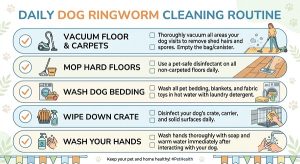
A puppy sheds infected hairs everywhere. If you only treat the dog, the house keeps reinfecting him. Here’s the routine I’d follow.
Step 1: Pick one isolation room
Choose a room with a hard floor (kitchen, utility room, bathroom). Avoid carpets and sofas. Remove anything you can’t wash or disinfect: cushions, rugs, soft toys that aren’t machine-washable.
Step 2: Daily cleaning
- Vacuum and mop every day. Empty the vacuum outdoors straight after use. Bag and bin the contents, or disinfect the canister.
- Wipe hard surfaces with soap and water first (dirt blocks disinfectant), then apply a disinfectant.
- Use diluted household bleach at about 1 part bleach to 10 parts water, left on the surface for around 10 minutes, then rinse. Mix it fresh each day. Never mix bleach with other cleaners, and keep the puppy out until surfaces are dry. Bleach can damage some floors and fabrics, so spot-test first. Vet-approved antifungal disinfectants (such as accelerated hydrogen peroxide products) are a good alternative.
- Wash bedding and blankets on the hottest cycle the fabric allows (60°C / 140°F or above is ideal) with detergent. Dry on high heat. Wash twice if you can.
Step 3: Tools and crates
- Soak combs, brushes, clippers and bowls in the dilute bleach solution, or replace cheap items.
- Disinfect the crate, leash, harness and collar. Nylon and leather gear can be hard to disinfect, so consider replacing worn items. Check our tactical K9 gear guide for gear that wipes down easily.
- Keep one grooming kit just for the infected puppy until cure is confirmed.
Step 4: Air and fabrics
- Change HVAC filters and clean air vents if the puppy has roamed the house.
- Steam-clean carpets and upholstery during treatment if possible.
- Wash your clothes after handling the puppy, and wear a long-sleeve shirt or apron you can wash.
Step 5: Keep going
Consistency beats one big clean. Light daily cleaning works better than one big weekly scrub. Keep it up until your vet confirms mycological cure, then do one last deep clean.
Protecting Your Family and Other Pets
Ringworm is zoonotic, which means it can jump from animals to people. Most healthy adults get a mild rash and recover well. But some people need extra care.
Who is at higher risk?
- Young children (they cuddle, kiss and touch the puppy constantly)
- Older adults
- People with weak immune systems (chemotherapy, HIV, organ transplant medication, long-term steroids)
- People with broken or irritated skin
- Pregnant women. Talk to a doctor about any skin lesion rather than self-treating, because some oral antifungals aren’t safe in pregnancy.
What ringworm looks like on people
An itchy, red, ring-shaped patch with a raised, scaly border and a clearer center. It’s common on arms, hands, face and neck. If someone in your home gets this, see a doctor or pharmacist. Mild cases usually clear with over-the-counter antifungal cream.
Safe handling rules
- Wear disposable gloves when treating or cleaning.
- Wash hands with soap and water after every contact.
- Keep young kids and immunocompromised family members away from the puppy until treatment is well underway. Ask your doctor for personal advice.
- Don’t let the puppy sleep on beds or sofas.
- Skip the face-licking and kisses until the puppy is cleared.
- Wash clothes you wore while handling the puppy.
What about other pets?
Cats are classic carriers of M. canis. Check any cat in the house, even one with no signs. Other dogs, rabbits, guinea pigs and horses can also catch it. Ask your vet whether to test other pets, and whether to treat only the infected animals or all of them. For multi-animal homes and kennels, vets often use preventive lime sulfur dips for the exposed animals while waiting for results.
Isolation Without Ruining Socialization
Here’s a problem almost no article talks about. Puppies have a critical socialization window, which is roughly 3 to 14 weeks of age. In that window they learn that people, dogs, noises, surfaces and new places are safe. Miss it, and you can end up with a fearful or reactive adult dog.
Ringworm isolation can run six weeks or more. That’s a big chunk of the window. So how do you protect your family and your puppy’s future behavior?
Practical ways to isolate without isolating
- Use a “clean room” with company. Spend time in the room with the puppy, wearing washable clothes. Play, train and cuddle (with gloves and hygiene) so the puppy isn’t lonely.
- Do short, structured exposure to new things at home. Play different sounds, introduce new textures (towels, tiles, a wobble board), and rotate toys that you can disinfect easily.
- Invite healthy adult visitors who aren’t at high risk, who agree to wear a smock and wash hands. Visitors with the right precautions help your puppy see new faces.
- Do carrying outings carefully. Ask your vet whether short trips in a carrier or stroller to see the world (without touching floors or other dogs) are okay.
- Skip puppy classes and dog parks until your vet clears it. Spores spread on equipment and floors. Ask whether the trainer offers one-on-one sessions or video classes during treatment.
- Start the basics now. Name recognition, sit, crate manners and potty routines all work well in a small room. Our crate training guide and the potty-training routines in our ebook Beyond the Bark give you a day-by-day plan that fits perfectly into isolation time.
- Keep the vet in the loop. Ask when vaccinations, health checks and social outings can safely resume.
Think of isolation as “slow and controlled” rather than “shut away.” Puppies that get calm, safe, varied experiences during treatment usually bounce back fine.
How Much Does Ringworm Treatment Cost?
Prices vary widely by country, clinic and puppy size, so use these as rough planning numbers only, not quotes. Always ask your own vet for an estimate.
| Item | Rough range (USD) |
|---|---|
| Vet exam | $50 to $100 |
| Fungal culture or PCR | $40 to $150 per test |
| Oral antifungal medicine (6+ weeks) | $50 to $300, depending on drug and puppy weight |
| Lime sulfur dip or medicated shampoo | $15 to $40 per bottle |
| Repeat cultures (2 to 4 tests) | $80 to $400 total |
| Disinfectant, gloves, laundry, replacement bedding | $30 to $100 |
| Typical total | Roughly $250 to $800 or more |
How to save money without cutting corners:
- Ask whether your vet can culture in-house or send out to a cheaper lab.
- Ask about generic terbinafine, which is often cheaper.
- Check your pet insurance. Many plans cover ringworm if it’s not a pre-existing condition.
- Don’t skip cultures. Stopping too early and relapsing costs far more.
Prevention Checklist
Prevention is the most under-covered part of puppy ringworm articles. Here’s a practical checklist.
For new puppy owners
- Buy from a breeder or shelter who lets you see the whole litter, the mother and the kennel. Ask directly about any skin problems.
- Run your hands over the puppy’s whole body before you take them home.
- Have a vet check within the first few days.
- Keep new puppies away from stray animals, unknown cats and shared grooming tools for the first few weeks.
- Wash your hands after petting unknown animals.
For breeders and kennels
- Quarantine new arrivals for at least 2 weeks and check skin and coat.
- Don’t share brushes, clippers or crates between litters.
- Disinfect whelping areas, runs and kennel walls between litters.
- Inspect litters weekly for crusty or bald spots.
- Test and treat any adult cat or dog that has contact with litters if a case pops up.
- Keep records of any outbreak, so buyers get honest information.
For K9 handlers and working-dog programs
Working dog puppies move through many hands: breeders, foster homes, kennels, vets and trainers. That’s a lot of exposure points. Add these to your protocol:
- Do a skin and coat check as part of every weekly weigh-in.
- Wipe down shared equipment (tracking harnesses, muzzles, agility tools, training dummies) before each puppy uses it.
- Don’t mix a new puppy with the rest of the kennel until a vet clears it.
- Keep puppies out of shared training areas if skin lesions appear.
- Never let a dog with suspected ringworm into a vehicle shared with other animals without disinfecting it afterward.
If you also fight ticks and fleas in your kennel, see our K9 Advantix II tick care guide. Parasite control keeps skin healthy, and healthy skin resists fungus better.
Is there a ringworm vaccine for dogs?
Some countries have licensed ringworm vaccines for certain animals, but there’s no widely recommended vaccine for dogs. Vets generally rely on hygiene, quarantine and early treatment instead. Ask your vet what’s available where you live.
A Handler’s Field Notes
Over years of working with puppies and young working-dog prospects, a few patterns repeat every time:
- People stop treatment when the hair grows back. This is the number one reason ringworm returns. New hair means clinical cure. It does not mean the fungus is gone.
- Cleaning gets skipped by day 10. Owners start strong, then tire. The puppy relapses at week 5, and everyone blames the medicine.
- The family cat is the missing piece. Whenever a puppy keeps getting reinfected, a healthy-looking cat is often a silent carrier.
- Early hands-on checks save weeks. Handlers who run their hands over every puppy during grooming catch spots at the size of a coin, not the size of a palm.
- Isolation needs a plan. Puppies kept alone and bored in a back room develop fear and clinginess. Short, structured sessions with the right hygiene prevent that.
Sources and standards used in this article: Merck Veterinary Manual (causes and species), VCA Animal Hospitals (spore survival, contagious period, culture and cleaning guidance), University of Florida Shelter Medicine program (drug protocols and mycological cure), and general shelter-medicine guidelines from organizations such as the Association of Shelter Veterinarians and Maddie’s Fund. This article is educational. It’s not a substitute for an examination by a licensed veterinarian.
FAQs
1. Can I treat ringworm in my puppy at home?
You can do most of the care at home, but you shouldn’t skip the vet. A vet confirms the diagnosis, picks the right medicine for your puppy’s age and weight, and runs the follow-up cultures. At home, you give the medicine, do the dips or baths, isolate the puppy and clean daily. Home remedies alone, like vinegar or coconut oil, don’t cure ringworm. Some, like tea tree oil, are dangerous.
2. How long does ringworm last in puppies?
With proper treatment, most puppies need 6 to 12 weeks. Lesions often look better after 2 to 4 weeks, but your puppy isn’t cured until two fungal cultures in a row come back negative. Without treatment, it can take months and spread to people and pets.
3. Is puppy ringworm contagious to humans?
Yes. Ringworm is zoonotic. People catch it by touching the puppy or contaminated bedding, brushes and surfaces. Children, older adults and people with weak immune systems are at higher risk. Wear gloves, wash your hands after contact and see a doctor if you notice a red, ring-shaped, scaly rash.
4. What does ringworm look like on a puppy compared with mange?
Ringworm usually appears as round or uneven bald patches with scaly, crusty skin and broken hairs, and often causes only mild itching. Mange, especially sarcoptic mange, tends to cause more intense itching, and demodectic mange often starts around the eyes and mouth. Only a fungal culture, PCR or a skin scraping can tell them apart for sure, so see a vet.
5. When can my puppy go back to normal life after ringworm?
Wait until your vet confirms two negative fungal cultures in a row and tells you treatment can stop. Until then, keep the puppy away from other dogs, puppy classes and dog parks. Keep cleaning for a couple more weeks after the final negative culture, then ask your vet to clear the puppy for socialization, grooming and boarding.
Conclusion
Ringworm in puppies is common, contagious and very beatable. Here’s what to remember:
- Spot it early. Scaly, round or uneven bald patches, broken hairs and crusty skin, especially on the face, ears, paws and tail, are your warning signs.
- Get it confirmed. A vet’s fungal culture or PCR test beats guessing every time.
- Treat it properly. That means oral antifungals plus topical care and daily cleaning, for as long as your vet says, usually 6 to 12 weeks.
- Don’t quit when the hair grows back. Wait for two negative cultures.
- Protect your people and pets. Gloves, hand washing, separate rooms and a check on your cat go a long way.
- Keep the puppy’s mind healthy too. Use isolation time for calm, controlled training and enrichment.
If you have a puppy right now with a suspicious bald spot, book a vet visit today rather than waiting to see if it clears. Early treatment saves you weeks, money and a lot of stress.
Want more practical dog care and K9 training guidance like this every week? Subscribe to our weekly articles roundup at arfsk9team.com.ng/newsletter and get new guides straight to your inbox.
And if you’re welcoming a new puppy soon, grab our e-book Beyond the Bark for a clear, day-by-day routine that makes the first weeks much easier.
Medical disclaimer: This article is for education only and isn’t a replacement for professional veterinary advice. Always follow your veterinarian’s diagnosis, drug choice and dosing for your puppy.

Her work centres on obedience, detection, protection and operational readiness. She favours proven methods built on repetition, consistency and real-world conditioning, so that both dogs and handlers are prepared for high-pressure tasks.
Rofiat represented the Nigerian Army Dog Centre at the Nigerian Army Day Celebration (NADCEL) 2026, where she led demonstrations in obedience, explosive detection, agility and tactical movement. Through articles, training content and documentaries, she shares field-based insight into how structured training, clear communication and trust between handler and dog affect performance and reliability.
She is the author of Beyond the Bark: Inside a Pro Handler's Playbook for Raising the Ideal Dog, a practical guide that helps dog owners and handlers apply professional training principles in everyday situations.
- Westminster Dog Show 2026: Winners & Full Results - October 17, 2026
- 10 K9-Approved Tricks to Teach Your Dog (Step-by-Step) - October 16, 2026
- COBA National Dog Championship 2026: Full Guide - October 15, 2026