Shih Tzu Poodle Mix Shedding: Do Shih-Poos Shed?
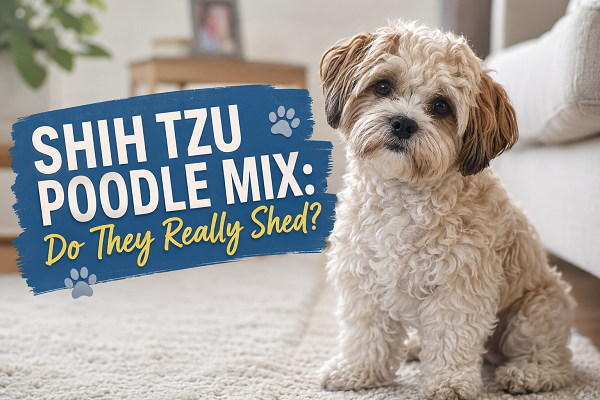
Yes, a Shih Tzu Poodle mix (Shih-Poo) sheds, but usually very little. Most lose small amounts of hair that get caught in the coat instead of landing on your floor. How much depends on which parent’s coat the puppy inherits. Curly, Poodle-type coats shed least. Straight, Shih Tzu-type coats shed more. No Shih-Poo is truly shed-free or allergy-proof.
Table of Contents
- Introduction
- What Is a Shih Tzu Poodle Mix?
- Do Shih-Poos Shed? The Real Answer
- Why Shih-Poo Shedding Varies: The Coat Genes
- Generations: F1 vs F1B vs F2 Shedding
- The 3 Coat Types and How Each One Sheds
- How to Predict a Puppy’s Coat Before You Buy
- Are Shih-Poos Hypoallergenic? What the Research Says
- Grooming Plan and Real Costs
- Shedding or Something Worse? Red Flags
- Keeping Your Home Hair-Free (and Allergy-Friendlier)
- Shih-Poo vs Other Small Mixes
- A Handler’s Take
- Myths, Busted
- FAQs
- Final Thoughts
Introduction
Picture this. It’s 11 p.m., you’re scrolling teddy-bear Shih-Poo photos, and you’re typing “does a Shih Tzu Poodle mix shed?” because your sofa, your sinuses, or both can’t take another hairy dog. You’re not alone. It’s one of the most searched questions about this crossbreed.
The honest answer isn’t yes or no. It’s “a little, and it depends on the puppy.” So here’s what you’ll learn in this guide:
- How much a Shih Tzu Poodle mix really sheds
- Why two puppies from the same litter can have totally different coats
- Which generation (F1, F1B, F2) sheds least
- What science says about “hypoallergenic” dogs
- What grooming costs, and what’s normal versus a vet-worthy sign
I’ve worked with dogs of every coat type, from short-haired working breeds to heavy-coated family pets. One thing I’ve learned: shedding is never as simple as “this breed does, that one doesn’t.” The Shih-Poo proves it.
What Is a Shih Tzu Poodle Mix?
A Shih-Poo (also called Shihpoo, Shoodle or Poo-Shih) is a cross between a Shih Tzu and a Toy or Miniature Poodle. It’s a designer crossbreed, not a recognised breed. The American Kennel Club and The Kennel Club (UK) don’t register it, so no official breed standard exists. That’s the root of the shedding confusion: nothing fixes what a Shih-Poo’s coat “should” look like.
Quick facts:
- Size: About 8–18 lbs (3.6–8 kg), depending on the Poodle parent
- Lifespan: Around 10 to 15 years
- UK puppy price: Roughly £500 to £850
- Temperament: Affectionate, clever, playful; usually good lap dogs
- Heat note: The Shih Tzu’s facial structure can make breathing harder in hot, humid weather
Do Shih-Poos Shed? The Real Answer
Yes, but less than most dogs. Every dog loses hair, even Poodles. The difference is where the hair goes.
A Poodle has a single coat of hair that grows for a long time. Poodles and Doodles have a single coat, and the hair they shed gets trapped inside the thick, curly coat. That’s why a Poodle seems not to shed. The hair still falls out. It just stays put until you brush it out.
The Shih Tzu side complicates this. Breed descriptions list the Shih Tzu with a long, dense coat that sheds lightly. Dogs with double coats shed more than dogs with single coats, so a Shih-Poo that favours the Shih Tzu will drop more hair than a curly one.
Simple rule: The more Poodle in the coat, the less hair on your floor. The more Shih Tzu, the more you’ll see.
Why Shih-Poo Shedding Varies: The Coat Genes
Here’s the part almost no competitor explains, and it’s the most useful thing you can learn before choosing a puppy.
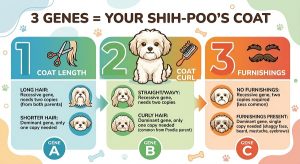
Researchers at the US National Human Genome Research Institute found that variants in just three genes account for the wide range of coat textures in dogs, from the Poodle’s tight curls to the Beagle’s straight fur. In plain English:
- FGF5 controls hair length. It decides long versus short hair.
- KRT71 controls curl. It decides straight versus curly hair.
- RSPO2 controls “furnishings” (the beard, moustache and eyebrows). It also appears linked to shedding, and breeds that rarely shed, like the Poodle, almost always carry two copies of the variant.
Why this matters for your puppy: A Poodle carries the curl gene. A Shih Tzu has straight hair. When you cross them (F1), each puppy gets one copy of the curl gene from the Poodle side and a straight version from the Shih Tzu. Curl is mostly a recessive trait, so a single copy often gives a wave, not tight curls. That’s my own plain-language summary of how the genes work, and individual dogs vary. But it explains why first-generation Shih-Poos so often turn out wavy, and why tightly curled coats show up more in puppies with more Poodle in the pedigree.
Generations: F1 vs F1B vs F2 Shedding
A generation label tells you roughly how much Poodle is in the mix. Here’s the breakdown (percentages are rough estimates, since genetics rarely follows the maths exactly):
| Generation | Parents | Approx. Poodle | Shedding expectation |
|---|---|---|---|
| F1 | Shih Tzu × Poodle | 50% | Unpredictable; wavy or straight common |
| F1B | F1 Shih-Poo × Poodle | 75% | Lower; more likely curly |
| F1BB | F1B × Poodle | 87.5% | Lowest |
| F2 | F1 × F1 | 50% | Unpredictable |
| F2B | F2 × Poodle | 75% | Lower |
An F1 Shih-Poo may not suit you if you want a very low or non-shedding dog, while F1B puppies have a much smaller potential for shedding.
My caution: Don’t treat “F1B” as a guarantee. A few F1B puppies still come out wavy or straight. Ask the breeder for photos of the parents and older puppies from previous litters.
The 3 Coat Types and How Each One Sheds
1. Curly Coat (Poodle-Type)
Tight, dense curls. This type sheds the least visibly, but it mats fastest. Expect professional trims every 4–6 weeks.
2. Wavy Coat (the “Blend”)
Soft, loose waves. This is the most common coat and a good middle ground: moderate shedding and easier to keep tangle-free than tight curls.
3. Straight Coat (Shih Tzu-Type)
Silky and smooth. It sheds the most of the three, and it tangles behind the ears, under the legs and along the belly. Even so, straight-coated Shih-Poos still shed considerably less than purebred Shih Tzus.
Handler tip: If a breeder says “all my puppies are 100% non-shedding,” walk away. Honest breeders talk about likelihood, not promises.
How to Predict a Puppy’s Coat Before You Buy
Most guides skip this. Here’s what I’d do:
- Meet both parents (or at least the mother). The parents’ coats are your best clue.
- Look at the muzzle at 8 weeks. Longer, wirier hair around the mouth and chin (furnishings) often signals a fuller, curlier adult coat. A smooth, short muzzle often goes with a straighter coat.
- Feel the texture. Cottony and crimped usually means curl later. Silky and flat usually means straight.
- Ask about DNA coat testing. Commercial panels now check coat traits. One test provider describes a shedding test that combines the MC5R and RSPO2 genes. Treat results as a guide, not a guarantee.
- Expect a coat change. The puppy coat often shifts between about 6 and 12 months. Many owners see waves become curls, or fluff turn silky. Don’t judge the final coat at 8 weeks.
Are Shih-Poos Hypoallergenic? What the Research Says
No dog breed is proven hypoallergenic, and that includes Poodles and Shih-Poos. Here’s the evidence, and it may surprise you.
The main allergen: Can f 1 is the primary allergen in dog dander and saliva, and about 70% of dog-allergic people react to it. So the problem isn’t only hair. It’s the protein in dander and saliva.
The Dutch study: Researchers at Utrecht University compared “hypoallergenic” breeds (including Poodles and Labradoodles) with other dogs. The so-called hypoallergenic dogs actually had higher Can f 1 levels in hair and coat samples, though this didn’t lead to higher levels in the home. The authors found no evidence to classify any breed as hypoallergenic. Airborne allergen levels didn’t differ between breeds.
The US study: A Henry Ford Hospital team studied homes with 60 different breeds, 11 of them marketed as hypoallergenic, and found no significant difference in allergen levels.
So why do some allergic owners cope better with Shih-Poos? Three likely reasons:
- Smaller dogs put less total allergen into the home
- Less loose hair means fewer places for dander to settle
- Individual dogs vary a lot. Differences between breeds were small compared with the variation within a breed.
What I’d tell an allergic buyer:
- Spend several hours with the specific puppy or parent dog, more than once
- Test for reactions to saliva as well as fur
- Talk to an allergist before you commit, especially if you have asthma
Grooming Plan and Real Costs
Low-shedding doesn’t mean low-maintenance. It often means the opposite, because loose hair doesn’t fall away. You have to remove it.
Routine:
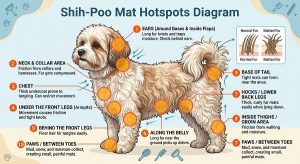
- Daily (5–10 minutes): Slicker brush, then a metal comb through ears, armpits, belly and behind the legs
- Weekly: A full comb-out down to the skin, which catches tangles early
- Every 4–8 weeks: Professional groom (bath, trim, ears, nails, sanitary trim)
- Face: Wipe daily. Shih Tzu-type faces often get tear staining.
Cost breakdown (typical ranges; local prices vary):
| Item | US | UK |
|---|---|---|
| Professional groom (per visit) | $45–$75 | £30–£50 |
| Visits per year (every 6 weeks) | ~8–9 | ~8–9 |
| Yearly groomer cost | ~$400–$650 | ~£260–£430 |
| Home tools (brush, comb, spray, shampoo) | $40–$80 | £30–£60 |
Pro tip: Teach grooming early. Start gentle handling and brushing at 8–10 weeks. A puppy that learns grooming is normal grows into an adult who tolerates trims, nail clips and vet exams. This is the same habituation we use with working K9s. For step-by-step basics, see our puppy grooming guide.
Shedding or Something Worse? Red Flags
A normal Shih-Poo loses a little hair daily and a bit more during coat changes. Call your vet if you see:
- Bald patches or thinning that wasn’t there before
- Red, flaky or smelly skin
- Constant scratching, licking or chewing
- Sudden heavy shedding in a normally low-shedding dog
- Dull coat plus tiredness or weight change (thyroid or hormone problems can cause this)
Common triggers behind extra hair loss:
- Diet: An unbalanced diet is one of the most common causes of excessive shedding, and switching food too fast can cause skin problems too. Change foods gradually over about 7–10 days.
- Allergies: Food allergies and sensitivities, and even some shampoos, can trigger shedding or bald patches.
- Parasites: Fleas and mites cause itching, which causes hair loss.
- Stress: Anxious dogs lick and scratch themselves, which can lead to hair loss, and Shih-Poos are prone to separation anxiety.
Don’t self-diagnose. Ask your vet before adding supplements. Fatty-acid supplements can help coat quality, but dosing matters.
Keeping Your Home Hair-Free (and Allergy-Friendlier)
- Brush outdoors or on a washable mat so loose hair doesn’t end up on your sofa
- Vacuum with a HEPA filter a few times a week
- Wash dog bedding weekly in hot water
- Bathe regularly with a gentle dog shampoo. Washing reduces surface allergen, though levels can climb back within days, so don’t expect permanent results.
- Keep the dog out of the bedroom if you’re allergic
- Use a HEPA air purifier in the main living area
Shih-Poo vs Other Small Mixes
| Dog | Parents | Shedding (general) | Notes |
|---|---|---|---|
| Shih-Poo | Shih Tzu × Poodle | Low | Coat varies by puppy |
| Maltipoo | Maltese × Poodle | Low | Also mat-prone |
| Cavapoo | Cavalier × Poodle | Low to moderate | Cavalier side can shed more |
| Malshi | Maltese × Shih Tzu | Low to moderate | No Poodle genes |
Weighing small mixes? Our Malshi puppy guide shows how a Poodle-free cross differs. For more easy-care options, see our list of the 10 best low-maintenance dog breeds.
A Handler’s Take
Written by Cpl. Rofiat Muritala, a Nigerian Army military working dog instructor and handler with more than 14 years at the Nigerian Army Dog Centre.
I train dogs for obedience, detection and protection, so I see coats in every condition. Here’s what carries over to Shih-Poos:
- Coat checks are part of daily kennel care. Skin and coat tell you about a dog’s health before anything else does. Check your Shih-Poo’s skin weekly, not just the top layer of hair.
- Consistency beats intensity. Five minutes of daily brushing beats one hour-long session on Sunday.
- Calm handling starts early. The same patient handling we use for working dogs makes grooming stress-free for a lap dog.
If you want the full handling and routine-building approach, my book Beyond the Bark covers it step by step.
Myths, Busted
- “Poodle mixes never shed.” False. Hair still falls out. It just stays trapped in the curls until you brush it out.
- “Hypoallergenic means allergy-proof.” False. The research above found no evidence that any breed is hypoallergenic.
- “F1B guarantees a curly coat.” False. It improves the odds, nothing more.
- “Shaving stops shedding.” Not really. A shave hides loose hair and can change regrowth texture, but dander is still there.
- “Grooming twice a year is enough.” False. That’s how painful mats form.
FAQs
1. Do Shih Tzu Poodle mixes shed a lot?
No. Most shed very little. Straight-coated ones shed more than curly ones, but still less than heavy shedders like Labradors or German Shepherds.
2. Which Shih-Poo generation sheds the least?
F1BB and F2BB puppies (about 87.5% Poodle) usually shed least, followed by F1B and F2B. F1 puppies are the least predictable.
3. Are Shih-Poos good for people with allergies?
Maybe, but no guarantee. Studies found no breed is truly hypoallergenic, and individual dogs vary a lot. Spend time with the actual dog first and check with an allergist.
4. Do Shih-Poo puppies shed more than adults?
They often change coat between about 6 and 12 months. You may see extra loose hair and more tangling during that stage. It’s normal.
5. How often should I brush and groom a Shih-Poo?
Brush every day for 5–10 minutes, and book a professional groom every 4–8 weeks to prevent matting.
Final Thoughts
So, do Shih Tzu Poodle mixes really shed? Yes, a little. Most drop far less hair than the average dog, but “low-shedding” isn’t “no-shedding,” and it definitely isn’t “allergy-proof.” Your puppy’s coat comes down to genetics: curl, length and furnishings.
Your action plan:
- Choose an F1B or later-backcross puppy if low shedding is your priority
- Meet the parents and ask for photos of older puppies from earlier litters
- Test your allergies with the actual dog before you commit
- Budget $400–$700 (£260–£500) a year for grooming
- Brush every day from week one
- See a vet for patchy hair loss, itching or sudden heavy shedding
Want more breed guides and handler tips like this? Subscribe to our weekly articles roundup newsletter and get them in your inbox.

Her work centres on obedience, detection, protection and operational readiness. She favours proven methods built on repetition, consistency and real-world conditioning, so that both dogs and handlers are prepared for high-pressure tasks.
Rofiat represented the Nigerian Army Dog Centre at the Nigerian Army Day Celebration (NADCEL) 2026, where she led demonstrations in obedience, explosive detection, agility and tactical movement. Through articles, training content and documentaries, she shares field-based insight into how structured training, clear communication and trust between handler and dog affect performance and reliability.
She is the author of Beyond the Bark: Inside a Pro Handler's Playbook for Raising the Ideal Dog, a practical guide that helps dog owners and handlers apply professional training principles in everyday situations.
- Westminster Dog Show 2026: Winners & Full Results - October 17, 2026
- 10 K9-Approved Tricks to Teach Your Dog (Step-by-Step) - October 16, 2026
- COBA National Dog Championship 2026: Full Guide - October 15, 2026