Can a Local Dog Really Be Used as a Working Dog?
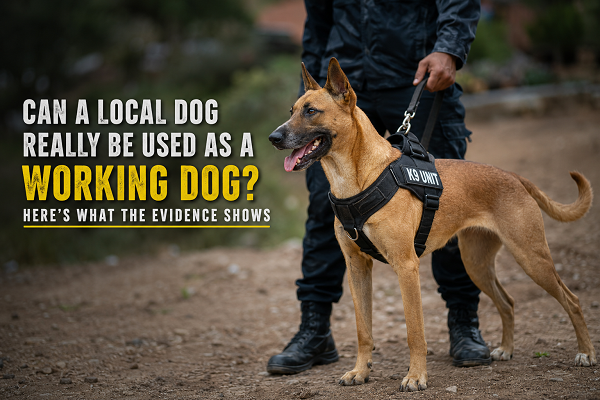
Yes, a local or “village” dog (also called an indigenous, landrace, or mongrel-type dog) can absolutely be trained into a working dog, including a guard dog, patrol dog, or even a detection dog. Police units in India have already proven it with rescued street dogs outperforming purebred squad members in scent work. What determines success isn’t the pedigree on paper, it’s nerve strength, drive, health, and how early and consistently the dog is trained. That said, local dogs come with more genetic unpredictability than purpose-bred working lines, so proper temperament testing matters more than it does with an established breed.
Table of Contents
- Introduction
- What Is a “Local Dog,” Exactly?
- Why This Question Is Getting Louder
- What Actually Makes a Dog “Working Dog Material”
- How Local/Village Dogs Measure Up, Trait by Trait
- Global Proof: Landrace Dogs Already on the Job
- What the Science Says About Village Dog Cognition
- The Honest Challenges Nobody Talks About
- How to Evaluate and Train a Local Dog for Work
- Local Dog vs. Imported Working Breed: A Real Cost Comparison
- Trainer’s Insight
- FAQs
- Conclusion
Introduction
If you’ve ever watched a local dog patrol a compound at 2 a.m., barking at anything that moves near the gate, you’ve probably wondered the same thing a lot of dog owners and even some professional handlers wonder: could that dog do more? Could it actually be trained the way a German Shepherd or Belgian Malinois is trained for security, patrol, or detection work?
It’s a fair question, and it’s one I get asked constantly, usually from someone who already owns a local dog and doesn’t want to spend six figures importing a “proper” working breed just to get basic protection at home.
So here’s the thing: the answer isn’t a flat yes or no. It’s “yes, with conditions.” In this guide, I’m going to walk you through what actually makes a dog fit for working roles, how local/village-type dogs stack up against that checklist, what real programs around the world have already proven, and exactly how you’d go about testing and training one yourself. By the end, you’ll know whether the dog sleeping on your porch right now has what it takes and what to do next if it does.
What Is a “Local Dog,” Exactly?
Before we go further, let’s clear something up. “Local dog” isn’t a breed name, it’s a category. Around the world, these dogs go by different names: village dogs, street dogs, indigenous dogs, landrace dogs, or pariah-type dogs. They share one thing in common, they weren’t shaped by a kennel club breed standard. They were shaped by survival.
In West Africa, this type of dog is often nicknamed “Ekuke” or “Bingo,” and researchers generally classify it as part of the broader West African Village Dog group, a population believed to be a natural mix of ancient African landrace lines, with visible traits shared with sighthound-type dogs like the Azawakh, the Basenji, and even the Greyhound, likely from centuries of unmanaged crossbreeding around trade routes and settlements. Physically, you’ll usually see:
- Medium build, roughly 18–24 inches at the shoulder
- Short, low-maintenance coat
- Erect ears and a wedge-shaped head
- Lean, athletic body built for endurance, not bulk
- A tightly curled or sickle-shaped tail in many individuals
This isn’t unique to West Africa. Nearly every region with a long history of free-roaming dogs has developed its own version: the Africanis in Southern Africa, the Indian Pariah Dog (INDog) in South Asia, the Carolina Dog in the southeastern United States, the Bali Dog in Indonesia, and the Canaan Dog in the Middle East (which, notably, did get formal breed recognition and now works as a herding and service dog). These dogs evolved through natural selection rather than deliberate breeding programs, which is exactly why their working potential is so inconsistent from one individual to the next, and exactly why testing matters so much (more on that shortly).
Why This Question Is Getting Louder
Security concerns are rising in cities worldwide, and the cost of importing a European or American-bred working dog has climbed right along with shipping, import duties, and vet documentation costs. A working-line German Shepherd or Belgian Malinois from a reputable European breeder often runs anywhere from $2,500 to $8,000 before you’ve even paid for transport and quarantine paperwork. For most households and even small security firms, that’s simply out of reach.
Meanwhile, local dogs are everywhere, cheap to acquire (often free), naturally hardy against local diseases and climate, and crucially, already showing the raw instincts that matter: territorial alertness, a strong bark response, and a suspicion of strangers that a purpose-bred guard dog would have to be trained into from scratch. It makes sense that people are asking whether these dogs can be developed rather than replaced.
What Actually Makes a Dog “Working Dog Material”
Before judging whether local dogs qualify, you need to know what the checklist actually looks like. Professional handlers evaluate five core traits, regardless of breed:
- Nerve strength — how the dog reacts to sudden noise, unfamiliar people, or unexpected environments. A dog that startles and stays rattled is a liability; one that startles and recovers in seconds is gold.
- Drive — prey drive, food drive, and play drive. This is the engine that makes training possible. No drive, no motivation, no matter how “smart” the dog is.
- Trainability / handler focus — how readily the dog reads and responds to a human partner, rather than just running on raw instinct.
- Physical soundness — hips, joints, cardiovascular endurance, and structure suited to the job (a dog with poor hip conformation won’t hold up in agility or patrol work long-term).
- Temperament stability — the difference between a dog that’s naturally protective and one that’s simply fearful or reactive. Fear-based aggression is not the same as working drive, and confusing the two gets handlers and the public hurt.
None of these five traits are exclusive to any particular breed. They show up or don’t, in individuals. That’s the whole foundation of this article.
How Local/Village Dogs Measure Up, Trait by Trait
Here’s an honest, trait-by-trait breakdown, based on what handlers who’ve actually worked with local/landrace dogs consistently report:
Nerve strength: Strong, often underrated. Dogs that survive years of free-roaming life, dodging traffic, competing for food, navigating unfamiliar humans, develop genuinely resilient nervous systems. This isn’t guesswork; it’s natural selection doing what selective breeding sometimes struggles to replicate.
Drive: Variable, but present. Food and territorial drive tend to be strong (these dogs learned early that resources aren’t guaranteed). Prey drive varies a lot by individual, some show intense chase instinct, others show almost none. This is the trait you’ll need to test most carefully.
Trainability: Good, once trust is built. Because these dogs weren’t bred for generations of close human partnership the way herding or retrieving breeds were, they can take longer to form the tight “team” bond a Malinois forms almost instinctively. But once that bond forms, handlers frequently describe local dogs as fast learners with excellent problem-solving instincts, arguably sharper street-smarts than a dog raised entirely indoors.
Physical soundness: Generally excellent. This is one of the biggest advantages. Because there’s no artificial selection pushing exaggerated features (short legs, oversized heads, excessive coat), local dogs tend to have naturally sound structure, fewer inherited joint disorders, and stronger immune resistance to regional parasites and diseases than many imported breeds face when relocated.
Temperament stability: The wild card. This is where individual variation is highest. Some local dogs are naturally confident and stable. Others carry fear-based reactivity from early neglect or lack of socialization. This is exactly why a proper temperament assessment, not guesswork, has to come before any training decision.
Global Proof: Landrace Dogs Already on the Job
This isn’t theoretical. Several countries have already tested this exact question in the field.
India’s police canine units. Multiple Indian state police forces, including units in Uttarakhand and West Bengal, have adopted rescued Indian Pariah Dogs (INDogs) into their K9 squads. In more than one documented case, a rescued street dog placed into a sniffer/detection unit went on to match or outperform German Shepherd and Labrador squad-mates in explosive and narcotics detection work after training. One widely reported case involved a rescued dog named Asha, found injured and later trained into a top-performing bomb- and drug-detection dog within about 18 months.
South Africa’s Africanis. Recognized as a genuine landrace with lineage traced back roughly 7,000 years, the Africanis is still actively used across rural South Africa for property and livestock security, and increasingly for search-and-rescue and police-adjacent roles once given structured training. It’s also the acknowledged genetic contributor behind the ridged coat seen in the modern Rhodesian Ridgeback, a breed that itself started as a working farm dog before formal recognition.
The United States’ Carolina Dog. Originally a free-ranging landrace found in the swamps and forests of the southeastern US, the Carolina Dog has since been used in hunting, tracking, and even scent-detection hobbyist work, prized for its independence and stamina.
The Middle East’s Canaan Dog. Once a fully free-ranging desert landrace, the Canaan Dog was deliberately developed starting in the 1930s into a formally recognized breed now used for herding, therapy, and search-and-rescue work, proof that a landrace population can, with structured breeding and training investment, be formalized into a fully functional working breed within a few generations.
The pattern across all four examples is the same: it’s not the paperwork that determines whether a dog can work. It’s the individual dog’s traits, plus the quality and consistency of the training behind it.
What the Science Says About Village Dog Cognition
It’s worth pausing on the research here, because it directly answers a question a lot of skeptics raise: “aren’t purpose-bred dogs just naturally smarter or more trainable?”
Not quite. Comparative cognition studies have found that free-ranging village dogs read human facial expressions about as well as pet dogs do, despite having far less structured human contact, suggesting that the ability to pick up on human communication is closer to a species-wide trait than something only “bred-in” breeds possess. Other research comparing trained versus untrained dogs across different breed groups (herding, mastiff-type, working, and retriever lines) found that training history, not breed, was the strongest predictor of problem-solving speed on detour and puzzle tasks.
Where research does show a real gap is between what scientists call “premodern” dogs (which includes village/landrace dogs) and heavily selected modern breed lines: modern breeds do show higher average trainability scores and larger cortical brain regions linked to trainability, according to neuroimaging research published in The Journal of Neuroscience. In plain English, that means the average purpose-bred working dog may be slightly easier to train than the average village dog, but “average” hides enormous individual variation, which is exactly why the India police program and the Africanis programs work: they don’t train the average dog, they select and train the standout individuals.
The Honest Challenges Nobody Talks About
I’m not going to sugarcoat this, because half-truths get people hurt or get dogs abandoned when things don’t go as expected.
- Genetic unpredictability. Without controlled breeding, you can’t reliably predict adult size, temperament, or drive from a litter the way you can with an established working line. Two puppies from the same litter can turn out dramatically different.
- No standardized training pipeline (yet). Established working breeds have decades of refined training protocols behind them. With local dogs, much of the process is still individualized trial and adjustment, which means you need a genuinely experienced handler, not a beginner following a YouTube video.
- Health screening gaps. Local dogs rarely come with health records, vaccination history, or parasite screening. Budget for a full veterinary workup before you invest months of training time.
- Bias and public perception. Clients, employers, or even family members may not take a “local dog” seriously as a security asset, regardless of how well it performs. This is a real, practical hurdle if you’re building a service business around it.
- Age of assessment matters. Testing a dog too young (under 12–16 weeks) gives unreliable results. Testing too late (after 2+ years of unmanaged free-roaming life) means you may be working against ingrained fear or avoidance behaviors that take much longer to undo.
If you’re serious about developing a local dog for protection or working roles, it helps to understand where obedience ends and raw instinct begins, I go deeper into that distinction in Dog Obedience vs. Instinct: How to Balance Drive and Control, which is essential reading before you start shaping any dog’s natural drive into controlled work.
How to Evaluate and Train a Local Dog for Work
Here’s the practical, step-by-step version of what I’d actually walk a client through.
Step 1: Temperament testing (Week 1)
Before any training begins, run a structured assessment:
- Startle recovery test — drop a metal bowl or clap loudly from a distance; a good candidate flinches but recovers within a few seconds and re-engages.
- Novel object test — introduce an unfamiliar object (umbrella, traffic cone); look for curiosity over avoidance.
- Food/toy drive test — see how persistently the dog works to get a treat out of a puzzle or towel.
- Handler focus test — how quickly the dog checks back in with you after being distracted.
Step 2: Health clearance (Weeks 1–2)
Full vet exam, deworming, vaccination catch-up, and if the dog is over a year old, hip and joint evaluation before any serious physical conditioning begins.
Step 3: Foundation obedience (Weeks 2–10)
Basic commands, leash manners, crate comfort, and socialization drills. This phase usually takes 6–8 weeks with consistent daily sessions of 15–20 minutes, twice a day. Don’t rush this stage, it’s the foundation everything else is built on.
Step 4: Drive channeling (Months 3–5)
This is where you start shaping natural territorial instinct into controlled behavior: bark-on-command, alert-and-report, and controlled bite work if the dog is being developed for protection roles specifically. This stage absolutely requires a qualified handler, untrained “protection training” attempts are one of the most common ways dogs (and people) get hurt.
Step 5: Task-specific specialization (Months 5–9)
Depending on the intended role, property guarding, patrol, or scent-detection, this is where specialized drills begin. Detection work in particular benefits from the same natural scavenging instincts that helped these dogs survive on the streets in the first place.
Realistically, expect a local dog with strong raw material to reach a solid, dependable working level in 6 to 9 months of consistent training, comparable to the general timeline used for purpose-bred protection dogs, though the early weeks may take a little longer if there’s a trust deficit to overcome. If you want a broader look at how professional programs structure this kind of timeline, I’d recommend reading How Are Military Working Dogs Trained? for a side-by-side comparison against formal military protocols.
Throughout every stage, exercise volume matters just as much as the drills themselves, a dog that isn’t getting adequate physical and mental output will plateau no matter how good the training plan is. I cover exactly how much activity a working-role dog needs in How Often Do You Exercise Your Working Dog?
Local Dog vs. Imported Working Breed: A Real Cost Comparison
| Factor | Local/Village Dog | Imported Working Breed (e.g., GSD, Malinois) |
|---|---|---|
| Acquisition cost | Often free–$100 | $2,500–$8,000+ |
| Import/shipping costs | None | $800–$2,500 |
| Disease resistance to local conditions | Generally high | Often lower until acclimated |
| Predictability of adult temperament | Lower, individual-dependent | Higher, line-tested |
| Available training protocols | Limited, handler-dependent | Extensive, decades-refined |
| Public/client perception | Often underestimated | Generally trusted by default |
| Average time to working readiness | 6–9 months (varies more) | 5–8 months (more predictable) |
The bottom line: local dogs win heavily on cost and resilience, but you’re trading predictability for savings. If you’re a household wanting a dependable alert-and-guard dog on a budget, this trade-off usually makes sense. If you’re building a professional detection or protection unit where consistency across every dog is non-negotiable, a blended approach, a few proven local dogs alongside purpose-bred lines, tends to work best.
It also helps to understand what actually separates a working dog from an ordinary pet before you commit resources either way; I break that down fully in K9 Canine vs Pet Dog: 5 Key Differences You Should Know.
Trainer’s Insight
We’ve handled and trained working dogs across military demonstration events, private security placements, and family protection roles, and local/landrace-type dogs have come through our program more than once. The single biggest predictor of success we’ve seen isn’t the dog’s background, it’s whether the handler runs a real temperament assessment before committing to a training plan, and whether they’re honest about a dog that simply isn’t wired for the job. Not every dog, local or imported, is working-dog material. The ones that are deserve a structured, patient program built around their actual strengths rather than a breed stereotype.
If you want a deeper, structured breakdown of temperament testing, drive development, and building a working relationship with any dog, local or purebred, our field guide Beyond the Bark walks through the exact framework professional handlers use. Check it out here.
Once a dog reaches working-ready status, the right equipment matters too, a poorly fitted harness or collar can undo months of conditioning. See our breakdown of 10 Best Tactical K9 Gear Items for Working Dogs once you’re ready to gear up.
FAQs
1. Can a local/village dog really be trained as a guard dog without any special breeding?
Yes. Guarding is one of the most natural instincts already present in most local dogs, territorial alertness and a strong bark response usually just need to be shaped and controlled, not built from zero.
2. How long does it take to train a local dog into a working role?
Most dogs with strong raw material reach dependable working readiness in 6 to 9 months of consistent, structured training, similar to timelines used for purpose-bred protection dogs.
3. Are local dogs safe around families if trained for protection work?
Yes, when the training is done properly. A well-trained protection dog, regardless of breed, should be able to switch cleanly between “off duty” family behavior and “on duty” alertness. That switch is trained, not automatic.
4. Do local dogs have health advantages over imported working breeds?
Generally, yes. Because they haven’t gone through generations of selective breeding for appearance, local/landrace dogs tend to have fewer inherited joint and structural issues and stronger natural resistance to regional parasites and climate stress.
5. What’s the biggest mistake people make when trying to train a local dog for work?
Skipping the temperament assessment. Handlers who assume “protective barking at strangers” automatically equals working potential often end up trying to train fear-based reactivity into controlled work, which doesn’t work and can make the dog worse.
Conclusion
So, can a local dog really be used as a working dog? Based on everything we’ve covered, from India’s police-adopted street dogs outperforming purebred squad-mates, to South Africa’s Africanis still guarding rural homesteads today, to the cognition research showing training history matters more than pedigree, the honest answer is yes, with the right individual and the right program behind it.
What local dogs lack in predictability, they make up for in resilience, cost, and raw natural instinct that many purpose-bred dogs have to be trained into from scratch. The path forward isn’t guesswork: run a real temperament assessment, get a full health workup, commit to 6–9 months of structured, patient training, and be honest when a particular dog just isn’t the right fit for the job.
If you’ve got a local dog at home showing sharp instincts and steady nerves, don’t write off its potential just because it doesn’t come with papers. With the right handler and the right process, that dog on your porch might just become the working partner you didn’t know you already had.

Her work centres on obedience, detection, protection and operational readiness. She favours proven methods built on repetition, consistency and real-world conditioning, so that both dogs and handlers are prepared for high-pressure tasks.
Rofiat represented the Nigerian Army Dog Centre at the Nigerian Army Day Celebration (NADCEL) 2026, where she led demonstrations in obedience, explosive detection, agility and tactical movement. Through articles, training content and documentaries, she shares field-based insight into how structured training, clear communication and trust between handler and dog affect performance and reliability.
She is the author of Beyond the Bark: Inside a Pro Handler's Playbook for Raising the Ideal Dog, a practical guide that helps dog owners and handlers apply professional training principles in everyday situations.
- Is K9 Advantix Safe for Dogs? A Handler’s Honest Review - October 2, 2026
- Australian Cattle Dog vs Blue Heeler: Any Difference? - October 1, 2026
- Bousnic Dog Training Collar Review: Is It Safe? - September 30, 2026