Military Dog Tag Format: What to Engrave
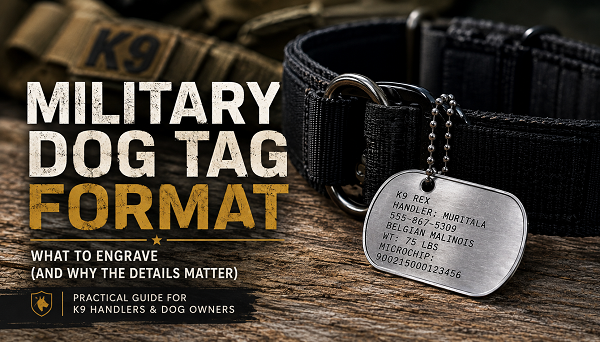
The standard military dog tag format has four core details: the wearer’s name, a 10-digit DoD ID number, blood type and religious preference, stamped on a tag about 2 inches by 1⅛ inches. Military working dogs don’t use that format. They’re identified by an ear tattoo and official records. For your own dog, engrave a phone number first, then a medical note, and add your name and address if your local law requires it, as UK law does.
Table of Contents
- Introduction
- What a Military Dog Tag Is (and Why There Are Two)
- The Official U.S. Military Dog Tag Format
- How British and Commonwealth Tags Differ
- How Military Working Dogs Are Really Identified
- What to Engrave on a Military-Style Tag for Your Dog
- Size, Material and Engraving Method
- 7 Tag Mistakes I See Handlers Make
- Tag vs. Microchip vs. GPS
- Trainer Notes From the Field
- FAQs
- Final Thoughts: Your Tag Checklist
Introduction
Military dog tag format looks easy until you sit down to order a set. Which lines go first? Do you copy the Marines or the Army? And if the tag is for a dog, what even belongs on it?
Here’s the problem. People search this topic for two very different reasons. Some want to copy a real soldier’s tag for a keepsake or a memorial. Others want a tough, military-style tag for their own K9 or protection dog. Most pages I found are shop listings that skip the rules, the law and the safety side.
So I’ll cover both. You’ll learn the real U.S. format, how actual military working dogs get identified (it’s not with a neck tag), exactly what to engrave on your dog’s tag, and the legal trap that catches a lot of owners out. Let’s start.
What a Military Dog Tag Is (and Why There Are Two)
A military dog tag is a small metal ID plate worn on a chain around the neck. Its job is simple and grim: identify a service member who’s hurt or killed so the right person gets notified and the right care or burial follows.
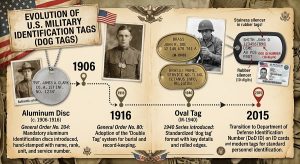
The history helps you understand the format. The U.S. Army first authorized identification tags in War Department General Order No. 204, dated December 20, 1906, which called for an aluminum tag about the size of a silver half dollar. On July 6, 1916, the Army changed the rule so every soldier carried two tags: one stays with the body, and one goes to the person in charge of burial for record-keeping.
The Marine Corps joined in quickly. Marine Corps records show identification tags have been used since 1916, and in 1918 serial numbers started appearing on tags in France. Later, the oval shape you picture today arrived around 1940. Marine tags from that period were made of Monel metal, and the Army’s M1940 tag was stainless steel.
One more detail that surprises people: the two-tag rule changed. In 1959 the procedure changed so both tags stay with the service member if they die.
Does the military still issue them, even with DNA testing? Yes. The Department of Defense says dog tags are still issued to service members today despite advances like DNA identification.
The Official U.S. Military Dog Tag Format
The format has changed over time, so “military dog tag format” depends on the era and the branch. Here’s what I can confirm from official sources.
U.S. Army: The DoD ID Switch
For more than 40 years, the Social Security number (SSN) sat on Army tags. In December 2015, that changed. The Army announced the SSN would be replaced by a 10-digit, randomly generated number to cut identity theft risk. The Army’s updated pamphlet (DA PAM 600-8-14) lists the DoD ID number as 10 digits with no hyphens.
The Army’s own reasoning was blunt. An official said that if you found lost tags, you could do almost anything with that person’s identity because you’d have their name, blood type, religion and Social Security number.
So a modern Army tag carries these details:
- Last name, first name, middle initial
- 10-digit DoD ID number (no dashes)
- Blood type
- Religious preference (or “NO PREFERENCE”)
U.S. Marine Corps: The Five-Line Layout
The Marines use more lines and add something no other branch does: gas mask size. The Marine Corps History Division lists the layout as last name on line 1; first and middle initials plus blood type on line 2; an ID number on line 3; “USMC” plus gas mask size on line 4; and religious preference on line 5.
| Line | What goes there |
|---|---|
| 1 | Last name |
| 2 | First and middle initials, blood type |
| 3 | ID number (the page still says SSN; modern tags use the DoD ID) |
| 4 | USMC, gas mask size |
| 5 | Religious preference |
Notice the note on line 3. The Marine page I checked still lists the Social Security number, while the Army moved to the DoD ID. If you’re making a replica, check which era you’re copying.
Navy, Air Force, Space Force and Coast Guard
They use the same building blocks: name, ID number, blood type and religion. Small layout differences exist, and some tags add a branch abbreviation such as USN or USCG. I won’t guess exact line breaks here, because guessing is how replicas end up wrong. Check your branch’s current identification-tag regulation if you need an exact copy.
The Red Tag Nobody Mentions
Some service members with a serious medical condition wear an extra tag. When a member has a medical condition that needs special attention, an additional red tag with the key details is issued and worn with the dog tags. Keep that idea in mind. We’ll steal it for your dog later.
How British and Commonwealth Tags Differ
You’re reading this from around the world, so here’s the quick global picture. British tags followed a different path. The British Army introduced identity discs in 1907, stamped with details like service number, surname and initials, and regiment, with religion also marked.
The two-disc idea showed up too. Army Order 287 of September 1916 required two discs: a green octagonal one worn on a long cord and a circular red one hanging from it. Hence the red-and-green pairs you see in museums. One museum example from World War II shows a stamped name, religion, ID number and a blood group on the reverse.
The lesson for your dog: every country does it differently, so use the military format as inspiration, not as a rulebook.
How Military Working Dogs Are Really Identified
Here’s what surprises most people. A military working dog (MWD) doesn’t depend on a neck tag at all.
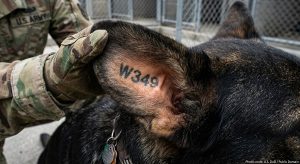
In the U.S., a dog earns its tattoo number, placed on its ear, when it completes training at the 341st Training Squadron at Lackland Air Force Base in Texas. One U.S. Air Force photo shows a tattoo reading “T207” inside a working dog’s ear. That’s a letter plus digits, and it stays with the dog for life.
The tattoo ties into records. The 341st’s logistics flight handles shipping and tracking for all Department of Defense working dogs worldwide. So if a dog loses its collar, gets moved between bases or turns up after an incident, the ear number still answers the question “whose dog is this?”
So why do you still see MWDs in photos with collar tags? Handlers add them for quick visual reference, like a call sign or kennel number. It’s a convenience, not the official ID.
A Legal Detail Most Articles Miss
In the UK, working dogs get special treatment. The Control of Dogs Order 1992 exempts several groups from wearing an ID collar, including dogs on official duties with the armed forces, customs or police, dogs doing emergency rescue work, and dogs used for tending cattle or sheep. The exemption applies only while the dog is working. Your off-duty protection dog doesn’t get a free pass.
What to Engrave on a Military-Style Tag for Your Dog
What should you engrave on a military-style dog tag? Put your phone number first, then a short medical or “working dog” note. Add your name and full address if your local law requires it (the UK does). The dog’s name is optional, and many owners leave it off to make theft harder.
That’s the short version. Now the detail, because the order you choose matters.
Step 1: Check Your Local Law First
This is the step every shop listing skips, and it’s the one that can cost you money.
United Kingdom. The Control of Dogs Order 1992 says a dog in a public place must wear a collar with the owner’s name and address inscribed on it or on a plate or badge attached to it. Dog-law guidance notes that your telephone number is optional but recommended, and you don’t have to put the dog’s name on the tag. Penalties exist too. One local council says you can face a fine of up to £5,000 if your dog doesn’t wear an ID tag.
A phone number alone doesn’t meet that rule. Plenty of owners don’t know this.
United States and most other countries. Rules usually come from your city, county or state rather than one national law, and licence or rabies tags are common. Check your local council or animal control office.
Here’s my honest take on the address question. Some trainers say never engrave your address, because it tells a thief where the dog lives. That’s a fair worry. But if you’re in the UK, leaving it off breaks the rule. In places without that rule, I lean toward a phone number only, plus a microchip. You decide based on your law and your risk.
Step 2: Spend Your Character Budget Wisely
A classic military-style tag is small, so space is tight. Real product listings show how tight:
- One popular dog ID maker allows up to 4 lines of engraving per side, with up to 15 characters per line.
- A military-pattern tag pair from another seller allows up to 5 lines of 14 characters.
- An anodized aluminum option allows up to 5 lines per side, with up to 20 characters per line.
Plan for about 14 to 15 characters per line and you’ll fit almost any shop. That’s why “555-0123-4567” fits but “Handler: J. Okonkwo 555-0123-4567” doesn’t. Count every space and dash before you order.
Step 3: Pick Your Template
Here are three layouts I’d recommend. Each uses both sides of the tag.
Template A: UK legal tag (meets the Control of Dogs Order)
| Front | Back |
|---|---|
| J OKONKWO | MICROCHIPPED |
| 12 ELM ROAD | ASTHMA MEDS |
| LEEDS LS1 2AB | (or blank) |
| 07700 900123 |
Template B: Privacy-first tag (no home address, where the law allows)
| Front | Back |
|---|---|
| CALL OWNER | CHIPPED |
| 555 0123 4567 | ALLERGY: BEES |
| 555 0199 8877 (2nd #) | DO NOT FEED |
Template C: Working or protection dog
| Front | Back |
|---|---|
| RAMBO (call name) | WORKING DOG |
| HANDLER: JO | DO NOT APPROACH |
| 555 0123 4567 | CHIP: LAST 8 DIGITS |
Notice a few things. A second phone number helps when your first one goes to voicemail. A short instruction like “DO NOT FEED” or “NEEDS MEDS” gives a stranger something useful to do. And “last 8 digits” of the microchip lets a vet confirm the match without exposing your full record.
Step 4: Pick the Right Priority Order
When space runs out, drop lines from the bottom of this list first:
- Phone number (always)
- Medical alert (if any)
- Name and address (required in the UK)
- “Microchipped” or the chip’s last digits
- Working-dog instruction
- Dog’s name (optional)
- Breed and weight (nice to have)
Step 5: Borrow the Military’s Two-Tag Idea
The military wears two tags for a reason: if one goes missing, the other survives. Do the same. Put one tag on the collar and a duplicate on the harness or working vest. Add a separate red tag for any serious medical condition, borrowing the red tag idea from above. A stranger sees red and knows to read it.
One more trick from the military world: rubber silencers. Standard dog tag silencers fit military-style tags and stop the metal from clinking. That helps on quiet work, and many handlers find a quiet tag less distracting for the dog.
A tag is only as safe as the collar holding it. If you’re still choosing hardware, read our guide on how to choose a safe, durable collar for your dog. A weak collar ring is one of the most common reasons I see tags lost in the field.
And if you’re building a full working-dog kit, our rundown of tactical K9 gear every working dog should have covers the rest of the list.
Size, Material and Engraving Method
Tag Size
The classic military size is about 2 inches by 1⅛ inches. Replica makers describe regulation tags as embossed (raised) text on a 2-inch by 1⅛-inch dull stainless steel tag. Dog-focused sellers offer two sizes: a small 1½ by ⅞ inch tag and a large 2 by 1⅛ inch tag. My rule: use the large tag for medium and big dogs, and the small one for toy breeds. A big tag swinging on a tiny dog gets annoying fast.
Materials
- Stainless steel. My first choice for working dogs. It resists rust, shrugs off mud and water, and matches the real thing.
- Brass. Great look, but it needs care. One seller offers brass but notes it needs a bit more care and provides a cleaning video. Expect tarnish.
- Anodized aluminum. Light and colourful, sold in colours like blue, red, pink, green, purple, black and silver. It scratches and dents more than steel, so I treat it as a backup tag, not the main one.
- Titanium. Light and tough, but pricier. Check a shop’s own specs before buying.
Engraving Method
- Embossing (raised letters). The classic military look, and easy to read by touch in the dark.
- Laser engraving. Sharp and precise. Some dog tag makers use laser engraving on both sides and offer a range of fonts.
- Diamond-drag engraving. Some aluminum tags are diamond-drag engraved, and double-engraved for extra definition.
The cheapest place to save money is the tag. The costliest place is a tag you can’t read. At the time I checked, one dog-focused military-style tag was listed at $15, and a military-pattern pair with chains and silencers was $16.99. Prices change, so check before you order.
Attachment Matters
Use a solid split ring, not a thin one. Check it for wear every month. A bent ring opens under stress, and then you’ve got a very nice tag lying in the grass.
7 Tag Mistakes I See Handlers Make
- Ignoring local law. In the UK, a phone number alone doesn’t meet the Control of Dogs Order. Check before you engrave.
- Cramming too much text. If you can’t read it at arm’s length, a stranger holding a scared dog can’t either.
- Engraving the dog’s name by default. It’s optional in the UK, and dog-law guidance warns that a stolen dog answering to its name looks like it belongs to the thief when it’s sold on. Think before you add it.
- Skipping the medical line. If your dog takes meds or has an allergy, say so. A vet tech needs that fast.
- Using only one tag. Chains snap and rings open. Carry a backup on the harness.
- Letting information go stale. An old phone number or an old address is worse than a blank line. An outdated address doesn’t meet the UK requirement and helps no one.
- Copying human fields. Blood type, religion and gas mask size mean nothing on a dog’s tag. Swap them for contact details and a medical alert.
Tag vs. Microchip vs. GPS
A tag is fast. Anyone can read it, and it needs no scanner or battery. But it can fall off, get chewed, or vanish in thick bush. A microchip can’t fall off. A GPS tracker shows where your dog is right now. Each one covers the other’s weakness.
The numbers back this up. A well-known 2009 study in the Journal of the American Veterinary Medical Association looked at more than 7,700 stray animals in shelters. Microchipped dogs were returned to their owners 52.2 percent of the time, compared with 21.9 percent for dogs without chips. The most common reason a chipped pet didn’t go home? Incorrect or missing owner information.
The lesson is easy: a chip is only as good as its registration. When you move or change your number, update the chip database and re-engrave the tag.
How big is the problem? The American Humane Association estimates over 10 million dogs and cats are lost or stolen in the U.S. each year, and one in three pets will become lost at some point.
UK owners face a legal layer too. From 6 April 2016, all dogs in England and Wales must be microchipped and registered on an approved database. Owners can face a fine of up to £500 for not microchipping or for not keeping details up to date. And local councils stress that a microchip does not replace a collar and tag.
| Layer | Strength | Weakness |
|---|---|---|
| Engraved tag | Instant, no scanner needed | Can fall off or get chewed |
| Microchip | Permanent | Needs a scanner and an up-to-date registry |
| GPS tracker | Live location | Needs charge and signal |
If your dog works off-leash or roams large property, add the third layer. Our guide on choosing the right tracker for your dog shows what’s worth paying for.
Trainer Notes From the Field
I’m Cpl. Rofiat Muritala, and I’ve spent more than 14 years as a military working dog instructor and handler at the Nigerian Army Dog Centre. I’ve handled working dogs in obedience, explosive detection, agility and tactical movement, including public demonstrations at the Nigerian Army Day Celebration (NADCEL) 2026.
Here’s the habit I push on every new handler: treat your dog’s ID as gear, not a one-time purchase. We check boots, harnesses and leads before every session. The tag belongs on that list.
My 60-second tag check (do it monthly):
- Read every line out loud. Can you read it without squinting?
- Pull on the split ring. Does it hold?
- Check the collar attachment point for wear.
- Confirm the phone number still works.
- Check the backup tag on the harness.
If you’re building a full routine for a working or protection dog, our e-book, Beyond the Bark: Inside a Pro Handler’s Playbook for Raising the Ideal Dog, walks through the structure professional handlers use to build dependable, obedient dogs from the ground up.
Insights from the ARFS K9 Training Team.
FAQs
1. What is on a military dog tag?
Modern U.S. tags carry the wearer’s name, a 10-digit DoD ID number, blood type and religious preference. The exact layout varies by branch. The Marine Corps layout also includes “USMC” and gas mask size across five lines.
2. Do military working dogs wear dog tags?
Not as their main ID. In the U.S., working dogs get a tattoo number on the ear after training at the 341st Training Squadron. Handlers sometimes add a collar tag for convenience, but the tattoo and records are what count.
3. What should I engrave on my dog’s military-style tag?
Put your phone number first, then a medical alert. Add your name and full address if your law requires it, as UK law does. The dog’s name is optional. Add “WORKING DOG” or “DO NOT FEED” if it fits your dog’s training.
4. Is it illegal to leave my address off my dog’s tag?
In the UK, yes. The Control of Dogs Order 1992 requires the owner’s name and address on a collar or attached tag, with exemptions for certain working dogs on duty. In the U.S. and many other countries, rules vary by city or state, so check your local council or animal control office.
5. How many characters fit on a military-style dog tag?
Most shops allow 4 or 5 lines per side, with about 14 to 20 characters per line. Plan for 14 to 15 characters per line so your text fits any maker, and count spaces and dashes before you order.
Final Thoughts: Your Tag Checklist
The military dog tag format works because it’s short, tough and built for a bad day. Copy that spirit, not the exact fields.
Here’s your quick checklist:
- Check your local law before you engrave anything.
- Lead with a working phone number.
- Add a medical alert, and use a red tag for serious conditions.
- Keep lines to about 14 or 15 characters.
- Choose stainless steel for dogs that work outdoors.
- Carry a backup tag on the harness.
- Pair the tag with a registered microchip, and add GPS if your dog roams.
- Run the 60-second check every month.
Get those right and you’ve built an ID system that works when it matters, not just one that looks good on a collar.
Want more handler-tested guides like this one? Subscribe to our weekly articles roundup at arfsk9team.com.ng/newsletter and get new K9 training, gear and safety articles in your inbox each week.
Sources and Further Reading
- Marine Corps University History Division: Dog Tags
- U.S. Army: Dog tags get first update in 40 years
- The Control of Dogs Order 1992, Article 2 (legislation.gov.uk)
- AVMA: Check the Chip
- Imperial War Museums: First World War identity discs

Her work centres on obedience, detection, protection and operational readiness. She favours proven methods built on repetition, consistency and real-world conditioning, so that both dogs and handlers are prepared for high-pressure tasks.
Rofiat represented the Nigerian Army Dog Centre at the Nigerian Army Day Celebration (NADCEL) 2026, where she led demonstrations in obedience, explosive detection, agility and tactical movement. Through articles, training content and documentaries, she shares field-based insight into how structured training, clear communication and trust between handler and dog affect performance and reliability.
She is the author of Beyond the Bark: Inside a Pro Handler's Playbook for Raising the Ideal Dog, a practical guide that helps dog owners and handlers apply professional training principles in everyday situations.
- Westminster Dog Show 2026: Winners & Full Results - October 17, 2026
- 10 K9-Approved Tricks to Teach Your Dog (Step-by-Step) - October 16, 2026
- COBA National Dog Championship 2026: Full Guide - October 15, 2026