Portie Dog Breed Guide: Temperament & Care Tips
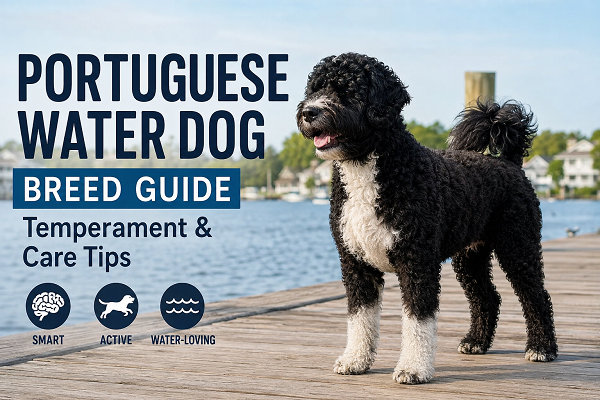
The Portuguese Water Dog, or “Portie,” is a medium-sized working breed (males 20–23 inches, 42–60 lbs; females 17–21 inches, 35–50 lbs) known for a hypoallergenic curly or wavy coat, high intelligence, and a strong, athletic temperament bred for full days of fishing work in and out of the water. They need 60–90 minutes of daily exercise, professional grooming every 4–6 weeks, and an owner ready for a dog that thinks for itself. Life expectancy runs 11–14 years.
Table of Contents
- Introduction
- Where the Portuguese Water Dog Came From
- Temperament: What a Portie Is Really Like
- Physical Traits and Breed Standard
- Exercise and Mental Stimulation Needs
- Training a Portuguese Water Dog
- Coat, Grooming, and the “Hypoallergenic” Question
- Health Issues Every Owner Should Screen For
- Portuguese Water Dog vs. Standard Poodle
- Cost of Owning a Portie
- Is a Portuguese Water Dog Right for You?
- Trainer’s Note
- FAQs
- Final Thoughts
Introduction
If you’ve spent any time around working breeds, you already know that “hypoallergenic” and “easygoing” rarely belong in the same sentence. The Portuguese Water Dog is proof of that. Most people meet this breed through two very famous examples, Bo and Sunny, the Obama family’s White House dogs and walk away thinking they’ve found a low-key, allergy-friendly family pet. What they’ve actually found is a former fishing boat deckhand with webbed feet, a rudder for a tail, and a job description that used to include diving under waves to herd fish into nets.
In this guide, I’m going to walk you through what a Portie actually is, not the sanitized version, but the version I’d tell a client sitting across from me deciding whether this breed fits their life. We’ll cover temperament, exercise needs, grooming realities, health risks worth knowing before you buy, and what it actually costs to own one of these dogs over a lifetime.
Summary of What You’ll Learn
- Where the Portuguese Water Dog came from and why it was built the way it was
- What Portie temperament is really like day to day, including the parts breeders don’t advertise
- Exercise, training, and mental stimulation needs for this working breed
- Coat type, grooming schedule, and realistic grooming costs
- Health conditions to screen for before buying a puppy
- Whether a Portie fits your household, and what it costs to own one
Where the Portuguese Water Dog Came From
The Portie’s story starts in the Algarve region of Portugal, where fishermen needed a dog that could work as hard as they did. The breed’s job wasn’t decorative. Porties herded fish into nets, retrieved gear that fell overboard, dove to recover broken nets, and carried messages between boats and shore. A monk in the 1200s reportedly described a Portie-like dog pulling a drowning sailor out of the sea, which tells you everything about the temperament this breed was selected for: fearless, useful, and completely at home in rough water.
By the mid-20th century, the working population had nearly collapsed as motorized fishing boats replaced the need for a canine crew member. A Portuguese ship owner named Vasco Bensaude is widely credited with saving the breed from near-extinction in the 1930s, and breeder Deyanne Miller later brought the Portie to North America and helped found the Portuguese Water Dog Club of America (PWDCA), which remains the AKC parent club today. The AKC granted full recognition in 1983, and the breed became eligible to compete in the Working Group starting in 1984.
Today the Portuguese Water Dog sits around 69th in AKC registration popularity out of roughly 155 recognized breeds, a respectable niche position that got a real publicity bump after 2009, when Bo joined the Obama family in the White House.
Temperament: What a Portie Is Really Like
The official AKC breed standard describes the Portuguese Water Dog’s temperament as “spirited disposition, self-willed, brave, and very resistant to fatigue” and I want you to actually sit with that phrase “self-willed” for a second, because it’s doing a lot of work.
Here’s what that means in a living room instead of a breed standard:
- They’re smart enough to problem-solve without you. This is a dog that was bred to make independent decisions on a moving boat, often out of arm’s reach of its handler. That instinct doesn’t disappear on land. Porties will figure out how to open latched gates, unzip bags, and work out that the couch cushions hide the good smells.
- They bond hard, and they show it. Porties are famously affectionate and tend to attach closely to their family, sometimes following one person from room to room like a furry shadow. Left alone too often, that attachment can tip into separation-related anxiety and destructive chewing.
- They’re playful well into adulthood. Owners often describe Porties as clownish. Mine has met more than one that will invent a game just to get a reaction out of you.
- They’re good with kids and other pets when raised right, but their exuberance and strength mean early socialization matters. A 50-pound dog with fishing-boat drive and no manners is a genuinely different animal than one that’s been worked with since puppyhood.
- Some lines run more strong-willed than others. The PWDCA itself notes you’ll find a real range of temperaments across the breed, some laid back, some stubborn, most somewhere in between. Meeting the parents before you commit to a puppy tells you more than any written description will.
If you want a dog that will lie quietly by the door while you work a 10-hour shift, this isn’t your breed. If you want a dog that will happily swim laps beside your kayak, then flop across your lap that evening demanding attention, you’re in the right place.
Physical Traits and Breed Standard
| Trait | Males | Females |
|---|---|---|
| Height | 20–23 inches | 17–21 inches |
| Weight | 42–60 lbs | 35–50 lbs |
| Coat | Curly or wavy, single-layer | Curly or wavy, single-layer |
| Life expectancy | 11–14 years | 11–14 years |
| AKC Group | Working Group | Working Group |
| Colors | Black, brown, black & white, brown & white | Black, brown, black & white, brown & white |
A few details that matter beyond the numbers: Porties are built slightly longer than tall, with a broad chest and a naturally long, thick tail that’s never docked, because it doubles as a rudder in the water. Their feet are webbed, a functional trait, not a party fact and their coat is genuinely waterproof. Dark eyes and a big, well-proportioned head are called for in the standard, and you’ll see the breed shown in either the traditional “lion clip” (shaved hindquarters, full coat on the front and head) or a more even “retriever clip.”
Exercise and Mental Stimulation Needs
Porties need somewhere in the range of 60 to 90 minutes of real exercise a day, and I want to stress the word “real.” A lap around the block doesn’t come close to satisfying a dog bred to swim for hours retrieving nets.
What actually works for this breed:
- Swimming, whenever you can offer it. This is the single best outlet for a Portie, low-impact on joints prone to dysplasia, and it taps directly into what the breed was built for.
- Retrieving games on land or water. Fetch, dock diving, and floating toy retrieval all scratch the same itch as their original job.
- Obedience or agility sport work. Porties are consistently competitive in AKC obedience and agility because the breed genuinely enjoys having a task.
- Puzzle feeders and scent games on days when weather or time keeps you indoors. A bored Portie will find its own project, and you usually won’t like the project it picks.
Skimping on exercise is the fastest route to the behavior problems Portie owners complain about most: excessive barking, chewing, and a dog that seems to have twice the energy it did that morning.
If you’re already tracking a working dog’s activity load for another breed in your household, the same logic applies here, check our guide on how often you should exercise a working dog for a breakdown of structured versus casual activity.
Training a Portuguese Water Dog
Porties are genuinely easy to train in the sense that they pick up commands fast, this is a breed that ranks near the top for working and obedience intelligence. The catch is that “easy to train” and “easy to control” aren’t the same thing with a self-willed dog.
A few things I tell every Portie owner starting obedience work:
- Start early, and start with structure, not just tricks. Basic obedience, leash manners, and a reliable recall matter more with this breed than most, because they’re strong swimmers with a genuine drive to chase birds or other movement into open water.
- Keep sessions short and varied. Porties get bored with repetition fast. Five to ten minutes of focused work, several times a day, beats one long drilling session.
- Use positive reinforcement, not force. This breed responds to praise, play, and food rewards. Heavy-handed corrections tend to produce a dog that shuts down or gets more stubborn, not one that listens better.
- Crate train from the start if you want a dog that settles calmly when you’re not home, it also helps manage the separation-related anxiety this breed can develop. If you’re setting this up for the first time, our step-by-step crate training guide walks through the exact timeline pro trainers use.
Coat, Grooming, and the “Hypoallergenic” Question
Here’s the part that surprises a lot of new owners: Porties don’t shed much, which is genuinely helpful for allergy-sensitive households (this is why the Obamas chose the breed for Malia). But low-shedding does not mean low-maintenance. It’s closer to the opposite.
A Portie’s coat grows continuously, like human hair, rather than cycling through a shed-and-regrow pattern. Left unclipped, it just keeps getting longer and denser. That means:
- Brushing 2–3 times a week minimum to prevent mats, especially behind the ears, under the legs, and around the collar.
- Professional grooming every 4–6 weeks, typically $60–$100 per session in the US depending on your area and the clip style, plus a bath. Many owners in the “lion clip” tradition alternate a full shave-down with maintenance trims.
- A quality slicker or pin brush at home built for curly, dense coats, a standard short-hair brush won’t get through this coat without pulling.
- Regular ear checks. Curly-coated, floppy-eared breeds trap moisture, which raises the risk of ear infections, especially in a dog that swims often.
For the brushing routine between grooming appointments, I use something similar to the Poodle Pet Slicker Brush, the fine, rounded pins are built for exactly this kind of dense curly coat and won’t scratch the skin underneath.
Because Porties love water and their coat holds onto whatever they swim through, a gentle wash after lake or ocean trips matters too. A shampoo formulated for sensitive skin, like the Natural Dog Company Sensitive Skin Shampoo, helps rinse out salt, chlorine, or pond debris without stripping the coat’s natural oils.
If your household is dealing with grooming for the first time, our broader puppy grooming guide covers the fundamentals that apply before you even get into breed-specific coat care.
Health Issues Every Owner Should Screen For
Porties are generally a healthy breed, but the PWDCA runs one of the more rigorous health-testing programs of any AKC parent club, and there’s a reason for that. A handful of hereditary conditions show up at meaningful rates in this breed, and several are serious enough that responsible breeders test for them before ever placing a litter.
Conditions to ask breeders about directly:
- GM1 Gangliosidosis — A fatal lysosomal storage disease that causes progressive neurological decline, typically appearing around 2–6 months of age. It’s recessive, meaning both parents must carry the gene to produce an affected puppy. A DNA test exists, and any responsible breeder will have both parents tested.
- Juvenile Dilated Cardiomyopathy (JDCM) — An inherited heart condition that causes sudden death in puppies, most often between 6 weeks and 7 months of age, sometimes with no warning signs at all. A linked-marker DNA test has been available through PennGen since 2007.
- Hip and elbow dysplasia — Common across medium and large working breeds; OFA radiographic evaluation of breeding stock is standard practice for this reason.
- Addison’s disease — Affects roughly 1.4% of the breed according to PWDCA health data, causing adrenal insufficiency that requires lifelong management once diagnosed. Symptoms are often vague (lethargy, intermittent vomiting, poor appetite), which makes it easy to miss until a crisis.
- Progressive retinal atrophy (prcd-PRA) and microphthalmia syndrome — Inherited eye conditions with available DNA tests.
- Follicular dysplasia — A hereditary hair-loss condition that usually shows up between two and four years of age.
The PWDCA’s CHIC (Canine Health Information Center) certification requires OFA hip evaluation, annual eye exams, and DNA testing for the conditions above. If you’re buying a puppy, ask to see the CHIC numbers for both parents, it’s the single most useful piece of paperwork a breeder can hand you. With good screening, most Porties live a full, healthy 11 to 14 years.
Portuguese Water Dog vs. Standard Poodle
Porties and Standard Poodles get confused constantly, since both are curly-coated, low-shedding, highly intelligent water-bred dogs. Here’s how they actually differ:
| Trait | Portuguese Water Dog | Standard Poodle |
|---|---|---|
| Origin | Portugal — fishing boat helper | Germany/France — waterfowl retriever |
| Weight | 35–60 lbs | 45–70 lbs |
| Coat texture | Curly or wavy, coarser | Dense, softer curls |
| Tail | Long, natural, used as a rudder | Traditionally docked in some countries |
| Temperament | Spirited, self-willed, bold | Highly biddable, eager to please |
| AKC Group | Working Group | Non-Sporting Group |
| Common health watch-outs | JDCM, GM1, hip dysplasia, Addison’s | Bloat, Addison’s, hip dysplasia, epilepsy |
Both make excellent choices for allergy-sensitive households and active owners. If you want a dog that questions your instructions occasionally, go Portie. If you want a dog that treats every command like a delightful suggestion it’s thrilled to follow, the Poodle usually edges ahead on pure obedience-trial biddability.
Cost of Owning a Portie
Budget realistically before you bring one home:
- Puppy price: Roughly $2,000–$3,000 from a health-tested breeder in the US, with an average around $2,100. Prices below $1,500–$1,600 should raise questions about health testing.
- Grooming: $60–$100 every 4–6 weeks, or the time cost of learning to clip the coat yourself.
- Food: Budget for a medium-to-large active breed; expect $50–$80 a month for quality food.
- Health testing and vet care: Routine care plus the genetic screening panels above if you’re buying from a breeder who hasn’t already run them.
- Gear: A well-fitted swim vest is worth the investment for boating or open-water swims, something like the Dogcheer Dog Life Jacket adds visibility and buoyancy for a breed that will happily swim further than it should.
Total first-year cost, including a health-tested puppy, typically lands somewhere between $3,500 and $5,000 once you factor in initial vet visits, vaccinations, spay/neuter, and gear.
Is a Portuguese Water Dog Right for You?
A Portie is a strong fit if you:
- Have an active lifestyle with regular access to water, lakes, beaches, or a pool
- Want a low-shedding dog for allergy management, and are prepared to pay for grooming to keep that benefit
- Can commit 60–90 minutes a day to real exercise and mental engagement
- Enjoy training and want a dog that can compete in obedience, agility, or dock diving
- Have time to spend with the dog, this isn’t a breed that thrives left alone for long stretches
A Portie is probably not a fit if you want a low-energy companion, have very limited grooming budget or time, or need a dog that’s content home alone for 9–10 hours regularly.
Trainer’s Note
I’ve worked hands-on with working and sporting breeds throughout my career as a K9 handler and trainer, including dogs bred for water retrieval work similar to the Portie’s original fishing-boat role. What I see most often with this breed isn’t a temperament problem, it’s a mismatch problem. Owners fall for the hypoallergenic coat and the White House association without budgeting for the exercise, grooming, and mental engagement a genuine working line demands. Get those three things right, and a Portie is one of the most rewarding, good-humored dogs you can bring into an active household.
Frequently Asked Questions
Are Portuguese Water Dogs really hypoallergenic?
They’re considered one of the better breeds for allergy-sensitive households because of their low-shedding, single-layer coat, which produces less loose dander around the home. No dog is 100% allergen-free, so anyone with a serious dog allergy should spend time with an adult Portie before committing.
How much exercise does a Portuguese Water Dog need?
Plan for 60–90 minutes of active exercise daily, ideally including swimming, retrieving, or structured training. This is a working breed built for full days of physical activity, and under-exercising it usually shows up as barking, chewing, or restlessness.
Do Portuguese Water Dogs get along with kids and other pets?
Generally yes, especially when raised with early socialization. Their playful, affectionate nature makes them good family dogs, though their strength and enthusiasm mean supervision matters with very young children.
How long do Portuguese Water Dogs live?
Typically 11 to 14 years, with some living past 15 given good genetics, weight management, and preventive healthcare. Screening breeding stock for JDCM, GM1, and hip dysplasia is the biggest factor in a longer, healthier life.
How much does a Portuguese Water Dog puppy cost?
Expect to pay roughly $2,000 to $3,000 from a health-tested breeder, with the US average around $2,100. Add grooming, food, and vet costs, and first-year ownership typically runs $3,500 to $5,000.
Final Thoughts
The Portuguese Water Dog is one of those breeds that looks like a low-maintenance lap dog in photos and lives like a working athlete in real life. That gap is exactly what trips up new owners. If you go in clear-eyed, ready for real daily exercise, a genuine grooming budget, and a dog smart enough to outthink you occasionally, you’ll get one of the most loyal, funny, and genuinely capable companions in the working dog world.
Before you bring one home, talk to a breeder about CHIC health certifications, meet the parents if you can, and start thinking now about training structure and exercise routine so you’re ready on day one.
Rofiat Muritala is a veteran military K9 handler and certified trainer, and the voice behind ARFS K9 Team’s breed and training content.

Her work centres on obedience, detection, protection and operational readiness. She favours proven methods built on repetition, consistency and real-world conditioning, so that both dogs and handlers are prepared for high-pressure tasks.
Rofiat represented the Nigerian Army Dog Centre at the Nigerian Army Day Celebration (NADCEL) 2026, where she led demonstrations in obedience, explosive detection, agility and tactical movement. Through articles, training content and documentaries, she shares field-based insight into how structured training, clear communication and trust between handler and dog affect performance and reliability.
She is the author of Beyond the Bark: Inside a Pro Handler's Playbook for Raising the Ideal Dog, a practical guide that helps dog owners and handlers apply professional training principles in everyday situations.
- Is K9 Advantix Safe for Dogs? A Handler’s Honest Review - October 2, 2026
- Australian Cattle Dog vs Blue Heeler: Any Difference? - October 1, 2026
- Bousnic Dog Training Collar Review: Is It Safe? - September 30, 2026