German Shepherd Cross Doberman Puppies: 7 Vital Facts
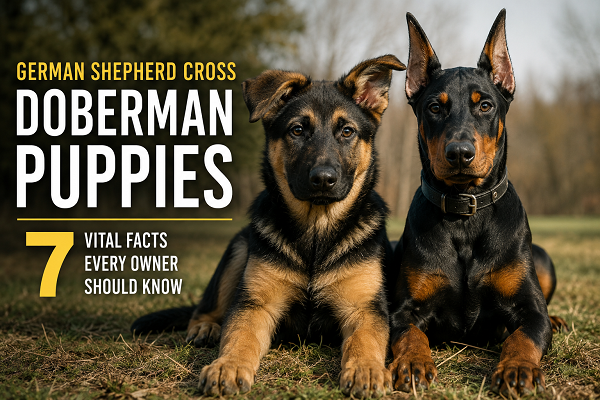
A German Shepherd Doberman mix (often called a Doberman Shepherd or Dobershep) is a large hybrid dog that typically weighs 60–100 pounds, stands 24–28 inches tall, lives 10–13 years, and combines the German Shepherd’s trainability with the Doberman’s sharp protective drive. It’s a serious working-type dog best suited to experienced owners who can commit to early socialization, structured training, and daily exercise.
Table of Contents
- Introduction
- It’s a Newer Cross of Two Very Old Working Breeds
- You’re Getting a Big, Athletic Dog With a Coat That Hates the Cold
- The Temperament Is Two Guard Dogs Rolled Into One
- Hybrid Vigor Helps, But These Health Risks Still Apply
- Training Has to Start Early and Stay Consistent
- This Is Not a Low-Energy, Apartment-Friendly Dog
- What You’ll Actually Pay, and Where to Find a Healthy Puppy
- A Note From the Trainer’s Chair
- Frequently Asked Questions
- Conclusion
Introduction
Here’s the problem I see over and over again: someone falls in love with photos of a German Shepherd Doberman mix online, an intense-looking dog with cropped-style ears, a lean Doberman body, and German Shepherd coloring, and they bring one home without understanding what they’re actually getting. Two months later, they’re calling trainers like me asking why their “cute puppy” is now lunging at the mail carrier.
That’s not a knock on the dog. It’s a knock on how little solid, practical information exists about this specific cross. Most articles either romanticize the breed or just recycle the same three facts about loyalty and intelligence.
In this guide, you’ll learn the seven things that actually matter before you commit to a German Shepherd cross Doberman puppy: where this mix really comes from, what it looks like and how big it gets, what its temperament is genuinely like day-to-day, the specific health conditions to screen for, how training timelines work in the real world, how much exercise it needs, and what a responsible puppy actually costs. Let’s get into it.
1. It’s a Newer Cross of Two Very Old Working Breeds
Ever wonder why the German Shepherd Doberman mix doesn’t have a long, storied history like its parent breeds? That’s because it doesn’t. Both parent breeds have deep, well-documented pedigrees, but the cross itself is a modern development, most breeders trace its rise to the early 2000s in the United States, driven by demand for a dog that combined the German Shepherd’s versatility with the Doberman’s sleeker frame and sharper edge.
To understand the mix, you need to understand the parents:
- The German Shepherd was developed in Germany starting in 1899 by Max von Stephanitz, originally bred to herd sheep before proving itself in police work, military service, search-and-rescue, and disability assistance. It’s consistently one of the most registered breeds worldwide.
- The Doberman Pinscher came about roughly a decade later, in the 1890s, when a German tax collector and night watchman named Karl Friedrich Louis Dobermann wanted a dog fierce and loyal enough to protect him on dangerous collection routes. He combined several German breeds, prioritizing long, intimidating ears and a short tail that couldn’t be grabbed in a fight.
Both dogs ended up serving in the same roles over the following century: military work, police patrol, and personal protection. So when breeders started crossing them, the goal wasn’t novelty. It was trying to produce a dog with the trainability of the Shepherd and the compact athleticism of the Doberman.
One thing to know upfront: the German Shepherd Doberman mix isn’t recognized by the American Kennel Club, The Kennel Club (UK), or the FCI. It’s a hybrid, not a breed with an official standard, which means you won’t find health-testing requirements or a breed club holding lines to a consistent look or temperament. That responsibility falls entirely on the individual breeder, and it’s one of the biggest reasons due diligence matters so much with this cross.
2. You’re Getting a Big, Athletic Dog With a Coat That Hates the Cold
How big does a German Shepherd Doberman mix get? Most adults weigh between 60 and 100 pounds and stand 24 to 28 inches at the shoulder, putting them solidly in large-breed territory, similar in scale to a working-line German Shepherd but often leaner through the chest and legs like a Doberman.
Because this is a mixed breed with no fixed standard, appearance genuinely varies from litter to litter, and even within the same litter. Here’s what tends to show up:
- Build: Muscular and athletic, usually leaner than a purebred German Shepherd but heavier-boned than a purebred Doberman
- Coat: Short to medium length, dense, and much closer to the Doberman’s coat than the Shepherd’s famous double coat
- Ears: Can go either way, upright and pointed like a Shepherd, or naturally erect and Doberman-shaped (without cropping, since ear cropping is banned or restricted across most of Europe and increasingly discouraged in the US and UK)
- Coloring: Commonly black and tan, though sable, solid black, and the classic Doberman rust-and-black pattern all show up depending on which parent dominates
- Tail: Usually left natural and un-docked, long and slightly curved
Here’s the practical issue that catches new owners off guard: that short-to-medium Doberman-influenced coat is not built for cold climates. If you live somewhere with real winters, you’ll need a good dog coat for walks and you should never leave this mix outside for long stretches once temperatures drop toward freezing. This is one of those small details that gets left out of most breed write-ups but genuinely affects your day-to-day care routine.
3. The Temperament Is Two Guard Dogs Rolled Into One
This is the section I wish more people read carefully before buying. When you’re choosing a guard dog for your family, temperament matters more than looks, and this cross inherits strong protective instincts from both sides.
What you should expect:
- Fierce loyalty to family. Both parent breeds bond intensely with their people, and the mix is no different. This isn’t a dog that will warm up to just anyone.
- Natural wariness of strangers. Without deliberate, early socialization, that wariness can tip into fear-based reactivity or unwarranted suspicion. This isn’t a dog that greets every visitor like a Labrador would.
- High intelligence. Both parent breeds rank among the smartest working dogs in the world, which is a double-edged sword. A bored, understimulated German Shepherd Doberman mix will find its own “jobs,” and you usually won’t like what it picks.
- Dominant, confident personality. This mix does best with an owner who can lead calmly and consistently. It is not the right dog for someone who wants a pushover pet.
I want to be direct about something a lot of breed pages soften: this cross relies heavily on its guarding instincts, and if a dog isn’t taught how to regulate its suspicion of people and situations, it can act on that suspicion in ways that create real liability for the owner. That’s true of the Doberman side and the German Shepherd side individually, and it doesn’t cancel out in the mix, it compounds.
None of this means the dog is inherently dangerous. It means it’s a serious working-type temperament that needs serious, competent handling. If you’ve read about the difference between obedience and instinct in dog intelligence, you’ll recognize this mix leans heavily on instinctive drive, which is exactly why structured leadership matters more here than with a typical companion breed.
4. Hybrid Vigor Helps, But These Health Risks Still Apply
How long do German Shepherd Doberman mixes live? Most sources put the lifespan at 10 to 13 years, which lines up with both parent breeds individually. Mixed breeds often benefit from what’s called hybrid vigor, a broader gene pool that can reduce the concentration of inherited defects, but “reduced risk” doesn’t mean “no risk.”
Here’s the reality: this mix can inherit health conditions from either parent, and both the German Shepherd and Doberman carry some serious ones. A responsible owner screens for these rather than hoping for the best.
| Condition | Comes From | What to Watch For |
|---|---|---|
| Hip & elbow dysplasia | Both breeds | Limping, stiffness after rest, reluctance to jump or climb stairs |
| Gastric dilatation-volvulus (bloat/GDV) | Both breeds (deep-chested) | Distended abdomen, unproductive retching, restlessness, sudden collapse; this is a life-threatening emergency requiring immediate surgery |
| Dilated cardiomyopathy (DCM) | Primarily Doberman | Lethargy, coughing, exercise intolerance; often requires cardiac screening via echocardiogram |
| Von Willebrand disease | Primarily Doberman | Excessive bleeding from minor cuts, prolonged bleeding after surgery |
| Degenerative myelopathy | Primarily German Shepherd | Hind-leg scuffing, progressive weakness in the rear limbs, usually appearing in older dogs |
| Hypothyroidism | Both breeds | Weight gain, lethargy, coat and skin problems |
A few practical notes worth knowing:
- Bloat prevention matters daily, not just in an emergency. Feeding two or three smaller meals instead of one large one, and avoiding vigorous exercise right after eating, meaningfully lowers the risk in deep-chested breeds like this mix.
- Ask breeders for proof of health testing on both parent dogs, specifically hip and elbow scores (OFA or PennHIP in the US, or equivalent schemes in the UK/EU) and, ideally, a cardiac clearance if there’s Doberman ancestry involved. A breeder who can’t produce this documentation is a red flag.
- Annual vet checkups become non-negotiable once your dog passes age six or seven, since several of these conditions are far more manageable when caught early.
5. Training Has to Start Early and Stay Consistent
If you’ve ever felt frustrated training a strong-willed dog, a German Shepherd Doberman mix will test that patience in new ways, mostly because it’s smart enough to learn fast and independent enough to decide when it feels like listening.
Here’s a realistic training timeline based on how both parent breeds typically develop:
| Age | Training Focus | What Success Looks Like |
|---|---|---|
| 8–10 weeks | Name recognition, crate training, gentle handling, first exposure to new people and environments | Puppy accepts handling calmly, starts responding to its name |
| 3–6 months | Basic obedience (sit, stay, come, leash walking), active socialization window | Reliable response to 3–5 basic commands in low-distraction settings |
| 6–12 months | Impulse control, boundary training, structured socialization with strangers and other dogs | Dog can hold a stay around mild distractions, greets new people without excessive suspicion |
| 12–24 months | Advanced obedience, refining protective instincts into controlled responses | Dog distinguishes between genuine threats and normal visitors; responds to recall even under distraction |
The single most important window is 3 to 12 months. This is when the natural wariness both parent breeds carry either gets shaped into a stable, discriminating adult temperament, or hardens into fear-based reactivity that’s much harder to undo later. Skipping structured socialization during this stage is, hands down, the most common mistake I see with protective hybrid breeds like this one.
A few things I tell every owner of a strong guarding-type dog:
- Lead with structure, not force. Dominance-based “alpha” training methods are outdated and tend to backfire on confident, intelligent breeds like this mix. Understanding the difference between dominance and discipline will save you months of frustration.
- Basic protection commands aren’t the same as bite training. A well-trained family guardian needs reliable obedience under pressure, not aggression. If you want your dog’s natural instincts to be an asset instead of a liability, teaching solid control commands early is the foundation.
- Consider working with a trainer experienced in German Shepherds or Dobermans specifically. General obedience classes are a fine start, but this mix benefits from handlers who understand drive-based training, not just treat-based compliance.
6. This Is Not a Low-Energy, Apartment-Friendly Dog
Both parent breeds were bred for demanding physical work, so it shouldn’t surprise anyone that the offspring needs real daily exercise, not a quick walk around the block.
Plan on 60 to 90 minutes of physical activity daily, split across two sessions if possible, plus mental stimulation on top of that. Good options include:
- Structured walks or jogs (this mix makes an excellent running partner once fully grown)
- Off-leash time in a securely fenced area
- Obedience or agility training sessions, which double as mental exercise
- Scent work or puzzle feeders on lower-activity days
- Supervised play with other calm, well-socialized dogs
Without enough outlet for that energy, you’ll likely see destructive chewing, excessive barking, or restlessness. I’ve met more than one owner who mistook a bored, understimulated German Shepherd Doberman mix for an “aggressive” dog, when the real issue was a working-bred animal with nowhere to put its drive.
Living situation matters too. This mix can adapt to apartment life if you’re genuinely committed to the exercise schedule above, but it thrives best with access to a yard and a household that treats daily activity as non-negotiable, not optional.
7. What You’ll Actually Pay, and Where to Find a Healthy Puppy
How much does a German Shepherd Doberman mix puppy cost? Expect to pay roughly $500 to $1,500 from a reputable breeder, generally less than a purebred German Shepherd or Doberman from health-tested parents, since designer crosses without breed-club backing typically command lower prices. That said, “cheaper puppy” often means “fewer health guarantees,” so price alone shouldn’t be your deciding factor.
Rough annual ownership costs to budget for:
| Category | Estimated Annual Cost |
|---|---|
| High-quality large-breed food | $600–$900 |
| Routine veterinary care | $500–$900 |
| Emergency vet fund (bloat surgery alone can run $3,000–$7,000) | Recommend a dedicated savings buffer or pet insurance |
| Training classes | $300–$600 |
| Grooming and basic supplies | $150–$300 |
Where to look, and what to avoid:
- Reputable breeders will let you meet both parent dogs, provide hip/elbow health clearances, and welcome questions about temperament and lineage. Be wary of anyone who can’t or won’t do this.
- Rescue and shelter options are worth checking first. German Shepherd and Doberman mixes show up in shelters more often than people expect, and adoption typically runs $150–$400, a fraction of breeder pricing.
- Red flags include sellers who push same-week pickup, won’t let you see where the puppies were raised, or have no information on either parent’s temperament or health history.
If you’re weighing this cross against other protective breeds before committing, it’s worth reading up on how German Shepherds compare to other working breeds like the Belgian Malinois, since a lot of the same “is this the right dog for my life” questions apply here too. And if you land on a working-line German Shepherd influence in your mix specifically, understanding how working-line training differs from show-line training will help you set realistic expectations for drive and energy.
A Note From the Trainer’s Chair
Insights from the ARFS K9 Team: over years spent around working German Shepherds and Dobermans in security and protection contexts, the pattern with hybrid guardian breeds is consistent, the dogs that turn out stable and reliable are the ones whose owners treated the first year as a training investment, not an afterthought. The dogs that turn into liabilities are almost always the ones left to “figure it out” on their own during that critical socialization window. If you’re serious about raising a German Shepherd Doberman mix well, the training principles that apply to any strong protection-bred dog, structured leadership, early socialization, and consistent boundaries, matter more than any single fact about the breed itself. Our guide, Beyond the Bark: Inside a Pro Handler’s Playbook for Raising the Ideal Dog, walks through exactly this process step by step if you want a deeper resource to work from.
Frequently Asked Questions
Is a German Shepherd Doberman mix a good family dog?
It can be, but only with the right owner. This mix does best with families experienced in handling large, protective breeds who can commit to early socialization and daily structured exercise. It’s generally not recommended as a first dog for a novice owner or a household without time for consistent training.
Are German Shepherd Doberman mixes aggressive?
Not inherently. Both parent breeds are protective by nature rather than aggressive, but without proper socialization between roughly 3 and 12 months of age, that natural wariness toward strangers can develop into fear-based reactivity. A well-bred, well-trained German Shepherd Doberman mix is loyal and controlled, not unpredictable.
How big will my German Shepherd Doberman mix puppy get?
Most adults reach 60 to 100 pounds and stand 24 to 28 inches tall at the shoulder, though exact size depends heavily on which parent’s genetics dominate. Puppies from working-line parents on either side tend to mature toward the larger end of that range.
What health tests should I ask a breeder for?
At minimum, ask for hip and elbow evaluation scores on both parent dogs (OFA or PennHIP certification in the US, equivalent hip scoring schemes in the UK and EU). If there’s strong Doberman lineage, also ask about cardiac screening for dilated cardiomyopathy and von Willebrand disease testing.
How much exercise does a German Shepherd Doberman mix need?
Plan for 60 to 90 minutes of physical activity daily, ideally split into two sessions, along with mental stimulation like obedience work or puzzle feeders. This is a working-bred hybrid, and inadequate exercise is one of the most common causes of behavioral problems in the breed.
Conclusion
A German Shepherd Doberman mix isn’t a dog you fall into by accident and figure out later. It’s a large, intelligent, instinct-driven hybrid built from two of the world’s most capable protection breeds, and it rewards owners who show up prepared with a loyal, discerning guardian that’s every bit as trainable as it is protective.
Before you commit, make sure you can genuinely offer: early and consistent socialization through the first year, 60-plus minutes of daily exercise, a household ready to handle a confident, sometimes stubborn temperament, and a financial buffer for the specific health conditions this cross can inherit from either parent. Do the legwork on the breeder, ask for health clearances without apology, and start training the day your puppy comes home rather than waiting for problems to show up first.
Get those fundamentals right, and you’ll end up with one of the most capable, loyal companions in the working-dog world. Skip them, and you’ll be dealing with the exact frustrations that send people searching for trainers six months down the line.
Insights from the ARFS K9 Team — professional K9 handlers and trainers specializing in working dogs, protection breeds, and security-focused canine training.

Her work centres on obedience, detection, protection and operational readiness. She favours proven methods built on repetition, consistency and real-world conditioning, so that both dogs and handlers are prepared for high-pressure tasks.
Rofiat represented the Nigerian Army Dog Centre at the Nigerian Army Day Celebration (NADCEL) 2026, where she led demonstrations in obedience, explosive detection, agility and tactical movement. Through articles, training content and documentaries, she shares field-based insight into how structured training, clear communication and trust between handler and dog affect performance and reliability.
She is the author of Beyond the Bark: Inside a Pro Handler's Playbook for Raising the Ideal Dog, a practical guide that helps dog owners and handlers apply professional training principles in everyday situations.
- Australian Cattle Dog vs Blue Heeler: Any Difference? - October 1, 2026
- Bousnic Dog Training Collar Review: Is It Safe? - September 30, 2026
- Gravy Train Dog Food Review: Ingredients & Recalls - September 30, 2026