Nova Scotia Duck Tolling Retriever: Pros & Cons

The Nova Scotia Duck Tolling Retriever (the “Toller”) is a smart, athletic, 30–50 lb retriever that’s affectionate with family and easy to train, but it needs 60–90 minutes of hard exercise a day, can be loud, and carries a higher-than-average risk of immune-system disease. It suits active owners who want a partner for hiking, water work or dog sports. It doesn’t suit sedentary homes, long workdays away, or buyers who skip health-tested breeders.
Quick verdict: Great for active, experienced or very committed first-time owners. Risky for everyone else.
Table of Contents
- What Is a Nova Scotia Duck Tolling Retriever?
- The Pros of Owning a Toller
- The Cons of Owning a Toller
- Toller Health Problems: The Numbers Most Articles Skip
- How Much Does a Toller Cost?
- Toller vs Labrador vs Golden Retriever vs Border Collie
- Is a Toller Right for You? (Self-Check)
- Working Roles and Training Tips
- Trainer’s Notes
- FAQs
- Conclusion
Introduction
You’ve seen the photos. A fox-red dog with white socks, grinning, soaking wet, and holding a ball like it’s treasure. It’s easy to fall for the Nova Scotia Duck Tolling Retriever in about four seconds.
But here’s the thing. Tollers aren’t Labradors in a smaller coat. They’re sharper, louder, more sensitive and a lot more demanding. I’ve watched plenty of families buy a Toller puppy for its looks, then struggle by month six when the dog starts shredding sofas at 3 a.m.
This guide gives you the honest pros and cons of the Toller, with real numbers on health, cost and daily workload. You’ll learn what the breed was built to do, which problems come up most, how it compares with Labs, Goldens and Border Collies, and whether one fits your life. If you work with dogs for a living, you’ll also see where Tollers shine in sport and search work.
What Is a Nova Scotia Duck Tolling Retriever?
The Toller is the smallest of the retriever breeds. Most weigh 30–50 lb (14–23 kg) and stand 17–21 in (43–53 cm) at the shoulder, with females a little smaller. The coat is a water-repellent double coat in shades of red or orange, usually with white on the chest, feet and tail tip. The feet are webbed, and the tail carries a feathered plume.
Where the Toller came from
The breed started around the early 1800s in Little River Harbour, Yarmouth County, Nova Scotia, where it was first called the Little River Duck Dog. Hunters bred it from retriever, spaniel and setter stock to do one odd job: toll ducks. According to Wikipedia’s breed history, the Canadian Kennel Club recognized it in 1945, and Nova Scotia named it the province’s official dog in 1995.
How tolling actually works
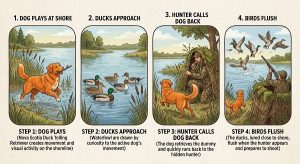
Most articles say “it lures ducks” and move on. Here’s the real sequence:
- The hunter hides in a blind near the water.
- A helper tosses a ball or stick, and the Toller runs along the shore, jumping, splashing and chasing it in plain view.
- The ducks get curious. The dog’s fox-like look and white tail tip draw them closer.
- When the birds drift into range, the hunter calls the dog back. The birds flush, and the hunter shoots.
- The dog then retrieves what’s down, even in icy water.
That story explains the whole personality. A Toller has to play hard, stay focused on a thrown object, then switch off and sit quietly in a blind. Intense drive plus self-control is the original job description. It’s also why a bored Toller drives owners up the wall.
Quick breed facts
| Trait | Typical range |
|---|---|
| Weight | 30–50 lb (14–23 kg) |
| Height | 17–21 in (43–53 cm) |
| Lifespan | 10–14 years (a small 2024 UK study reported 13.2 years on average) |
| Coat | Medium-length double coat, red/orange with white markings |
| Daily exercise | 60–90 minutes plus mental work |
| Group | Sporting (AKC, CKC) / Gundog (UKC, Kennel Club) |
| Famous trait | The “Toller scream,” a piercing high-pitched bark of excitement |
The Pros of Owning a Nova Scotia Duck Tolling Retriever
Let’s start with what makes people love this breed.
Quick answer: what are the main pros of a Toller? Tollers are smart, eager to please, affectionate with family, built for water, and small enough for most homes. They’re also versatile: one dog can hike, swim, compete in agility and do nosework.
1. They learn fast and want to work with you
Tollers are quick, eager to please and very food- and toy-motivated. Reward-based training clicks with them. Most owners get solid basics (sit, down, recall, loose-leash walking) in 8–12 weeks of short daily sessions, and bright dogs often hit that mark sooner.
2. They’re a manageable size
At 30–50 lb, a Toller fits in a normal car, on a normal couch and on a normal hiking trail. You get retriever skills without the 70-lb Lab muscle pulling you down the street.
3. They’re naturals around water
The webbed feet, water-shedding coat and strong swimming drive make Tollers excellent in lakes, rivers and surf. If you paddle, fish or camp, you’ve got a built-in partner. (Always check currents and water temperature. Even this coat has limits.)
4. They bond deeply with their people
A well-raised Toller sticks close to family and reads your mood. Owners describe them as “velcro dogs.” That’s lovely, but it also sets up the separation problems I cover in the cons.
5. They’re versatile athletes
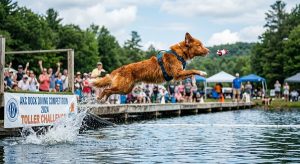
Tollers do well in agility, dock diving, flyball, obedience, rally, disc, lure coursing and field trials. You’ll also see Tollers in search and rescue and nosework, where nose, stamina and drive count.
6. The coat is easier than it looks
That medium coat doesn’t mat easily. Weekly brushing is usually enough most of the year, and you rarely need professional grooming. Rinse it after muddy swims and dry it well to keep skin healthy.
7. They make decent alert dogs
Tollers announce visitors loudly. They’re not protection dogs, and you shouldn’t expect one to guard your home. But as a doorbell with legs, they work very well.
8. They’re a conversation starter
You won’t meet one on every corner. The AKC ranks the breed around 69th in popularity per Wikipedia, so you’ll turn heads at the trailhead.
The Cons of Owning a Nova Scotia Duck Tolling Retriever
Now the part breeders sometimes gloss over.
Quick answer: what are the biggest cons of a Toller? Tollers need 60–90 minutes of hard exercise daily, bark and scream loudly, shed in big seasonal waves, struggle when left alone, and have a real risk of immune-system disease. They’re also hard to find, and good puppies often come with long waiting lists.
1. The exercise need is huge
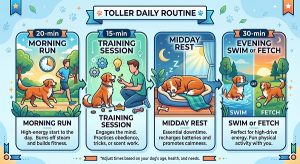
A walk around the block won’t cut it. A Toller needs at least an hour of running, swimming or fetch every day, plus brain work like scent games or trick training. Skip it, and you’ll see chewing, digging, pacing and nonstop barking.
Here’s a simple rule I give new owners: tired in the body, tired in the head. Aim for 45 minutes of physical work and 15 minutes of thinking games, then a second shorter session in the evening. For ideas, see our guide on how often to exercise a working dog.
2. The “Toller scream” is real
When a Toller gets excited, it can let out a high, shrill shriek. Ever had a smoke alarm go off next to your ear? That’s close. Some dogs do it at squirrels, some at the leash coming off the hook, and some at nothing. You can train it down, but you can’t train it out. Check your neighbors, your walls and your patience before you commit.
3. Separation anxiety is common
Because Tollers bond so tightly, many struggle when you leave. If you work 9 hours away from home, this breed is a poor fit unless you have a dog walker, daycare or a work-from-home setup. Start crate and alone-time training at 8 weeks, and build it up slowly. Our crate training tips show how to do it step by step.
4. High prey drive
The job was to chase and stay locked on moving things. So squirrels, birds, bikes and small pets can set a Toller off. Cats can work if the dog grows up with them and gets careful introductions, but it’s never guaranteed. Rabbits, hamsters and backyard chickens are risky.
5. Shedding in two big waves
The coat is manageable most of the year, but it “blows” in spring and autumn. Expect fur on everything for 2–3 weeks, and plan on daily brushing during that time. Weekly brushing the rest of the year keeps it under control.
6. They can be reserved or shy with strangers
Without early, careful socialization, some Tollers turn timid or wary. Plan on meeting 100 new people, places and sounds before 16 weeks, in a calm, positive way. Shy dogs often bark more, not less.
7. Heat is a problem
A thick double coat and high energy don’t mix with hot weather. In warm climates, exercise at dawn or dusk, offer shade and water, and never push a Toller hard in midday heat. Watch for heavy panting, drooling and slowing down, which are early heat-stress signs. Never shave the coat to “cool” the dog; it removes the insulation that also protects against sun and heat.
8. Sensitive and stubborn at the same time
Tollers respond badly to harsh correction. Yell, and a soft Toller shuts down; push too hard, and a bold one digs in. Calm, consistent, reward-based work gets the best results. They can also get “too smart,” learning how to open doors, steal snacks and train you.
9. Not great with very young kids
They’re mouthy, bouncy and fast. With toddlers and babies, supervision is a must. Teach kids not to hug, chase or grab the dog, and teach the dog a calm “settle” on a mat.
10. Hard to find and often expensive
Good breeders usually keep waiting lists, sometimes for a year or more. That brings us to the biggest con of all: health and genetic diversity, which gets its own section next.
Toller Health Problems: The Numbers Most Articles Skip
If you remember one section of this guide, make it this one. The Toller’s biggest weakness isn’t exercise or noise. It’s immune-system disease, and it links back to a tiny gene pool.
Why Tollers get sick: the small gene pool
The breed nearly vanished in the early 1900s and was rebuilt from very few dogs. A study of registrations across 17 countries (births 1999–2008) found that about 90% of the founding population’s genetic diversity has been lost. The average inbreeding coefficient was 0.26, which is high. Those figures come from the summary on Wikipedia’s breed page, which cites the research. Fewer genes mean a higher chance that a harmful gene shows up twice in the same puppy.
The main health conditions, with numbers
| Condition | What it is | Reported figures |
|---|---|---|
| Addison’s disease | The adrenal glands stop making enough hormones. Can strike young dogs. | About 1% of Tollers in one health survey, roughly 10 times the general dog rate; carrier rate about 18% |
| SRMA (steroid-responsive meningitis-arteritis) | Painful inflammation around the spinal cord. Signs: fever, stiff neck, crying out. | About 2.5% in a Norwegian population; 18 of 214 dogs (8%) in a UK breed club survey, though that survey was voluntary and likely skews results |
| Autoimmune thyroiditis | The immune system attacks the thyroid. | Up to 1 in 6 Tollers |
| PRA (progressive retinal atrophy) | Gradual blindness, starting with night vision. | About 7% affected, and an estimated 40% carry the gene |
| Collie eye anomaly | Eye development defect, mild to severe. | About 5% carriers, about 0.5% affected |
| Cleft palate (one form) | Birth defect of the roof of the mouth. | Early tests show about 15% carriers |
| Hip and elbow dysplasia, deafness, heart murmurs, epilepsy, allergies | Joint, hearing, heart, brain and skin issues | Reported at lower rates in the UK survey; screening still advised |
The UK survey also logged 20 dogs with cancer out of 214, which includes mast cell tumours and leukaemia. Take every figure here as a guide, not a guarantee. Surveys differ, sample sizes are small, and breeders who join them aren’t a perfect cross-section.
How long do Tollers live?
Expect 10–14 years. A small 2024 UK study of 47 deaths reported an average of 13.2 years, which beats many purebreds. An older breed-club survey reported a much lower average, but Wikipedia flags that source as unreliable. The safest message: lifespan can be good, but a Toller from unscreened parents carries more risk.
Health tests every Toller parent should have
Ask for paper proof, not promises:
- Hip and elbow scores (OFA, PennHIP, BVA/KC or equivalent)
- DNA test for prcd-PRA
- DNA test for collie eye anomaly / choroidal hypoplasia
- Annual eye exam by a veterinary ophthalmologist
- Heart exam by a cardiologist
- Hearing test (BAER)
- A clear family history of Addison’s, SRMA, thyroid disease and allergies. Ask how many relatives, and how old they were when diagnosed.
Red flags when choosing a breeder: no health records, parents under 2 years old, several litters per year, “rare color” pricing, no waiting list, refusal to let you see the mother, and pressure to pay a deposit on the spot.
Warning signs to act on fast
- Addison’s: vomiting, weakness, shaking, weight loss, collapse. It can look like a stomach bug. Call your vet the same day and ask for an Addison’s test.
- SRMA: fever, a hunched or stiff neck, reluctance to move, yelping. Treatment with steroids works best when it starts early.
- PRA: bumping into things in dim light, reluctance to go out at night.
How Much Does a Toller Cost?
Here’s a realistic budget. These numbers are approximate US-dollar estimates based on typical 2026 prices and published breeder ranges. Your costs will vary by country.
| Expense | Typical cost |
|---|---|
| Puppy from a health-testing breeder | $1,500–$4,000 (Canine Journal says well-bred pups start around $1,500, and show or hunting lines can top $3,000) |
| Adopting from a rescue | $200–$500 |
| First-year vet care (vaccines, microchip, spay/neuter) | $600–$1,200 |
| Food, per year | $500–$900 |
| Pet insurance, per year | $400–$900 |
| Training classes (puppy + basic) | $150–$400 per course |
| Crate, bed, leash, toys, first-year gear | $300–$600 |
| Dog walker or daycare, if you work out | $15–$40 per day |
| Total over 12 years | Roughly $20,000–$30,000 |
Tip: Insurance matters more for this breed than for most. Sign up before symptoms ever appear, because immune diseases are usually excluded as pre-existing conditions once diagnosed.
Toller vs Labrador vs Golden Retriever vs Border Collie
Many buyers weigh the Toller against these three. Here’s the quick view, using typical breed-standard ranges:
| Toller | Labrador | Golden Retriever | Border Collie | |
|---|---|---|---|---|
| Weight | 30–50 lb | 55–80 lb | 55–75 lb | 30–55 lb |
| Energy | Very high | High | High | Extreme |
| Trainability | Very high, sensitive | Very high, forgiving | Very high, forgiving | Extreme, intense |
| Noise | Loud (scream) | Moderate | Moderate | Moderate, can be vocal |
| Shedding | Moderate, 2 big waves | Heavy, year-round | Heavy, year-round | Moderate to heavy |
| Stranger-friendliness | Often reserved | Very friendly | Very friendly | Often reserved |
| Health risk to watch | Immune disease | Joints, weight | Cancer, joints | Eyes, hips, epilepsy |
| Best for | Active, committed owners | Families, first-timers | Families, therapy work | Experienced sport handlers |
If you want an easy family dog, a Lab or Golden is the safer bet. If you want a smaller, sharper, more athletic partner and you’ll put in the work, a Toller can be a better match. The Border Collie wins on raw brain power but needs even more structure.
Is a Toller Right for You? A Quick Self-Check
Answer yes or no:
- Can I give 60–90 minutes of real exercise daily for the next 12+ years, in any weather?
- Is someone home, or can I arrange care, for most of the day?
- Am I okay with a loud dog, and do my neighbors tolerate noise?
- Will I wait for a health-tested puppy and pay for insurance?
- Do I enjoy training, even when the dog is being stubborn?
- Do I live in a climate where I can exercise the dog safely most of the year?
Scoring: 6 yes = a Toller could thrive with you. 4–5 yes = go in with a plan and extra help. Fewer than 4 = choose a calmer breed. For other options, browse our guide to what makes a working dog to compare drive and energy levels across breeds.
Apartments can work if you meet the exercise need and your neighbors tolerate noise. Yard size matters less than daily outings.
Working Roles and Training Tips for Your Toller
Tollers began as hunting dogs, but today they work and play in many ways: waterfowl retrieving and tolling, agility, dock diving, flyball, obedience, lure coursing, search and rescue, and therapy visits. If you want to try a sport at home, our DIY dog agility course layout is a good starting point.
A simple Toller training timeline
| Age | Focus |
|---|---|
| 8–12 weeks | Name, crate and alone time, handling (paws, ears, mouth), meeting 100 new people, places and sounds |
| 3–6 months | Sit, down, recall on a long line, loose-leash walking, calm greetings, “settle” on a mat |
| 6–12 months | Distraction proofing, off-leash recall in safe areas, retrieve to hand, swimming introductions |
| 1–2 years | Sport foundations, nosework, advanced obedience, impulse control around prey |
5 tips that save Toller owners a lot of stress
- Train the “off switch” first. Reward calm behavior on a mat before you add excitement. A Toller that can settle is a Toller you can live with.
- Use a long line for recall. The prey drive is strong, so don’t trust a young Toller off-leash near wildlife.
- Rotate toys and games. Keep a “special” retrieve toy that only comes out for training.
- Teach “quiet” early. Reward the pause between screams, then add a cue.
- Mix work, play and rest. Adolescent Tollers over-exercised on pavement can strain joints. Favor swimming, trails and short, varied sessions.
Trainer’s Notes: What I’d Tell a First-Time Toller Owner
I work with working dogs and handlers, and the same pattern shows up with Tollers as with detection and patrol breeds: the dog isn’t the problem; the mismatch is. A Toller with a job and a routine is a joy. A Toller with nothing to do will invent a job, usually involving your shoes.
Three things I’d do before buying:
- Visit two or three adult Tollers. Spend an hour with them. Notice the noise, the energy and the clinginess.
- Read the health records yourself. Don’t accept “the vet checked him” as proof.
- Plan the first 90 days. Book puppy class, line up insurance, schedule time off, and decide who handles which routine.
If you want a deeper framework for reading dog drive and building a solid handler bond, you’ll find it in my e-book, Beyond the Bark: Inside a Pro Handler’s Playbook for Raising the Ideal Dog. It walks through drive, motivation and training structure in plain language.
Sources for this article’s statistics: Wikipedia: Nova Scotia Duck Tolling Retriever (summarizing breed studies), the Toller Club of UK 2014 health survey, Your Dog breed profile, Gundog Journal, Canine Journal and the AKC breed page. Cost figures are estimates. Always confirm health advice with your vet.
FAQs About the Nova Scotia Duck Tolling Retriever
1. Are Tollers good family dogs?
Yes, for active families with older children. They’re loving and playful, but they’re also mouthy and bouncy, so supervise them with toddlers and babies.
2. How much exercise does a Toller need?
At least 60–90 minutes a day of running, swimming or fetch, plus mental work like scent games and training. Puppies need shorter, more frequent sessions to protect growing joints.
3. Do Nova Scotia Duck Tolling Retrievers shed a lot?
Moderately. Expect light shedding most of the year and two heavy “coat blow” periods in spring and autumn. Weekly brushing, and daily during the blow, keeps it manageable.
4. Are Tollers good for first-time owners?
Sometimes. A first-timer who has time, enjoys training and picks a health-tested puppy can do well. Anyone wanting a low-effort pet should pick another breed.
5. What are the most common Toller health problems?
Immune-related diseases lead the list: Addison’s disease, SRMA and autoimmune thyroiditis. Eye problems like PRA and collie eye anomaly, plus hip dysplasia, also appear. Buy from a breeder who health-tests both parents, and insure your dog early.
Conclusion: Should You Get a Toller?
The Nova Scotia Duck Tolling Retriever is a brilliant, loving, athletic dog with a demanding side. The pros are real: smart, trainable, water-loving, affectionate and compact. The cons are real too: 60–90 minutes of daily exercise, the Toller scream, separation struggles, heat sensitivity, and a higher risk of immune disease because of a narrow gene pool.
Here’s what to do next:
- Run the self-check above and be honest.
- Meet adult Tollers before you meet puppies.
- Ask breeders for the full list of health tests, and walk away if they can’t show them.
- Budget $20,000–$30,000 over the dog’s life and get insurance early.
- Plan a daily routine for exercise, training and alone time before the puppy comes home.
Get those right, and a Toller will give you more fun per pound than almost any dog out there.
Get more dog-handling guides every week
Want a weekly roundup of our latest articles on working dogs, training and breed choices? Subscribe to our newsletter and we’ll send the best ones straight to your inbox.

Her work centres on obedience, detection, protection and operational readiness. She favours proven methods built on repetition, consistency and real-world conditioning, so that both dogs and handlers are prepared for high-pressure tasks.
Rofiat represented the Nigerian Army Dog Centre at the Nigerian Army Day Celebration (NADCEL) 2026, where she led demonstrations in obedience, explosive detection, agility and tactical movement. Through articles, training content and documentaries, she shares field-based insight into how structured training, clear communication and trust between handler and dog affect performance and reliability.
She is the author of Beyond the Bark: Inside a Pro Handler's Playbook for Raising the Ideal Dog, a practical guide that helps dog owners and handlers apply professional training principles in everyday situations.
- Westminster Dog Show 2026: Winners & Full Results - October 17, 2026
- 10 K9-Approved Tricks to Teach Your Dog (Step-by-Step) - October 16, 2026
- COBA National Dog Championship 2026: Full Guide - October 15, 2026