Saint Bernard Breed Dog: 5 Easy Obedience Training Tips
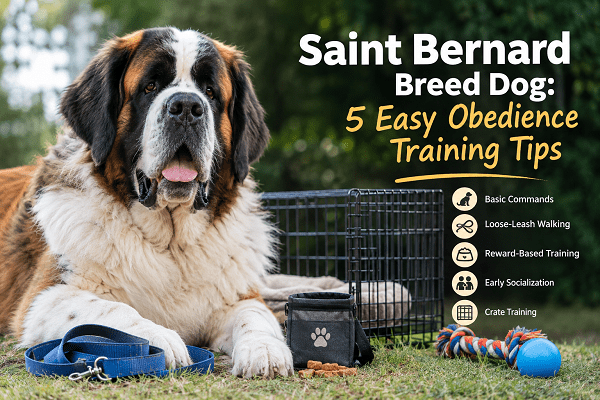
The 5 easiest ways to train a Saint Bernard are: (1) teach the “default sit” and core commands before your puppy grows past 100 pounds, (2) master loose-leash walking early since pulling from a giant breed is a real safety risk, (3) keep sessions short (5–10 minutes) with high-value rewards instead of harsh corrections, (4) front-load socialization between 8–16 weeks, and (5) use crate training for structure and calm behavior. Saint Bernards are willing, people-pleasing dogs, but their sheer size means small training gaps become big problems fast.
Table of Contents
- Why Saint Bernard Training Is Different From Other Breeds
- Before You Start: What You’re Really Working With
- Tip 1: Teach “Default Sit” and Core Commands First
- Tip 2: Master Loose-Leash Walking Before the Growth Spurt
- Tip 3: Keep Sessions Short and Reward-Based
- Tip 4: Socialize Early, Especially 8–16 Weeks
- Tip 5: Crate Train for Structure and Calm
- A Month-by-Month Training Timeline
- Common Mistakes Saint Bernard Owners Make
- Trainer’s Note: About This Guide
- FAQs
- Final Thoughts
Why Saint Bernard Training Is Different From Other Breeds
Ever watched a 150-pound dog lean against a toddler “just to say hi”? That’s a Saint Bernard being affectionate and it’s also a kid on the ground. This is the paradox of the breed: Saint Bernards are famously gentle, patient, and eager to please, yet their size means there’s almost no room for training slip-ups.
A Saint Bernard puppy that fits in your arms today will likely weigh somewhere between 120 and 180 pounds as an adult, standing 26 to 30 inches at the shoulder. Some working-line males top out even heavier. That’s not a “big dog” problem, that’s a dog who can outweigh most adults in the house. A jumping habit that’s cute at 20 pounds becomes a knocked-over grandmother at 150 pounds. A dog that pulls on leash at 30 pounds becomes one that can drag an adult off their feet at full size.
I’ve trained and handled working dogs for over 14 years, and giant breeds teach you one lesson fast: you are training the adult dog you’ll have in a year, not the puppy in front of you today. Every command you skip now is a command you’ll fight harder to teach later on a much bigger, much stronger animal.
The good news? Saint Bernards are not stubborn in the way people often assume. They’re intelligent and biddable, they were bred to work alongside monks at the Great St. Bernard Hospice, reading human cues in white-out conditions. The breed’s most famous dog, Barry, is credited with saving more than 40 lives during his years of alpine rescue work between 1800 and 1814. That’s not an accident of size, it’s a dog that could take direction, hold a task, and stay calm under pressure. Modern Saint Bernards still carry that trainability. They just process things at their own pace, and they need a handler who plays to their strengths instead of fighting their nature.
If you’re still deciding whether this breed fits your household in the first place, our guide on whether a Saint Bernard is right for your family breaks down the space, budget, and lifestyle questions to ask before you bring one home.
Before You Start: What You’re Really Working With
A few breed facts change how you should approach training:
- Growth timeline: Saint Bernards are a giant breed, and giant-breed growth plates don’t fully close until 18–24 months. That means high-impact exercise, forced long walks, and repetitive jumping should wait but mental training and manners work can and should start immediately.
- Training difficulty score: Most breed guides rate Saint Bernard trainability as moderate, willing but not naturally quick, closer to 3 out of 5 on standard trainability scales. Translation: expect steady progress with consistency, not overnight results.
- Lifespan and window: With an average lifespan of 8–10 years, and full physical maturity not arriving until age 2–3, you have a genuinely long adolescence to manage. Patience isn’t optional; it’s baked into the breed.
- Health considerations: Saint Bernards carry above-average risk for hip and elbow dysplasia, plus bloat (gastric dilatation-volvulus) common to deep-chested breeds. This matters for training because it means avoiding vigorous exercise right after meals and avoiding training drills that involve jumping or hard stops on immature joints.
None of this means the breed is hard to live with. It means training has to be intentional, early, and realistic about the size difference between an 8-week-old puppy and a 14-month-old dog that already outweighs you.
Tip 1: Teach “Default Sit” and Core Commands First
Before agility, before tricks, before anything else: teach your Saint Bernard that sitting is the answer to almost every situation. Trainers call this a “default sit”, the dog automatically sits for greetings, for doorways, for having a leash clipped on, for meals.
Why this matters more for a giant breed: A default sit solves the two biggest Saint Bernard complaints before they start, jumping on guests and leash-lunging at the door. If sitting is already the dog’s go-to response, you’ve pre-empted both problems.
How to teach it:
- Hold a treat at your dog’s nose, then lift it slowly up and back over their head. As the head goes up, the rear naturally goes down into a sit.
- The instant the rear touches the floor, mark it (“yes!” or a clicker) and reward.
- Add the word “sit” only once your puppy is reliably offering the position 8–9 times out of 10.
- Practice the sit in every doorway, before every meal, and before every leash clip-on, repetition in real contexts is what makes it a habit, not just a party trick.
Once sit is solid, layer in stay, down, and come in that order. For “come,” start in a quiet room, say your dog’s name followed by “come” in an upbeat tone, and reward heavily when they arrive, recall is the single most safety-critical command for a dog this size, since a Saint Bernard that won’t recall near a road or a small child is a genuine hazard.
Keep corrections verbal and mild. Saint Bernards are sensitive dogs; harsh corrections or yelling tend to shut them down rather than speed them up. If your dog isn’t responding, it’s almost always a sign you’ve moved too fast, not that the dog is “being stubborn.”
Tip 2: Master Loose-Leash Walking Before the Growth Spurt
This is the tip most first-time giant-breed owners underestimate. A 25-pound Saint Bernard puppy that pulls on leash is a mild annoyance. A 140-pound adult that pulls on leash can genuinely take you off your feet and giant-breed leash injuries to owners (dislocated shoulders, torn rotator cuffs, falls) are common enough that trainers see them regularly.
The rule: teach loose-leash walking as if the dog were already full grown, starting the week your puppy comes home.
Method that works for giant breeds:
- Stop the instant the leash goes tight. Don’t pull back, don’t yank, just stop moving and wait. Most puppies will turn back toward you out of curiosity within a few seconds. The moment there’s slack in the leash, mark and reward, then continue walking.
- Change direction often. Rather than fighting a pull, turn and walk the other way. This teaches the dog to watch you rather than drag you toward the next smell.
- Reward position, not just outcome. Treat your dog for simply being near your side, not only for “good” walking. This builds the habit of checking in with you.
- Use the right equipment. A front-clip harness gives you far more control over a large, strong dog than a flat collar alone, and it removes the temptation to use a choke or prong collar on a breed already prone to neck and joint sensitivity.
If you’re already dealing with an adult Saint Bernard who pulls, it’s not too late, the same stop-and-reward mechanics work at any age, they just take longer with an established habit. Our full walk-through on fixing leash pulling for good covers the exact daily drills to break the pattern.
Tip 3: Keep Sessions Short and Reward-Based
Saint Bernards are not high-energy dogs, and they’re not known for long attention spans in formal training settings. Trying to run a 30-minute obedience drill with a Saint Bernard puppy is a fast way to lose their interest and yours.
What actually works:
- 5–10 minute sessions, two to three times a day, rather than one long session.
- High-value rewards, small pieces of boiled chicken, cheese, or a low-calorie training treat, reserved specifically for training, so they stay motivating.
- One skill per session. Don’t try to layer sit, stay, and down all in the same five minutes. Master one, then move to the next.
- End on a win. Always finish a session with a command your dog knows well, so the last thing they experience is success and a reward.
- Vary the reward. Treats work, but so does praise, a favorite toy, or a few minutes of play, mixing rewards keeps a dog from becoming treat-dependent and keeps training feeling like a game rather than a job.
This is also where positive reinforcement really earns its reputation with this breed. Saint Bernards respond visibly better to reward-based training than to correction-heavy methods; owners and trainers alike consistently report that punishment or raised voices produce a dog that shuts down, not one that learns faster. If you want to understand the difference between building genuine obedience and simply suppressing behavior through dominance-based methods, our piece on dominance versus discipline in K9 training breaks down exactly why reward-based structure outperforms force with large, sensitive breeds.
Tip 4: Socialize Early, Especially 8–16 Weeks
The window between 8 and 16 weeks of age is when a puppy’s brain is most open to new experiences without triggering a fear response. For a breed that will eventually be large enough to intimidate people by presence alone, this window is not optional, it’s the single highest-leverage thing you can do in your dog’s first four months.
What to expose your Saint Bernard puppy to, safely and positively:
- Different types of people: children, people using wheelchairs or canes, people in hats and uniforms, people of different heights and voices.
- Other vaccinated, friendly dogs and, carefully, cats or other household pets.
- Everyday sounds and settings: vacuum cleaners, car rides, elevators, busy sidewalks (carried or in a stroller if vaccines aren’t complete yet).
- Gentle handling exercises: touching paws, ears, and mouth so future vet visits and grooming aren’t a fight.
Why this matters specifically for Saint Bernards: an undersocialized giant breed dog isn’t just awkward, it can become genuinely dangerous through fear-based reactivity, simply because of the size and strength involved even in a “startled” reaction. Well-socialized Saint Bernards are famous for being gentle with children and patient with chaos; that reputation is earned through early exposure, not something the breed gets automatically.
If your dog is past that early window and already showing signs of nervousness or reactivity around triggers, it’s not too late to make progress, it just takes a more structured approach. Our guide to reactive dog training exercises you can do at home lays out daily 5–15 minute drills that work well for larger, sensitive breeds.
Tip 5: Crate Train for Structure and Calm
A crate isn’t a cage, for a Saint Bernard, it’s one of the most useful management tools you have while the dog is still learning house manners, especially since giant breeds take longer to reach full bladder control and emotional maturity than smaller dogs.
Why crate training pays off specifically for this breed:
- It gives your puppy a den-like space to settle into, which matters for a breed that can otherwise struggle with over-attachment and separation anxiety if not given structure early.
- It protects your home (and your puppy) during the many unsupervised hours a growing giant-breed puppy would otherwise spend getting into trouble.
- It sets up calmer vet visits, travel, and boarding stays down the line, since an adult Saint Bernard that’s never been crated is genuinely difficult to manage in an emergency.
Quick-start approach:
- Introduce the crate with the door open and treats scattered inside, let your puppy choose to explore it.
- Feed meals in or right next to the crate to build a positive association.
- Start with very short door-closed periods (a minute or two) while you’re in the room, gradually extending the time.
- Never use the crate as punishment, it should always mean something good is happening or a calm rest is expected.
For a complete room-by-room, week-by-week breakdown, see our step-by-step crate training guide with faster-result trainer tips.
A Month-by-Month Training Timeline
Here’s a realistic training roadmap based on how giant breeds actually develop:
- Months 2–4 (8–16 weeks): Socialization is the priority. Layer in sit, name recognition, and crate comfort. Keep all sessions under 5 minutes.
- Months 4–8: Add down, stay, and loose-leash walking basics. This is also prime “manners” territory, no jumping, no counter-surfing, calm greetings.
- Months 8–14: Reinforce recall heavily. Growth spurts happen here, so expect some regression, a gangly, fast-growing body can temporarily make a dog clumsier and less focused. Stay patient and keep sessions consistent rather than longer.
- Months 14–24: Growth plates are closing during this window. This is when more structured obedience classes, off-leash reliability work, and advanced commands become appropriate, alongside a gradual increase in exercise intensity.
- Ongoing (adulthood): Saint Bernards benefit from continued mental stimulation for life, puzzle feeders, short refresher sessions, and new tricks keep a dog this large from becoming bored, which is often when unwanted behaviors creep back in.
Common Mistakes Saint Bernard Owners Make
- Waiting too long to start. Owners often assume a “big dog” needs to be older before training starts. In reality, waiting means training a much stronger, harder-to-manage animal later.
- Inconsistent rules among household members. If one person allows jumping on the couch and another doesn’t, a Saint Bernard (like any dog) will default to whichever rule gets rehearsed more often. Everyone in the house needs to enforce the same standards.
- Over-exercising a growing puppy. Long runs, repeated stair climbing, or jumping games before 18–24 months put real stress on joints that are still developing, a leading contributor to orthopedic issues later in life.
- Skipping structured obedience because the dog “seems friendly.” Temperament and training are different things. A friendly-but-untrained 150-pound dog is still a liability around children, elderly visitors, or other animals.
- Using force-based tools too early. Prong collars, choke chains, or harsh corrections can damage trust with a breed that’s naturally sensitive, and physically risk neck and spine strain on a large, still-growing dog.
Trainer’s Note: About This Guide
This guide draws on real training experience with working and companion dogs of all sizes, including giant breeds where the margin for error is smallest. I’m Rofiat Muritala, and I’ve spent over 14 years handling and training working dogs, with hands-on experience preparing dogs for security, detection, and obedience work. The same core principles, early structure, reward-based learning, and realistic timelines, apply whether you’re training a Malinois for detection work or a Saint Bernard for calm family life. Giant breeds simply raise the stakes on getting the basics right early.
FAQs
1. At what age should I start training my Saint Bernard puppy?
Start the day your puppy comes home, typically around 8 weeks. Early training should focus on socialization, name recognition, and simple commands like sit, not formal obedience drills, which can come a little later.
2. Are Saint Bernards hard to train?
Not hard, but not instant either. Most breed guides rate them as moderately trainable, willing and eager to please, but slower-paced than high-drive working breeds. Consistency matters more than intensity with this breed.
3. How long does it take to fully house-train a Saint Bernard?
Most Saint Bernard puppies are reliably house-trained between 4 and 6 months with consistent crate training and a regular schedule, though giant breeds can take slightly longer than small breeds due to a slower-maturing bladder.
4. Do Saint Bernards need professional obedience classes?
They’re not mandatory, but group puppy classes (often $100–$300 for a multi-week course) offer controlled socialization and expert feedback that’s hard to replicate alone, especially valuable for a breed where poor socialization has outsized safety consequences.
5. What’s the biggest training priority for a Saint Bernard specifically?
Loose-leash walking and a reliable recall. Because of the breed’s eventual size and strength, these two skills carry more real-world safety weight than any trick or advanced command.
Final Thoughts
Saint Bernards are, at heart, gentle and cooperative dogs, the same qualities that made them legendary alpine rescuers make them wonderful family companions when training keeps pace with their growth. The five tips here, default sit and core commands, loose-leash walking, short reward-based sessions, early socialization, and crate structure, aren’t complicated, but they need to start early and stay consistent, because a training gap that’s harmless in a 20-pound puppy becomes a real problem in a 150-pound adult.
If you want a deeper resource to keep on hand as your training progresses, our e-book Beyond the Bark goes further into building obedience, communication, and trust with large and working breeds, worth a look if this guide got you thinking seriously about your dog’s training path.

Her work centers on applied training across obedience, detection, protection, and operational readiness, with a strong focus on Military Working Dogs (MWDs) and security K9 programs. Rather than relying on theory alone, Rofiat emphasizes proven training methods built on repetition, consistency, and real-world conditioning principles that prepare both dogs and handlers for high-pressure tasks.
Through articles, training content, and documentaries, she shares experience-based insights from the field, highlighting how structured training, clear communication, and trust between handler and dog directly impact performance and reliability.
Drawing from years of frontline experience, she is also the author of “Beyond the Bark: Inside a Pro Handler’s Playbook for Raising the Ideal Dog,” a practical guide designed to help dog owners and handlers apply professional training principles in everyday situations.
She remains committed to responsible K9 development, continuous skill refinement, and practical education for handlers, trainers, and dog professionals.
- Essential Dog Agility Equipment for Home Training - September 13, 2026
- Saint Bernard Breed Dog: 5 Easy Obedience Training Tips - September 12, 2026
- How to Stop Puppy Biting Fast: 5 Proven Steps - September 12, 2026