What Colors Do Dogs See? Dog Vision Spectrum Explained
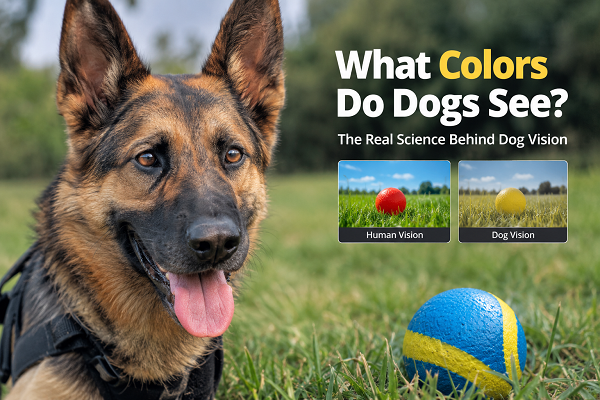
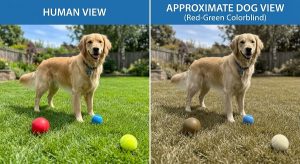
Dogs see mostly blue, yellow, and shades of gray. They have two types of color-sensing cells in their eyes (called cones) while humans have three, so reds, oranges, and greens look like muted yellow, brown, or gray to them. Dogs aren’t seeing in black and white. Their color vision is closest to a person with red-green color blindness.
Table of Contents
- What Colors Do Dogs See? The Dog Vision Spectrum at a Glance
- How We Know: The Science Behind Dog Color Vision
- How a Dog’s Eye Works (and Why It Trades Color for Night Vision)
- Color Isn’t Everything: Brightness, Motion, and Smell
- Dog Vision vs. Human Vision
- Do Dog Vision Filters Show the Truth?
- Do All Breeds See the Same Colors?
- What This Means for Working Dogs and Trainers
- Best Colors for Dog Toys and Gear (by Surface)
- A 10-Minute Color Test You Can Run With Your Dog
- When Vision Changes: Eye Health Warning Signs
- Trainer’s Notes: Field Experience
- FAQs
- Conclusion
Introduction
Ever tossed a bright red ball across a green lawn and watched your dog run in circles, sniffing around like the ball vanished into thin air? You’re not dealing with a dumb dog. You’re dealing with a dog whose eyes can’t separate red from grass the way yours can.
So, what colors do dogs see? That question trips up even experienced owners. Most of us grew up hearing dogs live in a black-and-white world. That’s wrong, but the “fix” you’ll read on most blogs (“dogs see blue and yellow, done”) leaves out half the story. It doesn’t tell you how brightness, motion, and smell fill in the gaps, or how to use all of this when you train.
I’ve worked with military and security dogs for over 14 years at the Nigerian Army Dog Centre, and I’ve seen small color choices change how fast a dog finds a target. In this guide, you’ll learn exactly what dogs can and can’t see, what the research really says (including a few surprises), how dog vision compares to ours, and which colors to pick for toys, markers, and gear.
What Colors Do Dogs See? The Dog Vision Spectrum at a Glance
Dogs have dichromatic vision. That’s a fancy way of saying two color channels: one tuned to blue-violet light and one tuned to yellow-green light. Everything a dog sees gets built from those two channels plus brightness.
Here’s how common colors likely look to a dog:
| Color you see | How it likely looks to a dog | Easy for a dog to spot? |
|---|---|---|
| Blue | Blue, clear and strong | Yes |
| Violet / purple | A shade of blue | Yes |
| Yellow | Yellow, clear and strong | Yes |
| Green | Yellowish, beige, or gray | Low contrast on grass |
| Orange | Muddy yellow or brown | Poor on dirt and sand |
| Red | Dark brownish-gray | Poor on grass and soil |
| Pink | Light gray or pale bluish-gray | Weak |
| Black, white, gray | Shades of gray, judged by brightness | Yes, as contrast |
Think of it this way: the dog’s world runs along a blue-to-yellow line, with gray in the middle. Colors that depend on a red signal (red, orange, many greens) slide toward that gray-yellow middle.
Quick fact for snippets: The two cone types in a dog’s eye peak at about 429 nanometers (blue-violet) and 555 nanometers (yellow-green), based on Jay Neitz’s original measurements.
One more point. Dogs aren’t unusual here. Cats, cattle, and pigs also have two cones. Humans are the odd ones out, with three. And roughly 8 percent of men and 0.5 percent of women have red-green color blindness, which gives you a decent mental model of how a dog sees.
How We Know: The Science Behind Dog Color Vision
Dog color vision has a surprisingly messy history. Here’s the timeline most articles skip:
| Year | What happened | Why it matters |
|---|---|---|
| 1940s | Optometrist Gordon Walls writes that dogs have weak or no color vision | Started the “black-and-white” myth that stuck for decades |
| 1989 | Jay Neitz and his team (then at UC Santa Barbara) test dogs with color discrimination tasks | First solid proof dogs see blues and yellows but not reds and greens |
| 2013 | Anna Kasparson’s Russian research team tests eight untrained dogs | Dogs picked color over brightness in most tests, so color isn’t just a bonus feature |
| 2017 | Marcello Siniscalchi’s team in Bari, Italy uses a dog version of the Ishihara color test | Dogs struggled with red-green contrasts like red-green color-blind people do |
| Later | Sarah-Elizabeth Byosiere’s lab tests dogs on screens at different brightness levels | Showed the picture is more complicated than “dogs can’t see red” |
Why the 2013 study surprised people
For years, trainers assumed dogs mostly judged objects by brightness (how light or dark something is). The Kasparson team trained dogs to find food behind a colored sheet of paper, then swapped the brightness. After ten test rounds, all eight dogs chose by color more than 70 percent of the time, and six of the eight chose by color 90 to 100 percent of the time.
It was a small study, and all eight dogs were mixed breeds, so don’t treat it as the final word. But it tells us something useful: when blue and yellow are available, dogs notice them.
The nuance almost nobody mentions
The Byosiere lab tested seven dogs on a screen using red-green and blue-yellow pairs at matched brightness. When the colors were pure and bright, the dogs spotted red against green just fine. They also found that as brightness went up, some color pairs got harder, and at the brightest level, even blue on yellow became tricky. The researchers think color saturation may be the reason, since dog eyes work best in dimmer light.
Translation: “dogs can’t see red” is too simple. A dog may still pick out a red object using brightness, edges, shape, and movement, even when the color itself doesn’t pop. Neitz made a similar point: a red apple reflects a bit less light than a green one, so a dog can sometimes guess correctly without ever “seeing red.”
How a Dog’s Eye Works (and Why It Trades Color for Night Vision)
Cones: the color cells
Cones are the cells in the retina that handle color and fine detail in good light. Humans carry three types (roughly red, green, and blue sensitive). Dogs carry two. No third cone tuned to long red wavelengths means anything that depends on red input loses its punch.
Rods and the tapetum: the night-shift crew
Dogs make up for fewer color channels with more rods, the cells that handle dim light and movement. They also have a mirror-like layer behind the retina called the tapetum lucidum. It bounces light back across the retina for a second shot at catching it. That’s why your dog’s eyes glow in a flash photo or in headlights.
Veterinary ophthalmologist Paul Miller of the University of Wisconsin-Madison says this lets dogs see in about six times less light than we need. The trade-off? The tapetum scatters light a little, which softens fine detail.
Why evolution chose this setup
Dog ancestors hunted around dawn and dusk. Spotting a moving rabbit in low light mattered far more than telling a ripe red berry from a green leaf. So their eyes stayed tuned for dim light and motion. Your couch-loving Labrador inherited the same hardware.
Color Isn’t Everything: Brightness, Motion, and Smell
This is the section I wish more articles covered, because it changes how you train.
- Brightness and contrast: Dogs are very good at noticing light-versus-dark differences, so a pale object on dark ground (or the reverse) stands out even if the colors are “wrong.”
- Motion: Dogs detect movement far better than we do. A rolling ball is easy to track. A ball sitting still in tall grass isn’t.
- Shape and edges: Familiar outlines help a dog recognize a toy or a person from a distance.
- Smell: Dogs smell roughly 10,000 to 100,000 times better than humans, according to estimates cited by Scientific American. A 2023-era study in the Journal of Neuroscience also found a direct brain link between the part of the dog brain that processes smell and the part that processes vision, which suggests the two senses work together. Some researchers joke dogs may “smell in 3-D.”
Jay Neitz put it well: humans care about color, but dogs live in a rich world of scent, and he never felt his own dogs were missing out. Byosiere agrees that dogs aren’t deprived, they just see differently. She even suggests giving your dog one red toy and one blue toy: toss the red one into the grass to make your dog use its nose, and the blue one to make it use its eyes. That’s brain exercise, not a problem to fix.
Dog Vision vs. Human Vision
Color is just one piece. Here’s the bigger comparison:
| Feature | Dogs | Humans |
|---|---|---|
| Color cones | 2 (dichromatic) | 3 (trichromatic) |
| Typical sharpness (visual acuity) | About 20/75 | 20/20 |
| Low-light vision | Much better (tapetum, more rods) | Weaker |
| Motion detection | Excellent | Good |
| Flicker fusion (when flicker looks like smooth motion) | About 70 to 80 Hz | About 45 to 60 Hz |
| Field of view | Wider (varies by breed) | Narrower |
| Smell | Up to 10,000 to 100,000 times stronger | Baseline |
What does 20/75 mean? Your dog has to stand 20 feet from something to see it as clearly as a person with normal vision sees it from 75 feet. So yes, picture a dog’s world as a bit blurrier than yours.
Why dogs sometimes ignore TV: Old TVs refreshed at rates that looked like smooth video to us but flickered for dogs. Modern screens refresh much faster, so many dogs now follow what’s on screen, especially animals and movement. Plenty of owners report dogs reacting to the TV, though dogs tend to watch in short bursts.
Do Dog Vision Filters Show the Truth?
The viral “dog vision” photo filters on TikTok and Instagram turn your photo into blues, yellows, and grays. They’re fun, but they’re not accurate.
Two big problems:
- They ignore sharpness. Filters keep the picture crisp. A real dog image would be blurrier. Neitz said the filtered images look far clearer than what dogs experience.
- They guess from color values only. The Byosiere lab pointed out that the common “Dog-Vision” tool only calculates color from maximum color values and hasn’t been validated on dogs. In their screen tests, dogs found red-green shapes the software said should be invisible.
Use filters as a rough teaching tool, nothing more.
Do All Breeds See the Same Colors?
As far as science can tell, all dog breeds share the same two-cone system. A Chihuahua and a Great Dane use the same color palette. What changes by breed is sharpness, field of view, and depth perception, because of eye placement and skull shape.
- Sighthounds (Greyhounds, Salukis, Whippets): Long, narrow skulls and a wide strip of sharp retina for scanning big open areas and spotting movement at a distance.
- Flat-faced breeds (Pugs, Bulldogs, Boxers): Eyes sit more forward, which usually means a narrower side view and different depth perception.
- Working and herding breeds (German Shepherds, Belgian Malinois, Border Collies): A solid middle ground: good movement tracking plus enough central focus to follow hand signals and a handler’s body language.
Small dogs tend toward nearsightedness and large dogs toward farsightedness, according to veterinary vision research. And individual dogs vary. Some are plain more visual than others, just like some people.
What This Means for Working Dogs and Trainers
When I teach handlers about color vision, I say the same thing: don’t panic about “red equals invisible.” Instead, stack the odds in your dog’s favor so the dog doesn’t have to work harder than it needs to.
1. Make visual cues pop against the background. Hand signals work best when they contrast with your clothing and the setting. A pale glove against a dark sleeve (or the reverse) beats a red glove against a green hedge. If you’re building a voice-plus-signal system for security or protection work, our guide to essential protection dog commands shows how we layer both.
2. Watch your own clothing on grass. Siniscalchi suggested trainers avoid red clothes when working on grass, since a dog may have trouble tracking your movement against it. It’s a simple fix.
3. Pick markers and dummies by background, not by habit. Search and rescue flags, target discs, and training dummies should contrast with the ground where you work. A blue dummy on grass or sand is a safe default.
4. Use color on purpose for scent versus sight games. Want your dog to hunt with its nose? Use a toy that blends into the ground. Want fast visual pickup (a quick retrieve or a long recall)? Use blue or a bright contrast color.
5. Plan for low light. At dusk and night, rods do most of the work and rods don’t carry color. So color matters even less. Big, clear movement, a lighter-versus-darker contrast, and your voice matter more. This is also why good detection work leans on scent, not sight.
6. Build your own gear with contrast in mind. If you’re making poles, jumps, or markers, our DIY dog agility equipment guide is a good place to start. I’d paint bars in high-contrast blue and white or blue and a light color so a fast-moving dog can judge them.
Curious how professional programs build all of this into daily sessions? See our breakdown of how military working dogs are trained.
Best Colors for Dog Toys and Gear (by Surface)
Here’s something other articles get wrong: “yellow and blue” isn’t a one-size-fits-all answer. Because green grass looks yellowish-gray to a dog, a yellow toy on grass can blend in more than you’d expect. Blue is the safest all-rounder. Here’s my rule of thumb, based on how dog color vision works:
| Surface | Best choice | Worst choice |
|---|---|---|
| Green grass | Blue (or white/black for contrast) | Red, orange, green |
| Dirt or sand | Blue | Orange, brown, red, tan |
| Snow | Blue, or dark colors | White, pale yellow |
| Concrete or pavement | Blue or yellow | Gray |
| Indoors (carpet or tile) | Blue or yellow | Colors that match your floor |
| Dusk or night | Light-versus-dark contrast, plus movement | Dark toys on dark ground |
Three quick tips:
- Choose by background first, color second.
- Pick toys that move, bounce, or squeak to help your dog’s strongest vision skill.
- Don’t throw out your dog’s red toys. Use them for nose games.
A note on collars and leashes: your dog isn’t looking at its own gear, so color there is for you and for safety. A bright blue or yellow leash is easy for you to see in an open field, and reflective trim helps drivers and other people see you both after dark.
A 10-Minute Color Test You Can Run With Your Dog
Want proof instead of theory? Try this simple home experiment. It’s the same logic scientists use, just simpler.
- Gather four identical toys (same type, size, and texture) in blue, yellow, red, and green.
- Remove scent as a clue. Wipe each toy with the same cloth, and handle them all with the same gloves so one toy doesn’t smell different.
- Pick a plain, even lawn and a calm time of day with good light.
- Hold your dog on a sit-stay and place one toy about 15 to 20 meters away while the dog watches.
- Release and time it. Note how quickly your dog heads straight to the toy and how much sniffing or circling you see.
- Repeat five times per color, shuffling the order and the location.
- Repeat on a different surface (dirt, sand, or pavement).
What to look for: straight lines to the toy, faster pickup, less circling. You’ll probably find blue wins on grass, but this test also shows your dog’s personality. Some dogs find anything quickly because their nose is excellent. That’s useful to know, too.
Note: this is a fun owner experiment, not a scientific diagnosis.
When Vision Changes: Eye Health Warning Signs
Normal dichromatic vision is nothing to worry about. A change in how your dog sees is. Call your vet if you notice:
- A cloudy, bluish, or whitish look in one or both eyes
- Bumping into furniture, missing stairs, or hesitating in dim light
- Suddenly losing interest in toys the dog used to track easily
- Squinting, redness, discharge, or pawing at the eyes
- A dog that startles when touched from the side
Common causes include cataracts, glaucoma, and inherited retinal diseases, and some conditions move fast. Early checks matter, and a veterinary ophthalmologist can examine the retina and lens properly. A dog that suddenly “can’t find” its toy might not have a color problem at all, so rule out eye disease first.
Trainer’s Notes: Field Experience
I’m Cpl. Rofiat Muritala, and I’ve worked as a military working dog instructor and handler for more than 14 years at the Nigerian Army Dog Centre. My background covers dog selection, foundation obedience, detection, and operational readiness. I also led obedience, explosive detection, agility, and tactical movement demonstrations at the Nigerian Army Day Celebration (NADCEL) 2026.
Here’s one lesson that stuck with me. I once watched a handler run a recall drill with a red training dummy across a grass pitch. The dog overshot, circled, and finally locked on. We swapped the red dummy for a bright yellow one and the dog picked it up right away, even beyond 40 meters. Same dog, same handler, same field. Only the color changed.
What I took from that wasn’t “red is bad.” It was: remove avoidable difficulty before you blame the dog. Now I check target markers, agitation equipment, and visual cues for contrast against the ground before every session. It costs nothing and saves hours.
If you want the deeper framework behind how I build obedience, drive, and control in working dogs, I cover it in my e-book, Beyond the Bark: Inside a Pro Handler’s Playbook for Raising the Ideal Dog. It’s written from real fieldwork, not textbook theory.
FAQs About What Colors Dogs See
1. Are dogs completely color blind?
No. Dogs aren’t color blind in the “black and white” sense. They see blues, yellows, and grays, but they can’t tell reds, oranges, and greens apart the way people with normal color vision can. The black-and-white idea traces back to a 1940s claim that research from 1989 onward disproved.
2. Can dogs see red or green?
Not as we do. Red tends to look dark brownish-gray, and green looks yellowish or gray. That doesn’t mean a red object is invisible. Dogs can still find it using brightness, shape, movement, and smell. It’s just harder to spot from far away.
3. What color toy is best for a dog?
Blue is the best all-round choice, especially on grass and sand. Yellow works well on darker ground and indoors. Avoid red, orange, and green toys for sight-based games, but keep them for scent games.
4. Can dogs see color at night?
In low light, a dog’s rods take over. Rods detect brightness and movement, not color, so color matters even less after dark. Dogs still see far better than humans at night, because of extra rods and the reflective tapetum lucidum.
5. Do different breeds see different colors?
No. All breeds share the same two-cone, blue-yellow system. Breeds differ in sharpness, field of view, and depth perception, which comes from eye placement and skull shape. Individual dogs also vary in how much they rely on sight versus smell.
Conclusion: See the World the Way Your Dog Does
Dogs see a world built from blue, yellow, and gray. Red, orange, and green fade into muted browns and yellows. They aren’t black-and-white viewers, and they aren’t missing out either, because their eyes are tuned for motion, low light, and a nose that does the heavy lifting.
Here’s what to do with all this:
- Pick blue first for toys, markers, and training dummies, especially on grass and sand.
- Choose by background, not by what looks good to you.
- Keep red toys for scent games. They give your dog’s nose a workout.
- Don’t wear red on grass when you want a dog to track your signals.
- Run the 10-minute color test to see how your own dog really behaves.
- Get a vet check if your dog’s vision seems to change suddenly.
Want more field-tested tips like these? Subscribe to our weekly articles roundup at the ARFS K9 Team newsletter and get new guides in your inbox.
Sources and Further Reading
- Scientific American, “What Colors Do Dogs See?” (interviews with Jay Neitz, Sarah-Elizabeth Byosiere, and Paul Miller)
- Kasparson, A. et al. (2013), Proceedings of the Royal Society B, on dogs using color over brightness
- Siniscalchi, M. et al. (2017), “Are dogs red-green colour blind?”, Royal Society Open Science
- Byosiere, S.-E. et al., Applied Animal Behaviour Science, on dog color discrimination at different luminance levels
- Veterinary Information Network, “Vision in the Animal Kingdom” (acuity and flicker fusion values)
- PetMD and Nylabone overviews of canine color vision

Her work centres on obedience, detection, protection and operational readiness. She favours proven methods built on repetition, consistency and real-world conditioning, so that both dogs and handlers are prepared for high-pressure tasks.
Rofiat represented the Nigerian Army Dog Centre at the Nigerian Army Day Celebration (NADCEL) 2026, where she led demonstrations in obedience, explosive detection, agility and tactical movement. Through articles, training content and documentaries, she shares field-based insight into how structured training, clear communication and trust between handler and dog affect performance and reliability.
She is the author of Beyond the Bark: Inside a Pro Handler's Playbook for Raising the Ideal Dog, a practical guide that helps dog owners and handlers apply professional training principles in everyday situations.
- Westminster Dog Show 2026: Winners & Full Results - October 17, 2026
- 10 K9-Approved Tricks to Teach Your Dog (Step-by-Step) - October 16, 2026
- COBA National Dog Championship 2026: Full Guide - October 15, 2026