How Many Teeth Do Dogs Have? Puppy vs Adult Chart
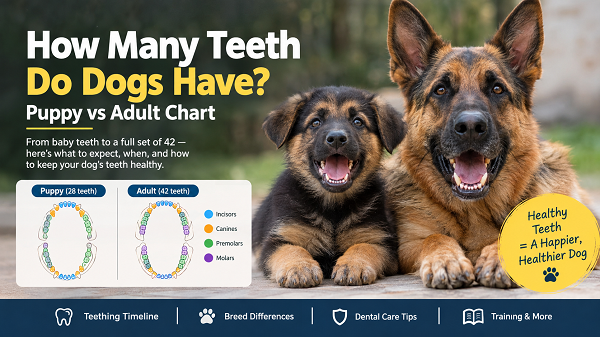
Puppies grow 28 baby (deciduous) teeth, and adult dogs have 42 permanent teeth, 20 on the top jaw and 22 on the bottom. That’s 10 more teeth than the 32 humans carry around. Puppies cut their full baby set by about 6-8 weeks old, start losing them around 12 weeks, and usually have a complete adult mouth by 6-7 months of age.
Table of Contents
- How Many Teeth Do Puppies Have?
- How Many Teeth Do Adult Dogs Have?
- Puppy vs. Adult Dog Teeth Chart
- Dog Teeth Eruption Timeline (Week by Week)
- Do All Dog Breeds Have the Same Number of Teeth?
- When Baby Teeth Don’t Fall Out: Retained Deciduous Teeth
- What Each Type of Tooth Actually Does
- Warning Signs: When Tooth Loss Isn’t Normal
- What Dental Care Actually Costs in 2026
- A Working Dog’s Perspective on Teeth
- How to Care for Your Dog’s Teeth at Every Stage
- Trainer’s Take
- FAQs
- Conclusion
Introduction
If you just needed the number, you’ve got it. But if you want to know why the count changes, what’s normal for your dog’s breed and age, and when a missing or wobbly tooth actually means “call the vet”, keep reading. I’ve handled and consulted on dental development in everything from toy breeds to working German Shepherds and Belgian Malinois, and the questions I get from owners are almost always more specific than a single number.
This guide breaks down exactly how many teeth dogs have at every stage, puppy and adult, with a printable-style chart, a week-by-week eruption timeline, breed-specific exceptions (yes, some breeds really do have fewer or “extra” teeth), the real statistics behind retained baby teeth and periodontal disease, what dental care actually costs in 2026, and practical, vet-backed steps for keeping your dog’s mouth healthy for life. You’ll also get a working-dog and K9 perspective you won’t find in most pet-care articles, since a dog’s bite and dental health matter just as much for a family companion as they do for a protection or detection dog.
How Many Teeth Do Puppies Have?
Puppies are born completely toothless. Their gums stay smooth for the first few weeks of life while they nurse, and then, right on schedule, things get sharp fast.
By around 2-4 weeks old, the first baby teeth start poking through. By 6-8 weeks, most puppies have their full set of 28 deciduous teeth, 14 on top, 14 on the bottom. Breeders and vets often use this milestone as one of the markers for when a litter is ready to start weaning onto solid food, since those needle-sharp puppy teeth make nursing uncomfortable for mom.
Here’s something a lot of articles skip: puppies don’t have molars at all. Their baby set only includes incisors, canines, and premolars. Molars are exclusively adult teeth, which is a big part of why the total count jumps so much between puppy and adult stages, it’s not just tooth replacement, it’s tooth addition.
Puppy teeth breakdown (28 total):
- 12 incisors (6 top, 6 bottom)
- 4 canines (2 top, 2 bottom)
- 12 premolars (6 top, 6 bottom)
- 0 molars
If you’ve ever been on the receiving end of a puppy “land shark” phase, you already know these teeth are disproportionately sharp for how small they are. That’s by design, they need to nurse, then quickly transition to tearing at solid food, all with a mouth barely the size of a golf ball.
How Many Teeth Do Adult Dogs Have?
Once the permanent set is fully in, most adult dogs carry 42 teeth, 20 on the upper jaw (maxilla) and 22 on the lower jaw (mandible). That’s a jump of 14 extra teeth compared to the puppy set, almost entirely thanks to the arrival of molars.
Adult teeth breakdown (42 total):
| Tooth Type | Top Jaw | Bottom Jaw | Total |
|---|---|---|---|
| Incisors | 6 | 6 | 12 |
| Canines | 2 | 2 | 4 |
| Premolars | 8 | 8 | 16 |
| Molars | 4 | 6 | 10 |
| Total | 20 | 22 | 42 |
Notice the mouth isn’t symmetrical top-to-bottom, the lower jaw carries two extra molars that the upper jaw doesn’t have. That’s normal anatomy, not a defect, and it’s the same across nearly every breed, from a 4-pound Chihuahua to a 150-pound Cane Corso.
For comparison, humans have 32 permanent teeth. Dogs run 10 teeth heavier, which makes sense once you consider how much more of a dog’s world is processed through its mouth, eating, exploring, carrying, gripping, and (for working and protection dogs) controlling.
Puppy vs. Adult Dog Teeth Chart
Here’s the side-by-side comparison most people are searching for:
| Feature | Puppy Teeth | Adult Teeth |
|---|---|---|
| Total count | 28 | 42 |
| Also called | Deciduous, milk teeth, baby teeth | Permanent teeth |
| Molars present? | No | Yes (10) |
| First appear | 2-4 weeks old | 3-7 months old |
| Fully in by | 6-8 weeks old | 6-8 months old (up to 8-9 for giant breeds) |
| Root structure | Shallow, thin roots | Deep, strong roots |
| Texture | Sharp, needle-like | Broader, flatter, built for grinding |
| Lifespan in mouth | Weeks to months | Meant to last the dog’s lifetime |
The bottom line: the difference isn’t just “more teeth”, it’s a completely different set of tools. Baby teeth are built for a temporary job (nursing, early chewing). Adult teeth are engineered for decades of biting, tearing, crushing, and (in working breeds) controlled grip strength.
Dog Teeth Eruption Timeline (Week by Week)
Understanding the timing, not just the final count, is what actually helps you catch problems early. Here’s a realistic timeline based on typical medium-breed development (small and giant breeds shift slightly, which we’ll get to):
| Age | What’s Happening |
|---|---|
| Birth – 2 weeks | No visible teeth; puppy nurses only |
| 2-4 weeks | Baby incisors and canines begin erupting |
| 4-6 weeks | Baby premolars come in |
| 6-8 weeks | Full set of 28 puppy teeth is usually in place |
| 8-12 weeks | Puppy teeth stable; peak “mouthy” chewing phase begins |
| 12-16 weeks | Baby teeth start loosening and falling out; permanent incisors erupt first |
| 4-5 months | Permanent canines and premolars come in |
| 5-7 months | Permanent molars erupt (these were never present as baby teeth) |
| 6-8 months | Full adult set of 42 teeth should be complete |
A study of Yorkshire terrier puppies found that dogs under about 3 kg (6.6 lbs) lose their deciduous teeth and grow permanent ones later than dogs over 3 kg, and the normal tooth-loss order (incisors, then canines, then premolars) is often disrupted in very small dogs. If you own a toy breed and things seem “behind schedule,” that’s often just biology, not a red flag on its own, though it’s still worth a vet check.
Handler tip: this teething window (roughly 3-6 months) is exactly when chewing behavior spikes and puppies start testing boundaries with their mouths. If you’re in the thick of it, our guide on crate training a puppy covers how to manage that chewing drive without turning it into a bad habit that follows your dog into adulthood.
Do All Dog Breeds Have the Same Number of Teeth?
Mostly, yes, 42 adult teeth is the standard across nearly all breeds recognized by kennel clubs worldwide (AKC, UKC, The Kennel Club UK, FCI). But there are real, documented exceptions worth knowing about:
- Brachycephalic breeds (Bulldogs, Pugs, Boston Terriers, French Bulldogs, Boxers) technically develop the same 42 teeth, but their shortened jaws often can’t fit them properly. This causes crowding, rotated teeth, and a much higher rate of retained baby teeth and malocclusion (bad bite alignment).
- Toy and small breeds (Chihuahuas, Yorkies, Pomeranians, toy Poodles) frequently run into the same crowding issue simply because the jaw is small relative to a full-size tooth set.
- Sighthounds like Greyhounds show unusually high rates of periodontal disease later in life, more on that below, even though their tooth count is standard.
- Some individual dogs are simply born with a naturally missing tooth (most often a premolar), which vets call hypodontia. It’s usually harmless and just gets noted on their dental chart.
A large veterinary hospital-chain study tracking almost 3 million dogs over five years found that extra-small breeds (under 6.5 kg, or about 14 lbs) had a persistent baby tooth rate of 15%, significantly higher than every other size category, where the overall average across all dogs was closer to 7%. If you’ve got a small-breed puppy, this is genuinely one of the more useful stats to know, it means routine dental checks matter more for them, not less.
When Baby Teeth Don’t Fall Out: Retained Deciduous Teeth
This is one of the most common and most missed, puppy dental issues, and it deserves more attention than most articles give it.
Normally, as a permanent tooth pushes up underneath a baby tooth, it triggers the baby tooth’s root to resorb (basically dissolve), which loosens it and lets it fall out. Sometimes that signal doesn’t happen, and the permanent tooth erupts right next to the baby tooth instead of pushing it out. Now you’ve got two teeth trying to occupy one socket.
Vets call these persistent or retained deciduous teeth, and here’s what the research actually shows:
- The upper canines are the most commonly retained tooth, followed by lower canines, then incisors.
- In a detailed study of Yorkshire terrier puppies, dogs weighing 3 kg or less retained their deciduous canines 89% of the time, compared to just 12% in dogs over 5 kg. That’s a massive gap driven almost entirely by body size.
- Any baby tooth still present after 6 months of age is officially considered abnormally persistent and usually needs to come out.
- Left alone, retained teeth trap food and plaque between the double roots, which speeds up gum disease and can push the permanent tooth into the wrong position, sometimes permanently.
Why this matters more than owners think: a retained tooth isn’t cosmetic. It’s a structural problem that gets harder (and more expensive) to fix the longer it’s left. If your puppy is past 6 months and you can still see or feel a small, sharp tooth sitting right next to a bigger adult tooth in the same spot, that’s your cue to call the vet, not to wait it out.
What Each Type of Tooth Actually Does
Every tooth type in a dog’s mouth has a specific job, and understanding this is genuinely useful, not just trivia, it explains a lot about natural chewing behavior.
- Incisors (12 total): The small teeth at the very front. Dogs use these for nibbling, grooming, and scraping meat off a bone, think of them as precision tools, not power tools.
- Canines (4 total): The long, pointed “fangs” next to the incisors. These are for gripping, tearing, and holding, in working and protection dogs, canine strength and positioning are part of what trainers evaluate during bite-work assessments.
- Premolars (16 total): Located behind the canines, these have sharp, jagged edges built for shearing and shredding, cutting food (or anything else) into smaller pieces.
- Molars (10 total): The flat teeth at the very back of the mouth. These are the “grinding stones”, built to crush and pulverize, especially kibble and harder chews. Puppies never have baby molars; they only show up with the adult set.
If you handle or train protection and security breeds, the canines and how a dog uses its full bite matter well beyond basic anatomy, grip, jaw pressure, and control are trained skills layered on top of natural dentition. We go deeper into how that training is structured in our breakdown of how military working dogs are trained, and in our guide to the top guard and protection dog breeds if you’re comparing bite strength and temperament across breeds.
Warning Signs: When Tooth Loss Isn’t Normal
Puppy tooth loss between 3-7 months is completely normal, expected, even. But adult dogs losing teeth is not normal and almost always signals a problem.
Watch for:
- A missing adult tooth with no obvious injury explanation
- Blood on chew toys or in the water bowl
- Bad breath that’s noticeably worse than usual
- Reluctance to chew on one side, or dropping food while eating
- Visible tartar buildup, red or swollen gums, or gum recession
The most common cause of adult tooth loss, by far, is periodontal disease and the numbers here are honestly staggering. Cornell University’s veterinary college and the American Veterinary Medical Association both report that 80-90% of dogs show some evidence of periodontal disease by age 3. A Swedish owner-survey study backed up that same 80-89% range in dogs over 3 years old. Detailed exams performed under anesthesia (which catch disease that a quick visual check misses) find rates even higher, sometimes 44-100% depending on the population studied.
It’s also not evenly distributed across breeds. One large-scale study of 60 breeds found the highest periodontal disease prevalence in Greyhounds (38.7%), Shetland Sheepdogs (30.6%), Papillons (29.7%), Toy Poodles (28.9%), and Dachshunds (28.1%), smaller and narrower-jawed breeds tend to be hit hardest, largely due to natural tooth crowding.
What Dental Care Actually Costs in 2026
This is the part most “how many teeth” articles skip entirely, and it’s exactly what owners actually want to know once they realize dental disease is this common.
Professional dental cleaning (under anesthesia):
- Routine cleaning at a general practice: roughly $300-$700
- With dental X-rays and one or more extractions: $500-$1,500+
- Complex cases with a board-certified veterinary dentist: can exceed $2,000
- Non-anesthetic “cosmetic” cleaning (offered by some groomers): $100-$350, most veterinary dental colleges, including the AVDC, oppose these as a substitute for real care since they can’t clean below the gumline, where disease actually starts.
Tooth extractions (per tooth):
- Simple extraction (loose, single-rooted, like an incisor): roughly $10-$80
- Surgical extraction (multi-rooted, like a canine or molar): roughly $130-$300+ per tooth
Geography matters a lot here too, the same simple extraction can run under $70 in a lower cost-of-living state and well over $140 in a higher-cost region.
The practical takeaway: consistent home care and annual checkups are genuinely cheaper than reactive treatment. A $15 dental chew and 60 seconds of brushing a day is a lot easier on your wallet than a $1,500 extraction bill five years from now. For more on keeping the rest of your dog’s routine on track alongside dental health, our Health & Nutrition section has additional breed-specific guides worth bookmarking.
A Working Dog’s Perspective on Teeth
Most articles on this topic are written purely from a pet-owner angle, but if you handle a working, security, or detection dog, teeth mean something extra.
A police or military K9’s teeth are part of its operational equipment. Bite work, apprehension training, and even scent detection (dogs use their mouth and nose together more than people realize) all depend on a dog having a full, healthy, correctly aligned set of 42 adult teeth. A handler who skips regular dental checks on a working dog isn’t just risking a vet bill, they’re risking the dog’s ability to do its job safely and effectively.
In my own work around K9 demonstrations and training environments, dental health checks are a standard part of the same physical evaluation that covers joints, coat, and weight. A cracked canine or advanced gum disease in a working dog isn’t cosmetic, it can affect bite pressure, willingness to engage, and long-term comfort during high-drive work. This is one reason professional K9 programs schedule dental exams on the same rotation as other performance health checks, not as an afterthought.
How to Care for Your Dog’s Teeth at Every Stage
During the puppy stage (0-8 months):
- Don’t brush baby teeth aggressively, a soft finger brush or gauze wipe is enough to build the habit
- Offer appropriate chew toys during the 3-6 month teething window to redirect that intense chewing urge
- Check the mouth weekly starting around 4 months, you’re looking for any baby tooth still in place next to an erupting adult tooth
- Keep up with grooming routines generally, since a lot of early health issues (dental included) get caught during regular handling, our puppy grooming guide walks through a full routine, dental care included
For adult dogs:
- Brush 3-5 times a week minimum with dog-specific toothpaste (never human toothpaste, it’s toxic to dogs)
- Use VOHC-accepted dental chews or water additives as a supplement, not a replacement, for brushing
- Schedule a professional dental exam annually, or every 6 months for small and toy breeds given their higher periodontal disease risk
- Watch for the warning signs above and don’t wait out unexplained bad breath or bleeding gums
If you want a deeper, structured framework for building healthy habits from day one, chewing, obedience, and behavior all connect more than most owners realize, I put together a full breakdown in my e-book, Beyond the Bark, which covers this alongside broader training and handling fundamentals.
Trainer’s Take
I’ve spent years working hands-on with working and protection breeds, German Shepherds, Belgian Malinois, and other high-drive dogs, where dental health directly affects bite work, training progress, and long-term performance. That perspective shapes how I approach even a “simple” topic like tooth count: the number matters less than what it tells you about a dog’s development, breed risk factors, and overall care needs. Every statistic in this guide is pulled from peer-reviewed veterinary studies, veterinary hospital data, and established institutions like Cornell University’s College of Veterinary Medicine and the American Veterinary Dental College, not guesswork.
FAQs
1. How many teeth do puppies have?
Puppies have 28 baby (deciduous) teeth, 14 on the top jaw and 14 on the bottom. They don’t have any molars; those only appear with the adult set.
2. How many teeth do adult dogs have?
Adult dogs have 42 permanent teeth: 20 on the upper jaw and 22 on the lower jaw, made up of 12 incisors, 4 canines, 16 premolars, and 10 molars.
3. At what age do dogs get all their adult teeth?
Most dogs have their full set of 42 adult teeth by 6-7 months of age, though giant breeds and some toy breeds can take until 8 months. Permanent molars are usually the last to arrive, around 5-7 months.
4. Is it normal for an adult dog to lose teeth?
No. Puppy tooth loss between 3-7 months is normal, but adult dogs losing permanent teeth is not, it’s almost always a sign of periodontal disease, trauma, or another underlying issue that needs a vet visit.
5. Do small dogs have fewer teeth than big dogs?
No, the tooth count (42 adult, 28 puppy) is the same regardless of size. But small and toy breeds are far more likely to have crowding, retained baby teeth, and higher rates of periodontal disease simply because 42 teeth have to fit into a much smaller jaw.
Conclusion
Here’s what to actually remember: puppies carry 28 baby teeth, adults carry 42 permanent ones, and the jump between them isn’t just about losing and regrowing, it’s about your dog gaining a whole new set of molars they never had before. Small breeds and brachycephalic dogs face a higher risk of crowding and retained baby teeth, adult tooth loss is never something to brush off, and periodontal disease is far more common (80-90% of dogs by age 3) than most owners realize.
The actionable part is simple: check your puppy’s mouth regularly through the teething window, don’t ignore a baby tooth still sitting there past 6 months, start a real brushing routine once the adult set is in, and get annual dental checks, twice yearly if you’ve got a small or toy breed. Whether you’re raising a family companion or training a working K9, a healthy mouth is one of the easiest health wins you can control, and it starts with knowing exactly what’s supposed to be in there in the first place.

Her work centers on applied training across obedience, detection, protection, and operational readiness, with a strong focus on Military Working Dogs (MWDs) and security K9 programs. Rather than relying on theory alone, Rofiat emphasizes proven training methods built on repetition, consistency, and real-world conditioning principles that prepare both dogs and handlers for high-pressure tasks.
Through articles, training content, and documentaries, she shares experience-based insights from the field, highlighting how structured training, clear communication, and trust between handler and dog directly impact performance and reliability.
Drawing from years of frontline experience, she is also the author of “Beyond the Bark: Inside a Pro Handler’s Playbook for Raising the Ideal Dog,” a practical guide designed to help dog owners and handlers apply professional training principles in everyday situations.
She remains committed to responsible K9 development, continuous skill refinement, and practical education for handlers, trainers, and dog professionals.
- How Many Teeth Do Dogs Have? Puppy vs Adult Chart - September 22, 2026
- What Colors Do Dogs See? (Dog Vision Spectrum) - September 22, 2026
- Is Cinnamon Bad for Dogs? Safe Dosage by Weight - September 21, 2026